
Summarize with AI


Ten studios are worth reviewing when a machine learning platform rebuilds its website: Studio Maydit, Pixelmatters, Engine Digital, Ramotion, Finsweet, Instrument, Refokus, Digidop, Edgar Allan, and Flow Ninja. Pixelmatters leads the nine. A Porto studio founded 2013, fifty-one to two hundred people, website and product design together, a published starting price, and Rubrik, Quantic, and UJET named. Engine Digital is next: Vancouver and New York, running since 2002, custom code, and Adidas, Autodesk, Goldman Sachs, and HP on the list. Edgar Allan and Flow Ninja are the weakest fit, the first a Webflow studio doing consumer brand work with no published price, the second publishing neither a client name nor a price.
Start with the page you probably treat as an afterthought. Your integrations list almost certainly converts better than your homepage.
An ML engineer evaluating a platform does not read your positioning. They check whether you work with the tools already in their stack, and that check decides whether anything else gets read. Yet the integrations page is usually built as a wall of logos, which answers nothing. What they want is a page for each one: what it connects to, what it does not, what breaks at scale, and how long setup takes. Those pages also earn search traffic individually, which a logo wall never will.
The second thing is who you are actually writing for. The practitioner is the buyer in this category, and the VP only signs after the practitioner says yes. So the page that reads well to an executive, full of acceleration and transformation, is the page that loses you the person whose opinion decides it. Their vocabulary is specific and unglamorous, and using it correctly is the fastest credibility you can buy.
Third, the self-hosting question needs a straight answer somewhere visible. Plenty of ML teams cannot send data to a managed service, and plenty more want to know the option exists before they commit. Hiding that path because it looks like lost revenue does not prevent the question, it just moves the answer to a competitor's comparison page.

How we picked these agencies
Five checks produced this order, and all five can be settled from public pages.
First, whether the studio can build a structured set of pages rather than a handful of nice ones. Your integrations, your model registry concepts, your framework guides: these are templated content that needs to scale to a hundred addresses without becoming a mess. That is a content architecture problem before it is a visual one.
Second, evidence with developer platforms where the reader is a practitioner. This stands in for generic AI experience here, because a studio that has done AI brand work has never had to satisfy somebody who will check your claim against their own pipeline by lunchtime. A studio that has shipped for a data tool or a developer product already knows the register.
Third, whether a starting figure is public. Your own buyers want a number they can evaluate without a call, and a studio that keeps its simplest number behind a form is not the one that will argue for yours to be visible.
Fourth, team shape. Your advantage is usually narrow and technical, perhaps how an experiment is reproduced or how lineage is tracked. It survives only while the person who understood it is writing. Ask for that person by name.
Fifth, the studio's own site, judged on structure rather than looks. Does its work section scale gracefully to fifty entries, or does it hold twelve carefully arranged ones. Yours needs to do the former.
Nothing was estimated. Every value came from each studio's own public material, and Not published means it was withheld.
What goes wrong
The integrations page stays a logo wall. Forty marks in a grid tell a practitioner nothing and earn no search traffic. Give each integration its own page with the same six headings: what it connects, setup time, what is supported, what is not, known limits, and a working example. It is dull work and it will become the best performing section of your site, because every one of those is a query somebody types.
Marketing vocabulary replaces the practitioner's. Words like streamline and unlock read as a warning to the person evaluating you, because nobody who has used the tooling talks that way. Write the way your own engineers write in a pull request description: specific, conditional, and unembarrassed about limitations. A rewrite that makes the copy plainer usually outperforms one that makes it more ambitious.
The self-hosting path is hidden. Somebody reasons that mentioning it costs conversions to the managed plan. What actually happens is the regulated buyer assumes you have no answer and stops. Put the deployment options on one page, say plainly what differs between them, and name the constraints. Teams that start self-hosted move to managed often enough that the page pays for itself.
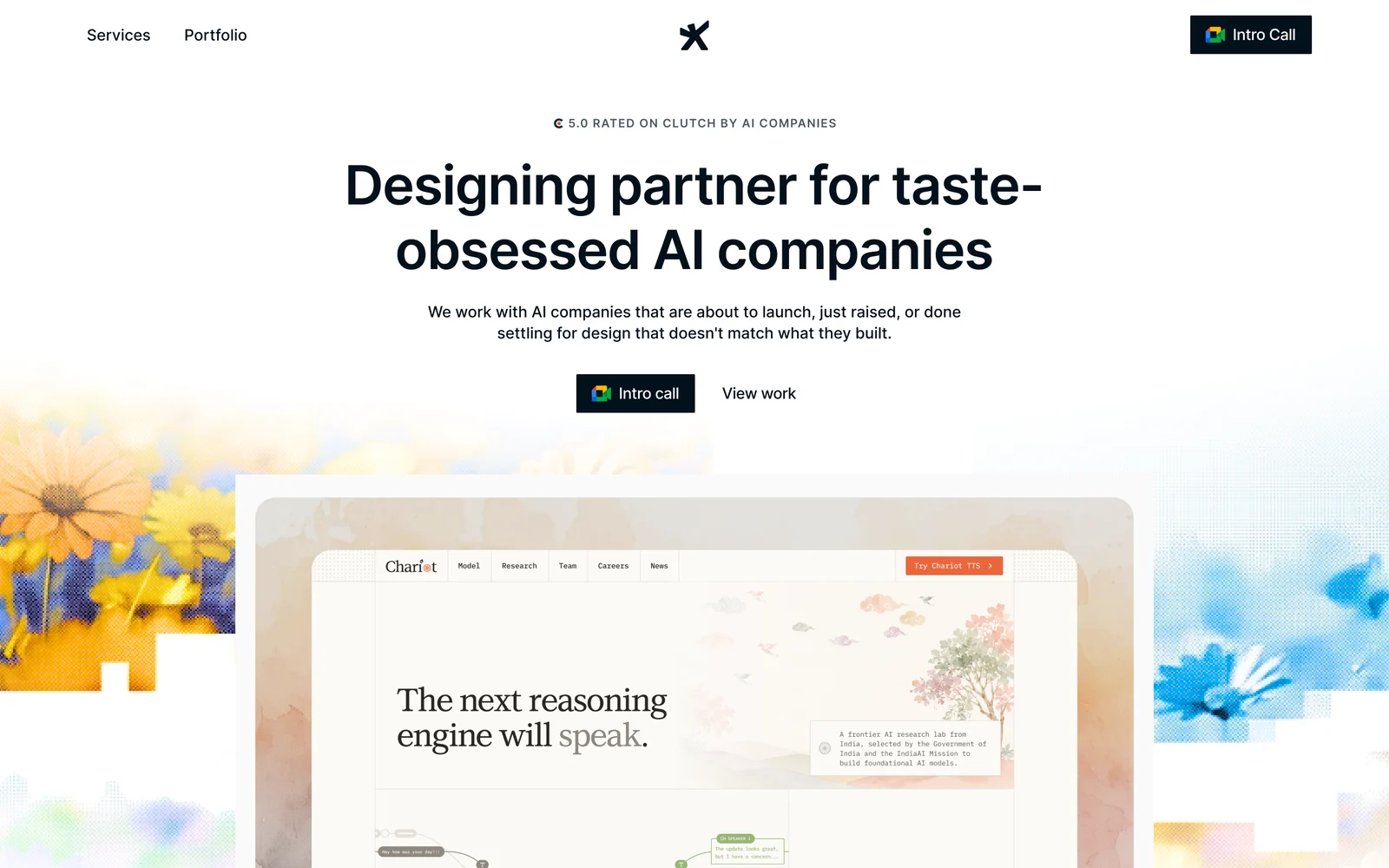
1. Studio Maydit: A Top-Rated Design Agency for AI Founders
On an ML platform the biggest available gain is usually structural rather than visual. Studio Maydit is a web and product design studio working with AI founders in the US, UK, and Europe, and the work here tends to start with the integrations and framework pages, because that is where a practitioner decides whether to keep reading. Rebuilds run in Framer, Webflow, or custom code, and with a large set of templated pages involved that choice is mostly about which system holds a hundred entries without becoming unmaintainable.
Design continues past the site into the product. For an ML platform that means the working surfaces: how two runs are compared without a spreadsheet, how a failed job explains which step broke and what it cost, how lineage is shown so somebody can answer where a number came from, and how a permission boundary is described to a team sharing one workspace. The clearest published outcome is Dualite, where design work supporting a repositioned ICP helped the product reach 100,000+ users in seven months. Recent clients include Wave, PixelFlow, Mi-VAD, and 15 other AI and SaaS teams.
There are two ways to engage, and the right one depends on the calendar. A fixed scope over three to four weeks works when a relaunch date is already set. A monthly retainer works when pages, campaigns, and product design will keep coming, with no long lock-in on either. The fixed-scope version closes with a written diagnosis of what is leaking in the product rather than a handoff and goodbye.
| Check | Finding |
|---|---|
| Based in | Remote, serving US / UK / EU |
| Platform depth | Framer, Webflow, and custom code |
| AI-sector proof | Yes. AI-native clients, published outcome on Dualite |
| Pricing | Fixed scope or monthly retainer, quoted per project |
| Team shape | Founder-led, small senior team |
| Best fit | ML platforms whose integrations page is still a logo wall |
If a practitioner cannot tell from your site whether you support their stack, start there. Book a 30-minute call.

2. Pixelmatters
Pixelmatters is a Porto studio founded 2013, fifty-one to two hundred people, working across website and product design with a published starting price. Rubrik is the name that decides its place: data infrastructure sold to technical buyers, which is the closest match in this pool to your audience. Doing product design as well matters more here than in most categories, because on an ML platform the run comparison view and the marketing site are arguing the same point and should not look like two companies.
The weakness is that its AI-sector proof is partial, so the specific positioning work would be new, and a studio of that size runs a formal process that a small platform team working to a conference date may find slow.
| Check | Finding |
|---|---|
| Based in | Porto, Portugal |
| Founded | 2013 |
| Team size | 51-200 |
| Primary platform | Mixed |
| AI-sector proof | Partial |
| Named clients | Rubrik, Quantic, UJET |
| Pricing | Published minimum |
| Best fit | ML platforms that want the product and the site in one system |
3. Engine Digital
Engine Digital has run since 2002 from Vancouver and New York and builds in custom code. Autodesk is the useful reference, complex technical software with an enormous content estate, which is structurally what a hundred integration pages becomes. Two decades of replacing large sites is also the discipline that matters when your risk is a migration rather than a visual direction, and custom code means a templated page type can be built properly instead of forced into a layout.
The weakness is that it is sized for large organisations. It publishes neither team size nor pricing, its AI-sector proof is partial, and enterprise timelines are longer than most platform startups can absorb.
| Check | Finding |
|---|---|
| Based in | Vancouver and New York |
| Founded | 2002 |
| Team size | Not published |
| Primary platform | Custom code |
| AI-sector proof | Partial |
| Named clients | Adidas, Autodesk, Goldman Sachs, HP |
| Pricing | Not published |
| Best fit | ML platforms with a large page estate to move intact |
4. Ramotion
Ramotion has run since 2009 from San Francisco, has eleven to fifty people, works across platforms, and publishes a starting price. Two names matter. Mozilla is an open source organisation, so the team has worked where the self-hosting and transparency questions are cultural rather than optional. Okta is identity and permissions, which is the sentence your shared-workspace page has to get right. Sixteen years with a published number and a startup-appropriate size is rare here.
The weakness is that its sector proof is partial, so arguing about reproducibility or lineage would be unfamiliar, and a formal process can feel slow against a short deadline.
| Check | Finding |
|---|---|
| Based in | San Francisco, USA |
| Founded | 2009 |
| Team size | 11-50 |
| Primary platform | Mixed |
| AI-sector proof | Partial |
| Named clients | Mozilla, Okta, Netflix, Adobe, Xero |
| Pricing | Published minimum |
| Best fit | ML platforms whose hardest pages are permissions and deployment |
5. Finsweet
Finsweet is a distributed studio based in Denver, founded 2017, with fifty-one to two hundred people working in Webflow. GitHub is the name worth weighing, because that is your audience almost exactly, and it is the strongest Webflow engineering team in this pool. If you are staying on Webflow and need a hundred filterable integration pages that do not collapse, this is the most likely team to deliver it.
The weakness is cost visibility and sector distance. It publishes no starting price, its AI-sector proof is partial, and none of the named work involves reproducibility or model operations, so the technical argument would be new ground.
| Check | Finding |
|---|---|
| Based in | Denver, USA, distributed |
| Founded | 2017 |
| Team size | 51-200 |
| Primary platform | Webflow |
| AI-sector proof | Partial |
| Named clients | Dropbox, Clay, GitHub, Steadily |
| Pricing | Not published |
| Best fit | ML platforms building many templated pages inside Webflow |
6. Instrument
Instrument is a Portland studio founded 2005 working across platforms for Nike, Microsoft, Electronic Arts, and Google. Microsoft and Google are the relevant names, both companies with developer platforms whose documentation and marketing had to coexist at enormous scale. Twenty years of interface work also means plenty of large rebuilds without losing structure.
The weakness is verifiability and scale. It publishes neither team size nor pricing, its sector proof is partial, and a client list of that shape implies engagements sized for organisations with a brand department rather than a platform team of twenty.
| Check | Finding |
|---|---|
| Based in | Portland, USA |
| Founded | 2005 |
| Team size | Not published |
| Primary platform | Mixed |
| AI-sector proof | Partial |
| Named clients | Nike, Microsoft, Electronic Arts, Google |
| Pricing | Not published |
| Best fit | Funded ML platforms rebuilding at genuine scale |
7. Refokus
Refokus is a remote German studio of eleven to fifty people founded 2021, working mainly in Webflow for Mural, BASF, Spotify, Yahoo, and BCG. Its register is restrained rather than decorative, which is the right tone for a practitioner audience that distrusts polish, and BASF is evidence of working with an organisation where technical accuracy is not negotiable. A European base helps if buyers are asking where training data sits.
The weakness is platform and evidence. Webflow is workable for templated pages but harder than custom code at volume, its sector proof is partial, and it publishes no starting price, so cost is a conversation.
| Check | Finding |
|---|---|
| Based in | Germany, remote |
| Founded | 2021 |
| Team size | 11-50 |
| Primary platform | Webflow |
| AI-sector proof | Partial |
| Named clients | Mural, BASF, Spotify, Yahoo, BCG |
| Pricing | Not published |
| Best fit | European ML platforms wanting a plain, restrained site |
8. Digidop
Digidop is a Paris studio of one to ten people founded 2021, working in Webflow with a published starting price. StreamNative is the relevant name, real-time data infrastructure sold to engineers, so this team has written for a reader who verifies. At that size the person who understood your lineage story writes about it, which is where the nuance usually goes missing.
The weakness is capacity. One to ten people is a queue, and a hundred integration pages plus a deployment page is a lot of careful work. Ask what else is live before agreeing any relaunch date.
| Check | Finding |
|---|---|
| Based in | Paris, France |
| Founded | 2021 |
| Team size | 1-10 |
| Primary platform | Webflow |
| AI-sector proof | Partial |
| Named clients | TSE Energy, Ramify, StreamNative |
| Pricing | Published minimum |
| Best fit | European ML platforms with a small, technically written site |
9. Edgar Allan
Edgar Allan is an Atlanta studio founded 2014 with fifty-one to two hundred people, building in Webflow for Porsche, Duracell, and NCR. The strength is throughput, since a team that size has rebuilt large Webflow sites repeatedly, and page count is one of your two real problems. NCR is industrial technology, at least adjacent to selling into a technical organisation.
The weakness is register and cost. That client list is consumer and industrial brand marketing, which is the opposite voice from a practitioner-facing platform, its sector proof is partial, and it publishes no starting price.
| Check | Finding |
|---|---|
| Based in | Atlanta, USA |
| Founded | 2014 |
| Team size | 51-200 |
| Primary platform | Webflow |
| AI-sector proof | Partial |
| Named clients | Porsche, Duracell, NCR |
| Pricing | Not published |
| Best fit | ML platforms needing a high page count shipped quickly |
10. Flow Ninja
Flow Ninja is a Belgrade studio founded 2018 with eleven to fifty people working in Webflow. A mid-size Webflow team in Serbia is a sensible cost position for a straightforward rebuild, and eleven to fifty people is genuinely more capacity than several studios ranked above it.
The weakness places it last. It publishes no client names and no starting price, which leaves both columns a shortlist relies on empty, and its sector proof is partial. Your buyers evaluate you by checking claims, so beginning with a studio whose own claims cannot be checked is an odd first move.
| Check | Finding |
|---|---|
| Based in | Belgrade, Serbia |
| Founded | 2018 |
| Team size | 11-50 |
| Primary platform | Webflow |
| AI-sector proof | Partial |
| Named clients | Not published |
| Pricing | Not published |
| Best fit | ML platforms wanting Webflow capacity at a lower rate |
How to choose between them
Sort by what the rebuild actually has to produce.
A hundred templated integration pages that stay fast. Finsweet or Engine Digital.
The product views and the marketing site should match. Pixelmatters or Instrument.
Deployment options and permissions are the blocking pages. Ramotion or Digidop.
It is mostly page count against a tighter budget. Edgar Allan or Flow Ninja.
One test before you sign. Name the three tools in your integrations list that your customers care about most and ask a candidate what each page should contain. A studio that understands this category asks about setup time, what is unsupported, and where it breaks at scale. A studio that does not will describe a grid of logos with a nicer hover state.