Summarize with AI


A non-technical founder redoing a website should consider Studio Maydit, Engine Digital, Phantom, Edgar Allan, Ramotion, Instrument, Flowout, Finsweet, Refokus, and Pixelmatters. Edgar Allan and Ramotion lead this list. Edgar Allan has worked from Atlanta since 2014 with fifty-one to two hundred people, in Webflow, for Porsche, Duracell, and NCR, and pairs writing with design rather than expecting you to supply the words. Ramotion has designed software from San Francisco since 2009 with eleven to fifty people and a published starting price, for Mozilla, Okta, Netflix, Adobe, and Xero. Engine Digital and Phantom are the wrong fit here. Both work in custom code for organisations that employ their own developers, and neither publishes a price.
The risk is not that you get a bad website. It is that you get a good one you cannot operate.
That distinction never comes up in a pitch, because the pitch is about how the site will look. Nobody demonstrates the Tuesday six months later when you want to change a headline, cannot find where it lives, and email the studio instead. That email becomes an invoice, and after two or three of them you stop sending them, and the site quietly stops being current.
The second thing working against you is vocabulary. Proposals arrive full of words you can either query, and feel slow, or nod at, and hope. Most founders nod. Scope then gets agreed by two people who each think they know what was agreed.
And there is a quiet ownership problem. Domains, hosting, analytics, and the design files all get set up by someone during the project, usually not by you.

How we picked these agencies
Five checks, all of which you can do yourself from public pages, without knowing anything technical.
Platform depth, translated into one plain question: after this is finished, can you change a sentence without asking anyone. Every studio will say the site is easy to edit. Ask them to show you the editing screen during the pitch and to let you type something into it while they watch. That two minute test tells you more than the rest of the call.
Proof with founder-led clients who had nobody technical in house. This is the criterion carrying the most weight here. A studio that usually works with a marketing department will assume a person on your side who reviews the build, chases the copy, and knows what a redirect is. There is no such person. You want evidence of projects where the client was one busy founder.
Pricing. Is a starting figure published anywhere. A public number lets you rule studios in or out before you have to have a conversation where you are the less informed party.
Team shape. Headcount tells you how many people will be between you and the person actually doing the work. Fewer is usually better when you cannot review the work technically, because explanations do not get relayed.
Their own site. Read it and see whether you understand what they do. If a studio cannot explain itself to you in plain language, it will not explain you in plain language either.
One more question worth asking outright: what will you need from me, and when. A studio used to founders answers in hours per week and names the moments. A studio that is not will say they are easy to work with.
Every entry in the tables below repeats what each studio publishes about itself, with nothing estimated or inferred. An unpublished row means that studio chose not to say.
What goes wrong for non-technical founders
Three failures, and they compound in order.
You end up with a site you cannot change. It was built in something that requires a developer, or in something editable that nobody ever actually showed you. Either way, the first small change goes back to the studio, and the site starts ageing on the day the invoice is paid. Make editability a written deliverable, not a reassurance, and include a training session with a recording in the scope.
Technical decisions get made without you knowing a decision happened. Who owns the domain, where the site is hosted, whose account the analytics sit in, who holds the design files. These are settled quietly during a project, usually in the studio's name because it was faster. It only surfaces when you want to leave, and at that point it is a negotiation instead of an export. Ask for everything in your own accounts from day one.
Nobody ever tells you what the site is supposed to do, so you review it on taste. You are shown pages, you say what you like, and the project proceeds on preference, because preference is the only language anyone has offered you. Insist on one sentence about what should happen more often after this launch, and ask at every review how the work you are being shown serves it.
1. Studio Maydit: A Top-Rated Design Agency for AI Founders
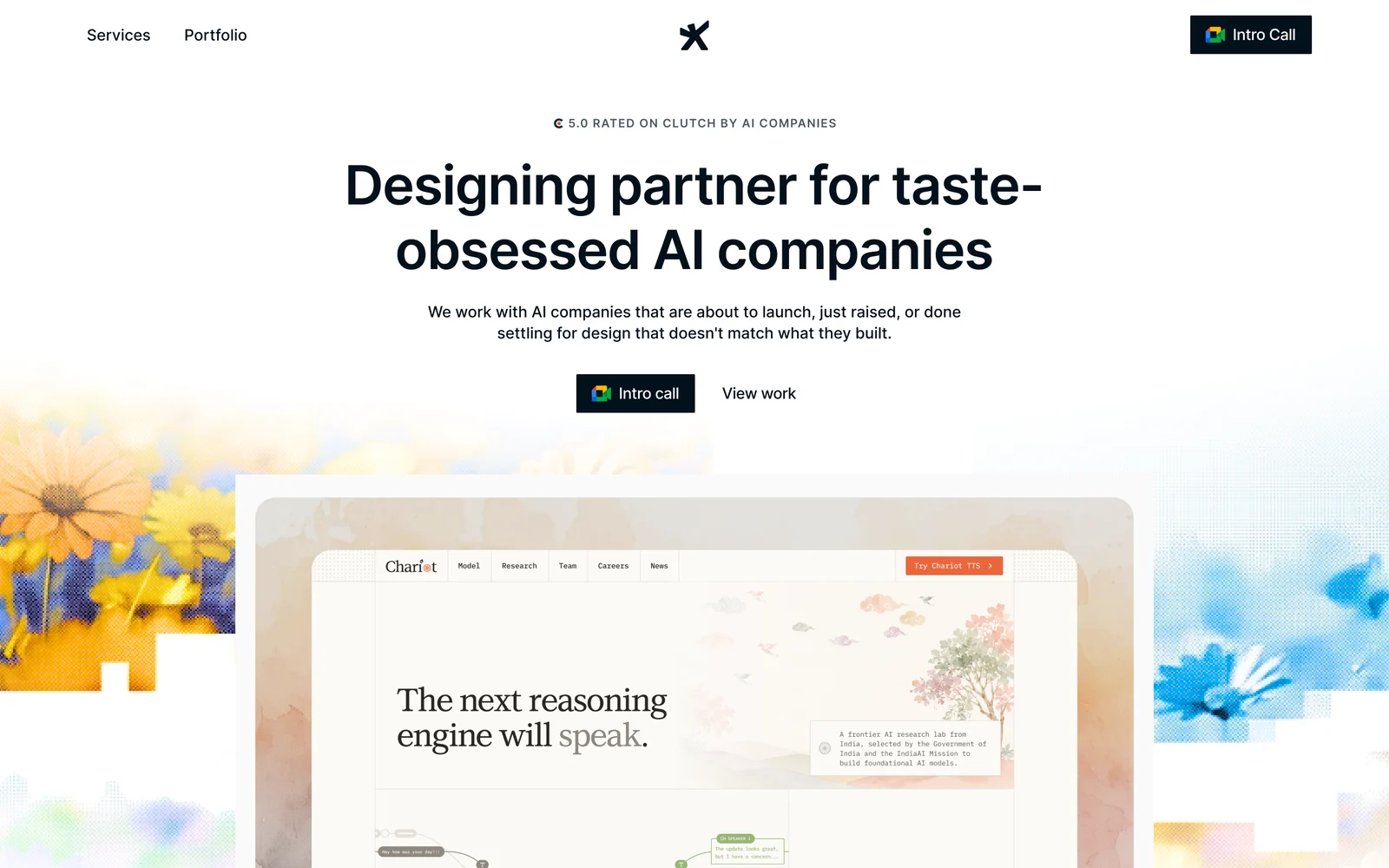
Working with a small team matters more than usual when you cannot audit the work yourself, because the person explaining a decision is the person who made it and nothing gets lost being passed along. Studio Maydit is founder-led and deliberately small. It is a web and product design studio. Its clients are AI founders, working across the US, UK, and Europe. The platform is chosen around who will edit the site afterwards: Framer when that person is you, Webflow when a marketing hire is coming, and custom code only when the product leaves no alternative.
Dualite is the clearest published outcome. The sequence went repositioned ICP first, then a product designed for the narrower group that decision defined, then 100,000+ users over seven months. It is worth knowing as a non-technical founder that this is what a design decision looks like when it matters, because it is a decision about who the thing is for rather than about how it looks, and it is the kind you are perfectly qualified to make. Recent clients include Wave, PixelFlow, Mi-VAD, and 15 other AI and SaaS teams.
Buying happens two ways. Fixed scope takes three to four weeks and suits a founder who wants a defined thing to finish, and it ends with a written diagnosis of what is leaking in the product, which is useful precisely because it is written down rather than explained in a call. The monthly retainer covers new pages, campaigns, and product design for teams still moving quickly, with no long lock-in, so nothing has to be committed to before you know whether it is working.
| Check | Finding |
|---|---|
| Based in | Remote, serving US / UK / EU |
| Platform depth | Framer, Webflow, and custom code |
| AI-sector proof | Yes. AI-native clients, published outcome on Dualite |
| Pricing | Fixed scope or monthly retainer, quoted per project |
| Team shape | Founder-led, small senior team |
| Best fit | Founders without a technical person who want to own the site after |
Ask for the editing screen in the first call. Everything else is easier after that. Book a 30-minute call.

2. Edgar Allan
Edgar Allan has worked from Atlanta since 2014 with fifty-one to two hundred people, in Webflow, for Porsche, Duracell, and NCR. They treat writing and design as one job rather than asking you to hand over copy, which removes the task that stalls most founder-led projects. Webflow also means you can edit the result yourself.
No pricing is published, the named clients are large organisations rather than startups, and the AI-sector proof is partial.
| Check | Finding |
|---|---|
| Based in | Atlanta, USA |
| Founded | 2014 |
| Team size | 51-200 |
| Primary platform | Webflow |
| AI-sector proof | Partial |
| Named clients | Porsche, Duracell, NCR |
| Pricing | Not published |
| Best fit | Founders who do not want to be responsible for writing the site |
3. Ramotion
Ramotion has designed software from San Francisco since 2009 with eleven to fifty people and a published starting price, for Mozilla, Okta, Netflix, Adobe, and Xero. The published figure is the single most useful thing for a buyer who cannot benchmark quotes, and sixteen years of software work means very little will be new to them.
The platform is mixed rather than fixed, so ask early what you will be able to change yourself, and the AI-sector proof is partial.
| Check | Finding |
|---|---|
| Based in | San Francisco, USA |
| Founded | 2009 |
| Team size | 11-50 |
| Primary platform | Mixed |
| AI-sector proof | Partial |
| Named clients | Mozilla, Okta, Netflix, Adobe, Xero |
| Pricing | Published minimum |
| Best fit | Founders who want a long record and a price they can check |
4. Engine Digital
Engine Digital has worked from Vancouver and New York since 2002 in custom code, for Adidas, Autodesk, Goldman Sachs, and HP. Two decades of running projects inside organisations where getting sign-off is the hard part is genuine expertise, and the delivery is disciplined.
The model assumes a client-side team you do not have. Custom code means every later edit comes back to them, timelines are long, and neither price nor headcount is published.
| Check | Finding |
|---|---|
| Based in | Vancouver and New York |
| Founded | 2002 |
| Team size | Not published |
| Primary platform | Custom code |
| AI-sector proof | Partial |
| Named clients | Adidas, Autodesk, Goldman Sachs, HP |
| Pricing | Not published |
| Best fit | Organisations with internal teams and long approval chains |
5. Phantom
Phantom has worked from London and Auckland since 2013 with fifty-one to two hundred people and AI-sector proof, for Diageo, SAP, Financial Times, and Zendesk. The craft level is high and they are used to products that need careful explaining rather than a slogan.
Custom code is the wrong end of the market for a founder without technical support, no pricing is published, and a studio of that size is built for programmes rather than a single site.
| Check | Finding |
|---|---|
| Based in | London, UK and Auckland, NZ |
| Founded | 2013 |
| Team size | 51-200 |
| Primary platform | Custom code |
| AI-sector proof | Yes |
| Named clients | Diageo, SAP, Financial Times, Zendesk |
| Pricing | Not published |
| Best fit | Larger companies with developers to maintain what is delivered |
6. Instrument
Instrument has run from Portland since 2005 for Nike, Microsoft, Electronic Arts, and Google. The brand work is exceptional and it has genuine cultural weight, which is worth a great deal to a company with the internal team to carry it forward.
For a founder working alone it is the wrong shape. The engagements expect marketers and designers on your side, nothing is published about price or headcount, and the AI-sector proof is partial.
| Check | Finding |
|---|---|
| Based in | Portland, USA |
| Founded | 2005 |
| Team size | Not published |
| Primary platform | Mixed |
| AI-sector proof | Partial |
| Named clients | Nike, Microsoft, Electronic Arts, Google |
| Pricing | Not published |
| Best fit | Companies with internal teams buying a full brand programme |
7. Flowout
Flowout is a distributed Webflow studio with a published starting price, for Jasper, Kajabi, Riverside, and Sendlane. A subscription arrangement suits a founder who would rather pay a predictable amount monthly than approve a large number once, and Webflow keeps the site in your hands.
No founding year, headcount, or location is published, and the AI-sector proof is partial, so you are judging almost entirely on the portfolio.
| Check | Finding |
|---|---|
| Based in | Distributed |
| Founded | Not published |
| Team size | Not published |
| Primary platform | Webflow |
| AI-sector proof | Partial |
| Named clients | Jasper, Kajabi, Riverside, Sendlane |
| Pricing | Published minimum |
| Best fit | Founders who prefer a steady monthly cost to one large decision |
8. Finsweet
Finsweet has worked from Denver since 2017 as a distributed team of fifty-one to two hundred, in Webflow, for Dropbox, Clay, GitHub, and Steadily. They are the studio other Webflow teams learn from, which matters to you for one practical reason: whatever they build can be picked up and continued by almost anyone else later.
No pricing is published, the AI-sector proof is partial, and a team that size may not put senior people on a small project.
| Check | Finding |
|---|---|
| Based in | Denver, USA, distributed |
| Founded | 2017 |
| Team size | 51-200 |
| Primary platform | Webflow |
| AI-sector proof | Partial |
| Named clients | Dropbox, Clay, GitHub, Steadily |
| Pricing | Not published |
| Best fit | Founders who want a build nobody else will struggle to inherit |
9. Refokus
Refokus has worked remotely from Germany since 2021 with eleven to fifty people, for Mural, BASF, Spotify, Yahoo, and BCG. That is a serious Webflow portfolio, and Mural is a product that had to be explained to people who had never seen anything like it, which is a useful habit.
No pricing is published, the AI-sector proof is partial, and the client list suggests engagements sized for companies with internal marketing teams.
| Check | Finding |
|---|---|
| Based in | Germany, remote |
| Founded | 2021 |
| Team size | 11-50 |
| Primary platform | Webflow |
| AI-sector proof | Partial |
| Named clients | Mural, BASF, Spotify, Yahoo, BCG |
| Pricing | Not published |
| Best fit | Funded founders who want Webflow at a high production standard |
10. Pixelmatters
Pixelmatters has worked from Porto since 2013 with fifty-one to two hundred people and a published starting price, for Rubrik, Quantic, and UJET. Design and engineering sit together, which means the technical parts you cannot supervise are handled inside one team rather than passed between two.
The platform is mixed rather than fixed, the AI-sector proof is partial, and Portugal shares only part of a working day with the US.
| Check | Finding |
|---|---|
| Based in | Porto, Portugal |
| Founded | 2013 |
| Team size | 51-200 |
| Primary platform | Mixed |
| AI-sector proof | Partial |
| Named clients | Rubrik, Quantic, UJET |
| Pricing | Published minimum |
| Best fit | Founders who want one team responsible for design and build |
How to choose between them
Sort by what is actually broken.
If the words are the problem and writing them yourself keeps not happening, buy the writing. Edgar Allan.
If you cannot compare quotes with any confidence, start with the studios that publish a number. Ramotion, Flowout, or Pixelmatters.
If your fear is being stuck afterwards, choose the platform before the studio. Finsweet or Flowout, both in Webflow.
If nobody on your side can check the technical work, buy design and build from one team. Pixelmatters.
One test before you sign. Ask them to explain the platform choice to you as if you were going to have to defend it to somebody else. If you can repeat their answer afterwards, they are a studio that works with founders. If you cannot, keep looking.