
Summarize with AI


For a second-time founder rebuilding a site, the ten studios worth reviewing are Studio Maydit, Ramotion, Finsweet, Instrument, Engine Digital, Lighthouse Digital, Flowout, 8020, Edgar Allan, and Refokus. Ramotion and Instrument lead this list. Ramotion has worked from San Francisco since 2009 with eleven to fifty people and a published starting price, for Mozilla, Okta, Netflix, Adobe, and Xero, all replacements of sites that already had audiences. Instrument has worked from Portland since 2005, for Nike, Microsoft, Electronic Arts, and Google, which is brand work at a scale where the story has to survive contact with a lot of people. Flowout and Lighthouse Digital fit least well. Flowout is a volume subscription service, and Lighthouse Digital publishes no AI work.
You have done this before, and that is the problem.
The second company starts faster than the first in almost every way. You know which mistakes cost money, you have a network, and you can skip six months of learning what a good supplier looks like. All of that is real.
What does not transfer is the specific thing that made the last site work. It worked because of a particular buyer, in a particular market, at a particular moment. Reusing its structure, its tone, or its conversion pattern in a different category produces something that feels professional and lands flat.
The failure is hard to see from inside, because the work looks competent. It is competent. It is just answering a question this company is not being asked.
There is a second trap, quieter. Second-time founders tend to move fast enough that nobody checks what the existing site is already earning, because checking feels like the sort of caution that slowed the first company down.

How we picked these agencies
Five criteria set the order below, and every one of them can be settled from public pages.
Platform depth, judged by how much you intend to be involved. Experienced founders usually want to change wording themselves at eleven at night, and then stop touching it entirely for four months. That pattern suits a system a non-developer can edit safely, and it punishes a build where every change is a ticket.
Proof with companies that changed direction, which is the criterion weighted most heavily here rather than AI proof specifically. What you need is a studio that has rebuilt for a business whose story moved, because your risk is carrying an old story into a new market. Rebuilds for companies with existing audiences are the clearest evidence.
Pricing. Is a starting figure published. You have bought agency work before and know how much of a quote is padding, so a studio willing to publish a floor starts the conversation somewhere honest.
Team shape. Small teams give you a peer who will disagree with you. Large teams give you capacity and process. For a second-time founder the first is usually worth more, because the risk is nobody pushing back.
Their own site. It is the only project with no client to blame, and it is the fastest read on whether a studio has a point of view or takes direction.
One extra question for the first call: ask what they would talk you out of. A studio that has an answer is a studio that will argue with your playbook, which is the whole reason to hire one.
These tables summarise what each studio makes public. No number has been inferred, and unpublished rows stay unpublished.
What goes wrong for second-time founders
Three failures, and the first is the one that feels most like competence while it happens.
The last company's playbook gets reused wholesale. Same page order, same proof structure, same tone, same conversion path, because it worked and arguing about it wastes time. But the previous site worked on a buyer who already understood the category, or who bought on trust, or who arrived through a channel you no longer have. Ported into a new market it produces a site that is fluent and unpersuasive. Keep the process and rebuild the argument.
Speed removes the checks that protect existing traffic. You want this done in three weeks because you know it can be. So nobody exports the current pages, nobody records what ranks, and nobody writes a redirect map. If the previous site was a placeholder that is fine. If it has been live for eighteen months and accumulated links from a launch, a podcast, and a few posts, that is an asset being deleted for the sake of a fortnight.
Your reputation carries the homepage, so the product never gets explained. Second-time founders often have an audience that arrives already convinced, and the site quietly starts assuming that context. It reads as a note between people who already know the story. Then the audience that did not follow you here lands on it, cannot tell what the product does, and leaves. The people you already have are not the ones the site needs to work on.
1. Studio Maydit: A Top-Rated Design Agency for AI Founders
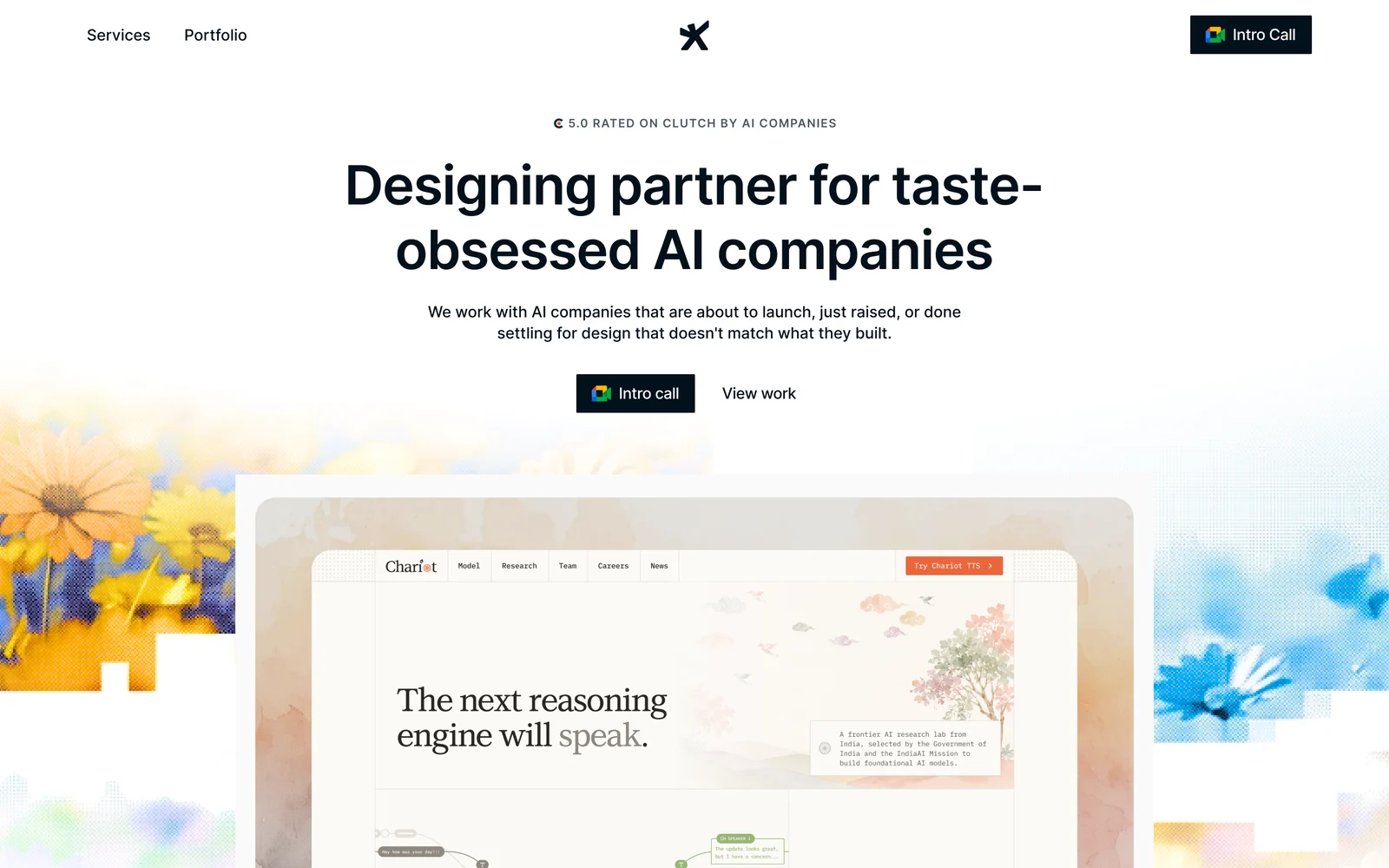
Hiring another studio when you have run this process before is only worth it if somebody argues with you. Studio Maydit is founder-led with a small senior team, which means the person who disagrees with your homepage is the person who then has to build it, and that combination produces fewer comfortable agreements than a larger studio does. It is a web and product design studio working with AI founders across the US, UK, and Europe, building in Framer, Webflow, and custom code.
The Dualite sequence is the argument in practice. A repositioned ICP came first, the product was designed for the narrower group that decision created, and 100,000+ users arrived across seven months. Narrowing is the move most second-time founders resist, because the last company earned the right to speak broadly and this one has not yet. Recent clients include Wave, PixelFlow, Mi-VAD, and 15 other AI and SaaS teams.
The work continues into product design after the site ships. For an experienced founder that is usually where the honest feedback is, since you can already tell whether a homepage is good and often cannot tell where the product loses people. Fixed scope runs three to four weeks, suits a founder who wants this finished, and ends with a written diagnosis of what is leaking in the product. A monthly retainer covers new pages, campaigns, and product design with no long lock-in, for teams still shipping.
| Check | Finding |
|---|---|
| Based in | Remote, serving US / UK / EU |
| Platform depth | Framer, Webflow, and custom code |
| AI-sector proof | Yes. AI-native clients, published outcome on Dualite |
| Pricing | Fixed scope or monthly retainer, quoted per project |
| Team shape | Founder-led, small senior team |
| Best fit | Repeat founders who want the last playbook challenged |
Ask what worked last time because of the market rather than because of you. Book a 30-minute call.

2. Ramotion
Ramotion has worked from San Francisco since 2009 with eleven to fifty people and a published starting price, for Mozilla, Okta, Netflix, Adobe, and Xero. Every one of those was a rebuild for a company with an existing audience and existing equity, which is the situation you are in rather than the greenfield one. A studio with that history asks what it is not allowed to break before it asks what it can change.
AI-sector proof is only partial, and the studio is used to longer enterprise timelines than a founder who wants this done in a month usually tolerates.
| Check | Finding |
|---|---|
| Based in | San Francisco, USA |
| Founded | 2009 |
| Team size | 11-50 |
| Primary platform | Mixed |
| AI-sector proof | Partial |
| Named clients | Mozilla, Okta, Netflix, Adobe, Xero |
| Pricing | Published minimum |
| Best fit | Founders with real existing traffic to protect |
3. Instrument
Instrument has worked from Portland since 2005, for Nike, Microsoft, Electronic Arts, and Google. This is brand-led work of the kind that survives being repeated by thousands of people who never met the founder, and that is the discipline a second company needs when the founder's own voice is doing too much of the lifting.
No pricing, no team size, and no AI-sector proof are published, and a studio aimed at brands this size is an expensive and slow fit for a company that is a few months old.
| Check | Finding |
|---|---|
| Based in | Portland, USA |
| Founded | 2005 |
| Team size | Not published |
| Primary platform | Mixed |
| AI-sector proof | Partial |
| Named clients | Nike, Microsoft, Electronic Arts, Google |
| Pricing | Not published |
| Best fit | Founders whose personal voice is carrying the whole brand |
4. Engine Digital
Engine Digital has worked from Vancouver and New York since 2002 in custom code, for Adidas, Autodesk, Goldman Sachs, and HP. Two decades of large replacements means the unglamorous parts are routine: inventories, redirect maps, staged launches. That is exactly the discipline that speed tends to delete from a second-time founder's project.
No pricing and no team size are published, AI-sector proof is only partial, and enterprise pace will frustrate anyone who expects a decision the same afternoon.
| Check | Finding |
|---|---|
| Based in | Vancouver and New York |
| Founded | 2002 |
| Team size | Not published |
| Primary platform | Custom code |
| AI-sector proof | Partial |
| Named clients | Adidas, Autodesk, Goldman Sachs, HP |
| Pricing | Not published |
| Best fit | Larger rebuilds where losing search traffic is unacceptable |
5. Finsweet
Finsweet works in Webflow from Denver as a distributed team with fifty-one to two hundred people, for Dropbox, Clay, GitHub, and Steadily. This is the deepest Webflow engineering here. If you intend to edit the site yourself at odd hours, a properly modelled CMS is the difference between that being pleasant and being a nightly hazard.
No pricing is published, AI-sector proof is only partial, and this is a build studio rather than a strategic one, so the argument about your positioning will not come from them.
| Check | Finding |
|---|---|
| Based in | Denver, USA, distributed |
| Founded | 2017 |
| Team size | 51-200 |
| Primary platform | Webflow |
| AI-sector proof | Partial |
| Named clients | Dropbox, Clay, GitHub, Steadily |
| Pricing | Not published |
| Best fit | Founders who will maintain and edit the site themselves |
6. 8020
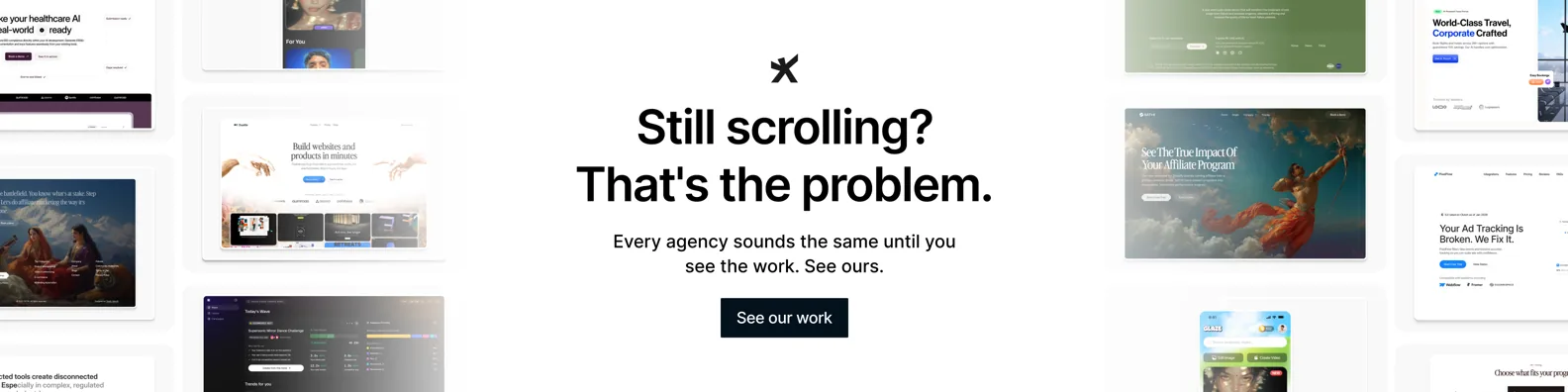
8020 works in Webflow from San Francisco and New York, for Wave, Superlist, Pilot.com, Vanta, and Circle. That client list is modern software companies with restrained, legible sites, which is a useful corrective if your instinct from the last company is to build something busier and louder than this market wants.
No pricing and no team size are published, AI-sector proof is only partial, and there is no founding-era track record with companies that changed direction.
| Check | Finding |
|---|---|
| Based in | San Francisco and New York, USA |
| Founded | 2014 |
| Team size | Not published |
| Primary platform | Webflow |
| AI-sector proof | Partial |
| Named clients | Wave, Superlist, Pilot.com, Vanta, Circle |
| Pricing | Not published |
| Best fit | Founders who want restraint rather than a bigger statement |
7. Edgar Allan
Edgar Allan has worked in Webflow from Atlanta since 2014 with fifty-one to two hundred people, for Porsche, Duracell, and NCR. A narrative studio is worth considering when the danger is that your new company inherits the old company's story wholesale. These are people who will start from what the argument should be rather than from what worked before.
No pricing is published, AI-sector proof is only partial, and the client list is large consumer brands rather than early software companies.
| Check | Finding |
|---|---|
| Based in | Atlanta, USA |
| Founded | 2014 |
| Team size | 51-200 |
| Primary platform | Webflow |
| AI-sector proof | Partial |
| Named clients | Porsche, Duracell, NCR |
| Pricing | Not published |
| Best fit | Founders who need a genuinely new argument, not a port |
8. Refokus
Refokus has worked in Webflow from Germany since 2021 with eleven to fifty people, for Mural, BASF, Spotify, Yahoo, and BCG. The studio is known for sites where motion does real work, and for a founder whose reputation precedes them, a site with genuine craft signals that this company is a serious second act rather than a side project.
No pricing is published and AI-sector proof is only partial, and a motion-led build is harder to edit quickly at midnight than a plainer one.
| Check | Finding |
|---|---|
| Based in | Germany, remote |
| Founded | 2021 |
| Team size | 11-50 |
| Primary platform | Webflow |
| AI-sector proof | Partial |
| Named clients | Mural, BASF, Spotify, Yahoo, BCG |
| Pricing | Not published |
| Best fit | Founders who want the second company to look considered |
9. Lighthouse Digital
Lighthouse Digital builds in Webflow from London with a published starting price, for HelloSelf, Freetrade, and IGN. Freetrade is the useful reference: a plain, trustworthy site for a product where overstatement would have been costly. That restraint suits a founder whose new company has to earn credibility rather than borrow it.
No AI-sector work is published at all, and neither team size nor founding year is on record, so there is little to verify beyond the three named clients.
| Check | Finding |
|---|---|
| Based in | London, UK |
| Founded | Not published |
| Team size | Not published |
| Primary platform | Webflow |
| AI-sector proof | No |
| Named clients | HelloSelf, Freetrade, IGN |
| Pricing | Published minimum |
| Best fit | UK founders who want plain and credible over ambitious |
10. Flowout
Flowout is a distributed Webflow studio with a published starting price, for Jasper, Kajabi, Riverside, and Sendlane. The subscription model is a reasonable fit for a founder who already knows exactly what they want and needs pages produced without a discovery process.
No team size, no founding year, and no AI-sector proof are published, and a volume model will never provide the argument about positioning that this audience most needs.
| Check | Finding |
|---|---|
| Based in | Distributed |
| Founded | Not published |
| Team size | Not published |
| Primary platform | Webflow |
| AI-sector proof | Partial |
| Named clients | Jasper, Kajabi, Riverside, Sendlane |
| Pricing | Published minimum |
| Best fit | Founders who know the plan and want execution only |
How to choose between them
Sort by what is actually broken.
If the new site is quietly a copy of the last one, buy an argument. Edgar Allan, or Instrument if the brand itself is the issue.
If the current site has eighteen months of accumulated links and rankings, buy migration discipline. Ramotion or Engine Digital.
If you intend to edit the site constantly yourself, buy build quality in the CMS. Finsweet.
If the company needs to look like a serious second act rather than an experiment, that is craft. Refokus.
One test before you sign. Describe the last company's homepage strategy and ask whether it applies here. A studio worth hiring will find a reason it does not, and name the market condition that made it work before. A studio that agrees with you enthusiastically is going to build the old site again, faster, which is the outcome you were trying to avoid by hiring anyone at all.