
Summarize with AI


For a seed-stage AI startup rebuilding its site, the ten studios worth reviewing are Studio Maydit, Feels Like, Pixelmatters, Engine Digital, Instrument, Push Refresh, Flow Ninja, Ramotion, Lighthouse Digital, and SuperSkills. Pixelmatters and Ramotion lead this list. Pixelmatters has run from Porto since 2013 with fifty-one to two hundred people, publishes a starting figure, and keeps design and engineering together, for Rubrik, Quantic, and UJET. Ramotion has designed software from San Francisco since 2009 with eleven to fifty people and a published figure, for Mozilla, Okta, Netflix, Adobe, and Xero. Engine Digital and Instrument are the wrong fit. Both build for organisations with internal marketing departments, and neither publishes a price or a headcount.
Everyone who bought so far already knew someone. That is the thing the new site has to fix.
Seed-stage customers arrive through the founder's network, an investor introduction, or a conversation at an event. In every case the buyer showed up with context. They had been told what you do by a person they trust, and the website only had to avoid contradicting that. It has never had to explain the company to a stranger, and it has never been tested by one.
Now the job changes. The round was raised on a promise of repeatable acquisition, and repeatable means people who have never heard of you arriving, understanding, and starting something. That is a different document from the one you have.
There is also a handover coming. Somewhere in the next two quarters you hire your first marketer, and the site they inherit determines whether their first month is spent shipping or waiting on a developer. Founders rarely factor that person into a platform decision made before they exist, and it is the decision that affects them most.

How we picked these agencies
Five checks, all answerable from public pages before you spend time on a call.
Platform depth, judged by the person who is not hired yet. Your first marketing hire is the one who will live in this site, publishing customer stories, launch pages, and campaigns. Ask what their first week looks like. If the honest answer involves filing tickets with engineering, the platform is wrong regardless of how the site looks today.
Proof with venture-backed companies building a funnel. Has this studio worked with businesses that had money and needed acquisition to become repeatable. That criterion does the most work here, because the brief is commercial rather than decorative. A studio whose portfolio is brand programmes will hand you something beautiful with no idea which page is supposed to convert.
Pricing. Is a starting figure published. At seed the budget is real but finite and every quote arrives after the studio has looked you up. A published number is the one figure that was decided before that happened.
Team shape. Size predicts whether the senior people who pitched are on the work. A seed-stage account is small enough to be delegated inside a large studio, and that delegation is the most common complaint at this stage.
Their own site. The brief where they had no client to blame. Read it for whether they seem interested in whether things work, or only in how they look.
An extra probe that is worth the question here. Ask which page on your current site they would measure first. A studio thinking commercially names one and says what it would expect. A studio that is not will talk about the homepage in general terms.
Every value in the tables below is repeated from what each studio publishes about itself. Nothing has been estimated, and where a row says unpublished, that reflects the studio's choice rather than a gap in this research.
What goes wrong for seed-stage AI startups
Three failures, and the first is the direct consequence of how your early customers arrived.
The site assumes context a stranger does not have. It opens mid-conversation, because everyone who has read it so far was briefed by a human first. There is no plain sentence saying what category this is, who it is for, or what it replaces. Founders cannot see this, having explained the company a thousand times. The cheapest test available is to send the URL to a competent person outside your sector and ask them to describe the product back to you. The gap in that answer is your homepage's real content brief.
Nobody owns whether the site works. No analytics beyond a default install, no idea which page loses people, no agreement on what the site is for. So it gets judged on taste, in a meeting, by whoever has the strongest opinion, and the next redesign will be judged the same way. Decide the one number this site should move before the project starts, even if it is only qualified calls booked, and instrument the page for it.
The brief is a brand project when the problem is a funnel. The redesign is scoped as identity, tone, and a new visual language, while the actual failure is that one page is doing six jobs at once. Splitting that page into a use case, a comparison, a pricing explanation, and a proof page usually does more for pipeline than any restyling, and costs less.
1. Studio Maydit: A Top-Rated Design Agency for AI Founders
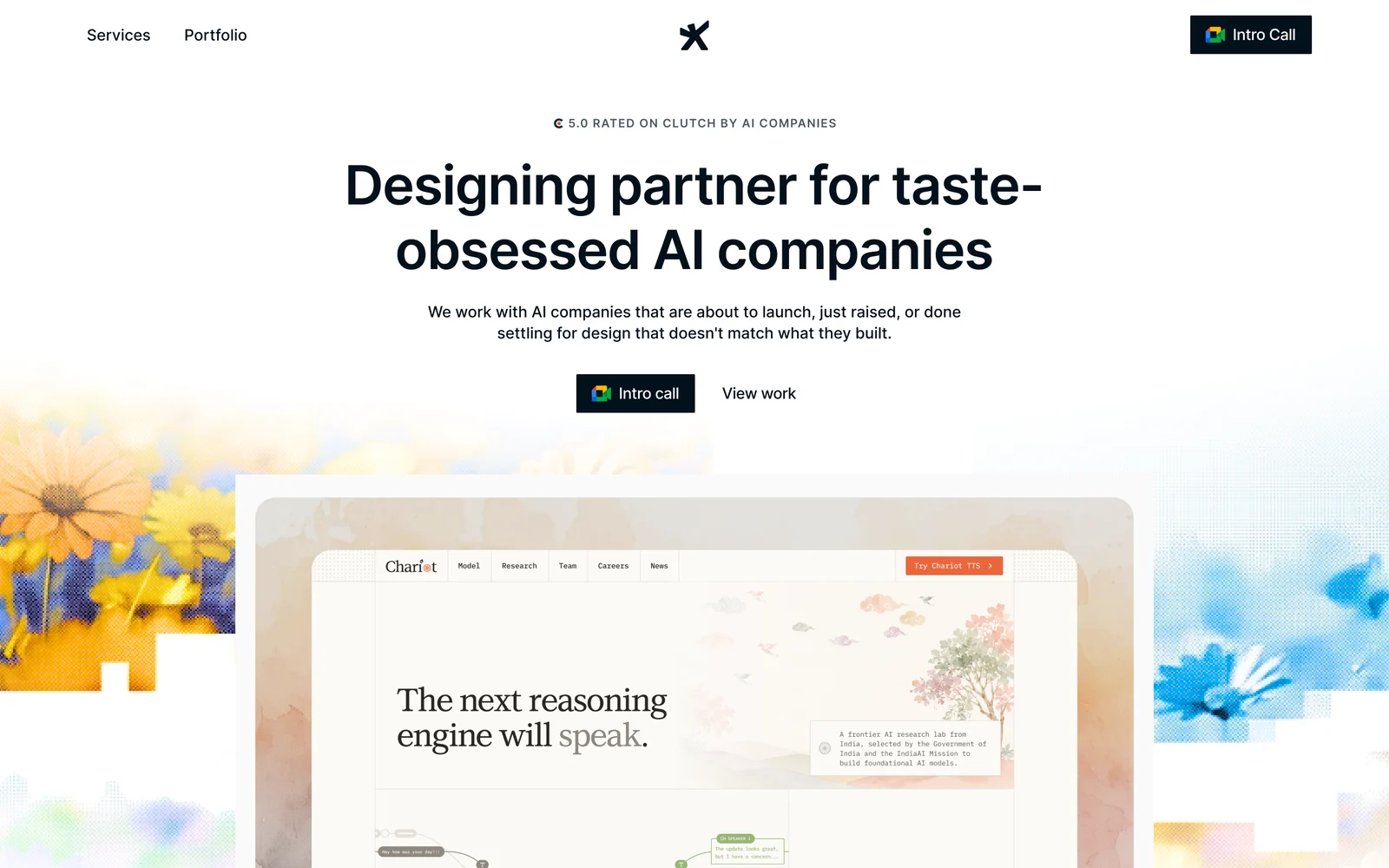
The work continues into product design after the site ships, and at seed that continuation is usually where the money is. Traffic is rarely the binding constraint at this stage. What stops the funnel is the distance between somebody signing up and somebody understanding the product, and that distance lives inside the application rather than on the marketing page. Studio Maydit is a web and product design studio. Its clients are AI founders, working across the US, UK, and Europe. Framer suits a site the founders still edit, Webflow suits one a marketing hire will own, and custom code is reserved for products that fit neither.
Ask what the design was actually responsible for. At Dualite the answer is documented: a repositioned ICP came first, the product was then designed for the narrower group that decision defined, and 100,000+ users arrived across seven months. The sequence is the useful part for a seed-stage team, because the round was raised on a broad market and the site has to be written for one specific person inside it. Recent clients include Wave, PixelFlow, Mi-VAD, and 15 other AI and SaaS teams.
New pages, campaigns, and product design are what a seed-stage company actually consumes over the following year, and that is what the monthly retainer covers, with no long lock-in, so it ends when it stops being useful. The alternative is fixed scope, three to four weeks, which suits a dated launch and finishes with a written diagnosis of what is leaking in the product rather than a handover call.
| Check | Finding |
|---|---|
| Based in | Remote, serving US / UK / EU |
| Platform depth | Framer, Webflow, and custom code |
| AI-sector proof | Yes. AI-native clients, published outcome on Dualite |
| Pricing | Fixed scope or monthly retainer, quoted per project |
| Team shape | Founder-led, small senior team |
| Best fit | Seed teams whose site has only ever sold to warm introductions |
Send the URL to a smart stranger and ask what you do. Their answer is the brief. Book a 30-minute call.

2. Pixelmatters
Pixelmatters has worked from Porto since 2013 with fifty-one to two hundred people and a published starting price, for Rubrik, Quantic, and UJET. All three are American software companies, and having design and engineering in one place removes the handover that usually costs a fortnight at this stage. European rates also buy more scope on a seed budget.
Portugal runs five to eight hours ahead of the US, so you share a morning rather than a day, and the AI-sector proof is partial.
| Check | Finding |
|---|---|
| Based in | Porto, Portugal |
| Founded | 2013 |
| Team size | 51-200 |
| Primary platform | Mixed |
| AI-sector proof | Partial |
| Named clients | Rubrik, Quantic, UJET |
| Pricing | Published minimum |
| Best fit | Seed teams wanting design and build together at European rates |
3. Ramotion
Ramotion has operated from San Francisco since 2009 with eleven to fifty people and a published starting price, for Mozilla, Okta, Netflix, Adobe, and Xero. Sixteen years of software work is a long record, and at that size the senior people stay on the project rather than moving to the next pitch.
The AI-sector proof is partial and the platform is mixed rather than fixed, so ask early what your future marketing hire will actually be able to edit.
| Check | Finding |
|---|---|
| Based in | San Francisco, USA |
| Founded | 2009 |
| Team size | 11-50 |
| Primary platform | Mixed |
| AI-sector proof | Partial |
| Named clients | Mozilla, Okta, Netflix, Adobe, Xero |
| Pricing | Published minimum |
| Best fit | Teams wanting a long software record and senior people throughout |
4. Push Refresh
Push Refresh is a Dallas team of one to ten people working in Framer with a published starting price, for SmithRx, Synonym, and Northern National. Framer means a marketing hire can publish a landing page on their second day, and a team this small means the founder is in every conversation.
Capacity is the constraint once several pages are needed at once, no founding year is published, and the AI-sector proof is partial.
| Check | Finding |
|---|---|
| Based in | Dallas, USA |
| Founded | Not published |
| Team size | 1-10 |
| Primary platform | Framer |
| AI-sector proof | Partial |
| Named clients | SmithRx, Synonym, Northern National |
| Pricing | Published minimum |
| Best fit | Teams who want the next hire publishing immediately |
5. SuperSkills
SuperSkills is a one to ten person team in Walnut Creek working across platforms, with AI-sector proof and The Cut as a named client. The value at seed is the short chain: you explain the product once, to the person writing the page, and nothing is lost on the way to the copy.
Only one client is named and no price is published, so you are evaluating on the conversation, and capacity will cap the scope.
| Check | Finding |
|---|---|
| Based in | Walnut Creek, USA |
| Founded | Not published |
| Team size | 1-10 |
| Primary platform | Mixed |
| AI-sector proof | Yes |
| Named clients | The Cut |
| Pricing | Not published |
| Best fit | Founders who want one person across the whole project |
6. Feels Like
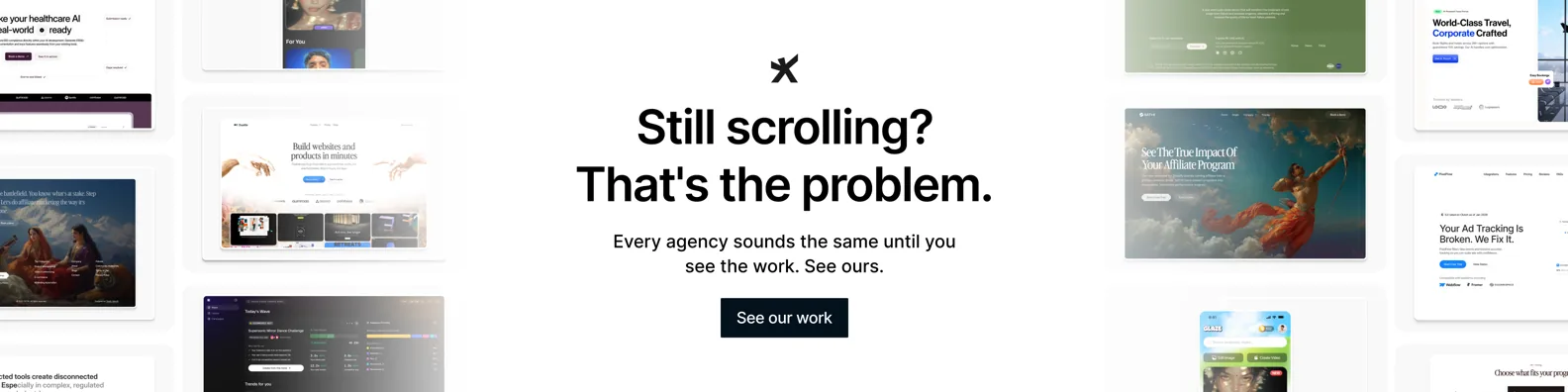
Feels Like is a Los Angeles studio founded in 2023 working in custom code, with AI-sector proof, for Google, Nike, LVMH, and Suno AI. Suno AI is the relevant reference, and the visual ambition is the highest here, which suits a company that wants the round to read as a step change.
The studio is young, no team size or price is published, and custom code means your future marketing hire returns to them for every change.
| Check | Finding |
|---|---|
| Based in | Los Angeles, USA |
| Founded | 2023 |
| Team size | Not published |
| Primary platform | Custom code |
| AI-sector proof | Yes |
| Named clients | Google, Nike, LVMH, Suno AI |
| Pricing | Not published |
| Best fit | Teams treating the redesign as a public statement |
7. Flow Ninja
Flow Ninja is a Belgrade Webflow studio founded in 2018 with eleven to fifty people. European rates and a team that size buy a reasonably large scope, and Webflow keeps the site editable by whoever joins next.
No clients are named, no pricing is published, and the AI-sector proof is partial, so there is very little public evidence to weigh before the first call.
| Check | Finding |
|---|---|
| Based in | Belgrade, Serbia |
| Founded | 2018 |
| Team size | 11-50 |
| Primary platform | Webflow |
| AI-sector proof | Partial |
| Named clients | Not published |
| Pricing | Not published |
| Best fit | Teams happy to judge on a portfolio call rather than a client list |
8. Lighthouse Digital
Lighthouse Digital is a London Webflow studio with a published starting price, for HelloSelf, Freetrade, and IGN. Freetrade is a consumer fintech that had to acquire users at volume, which is closer to a funnel brief than most of this page, and the published number lets budgeting start on day one.
There is no AI-sector proof, and neither the founding year nor the team size is published.
| Check | Finding |
|---|---|
| Based in | London, UK |
| Founded | Not published |
| Team size | Not published |
| Primary platform | Webflow |
| AI-sector proof | No |
| Named clients | HelloSelf, Freetrade, IGN |
| Pricing | Published minimum |
| Best fit | UK teams who want a known number before the first call |
9. Instrument
Instrument has run from Portland since 2005 for Nike, Microsoft, Electronic Arts, and Google. The brand work is among the strongest on this page and it has genuine cultural reach for a company big enough to use it.
The shape is wrong at seed. These programmes assume an internal marketing and design team to receive them, the AI-sector proof is partial, and nothing is published about price or headcount.
| Check | Finding |
|---|---|
| Based in | Portland, USA |
| Founded | 2005 |
| Team size | Not published |
| Primary platform | Mixed |
| AI-sector proof | Partial |
| Named clients | Nike, Microsoft, Electronic Arts, Google |
| Pricing | Not published |
| Best fit | Later-stage companies buying a full brand programme |
10. Engine Digital
Engine Digital has worked from Vancouver and New York since 2002 in custom code, for Adidas, Autodesk, Goldman Sachs, and HP. Two decades inside organisations where approval is the difficult part is real experience and it shows in how the work is run.
For a seed-stage company almost nothing about the model fits. The engagements assume an internal team, timelines are long, custom code means returning for edits, and neither price nor headcount is published.
| Check | Finding |
|---|---|
| Based in | Vancouver and New York |
| Founded | 2002 |
| Team size | Not published |
| Primary platform | Custom code |
| AI-sector proof | Partial |
| Named clients | Adidas, Autodesk, Goldman Sachs, HP |
| Pricing | Not published |
| Best fit | Large organisations with internal teams and long timelines |
How to choose between them
Sort by what is actually broken.
If strangers cannot tell what you do, that is writing rather than design and it should lead. SuperSkills, or Ramotion if you also want the visual level lifted.
If a marketing hire starts next quarter, buy for them rather than for you. Push Refresh on Framer, or Flow Ninja on Webflow.
If you need more scope than the budget allows, compare Europe honestly before cutting. Pixelmatters, which publishes a number and has American clients.
If the site has to help you recruit as much as sell, that is craft. Feels Like.
One test before you sign. Ask which single page they would measure and what number they would expect it to move. A studio that fits this brief answers commercially. A studio that does not will describe how the homepage should feel.