
Summarize with AI


A Series B AI company rebuilding its site should look at Studio Maydit, basement.studio, Lazarev, Trueform, SuperSkills, Phantom, Feels Like, Pixelmatters, Instrument, and Engine Digital. basement.studio and Lazarev lead this list. basement.studio has built in custom code since 2018 with eleven to fifty people, a published starting price, and AI-sector proof, for Vercel, Cursor, ElevenLabs, Harvey AI, and Scale AI. Lazarev has worked from San Francisco since 2015 with fifty-one to two hundred people, also with a published figure, for Payoneer, Peel, Elva, and Mozayix. SuperSkills and Trueform are the weakest fits at this stage, not on quality but on capacity: one names a single client and has one to ten people, and the other publishes no team size at all.
You are not redesigning a website. You are migrating a content estate, and nobody has counted it.
Somewhere between the last two rounds the site stopped being a document and became an accumulation. Eighty pages, give or take. Campaign landing pages from a launch that ended. Three blog posts that bring in most of the organic traffic and are two product versions out of date. A comparison page written against a competitor who has since changed their pricing. Several pages nobody in the company knows exist.
That inventory is the actual project, and it is why Series B redesigns run twice as long as the pitch said. The design is the visible part. The unglamorous work is deciding what survives, what merges, what dies, and what has to keep its address.
There is a second thing that has changed. You now have a product team shipping interface work, and a marketing team shipping pages, and no shared language between them.

How we picked these agencies
Five checks, all answerable from public pages before a call is booked.
Platform depth, judged against a site that several teams edit every week. At this stage you have people whose job is to publish, and the platform either serves them or becomes a ticket queue. Ask what the publishing workflow looks like for a marketer who wants a new landing page on Thursday, and whether any engineer is involved in that sentence.
Proof with companies that already had a site worth protecting. That is the criterion doing the most work here, and it is the one most studios cannot answer well. Rebuilding from nothing is a different discipline from replacing something that already ranks, already converts, and already has links pointing at it. Ask what happened to the search traffic on their last replatform, and whether they can show you.
Pricing. Is a starting figure published. At Series B the budget is approved rather than found, and a public number lets you check quickly whether a studio operates at your scale or several times above it.
Team shape. Headcount predicts whether they can run six workstreams at once, which is what an estate of this size needs. It also predicts whether the people who pitched will still be visible in month three.
Their own site. The one brief with no client to blame. Read it for how they handle depth, since yours has plenty.
An extra probe worth running early: ask how they would decide which pages not to rebuild. A studio that has done this describes a method. One that has not will say everything gets reviewed.
Every figure in the tables that follow is taken from a studio's own public statements, without estimation. Where a row reads unpublished, the studio has chosen not to say, and that choice is itself part of the comparison.
What goes wrong for Series B AI startups
Three failures, and the first one causes the second.
The project starts without an inventory. Nobody exports the page list with traffic, conversions, and inbound links attached, so the scope is set from memory. The result is predictable: several dead campaign pages get lovingly rebuilt, and two posts quietly responsible for a third of organic signups get dropped because nobody in the room had read them. Spend the first week on a spreadsheet of every URL with its numbers. It is the cheapest week of the project and it decides everything after it.
URLs move and the traffic does not come back. A replatform reorganises the structure, addresses change, redirects are done at the end by whoever has time, and three months later a page that used to rank is gone. This is the single most expensive mistake available at Series B, because you are losing traffic you already paid for. Map every old address to a new one before launch, keep the ones that earn their position exactly where they are, and check the mapping twice.
The site and the product drift apart within two quarters. The redesign delivers pages rather than a system, so when the product team ships a new interface the marketing screenshots are wrong and nothing shares a component or a colour. Ask for tokens, components, and documentation as named deliverables, and make sure somebody in your company owns them after handover.
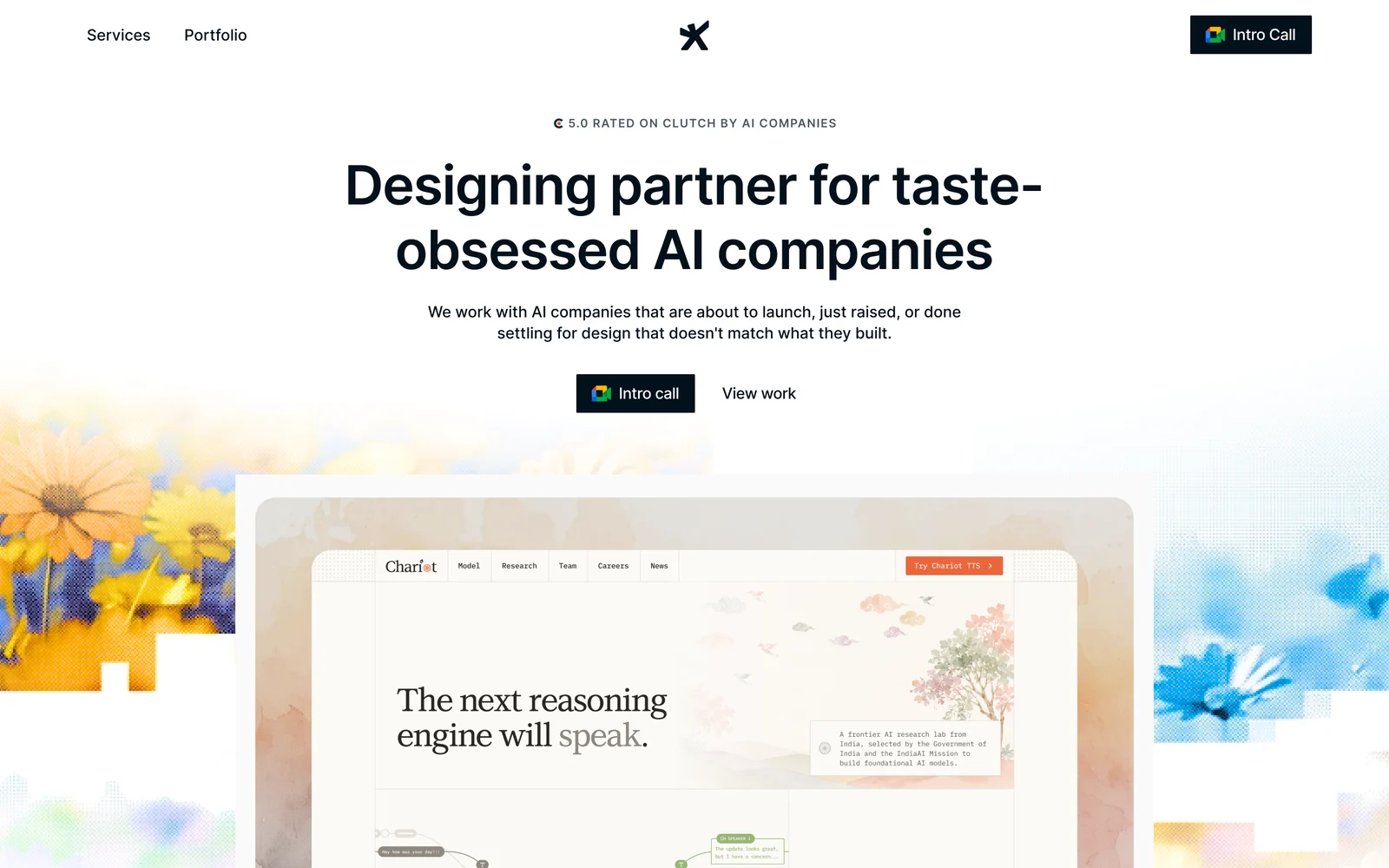
1. Studio Maydit: A Top-Rated Design Agency for AI Founders
The gap between the marketing site and the product is the specific Series B problem, and it is hard to close with a studio that only does one of the two. Studio Maydit continues into product design after the site ships, so the same people who set the type scale on the pricing page are the ones looking at the onboarding screens. It is a web and product design studio. Its clients are AI founders, working across the US, UK, and Europe. Framer where the site changes weekly, Webflow where a marketing team needs its own control, and custom code where the product will not fit either.
The Dualite outcome is documented, and the sequence is what a Series B team should notice. A repositioned ICP came first. The product was then designed for the narrower group that decision defined. 100,000+ users followed over seven months. By this stage most companies have added segments faster than they have added clarity, and the site shows it. Deciding who the page is not for is usually the highest-value hour of the project. Recent clients include Wave, PixelFlow, Mi-VAD, and 15 other AI and SaaS teams.
For a company with a marketing team already publishing, the monthly retainer is usually the right shape: new pages, campaigns, and product design, arriving continuously, with no long lock-in so it can stop the moment it stops paying for itself. Fixed scope is the alternative, three to four weeks against a firm date, and it ends with a written diagnosis of what is leaking in the product, which is worth having in hand before the next round of growth spend.
| Check | Finding |
|---|---|
| Based in | Remote, serving US / UK / EU |
| Platform depth | Framer, Webflow, and custom code |
| AI-sector proof | Yes. AI-native clients, published outcome on Dualite |
| Pricing | Fixed scope or monthly retainer, quoted per project |
| Team shape | Founder-led, small senior team |
| Best fit | Series B teams whose site and product no longer look related |
Export the page list first. The argument gets much easier after that. Book a 30-minute call.

2. basement.studio
basement.studio works from Mar del Plata and Los Angeles, founded in 2018, with eleven to fifty people, custom code, a published starting price, and AI-sector proof, for Vercel, Cursor, ElevenLabs, Harvey AI, and Scale AI. Every one of those is an AI company that scaled fast and had to look like a category leader while doing it, which is the position a Series B raise puts you in publicly.
Custom code means your marketing team publishes through them rather than around them, and the visual ambition can make routine page updates slower than they should be.
| Check | Finding |
|---|---|
| Based in | Mar del Plata, Argentina and Los Angeles, USA |
| Founded | 2018 |
| Team size | 11-50 |
| Primary platform | Custom code |
| AI-sector proof | Yes |
| Named clients | Vercel, Cursor, ElevenLabs, Harvey AI, Scale AI |
| Pricing | Published minimum |
| Best fit | AI companies who want the site to match their new position |
3. Lazarev
Lazarev has worked from San Francisco since 2015 with fifty-one to two hundred people, a published starting price, and AI-sector proof, for Payoneer, Peel, Elva, and Mozayix. At that headcount they can run several workstreams at once, which is what an eighty-page estate needs, and the strength is making complicated products legible rather than merely attractive.
The price band is premium, the platform is mixed rather than fixed, and you should establish who is actually assigned before the contract is signed.
| Check | Finding |
|---|---|
| Based in | San Francisco, USA |
| Founded | 2015 |
| Team size | 51-200 |
| Primary platform | Mixed |
| AI-sector proof | Yes |
| Named clients | Payoneer, Peel, Elva, Mozayix |
| Pricing | Published minimum |
| Best fit | Teams needing several parts of a large site rebuilt in parallel |
4. Trueform
Trueform has worked from Wil in Switzerland since 2022 in Framer, with a published starting price and AI-sector proof, for Miro, Morning Brew, Bilt Rewards, and Gather. Framer gives a marketing team the most direct control of any platform here, and Morning Brew is evidence of publishing at real volume.
No team size is published and the studio is young, which is a genuine question against a project this size, and Framer will not carry pages that need live data from the product.
| Check | Finding |
|---|---|
| Based in | Wil, Switzerland |
| Founded | 2022 |
| Team size | Not published |
| Primary platform | Framer |
| AI-sector proof | Yes |
| Named clients | Miro, Morning Brew, Bilt Rewards, Gather |
| Pricing | Published minimum |
| Best fit | Teams whose marketers should never wait on an engineer |
5. SuperSkills
SuperSkills is a one to ten person team in Walnut Creek working across platforms, with AI-sector proof and The Cut as its named client. For a focused piece of work, a repositioning or a single high-value page, the short chain between you and the person writing is a real advantage.
Against a full estate migration the capacity is the problem, only one client is named, and no pricing is published.
| Check | Finding |
|---|---|
| Based in | Walnut Creek, USA |
| Founded | Not published |
| Team size | 1-10 |
| Primary platform | Mixed |
| AI-sector proof | Yes |
| Named clients | The Cut |
| Pricing | Not published |
| Best fit | Companies carving off one focused problem rather than the whole site |
6. Phantom
Phantom has worked from London and Auckland since 2013 with fifty-one to two hundred people and AI-sector proof, for Diageo, SAP, Financial Times, and Zendesk. The Financial Times is a genuinely large content estate, which is the rarest relevant experience on this page, and SAP and Zendesk are both software companies sold through committees.
No pricing is published, custom code puts later edits back through them, and engagements at that scale are longer than an internal team may expect.
| Check | Finding |
|---|---|
| Based in | London, UK and Auckland, NZ |
| Founded | 2013 |
| Team size | 51-200 |
| Primary platform | Custom code |
| AI-sector proof | Yes |
| Named clients | Diageo, SAP, Financial Times, Zendesk |
| Pricing | Not published |
| Best fit | Companies with a large content estate and enterprise buyers |
7. Feels Like
Feels Like is a Los Angeles studio founded in 2023 working in custom code, with AI-sector proof, for Google, Nike, LVMH, and Suno AI. The visual level is the highest here, and at Series B, when the company is competing for senior hires against much larger employers, that has recruiting value as well as commercial value.
The studio is young, no team size or pricing is published, and custom code means the marketing team returns to them for changes.
| Check | Finding |
|---|---|
| Based in | Los Angeles, USA |
| Founded | 2023 |
| Team size | Not published |
| Primary platform | Custom code |
| AI-sector proof | Yes |
| Named clients | Google, Nike, LVMH, Suno AI |
| Pricing | Not published |
| Best fit | Companies who need the site to help them hire as well as sell |
8. Pixelmatters
Pixelmatters has worked from Porto since 2013 with fifty-one to two hundred people and a published starting price, for Rubrik, Quantic, and UJET. Rubrik is enterprise infrastructure with a substantial site, design and engineering sit in one team, and European rates make a large scope more affordable than the equivalent US quote.
The AI-sector proof is partial, the platform is mixed rather than specialised, and Portugal shares only part of the US working day.
| Check | Finding |
|---|---|
| Based in | Porto, Portugal |
| Founded | 2013 |
| Team size | 51-200 |
| Primary platform | Mixed |
| AI-sector proof | Partial |
| Named clients | Rubrik, Quantic, UJET |
| Pricing | Published minimum |
| Best fit | Teams wanting a large scope with design and build in one place |
9. Instrument
Instrument has worked from Portland since 2005 for Nike, Microsoft, Electronic Arts, and Google. Unlike at earlier stages, the shape now fits. These are programmes built to be handed to an internal marketing and design team, and at Series B you finally have one.
Nothing is published about price or headcount, the AI-sector proof is partial, and the engagements are large enough that they should be compared against a year of a smaller studio rather than against a project.
| Check | Finding |
|---|---|
| Based in | Portland, USA |
| Founded | 2005 |
| Team size | Not published |
| Primary platform | Mixed |
| AI-sector proof | Partial |
| Named clients | Nike, Microsoft, Electronic Arts, Google |
| Pricing | Not published |
| Best fit | Companies with an internal team ready to run a brand system |
10. Engine Digital
Engine Digital has worked from Vancouver and New York since 2002 in custom code, for Adidas, Autodesk, Goldman Sachs, and HP. Twenty-three years of running programmes inside organisations where approval is the hard part is exactly the experience a company with several stakeholder teams needs, and Autodesk is a software estate of real size.
Custom code makes routine publishing dependent on them, timelines are long, and neither price nor headcount is published.
| Check | Finding |
|---|---|
| Based in | Vancouver and New York |
| Founded | 2002 |
| Team size | Not published |
| Primary platform | Custom code |
| AI-sector proof | Partial |
| Named clients | Adidas, Autodesk, Goldman Sachs, HP |
| Pricing | Not published |
| Best fit | Companies running a long programme with many internal approvers |
How to choose between them
Sort by what is actually broken.
If the site no longer matches the company's standing, buy craft. basement.studio, or Feels Like if hiring is the pressure.
If eighty pages have to move without losing traffic, buy scale and method. Phantom, or Pixelmatters at a European rate.
If marketing is blocked on engineering every week, fix the platform first. Trueform on Framer.
If the site and the product look like two companies, buy the system rather than the pages. Lazarev.
One test before you sign. Ask what happened to organic traffic on their last replatform, with numbers. A studio that has done this at your size will have watched that graph closely and will tell you honestly. A studio that has not will change the subject to design quality.