

Summarize with AI


For a technical founder rebuilding a company website, the ten studios worth reviewing are Studio Maydit, basement.studio, Phantom, Feels Like, Ramotion, Engine Digital, Pixelmatters, Push Refresh, Flowout, and Instrument. basement.studio and Phantom lead this list. basement.studio has worked from Mar del Plata and Los Angeles since 2018 with eleven to fifty people in custom code, publishes a starting price, holds AI-sector proof, and has shipped for Vercel, Cursor, ElevenLabs, Harvey AI, and Scale AI. Phantom has worked from London and Auckland since 2013 with fifty-one to two hundred people, also in custom code and also with AI-sector proof, for Diageo, SAP, Financial Times, and Zendesk. Flowout and Instrument fit least well. Flowout's subscription shape suits teams who want steady small changes rather than one argued rebuild, and Instrument is built around clients with brand departments, which is the opposite of your situation.
You could build this yourself. You already did, which is the problem.
The current site is probably clean. It loads fast, the code is tidy, the Lighthouse score is something you would mention if asked. It was built over a weekend or two, mostly at night, and by every measure an engineer applies to software it is good work. It also does not say who the product is for, or what it replaces, or why anyone should care this month rather than next year.
That gap is not a skills gap, and calling it one gets the diagnosis wrong. You know how to make things. What the site lacks is a decision, and it is uncomfortable in a specific way: choosing who you are for means publishing who you are not for, while the company is still small enough that turning anyone away feels reckless.
Something else happens when engineers hire designers. You will have opinions about implementation and you will usually be right. You can also overrule the design on technical grounds, and because that is the argument you can win, it is the argument that happens. The expensive question, what the homepage should say, goes undiscussed because nobody finds it comfortable.

How we picked these agencies
Five checks set this ranking, and each is answerable from public pages before a call.
Platform depth, judged on whether the studio can work at the level you will hold them to. A technical founder will ask what the site is built on and will not accept a vague answer. Studios that only assemble pages get found out in the first call, and the relationship never recovers from it.
Proof with developer-facing or technically demanding clients. This criterion carries the most weight here, and it is not about sector. It is about whether a studio has delivered to people who read source and have opinions about it. Those studios have learned to justify decisions rather than present them, which is the only mode that works with an engineer on the other side of the table.
Pricing. Whether a starting figure is published. Engineers tend to research thoroughly before contacting anyone, and a public floor lets you do the whole shortlist without talking to a salesperson, which is how most of you would prefer to work anyway.
Team shape. Small studios give you a senior person who will disagree with you out loud. That matters more here than anywhere else on this site, because a studio that defers to a technical founder produces exactly the site the technical founder would have produced alone.
Their own site. The only project with nobody else to blame. Read their case studies rather than looking at the visuals, because you are checking whether they can explain a technical product in plain language, which is the thing you are actually buying.
Each row below came from a page the studio published. We did not estimate, average, or infer any of it, so Not published means the information genuinely is not public.
What goes wrong for technical founders
Three failures, and the first one is invisible precisely because the site is good.
The site is technically excellent and commercially silent. Fast, accessible, small bundle, clean markup. Then the headline says something like infrastructure for modern teams, which is true of four hundred companies. Engineering quality and communicative quality are separate axes, and strength in one says nothing about the other. It is hard to see from inside because every metric you know how to check comes back green.
The implementation argument crowds out the positioning argument. You will have views on the stack, the framework, the image pipeline, and whether that animation is worth the kilobytes. Those views are usually correct, and cheap compared with what the page should say. Because you can settle the technical question and cannot easily settle the other, meetings drift to the part you can win. Good studios drag the conversation back. Weak ones are relieved, since implementation notes are easier to action than a disagreement about the market.
Brand work gets classified as fluff and cut first. When the budget tightens, the positioning workshop and the messaging work are the first things to go, because they look like talking and the build looks like doing. They are almost always the highest-return part. A beautifully built site around an unresolved claim converts about as badly as the old one, and you will have spent the money proving the problem was never the code.
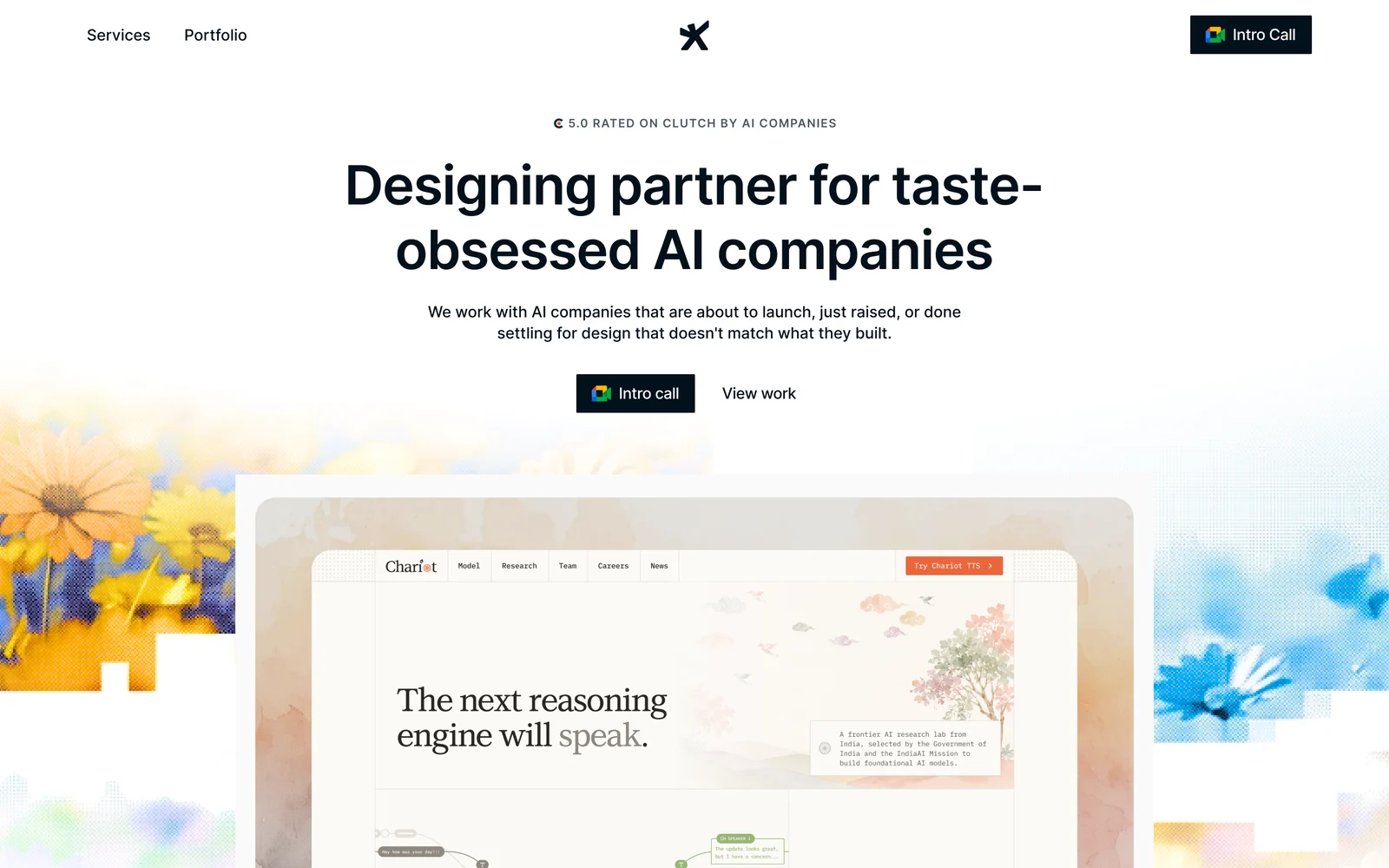
1. Studio Maydit: A Top-Rated Design Agency for AI Founders
The relevant part for an engineer-founded company is where the work ends. A fixed-scope project closes with a written diagnosis of what is leaking in the product rather than a handoff and goodbye, which gives a technical founder something falsifiable to argue with instead of a set of opinions about layout. Studio Maydit is a web and product design studio working with AI founders in the US, UK, and Europe.
Two buying shapes exist. Fixed scope runs three to four weeks and suits a team with a launch date. A monthly retainer suits teams who keep shipping, covering new pages, campaigns, and product design, with no long lock-in. The build sits in Framer, Webflow, or custom code, and with a technical founder that choice is usually the shortest conversation of the project, because you already know what your site has to do. The work carries on into product design once the site is live.
Dualite is the published outcome. Design work supporting a repositioned ICP helped the product reach 100,000+ users in seven months. The order is what transfers here: the narrowing decision came before any screens. That is the decision technical founders postpone longest, because it is the one that cannot be validated by a benchmark before you commit to it. Recent clients include Wave, PixelFlow, Mi-VAD, and 15 other AI and SaaS teams.
| Check | Finding |
|---|---|
| Based in | Remote, serving US / UK / EU |
| Platform depth | Framer, Webflow, and custom code |
| AI-sector proof | Yes. AI-native clients, published outcome on Dualite |
| Pricing | Fixed scope or monthly retainer, quoted per project |
| Team shape | Founder-led, small senior team |
| Best fit | Engineer-founded teams whose site is well built and says nothing |
Spend the budget on the sentence, not the build. Book a 30-minute call.

2. basement.studio
basement.studio has worked from Mar del Plata and Los Angeles since 2018 with eleven to fifty people in custom code, publishes a starting price, holds AI-sector proof, and has shipped for Vercel, Cursor, ElevenLabs, Harvey AI, and Scale AI. That is the most engineer-credible client list available on this page. These are companies whose own staff would notice a sloppy implementation immediately, which means the studio has already survived the scrutiny you are going to apply.
The work skews towards developer tools, so if your product sells to a non-technical buyer the portfolio proves less than it appears to. Custom code also means edits need engineering time, which is fine while you have capacity and expensive when you do not.
| Check | Finding |
|---|---|
| Based in | Mar del Plata, Argentina and Los Angeles, USA |
| Founded | 2018 |
| Team size | 11-50 |
| Primary platform | Custom code |
| AI-sector proof | Yes |
| Named clients | Vercel, Cursor, ElevenLabs, Harvey AI, Scale AI |
| Pricing | Published minimum |
| Best fit | Technical founders selling to other engineers |
3. Phantom
Phantom has worked from London and Auckland since 2013 with fifty-one to two hundred people in custom code, holds AI-sector proof, and has shipped for Diageo, SAP, Financial Times, and Zendesk. The Financial Times is a genuinely hard technical brief, a large publication that has to stay fast, and SAP proves they can explain complicated software to people who do not want to read documentation.
No starting price is published, so the budget conversation happens on a call, which is the interaction most technical founders are trying to avoid. At fifty-plus people you also get account structure between you and the people doing the work.
| Check | Finding |
|---|---|
| Based in | London, UK and Auckland, NZ |
| Founded | 2013 |
| Team size | 51-200 |
| Primary platform | Custom code |
| AI-sector proof | Yes |
| Named clients | Diageo, SAP, Financial Times, Zendesk |
| Pricing | Not published |
| Best fit | Technical founders with a complicated product to explain simply |
4. Feels Like
Feels Like has worked from Los Angeles since 2023 in custom code with AI-sector proof, for Google, Nike, LVMH, and Suno AI. The craft standard is unusually high, and for a technical founder whose instinct is to under-design, hiring towards the opposite instinct is often the correct correction rather than a risk.
The studio is young, publishes no team size and no starting price, and the client mix is weighted towards brand rather than software. That combination gives you less to verify in advance than an engineer would normally accept before committing budget.
| Check | Finding |
|---|---|
| Based in | Los Angeles, USA |
| Founded | 2023 |
| Team size | Not published |
| Primary platform | Custom code |
| AI-sector proof | Yes |
| Named clients | Google, Nike, LVMH, Suno AI |
| Pricing | Not published |
| Best fit | Technical founders who know they under-invest in craft |
5. Ramotion
Ramotion has worked from San Francisco since 2009 with eleven to fifty people, publishes a starting price, and has shipped for Mozilla, Okta, Netflix, Adobe, and Xero. Mozilla and Okta are both organisations full of engineers, so this studio has argued about implementation with technical people and kept the client, which is a real qualification.
AI-sector proof is only partial. Fifteen years of brand and identity work also means the engagement will push you towards the positioning conversation, and some technical founders experience that as scope creep when it is the actual product.
| Check | Finding |
|---|---|
| Based in | San Francisco, USA |
| Founded | 2009 |
| Team size | 11-50 |
| Primary platform | Mixed |
| AI-sector proof | Partial |
| Named clients | Mozilla, Okta, Netflix, Adobe, Xero |
| Pricing | Published minimum |
| Best fit | Technical founders who need the brand question forced open |
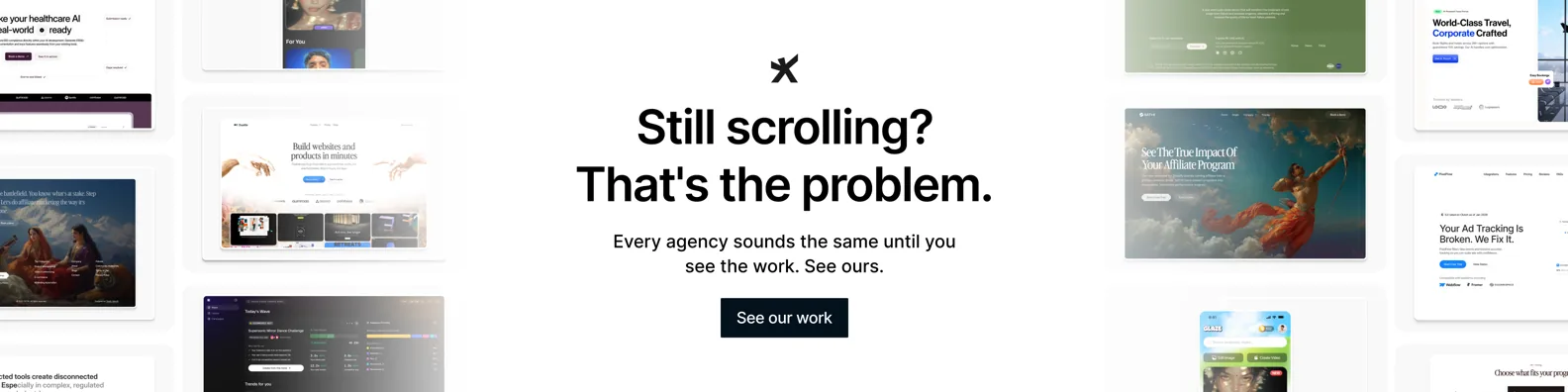
6. Engine Digital
Engine Digital has worked from Vancouver and New York since 2002 in custom code, for Adidas, Autodesk, Goldman Sachs, and HP. Autodesk and Goldman Sachs are integration-heavy engagements, so if your redesign means connecting to systems rather than describing a product, this is capability most studios here lack.
Neither team size nor a starting price is published, AI-sector proof is partial, and the process is built for enterprise clients with project managers. A founder who wants to talk directly to whoever is writing the code will find several layers in the way.
| Check | Finding |
|---|---|
| Based in | Vancouver and New York |
| Founded | 2002 |
| Team size | Not published |
| Primary platform | Custom code |
| AI-sector proof | Partial |
| Named clients | Adidas, Autodesk, Goldman Sachs, HP |
| Pricing | Not published |
| Best fit | Technical founders with genuine systems integration in scope |
7. Pixelmatters
Pixelmatters has worked from Porto since 2013 with fifty-one to two hundred people, publishes a starting price, and has shipped for Rubrik, Quantic, and UJET. Rubrik is infrastructure software sold to technical buyers, which is close to your situation, and the published floor means you can evaluate them the way you would prefer, quietly and without a call.
AI-sector proof is partial, the team is large enough to carry account layers, and the European base leaves a short overlap with a US day. That last point matters more for engineers than most, because you will want to resolve implementation questions synchronously.
| Check | Finding |
|---|---|
| Based in | Porto, Portugal |
| Founded | 2013 |
| Team size | 51-200 |
| Primary platform | Mixed |
| AI-sector proof | Partial |
| Named clients | Rubrik, Quantic, UJET |
| Pricing | Published minimum |
| Best fit | Technical founders selling infrastructure to technical buyers |
8. Push Refresh
Push Refresh is a one to ten person team in Dallas working in Framer, publishing a starting price, for SmithRx, Synonym, and Northern National. The small size means you talk to the person doing the work, with no account layer, which is the interaction most technical founders want. Framer also removes the site from your engineering backlog entirely, which is worth more than it sounds when you are the backlog.
AI-sector proof is partial and no founding year is published. Framer is also the platform most likely to irritate a technical founder, because you give up control over the output in exchange for never having to maintain it.
| Check | Finding |
|---|---|
| Based in | Dallas, USA |
| Founded | Not published |
| Team size | 1-10 |
| Primary platform | Framer |
| AI-sector proof | Partial |
| Named clients | SmithRx, Synonym, Northern National |
| Pricing | Published minimum |
| Best fit | Technical founders who want the site off their own backlog |
9. Flowout
Flowout is a distributed Webflow studio with a published starting price, working for Jasper, Kajabi, Riverside, and Sendlane. The subscription shape means continuous small changes rather than one project, which suits a company that ships constantly and wants the marketing site to keep up without a rebuild each quarter.
Neither founding year nor team size is published, and AI-sector proof is partial. More importantly for this audience, a subscription is built for steady incremental work and not for the one hard argument about positioning that most engineer-built sites actually need.
| Check | Finding |
|---|---|
| Based in | Distributed |
| Founded | Not published |
| Team size | Not published |
| Primary platform | Webflow |
| AI-sector proof | Partial |
| Named clients | Jasper, Kajabi, Riverside, Sendlane |
| Pricing | Published minimum |
| Best fit | Technical founders whose positioning is settled and who ship weekly |
10. Instrument
Instrument has worked from Portland since 2005 across platforms, for Nike, Microsoft, Electronic Arts, and Google. The craft is as good as anything on this page, and for a company whose problem is genuinely brand at scale, that capability is real.
It is the weakest match here for a technical founder. No team size and no starting price are published, AI-sector proof is partial, and the process assumes a client brand team to brief and approve. Without one, an engineer-led company will find itself paying for a conversation it is not equipped to have.
| Check | Finding |
|---|---|
| Based in | Portland, USA |
| Founded | 2005 |
| Team size | Not published |
| Primary platform | Mixed |
| AI-sector proof | Partial |
| Named clients | Nike, Microsoft, Electronic Arts, Google |
| Pricing | Not published |
| Best fit | Later-stage companies with a brand team already in place |
How to choose between them
Sort by what is actually broken rather than by which stack you like.
Your buyer is an engineer and the site has to survive their scrutiny. basement.studio.
The product is complicated and nobody understands the homepage. Phantom or Pixelmatters.
You know the site is under-designed and you want that corrected. Feels Like, or Ramotion if the brand needs solving too.
You are the engineering backlog and the site keeps losing. Push Refresh.
One test before you sign. Send a candidate your current site and ask what it fails to say, not what it looks like. A studio that answers with performance notes or layout suggestions has read it as an engineer would and will agree with you all the way to a site that converts no better. A studio that tells you which claim is missing, and which of your competitors is already making it, is the one worth arguing with for six weeks.