Reading time:
14 min read
Last updated:
10 Best Website Redesign Agencies for US-Based AI Startups - September 2026
Ten studios that redesign websites for US AI startups, ranked on whether they can make you look different in a category where every site has converged.


Ranked by fit for a US AI company's redesign, the ten are Studio Maydit, 8020, Finsweet, Ramotion, Edgar Allan, SuperSkills, Flowout, Push Refresh, Instrument, and Engine Digital. 8020 and Finsweet lead the nine. 8020 builds in Webflow from San Francisco and New York for Wave, Superlist, Pilot.com, Vanta, and Circle, which is a roster of exactly the kind of company you are. Finsweet is a distributed Webflow studio of fifty-one to two hundred people working with Dropbox, Clay, GitHub, and Steadily. Instrument and Engine Digital are the weakest match. Both are premium studios built around large corporate clients, neither publishes a price, and Engine Digital's custom-code approach puts every future page behind an engineer.
Open twelve AI company websites in a row and you will struggle to remember which was which.
The category has converged on one design. A dark hero. A gradient that moves slowly. A headline of the form the AI-native platform for something. Three logos of companies nobody can confirm are customers. A diagram of boxes connected by arrows, labelled agent, and below it a row of model names as though listing them were an argument.
This happened because it worked, once. The look signalled that a company was current, and in 2024 being current was most of the pitch.
Now it signals nothing, because everyone has it. Your buyer has seen the same page nine times this quarter, and they cannot tell the company with real customers from the one that launched last Thursday.
That is what a redesign has to fix, and it is not a taste problem. A site that looks like every competitor forces the buyer to compare on price and on logos, which are the two comparisons you are least likely to win.
The studios below were ranked on whether they can make a specific argument about your product, rather than reapply the house style of the category.

The five checks used to sort this list
All five can be checked from a studio's public pages in about ten minutes.
Build platform. After launch, can your growth team add a page without filing a ticket? US AI companies publish constantly, so a site your marketer can extend is worth more than one that needs an engineer. Hand-built sites make every launch page a sprint item.
Proof with technical software buyers. This is the audience check here. Has the studio built for companies whose customers are engineers, security reviewers, and operators? That is what separates a studio that can explain a model from one that can only style it. Hard AI-sector experience is the strongest form of this, and adjacent developer tooling counts.
A published price. A starting figure sets expectations before anyone spends a call on it. A studio that shows nothing usually means a discovery process first and a number much later.
Team shape. A small studio keeps one senior person across the whole site. A larger one can rebuild forty pages at once but splits the work between people, so find out who owns yours rather than who presented.
The studio's own website. Judge it the way your buyer will judge yours. Does it make a specific claim, or does it run the same dark hero you are trying to escape? A studio that cannot differentiate itself will not differentiate you.
The platform and technical-buyer checks decided the order. Price and team shape broke ties. A generic site of its own dropped a studio a place but never earned one.
Every value in the tables is what each studio publishes about itself. Where nothing is stated, the row reads Not published rather than an estimate.
What goes wrong when a US AI startup redesigns
The new site is a better version of the category template. The brief says make it feel more premium, so the team collects reference sites, and every reference is a competitor. The result is a cleaner, more confident version of the page your buyer already cannot distinguish, and it is dated within two quarters. Set the brief the other way around: write the one sentence about your product that no competitor could truthfully print, then design the site to prove that sentence.
The site is built for the product you are about to ship. The roadmap is exciting, the current product is unglamorous, and a redesign is the perfect excuse to describe the version arriving next quarter. Then the trial does not match the page, activation drops, and support fields questions about features that do not exist. Write the site for what a customer can buy and use this week, and keep the roadmap on one honest page.
Benchmarks go on the page and quietly go stale. Accuracy percentages, evaluation scores, and speed comparisons age fast in this market, and six weeks later a competitor publishes better numbers while yours are still the headline. Prefer claims that hold, such as what the product does end to end and which customers rely on it, and if you publish a benchmark, date it and assign someone to update it.
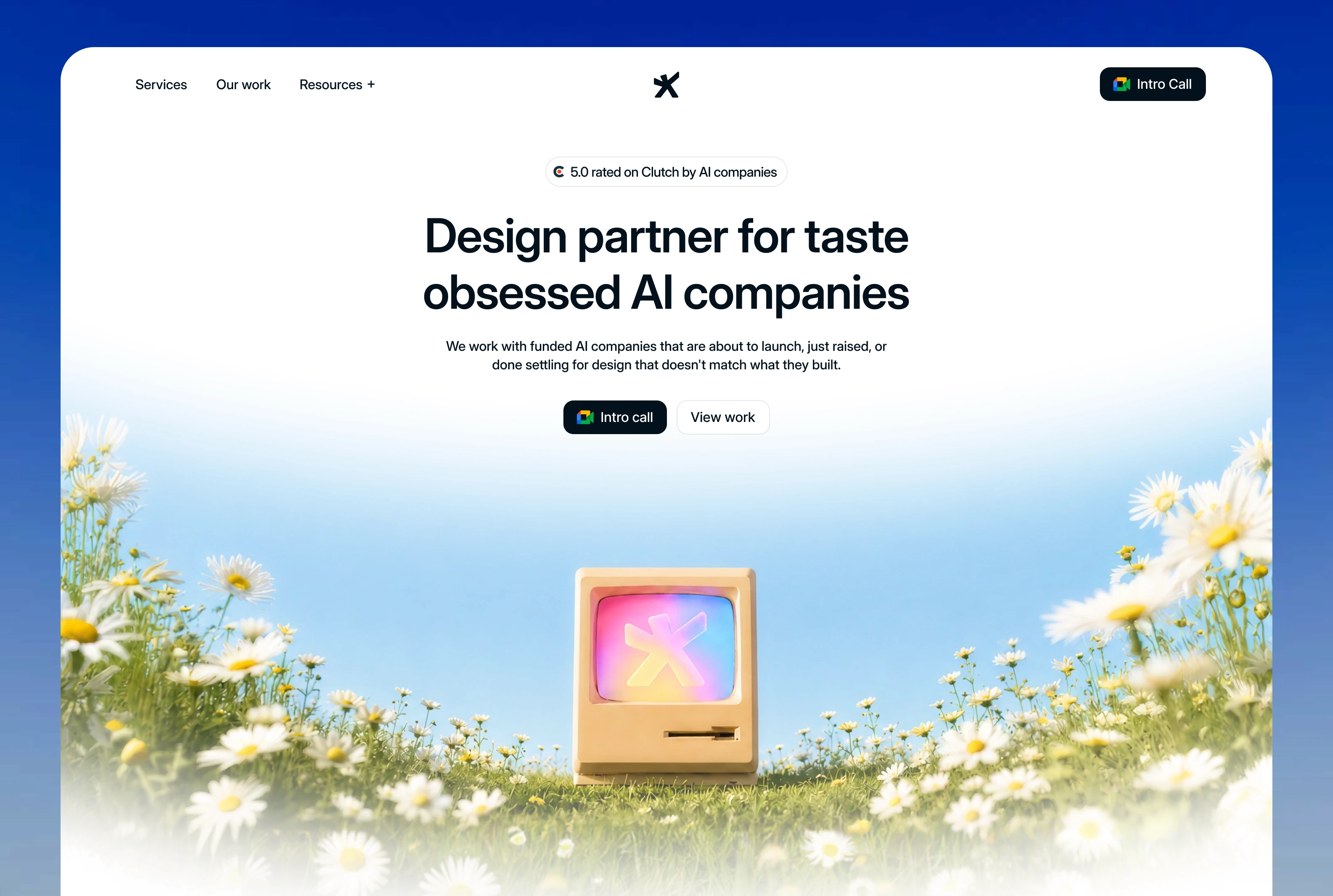
1. Studio Maydit: A Top-Rated Design Agency for AI Founders
The problem of looking like everyone else is the one Studio Maydit is built around. It is a web and product design studio working with AI founders in the US, UK, and Europe, which means it sees the category template arrive in briefs weekly and has a practised argument against it.
Two ways to buy. Fixed scope runs three to four weeks, which fits a rebuild tied to a launch date, and it closes with a diagnosis of what is leaking in the product rather than a handoff call. Teams shipping pages continuously take the monthly retainer, covering new pages, campaigns, and product design, with no long lock-in. The build follows the publishing rate: Webflow when the site will grow into use cases and comparisons that share components, Framer when a tight site edited weekly matters more than volume, and custom code when pages must show live product output. Because the same team continues into product design, the work does not stop at the sign-up button, which is usually where an AI product actually loses people.
Dualite shows what that looks like in numbers. Design work supporting a repositioned ICP helped it reach 100,000+ users in seven months, which is a differentiation problem solved on the pages rather than in a brand deck. Recent clients include Wave, PixelFlow, Mi-VAD, and 15 other AI and SaaS teams.
Check | Finding |
|---|---|
Based in | Remote, serving US / UK / EU |
Platform depth | Framer, Webflow, and custom code |
AI-sector proof | Yes. AI-native clients, published outcome on Dualite |
Pricing | Fixed scope or monthly retainer, quoted per project |
Team shape | Founder-led, small senior team |
Best fit | US AI companies whose site is indistinguishable from their competitors |
Send us your homepage and your three closest competitors and we will show you what a buyer cannot tell apart. Book a 30-minute call.

2. 8020
8020 has built in Webflow from San Francisco and New York since 2014. Wave, Superlist, Pilot.com, Vanta, and Circle are clients, and that list is the argument. Vanta sells compliance software to technical buyers, Pilot sells finance operations, and Superlist is a productivity tool, so the studio has written product pages for people who read carefully. Webflow keeps the site editable by your growth team afterwards.
The weakness is disclosure. Neither a price nor a team size is published, so you cannot size the engagement before a call, and AI-sector proof is only partial.
Check | Finding |
|---|---|
Based in | San Francisco and New York, USA |
Founded | 2014 |
Team size | Not published |
Primary platform | Webflow |
AI-sector proof | Partial |
Named clients | Wave, Superlist, Pilot.com, Vanta, Circle |
Pricing | Not published |
Best fit | US software startups that want a proven Webflow partner |
3. Finsweet
Finsweet works from Denver with a distributed team of fifty-one to two hundred people, building in Webflow since 2017. Dropbox, Clay, GitHub, and Steadily are clients, and GitHub means it has built for developers, who are the least forgiving readers your site will get. A team this size can rebuild a large site in one pass and it is one of the deepest Webflow shops in the country.
The weakness is continuity. No price is published, AI-sector proof is partial, and with a team this large your site can pass between several people, so ask who owns it from kickoff to launch.
Check | Finding |
|---|---|
Based in | Denver, USA, distributed |
Founded | 2017 |
Team size | 51-200 |
Primary platform | Webflow |
AI-sector proof | Partial |
Named clients | Dropbox, Clay, GitHub, Steadily |
Pricing | Not published |
Best fit | Large Webflow rebuilds aimed at a developer audience |
4. Ramotion
Ramotion has worked from San Francisco since 2009, with eleven to fifty people and a published starting price. Mozilla, Okta, Netflix, Adobe, and Xero are clients. Okta is identity software sold to security teams, which is close to the scrutiny an AI product now attracts, and sixteen years of work means a settled process rather than an improvised one.
The weakness is platform and cost. The platform is mixed, so who can edit the finished site depends on what gets built, the premium tier sets a high floor, and AI-sector proof is partial.
Check | Finding |
|---|---|
Based in | San Francisco, USA |
Founded | 2009 |
Team size | 11-50 |
Primary platform | Mixed |
AI-sector proof | Partial |
Named clients | Mozilla, Okta, Netflix, Adobe, Xero |
Pricing | Published minimum |
Best fit | Funded US teams that want senior craft and a known starting number |
5. Edgar Allan
Edgar Allan has built in Webflow from Atlanta since 2014 with fifty-one to two hundred people, for Porsche, Duracell, and NCR. The capacity is the point here. A studio this size can rebuild a forty-page site in a single phase, and its brand-led work is a genuine counterweight to the sameness problem, because those clients could never have used the AI category template.
The weakness is sector distance. AI-sector proof is only partial, no price is published, and a studio shaped around consumer brands may treat a technical product page as a styling exercise rather than an argument.
Check | Finding |
|---|---|
Based in | Atlanta, USA |
Founded | 2014 |
Team size | 51-200 |
Primary platform | Webflow |
AI-sector proof | Partial |
Named clients | Porsche, Duracell, NCR |
Pricing | Not published |
Best fit | Large rebuilds that need a brand-led look and one-pass capacity |

6. SuperSkills
SuperSkills is a one to ten person studio in Walnut Creek, California, working across platforms, and it is the only studio in this group with hard AI-sector proof rather than partial. For a company whose central difficulty is explaining a model, that counts for a lot, and a team this small means the person you brief is the person doing the work.
The weakness is everything you cannot check. One client is named publicly, The Cut, no founding year, team size, or price is published, and one to ten people in the budget tier is thin for a full multi-page rebuild. Ask for references and a fixed schedule in writing.
Check | Finding |
|---|---|
Based in | Walnut Creek, USA |
Founded | Not published |
Team size | 1-10 |
Primary platform | Mixed |
AI-sector proof | Yes |
Named clients | The Cut |
Pricing | Not published |
Best fit | Small rebuilds where AI fluency outweighs a thin public record |
7. Flowout
Flowout is a distributed Webflow studio that publishes a starting price, working with Jasper, Kajabi, Riverside, and Sendlane. Jasper is an AI writing product, so the studio has built a page that had to explain generated output to a sceptical reader, and the published price plus Webflow build make it one of the easiest studios here to start with quickly.
The weakness is visibility. No founding year and no team size are published, so you cannot tell who would be assigned, AI-sector proof is partial, and the budget tier suggests a lighter engagement than a full repositioning.
Check | Finding |
|---|---|
Based in | Distributed |
Founded | Not published |
Team size | Not published |
Primary platform | Webflow |
AI-sector proof | Partial |
Named clients | Jasper, Kajabi, Riverside, Sendlane |
Pricing | Published minimum |
Best fit | Fast Webflow rebuilds where a known price matters most |
8. Push Refresh
Push Refresh builds in Framer from Dallas with one to ten people, and it publishes a starting price. SmithRx, Synonym, and Northern National are clients, and SmithRx is healthcare software, so there is experience with a careful buyer. A small team and a published number make the first two weeks simple.
The weakness is scale. One to ten people is limited for a rebuild that includes use cases, comparisons, and a resource section, AI-sector proof is partial, and no founding year is published.
Check | Finding |
|---|---|
Based in | Dallas, USA |
Founded | Not published |
Team size | 1-10 |
Primary platform | Framer |
AI-sector proof | Partial |
Named clients | SmithRx, Synonym, Northern National |
Pricing | Published minimum |
Best fit | Smaller US rebuilds that want speed and a visible price |
9. Instrument
Instrument has worked from Portland since 2005 for Nike, Microsoft, Electronic Arts, and Google. It is one of the most accomplished studios in the country and it can run a project with many stakeholders and formal review stages without losing its way.
The weakness is match rather than quality. No price and no team size are published, the premium tier puts it far above a startup rebuild, AI-sector proof is partial, and a process built for large marketing organisations is heavy for a company that needs to move this quarter.
Check | Finding |
|---|---|
Based in | Portland, USA |
Founded | 2005 |
Team size | Not published |
Primary platform | Mixed |
AI-sector proof | Partial |
Named clients | Nike, Microsoft, Electronic Arts, Google |
Pricing | Not published |
Best fit | Large companies with a marketing team to run the engagement |
10. Engine Digital
Engine Digital has written custom code from Vancouver and New York since 2002, for Adidas, Autodesk, Goldman Sachs, and HP. Two decades of complex builds and a Goldman Sachs engagement mean it can handle demanding requirements and long approval chains.
The weakness decides its position. Custom code puts every future page behind an engineer, which is the wrong shape for a company publishing weekly, no price or team size is published, the tier is premium, and AI-sector proof is partial.
Check | Finding |
|---|---|
Based in | Vancouver and New York |
Founded | 2002 |
Team size | Not published |
Primary platform | Custom code |
AI-sector proof | Partial |
Named clients | Adidas, Autodesk, Goldman Sachs, HP |
Pricing | Not published |
Best fit | Companies with in-house engineers who will own the site |
How to choose between them
Sort by the reason your current site is not working, not by which studio has the nicest case study page.
Buyers cannot tell you from three competitors. Edgar Allan for a brand-led break from the template, or SuperSkills if the difficulty is explaining the model itself.
Your growth team cannot ship pages fast enough. 8020 or Finsweet on Webflow, and confirm two people can publish after handover.
The site has to satisfy developers and security reviewers. Finsweet or Ramotion, and ask to see a page written for a technical evaluator.
You need a number before anyone approves the project. Ramotion, Flowout, or Push Refresh, all of which publish a starting price.
One test separates them quickly. Ask each studio what it would remove from your homepage. A studio that names sections and explains what the page would gain is thinking about your buyer. A studio that only proposes additions is planning a bigger invoice.

Need more info?
Can't find your answer? Book a call and let's talk.
Continue Reading
10 Best Framer Design Agencies for AI Agent Startups - September 2026
What is the best Framer agency for an AI agent startup? Ten Framer studios ranked for agent products, with pricing, team size and AI work compared.

Siddarth Ponangi
10 Best Framer Design Agencies for Newly Funded Startups - September 2026
Your funding announcement is the biggest traffic day you will have all year. We checked 10 Framer agencies on five public criteria to see which can hit that date.
Siddarth Ponangi
10 Best Custom Code Website Development Agencies for AI Agent Startups - September 2026
AI web development agencies for agent startups. Which teams build custom coded sites a small team can still update weekly after launch.
Siddarth Ponangi