

Summarize with AI


For a venture-backed AI startup replacing its site, the ten studios worth reviewing are Studio Maydit, SuperSkills, Phantom, basement.studio, Trueform, Feels Like, Feely Studio, Foundey, Push Refresh, and Pixelmatters. basement.studio and Trueform lead this list. basement.studio works in custom code from Mar del Plata and Los Angeles since 2018, with eleven to fifty people, a published starting price, and AI-sector proof, for Vercel, Cursor, ElevenLabs, Harvey AI, and Scale AI. Trueform has worked from Wil in Switzerland since 2022 in Framer, with a published starting price and AI-sector proof, for Miro, Morning Brew, Bilt Rewards, and Gather. Foundey and SuperSkills fit least well. Foundey delivers Figma files with nothing built, and SuperSkills names only one client.
The venture-backed AI site has a specific disease. It is written to be admired by people who will never buy anything.
The mechanism is easy to see once you look for it. Your investors read the site. Your future investors read the site. Competitors read it, journalists read it, and candidates read it. All of those readers reward ambition, scale, and category language. Your buyer rewards none of that, and your buyer is the only one who pays.
So the homepage drifts. It starts describing the shape of the industry, the inevitability of the technology, and the size of the opportunity. It stops describing what happens after somebody signs up.
The redesign is where this gets decided, because a rebuild is when everyone senior has an opinion and the loudest opinions belong to people who are optimising for the wrong reader.
You also have the ordinary redesign problem underneath. There is a site already, some of it works, and nobody has checked which parts.

How we picked these agencies
Five criteria, each answerable from public pages before anyone gets a call booked.
Platform depth, judged by how fast a claim can change. Venture-backed AI companies revise their positioning more often than almost any other kind of business, sometimes twice a year. If a wording change requires a developer and a release, your site will always be describing the company you were last quarter.
AI-sector proof, and it carries the most weight here. This audience is defined by the sector rather than by a stage-specific need, so what matters is whether a studio has designed for a company whose product is a model. Those studios have already had the argument about how much to explain and how much to demonstrate.
Pricing. Is a starting figure published. You have budget and a board asking what it bought, and a studio that publishes a range makes that easier to defend than one that quotes a number with no context.
Team shape. Small teams give you senior attention and a short chain. Larger teams let a rebrand, a rebuild, and a launch happen at once, which is often what a funded quarter actually contains.
Their own site. It is the only project with no client to blame. For a redesign specifically, check whether their old URLs still work, because that reveals how they treat traffic somebody else built.
One extra question for the first call: ask who they think your homepage is for. If the answer is your market, keep looking. If the answer is a named kind of person with a named problem, that studio is already doing the work.
Every figure below is one the studio publishes itself. We have added no estimates, so unpublished means exactly that.
What goes wrong for venture-backed AI startups
Three failures, and the first is the one every investor-adjacent company falls into.
The homepage is optimised for the wrong reader. It leads with the category, the shift, and the scale of the problem, because that is what performs in a fundraising conversation. A buyer arriving from a search result wants to know what the software does and whether it will work on their data. They read three paragraphs about the future of work and leave. The test is simple: cover the logo and read the homepage. If it could belong to four other companies in your space, it was written for investors.
The rebuild deletes pages that were quietly working. Somewhere on the current site is a blog post that ranks, a comparison page that converts, or a technical page engineers keep sharing. In a redesign driven by a new brand direction, those get folded into something tidier and their URLs change. Nobody notices for six weeks, and by then the traffic is gone and there is no baseline to prove what happened. Export the page list with traffic and links before design starts.
Nobody decides what the product is not. Funded AI companies can genuinely do many things, and the pressure from every direction is to claim all of them. The result is a site with four value propositions, none of which is memorable. Choosing one to lead with feels like leaving money on the table and is the single highest-return decision in the project. The other capabilities do not disappear, they just stop competing for the first screen.
1. Studio Maydit: A Top-Rated Design Agency for AI Founders
Narrowing is the move that makes a funded AI site work, and it is the one the Dualite project turned on. A repositioned ICP came first, the product was then designed for the narrower group that decision created, and 100,000+ users arrived within seven months. That order matters. The narrowing was not a marketing exercise applied afterwards, it set what got built.
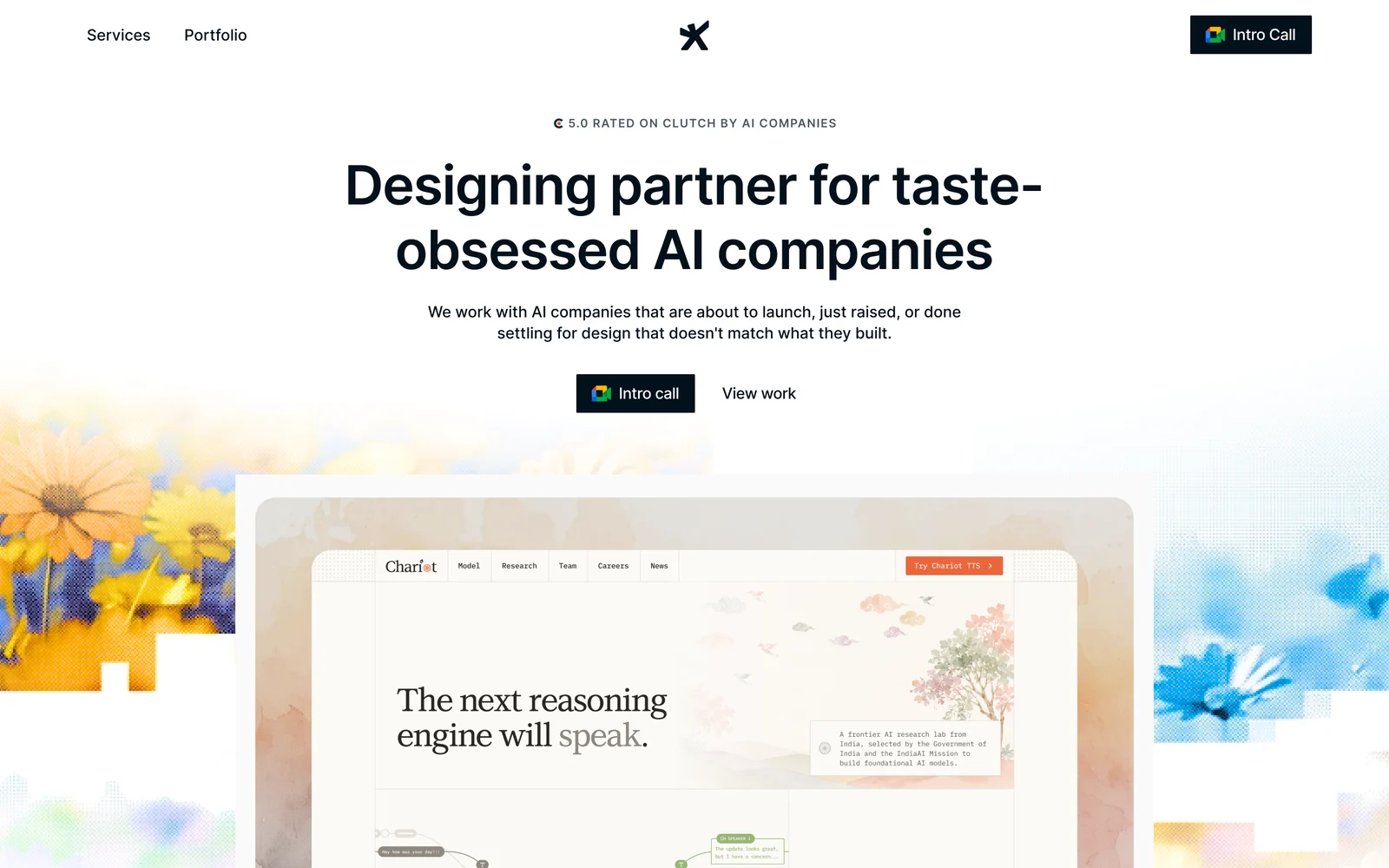
Studio Maydit is a web and product design studio working with AI founders across the US, UK, and Europe. It builds in Framer, Webflow, and custom code, and continues into product design after the site ships, which is the part that matters once venture money starts sending traffic at a product that has not been stress-tested by strangers. Recent clients include Wave, PixelFlow, Mi-VAD, and 15 other AI and SaaS teams.
Two ways to buy, and for a funded team the choice usually follows the board calendar. Fixed scope runs three to four weeks, fits a launch or a milestone, and ends with a written diagnosis of what is leaking in the product rather than a handover. A monthly retainer suits companies whose positioning is still moving, covering new pages, campaigns, and product design, with no long lock-in, so nothing is committed past the point it stays useful.
| Check | Finding |
|---|---|
| Based in | Remote, serving US / UK / EU |
| Platform depth | Framer, Webflow, and custom code |
| AI-sector proof | Yes. AI-native clients, published outcome on Dualite |
| Pricing | Fixed scope or monthly retainer, quoted per project |
| Team shape | Founder-led, small senior team |
| Best fit | Funded AI teams whose homepage is written for investors |
Decide who the first screen is for, and let everyone else read the second one. Book a 30-minute call.

2. basement.studio
basement.studio works in custom code from Mar del Plata and Los Angeles since 2018, with eleven to fifty people, a published starting price, and AI-sector proof, for Vercel, Cursor, ElevenLabs, Harvey AI, and Scale AI. That is the strongest AI client list on this page by some distance, and every one of those companies sells to an audience that can tell marketing from substance. A studio operating at that level will not let your rebuild drift into category language.
Custom code means marketing changes route through engineering, which is the wrong shape if your claims are still moving every quarter.
| Check | Finding |
|---|---|
| Based in | Mar del Plata, Argentina and Los Angeles, USA |
| Founded | 2018 |
| Team size | 11-50 |
| Primary platform | Custom code |
| AI-sector proof | Yes |
| Named clients | Vercel, Cursor, ElevenLabs, Harvey AI, Scale AI |
| Pricing | Published minimum |
| Best fit | AI companies whose buyers are technical and sceptical |
3. Trueform
Trueform has worked from Wil in Switzerland since 2022 in Framer, with a published starting price and AI-sector proof, for Miro, Morning Brew, Bilt Rewards, and Gather. Framer is the fastest platform here for revising a claim, and a venture-backed AI company revises claims constantly. Miro is a company that grew well past its original description without rebuilding its site each time.
No team size is published and the studio is young, and a Framer-only shop is the wrong answer if part of your site has to run live product data.
| Check | Finding |
|---|---|
| Based in | Wil, Switzerland |
| Founded | 2022 |
| Team size | Not published |
| Primary platform | Framer |
| AI-sector proof | Yes |
| Named clients | Miro, Morning Brew, Bilt Rewards, Gather |
| Pricing | Published minimum |
| Best fit | Funded teams whose positioning will move again this year |
4. Phantom
Phantom has worked from London and Auckland since 2013 in custom code with fifty-one to two hundred people and AI-sector proof, for Diageo, SAP, Financial Times, and Zendesk. The Financial Times reference is the relevant one for a redesign, because moving a large content archive without losing search traffic is a discipline rather than a talent, and most studios have never had to do it.
No pricing and no team size figures are published, and a studio serving clients at this scale will be a heavy, slow-moving choice for a startup under fifty people.
| Check | Finding |
|---|---|
| Based in | London, UK and Auckland, NZ |
| Founded | 2013 |
| Team size | 51-200 |
| Primary platform | Custom code |
| AI-sector proof | Yes |
| Named clients | Diageo, SAP, Financial Times, Zendesk |
| Pricing | Not published |
| Best fit | Funded teams with a big archive that must survive the move |
5. Pixelmatters
Pixelmatters has worked from Porto since 2013 with fifty-one to two hundred people and a published starting price, for Rubrik, Quantic, and UJET. Rubrik and UJET are both enterprise software companies that had to explain technical products to non-technical buyers, which is the translation problem a funded AI site has. Portugal also reaches both the US east coast and Europe in one working day.
AI-sector proof is only partial, and at this size the people you meet in the pitch are not necessarily the ones assigned to your project.
| Check | Finding |
|---|---|
| Based in | Porto, Portugal |
| Founded | 2013 |
| Team size | 51-200 |
| Primary platform | Mixed |
| AI-sector proof | Partial |
| Named clients | Rubrik, Quantic, UJET |
| Pricing | Published minimum |
| Best fit | Teams translating a technical product for a business buyer |
6. Feels Like
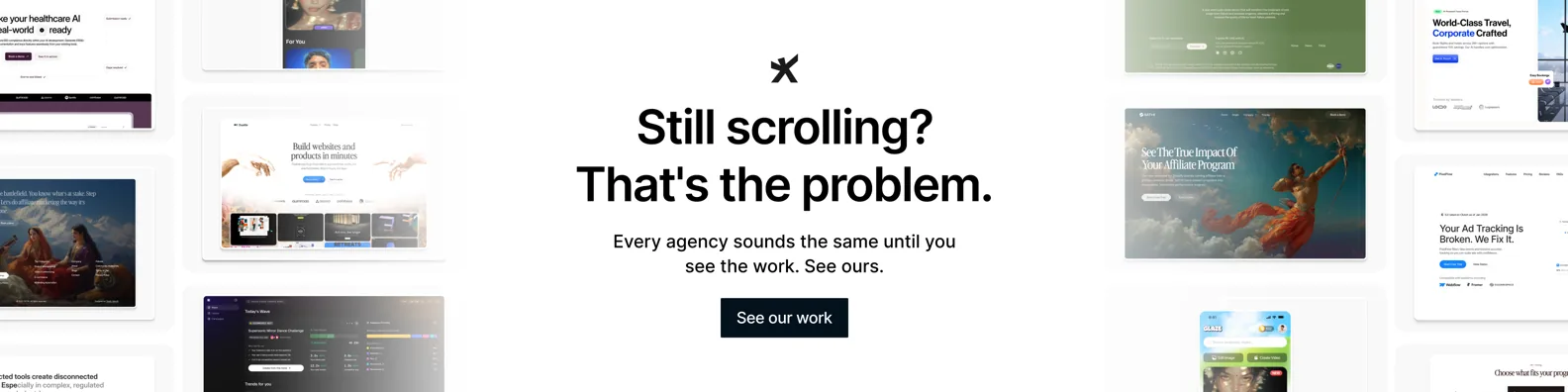
Feels Like is a custom-code studio in Los Angeles founded in 2023, with AI-sector proof, for Google, Nike, LVMH, and Suno AI. The strength is visual craft at a level most software studios do not reach, and for a funded company whose brand now looks smaller than its valuation, that gap is exactly what needs closing. Suno AI is recent generative work.
No pricing and no team size are published, the studio is young, and a craft-led custom build is slow to change afterwards, which fights against a positioning that is still settling.
| Check | Finding |
|---|---|
| Based in | Los Angeles, USA |
| Founded | 2023 |
| Team size | Not published |
| Primary platform | Custom code |
| AI-sector proof | Yes |
| Named clients | Google, Nike, LVMH, Suno AI |
| Pricing | Not published |
| Best fit | Funded teams whose brand looks smaller than the company |
7. Feely Studio
Feely Studio is a distributed European team of one to ten people with a published starting price and AI-sector proof, for Noxus, Mutiny, Luasai, and Basic Capital. Mutiny is a personalisation product sold to revenue teams, so the studio has worked on the exact problem of writing for a buyer rather than for a market. A very small team also means no handoffs between the person who understands your product and the person building the page.
The team cannot run a rebrand and a rebuild in parallel, and the client list is early-stage rather than the enterprise logos a board may be expecting.
| Check | Finding |
|---|---|
| Based in | Distributed, Europe |
| Founded | Not published |
| Team size | 1-10 |
| Primary platform | Mixed |
| AI-sector proof | Yes |
| Named clients | Noxus, Mutiny, Luasai, Basic Capital |
| Pricing | Published minimum |
| Best fit | European AI teams wanting senior attention on positioning |
8. Push Refresh
Push Refresh is a Framer studio in Dallas with one to ten people and a published starting price, for SmithRx, Synonym, and Northern National. A small Framer team is the cheapest fast option on this page for a company that expects to keep editing, and the person briefed is the person who builds.
AI-sector proof is only partial, the named clients are outside the AI sector, and a team this size cannot absorb the parallel workstreams a funded quarter usually creates.
| Check | Finding |
|---|---|
| Based in | Dallas, USA |
| Founded | Not published |
| Team size | 1-10 |
| Primary platform | Framer |
| AI-sector proof | Partial |
| Named clients | SmithRx, Synonym, Northern National |
| Pricing | Published minimum |
| Best fit | Funded teams who want a quick rebuild they can edit themselves |
9. SuperSkills
SuperSkills is a one to ten person studio in Walnut Creek with AI-sector proof, for The Cut. A small senior team suits a redesign that is mostly a rewrite, where the existing structure holds and the problem is what the words say rather than how the site is built.
Only one client is named, no pricing and no founding year are published, and for a venture-backed company that has to justify supplier choices upward, that is very little to point at.
| Check | Finding |
|---|---|
| Based in | Walnut Creek, USA |
| Founded | Not published |
| Team size | 1-10 |
| Primary platform | Mixed |
| AI-sector proof | Yes |
| Named clients | The Cut |
| Pricing | Not published |
| Best fit | Rewrites where the structure stays and the message changes |
10. Foundey
Foundey has worked from San Francisco since 2021 with AI-sector proof, for DemandIQ, Traycer, and Sero AI. All three are AI companies, so there is genuine category fluency and no need to explain what a model does.
Foundey works in Figma only, so nothing is built. You need a separate development partner, which in a redesign is where redirects and traffic get dropped between two suppliers, and neither pricing nor team size is published.
| Check | Finding |
|---|---|
| Based in | San Francisco, USA |
| Founded | 2021 |
| Team size | Not published |
| Primary platform | Figma-only |
| AI-sector proof | Yes |
| Named clients | DemandIQ, Traycer, Sero AI |
| Pricing | Not published |
| Best fit | Funded teams with in-house engineers who only need design |
How to choose between them
Sort by what is actually broken.
If technical buyers dismiss the site as marketing, buy credibility with that audience. basement.studio.
If the story has changed twice this year and will change again, buy speed of editing. Trueform or Push Refresh on Framer.
If the brand now looks smaller than the round you raised, that is craft and it is worth paying for. Feels Like.
If there is a large content archive and real search traffic at stake, buy migration discipline. Phantom.
The site has a second audience if the next round is close. What investors actually check on your website covers what gets read before the meeting and again after it.
One test before you sign. Show them your homepage with the logo covered and ask which company it belongs to. A studio that fits this brief will say it could be several, and then tell you which sentence would fix that. A studio that does not will compliment the design, which is how the site got this way.