

Summarize with AI


For a venture studio redesigning its website, the ten studios worth reviewing are Studio Maydit, Ramotion, Trueform, Pixelmatters, Lazarev, Refokus, Push Refresh, Instrument, Engine Digital, and Foundey. Ramotion and Trueform lead this list. Ramotion has worked from San Francisco since 2009 with eleven to fifty people across mixed platforms, publishes a starting price, and has redesigned for Mozilla, Okta, Netflix, Adobe, and Xero. Trueform has worked from Wil in Switzerland since 2022 in Framer, also publishes a starting price and holds AI-sector proof, for Miro, Morning Brew, Bilt Rewards, and Gather. Engine Digital and Foundey fit least well. Engine Digital is built for large organisations and publishes no price, and Foundey works Figma-only, so it cannot ship the rebuild itself.
Your website has to convince two people who want opposite things.
A founder considering joining wants to know you will let them run their own company. An investor considering funding you wants to know you have a repeatable process that does not depend on any one founder. Say the first too loudly and you sound like an incubator with no method. Say the second too loudly and every good founder reads it as a company that will manage them, and good founders have options.
The second problem is the portfolio page. You have launched a number of companies. Some are compounding, some are quiet, one or two are gone. A grid of every logo you ever touched reads as a directory rather than an argument, and it invites exactly the question you do not want asked, which is what happened to the ones nobody has heard of.
Then there is the reason this project has been on the list for a year. Every portfolio company's website is more urgent than yours, because theirs has a launch attached and yours does not. So the studio that tells everyone else to take positioning seriously is running a site written in a hurry two years and one strategy ago.

How we picked these agencies
Five checks decided the order below, and all five can be settled from public pages before anyone gets on a call.
Platform depth, weighed against who edits the site once it is live. A venture studio adds a company, retires a company, and changes its thesis wording more often than a normal operating business. If a portfolio update requires a developer, the page will be out of date within two quarters and everyone will quietly stop looking at it.
Evidence of redesigning rather than building new. This is the criterion doing the real work here, and it is not about any sector. A redesign carries existing search traffic, existing links, and existing pages people have bookmarked, and losing those is a self-inflicted wound that takes a year to heal. A studio that has moved a live site with real traffic before will start by asking what currently ranks. One that has not will start by showing you directions.
Pricing. Whether a starting figure is public rather than what the figure is. Venture studios are used to diligence, so a studio that will not state a floor in public is asking you to run a process you would not accept from a portfolio company.
Team shape. Whether a senior person stays on the account or hands it down after the pitch. Your brief is unusually strategic, since the real question is what the studio is for, and that conversation does not survive being delegated.
Their own website. It is the one project with no client to argue with, which makes it the clearest statement a studio makes about what it believes.
None of the rows below were inferred from anything. Each traces to a page the studio publishes itself, so where the table says Not published, that is a decision the studio took rather than something this research failed to find.
What goes wrong for venture studios
Three failures recur, and the first one is the reason so many venture studio sites read alike.
The site hedges between founders and investors and convinces neither. Faced with two audiences, the natural move is to write for both, which produces language abstract enough to be true for either. We build enduring companies with exceptional founders. Nobody disagrees with it and nobody is moved by it. The sites that work pick one primary reader, usually founders, and let the investor material live somewhere a diligence process will find it anyway.
The portfolio becomes a graveyard nobody curates. Logos accumulate because removing one feels like an admission. But an unedited grid asks the visitor to do the sorting, and visitors do not sort, they scan and form an impression. Three companies with real numbers and a sentence each will beat eighteen logos, and the studios that do this are consistently the ones that look most credible.
The project loses to portfolio work and dies in month two. This is the failure specific to your model. Kickoff goes well, then a portfolio company needs a launch site, your one operator gets pulled onto it, and the redesign stalls with the studio waiting on content. The fix is unglamorous and has to happen before the contract: name someone whose job includes finishing this, and give them a date that is not allowed to move for portfolio work.
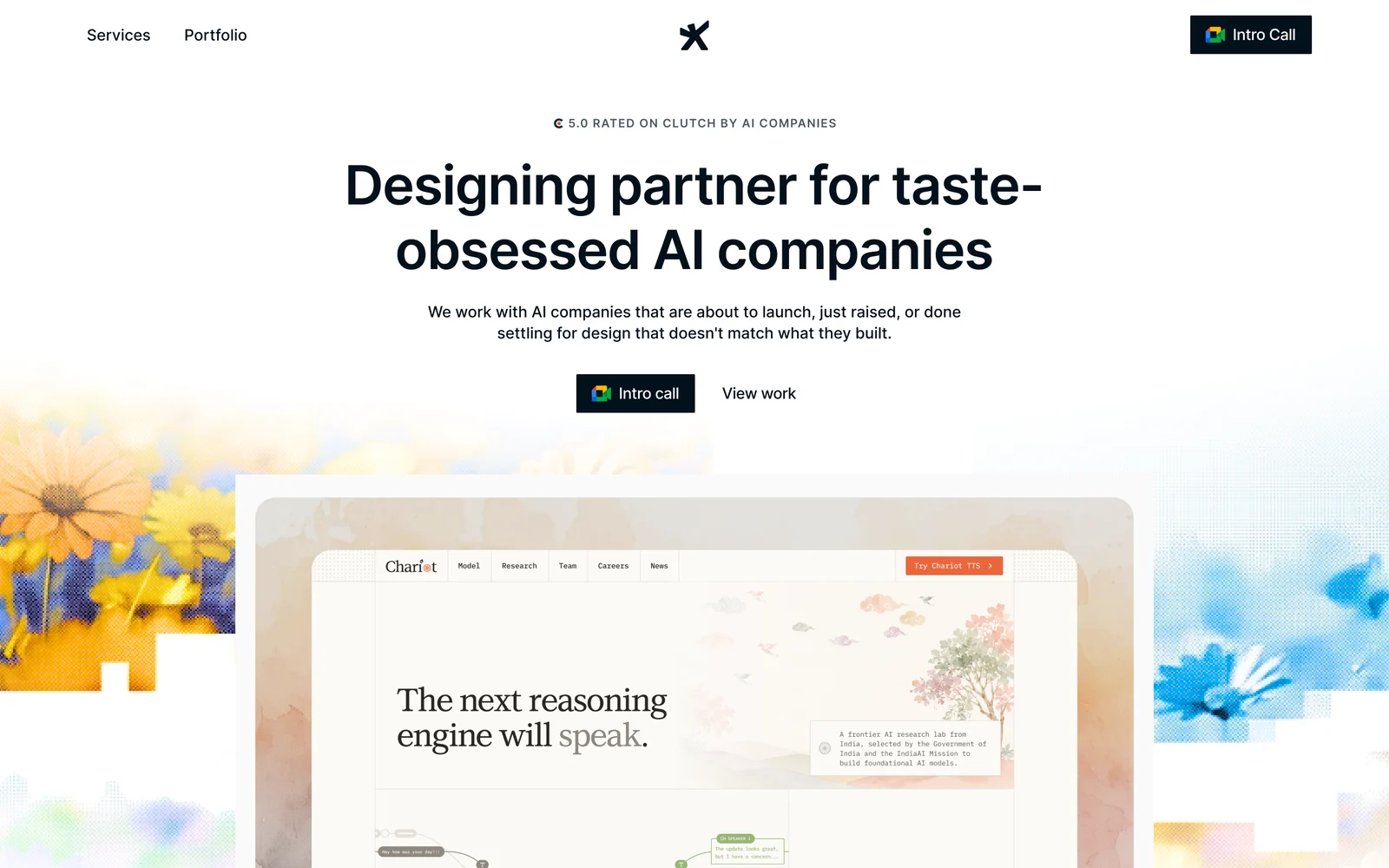
1. Studio Maydit: A Top-Rated Design Agency for AI Founders
The relevant experience for a venture studio is repetition. Studio Maydit works with AI founders across the US, UK, and Europe, which means the same problem arrives regularly in slightly different shapes, and a studio spinning up companies has that pattern too. It is a web and product design studio, building websites and then continuing into product design once the site is live.
Framer suits a site whose portfolio and thesis wording change often. Webflow suits a team that wants an operator publishing without engineering involvement. Custom code suits the case where neither will hold. For a venture studio the honest question is which of your people will make the edit when a company exits the portfolio, and how long they will tolerate the process.
The published outcome is Dualite. A repositioned ICP came first, the design followed for the narrower audience that decision created, and 100,000+ users arrived inside seven months. The part that transfers here is the order of operations, because a venture studio site fails for the same reason: it tries to remain true for every founder and every investor, and ends up specific to nobody. Recent clients include Wave, PixelFlow, Mi-VAD, and 15 other AI and SaaS teams.
There are two commercial shapes, and for a team that keeps losing its own project to portfolio work the difference matters. Fixed scope runs three to four weeks, which is short enough to survive one distraction rather than dying in it. The monthly retainer suits a studio adding and retiring companies continuously, covering new pages, campaigns, and product design with no long lock-in. Fixed-scope work ends with a diagnosis of what is leaking in the product rather than a handoff and goodbye.
| Check | Finding |
|---|---|
| Based in | Remote, serving US / UK / EU |
| Platform depth | Framer, Webflow, and custom code |
| AI-sector proof | Yes. AI-native clients, published outcome on Dualite |
| Pricing | Fixed scope or monthly retainer, quoted per project |
| Team shape | Founder-led, small senior team |
| Best fit | Venture studios whose own site keeps losing to portfolio work |
Write for founders and let diligence find the rest. Book a 30-minute call.

2. Ramotion
Ramotion has worked from San Francisco since 2009 with eleven to fifty people across mixed platforms, and publishes a starting price. Mozilla, Okta, Netflix, Adobe, and Xero are all companies with substantial existing traffic, which means the studio has repeatedly done the version of this job where losing the old rankings is not an option.
The weakness is that its AI-sector proof is partial, and a practice built around larger technology brands runs a heavier process than a small venture studio team may want to staff.
| Check | Finding |
|---|---|
| Based in | San Francisco, USA |
| Founded | 2009 |
| Team size | 11-50 |
| Primary platform | Mixed |
| AI-sector proof | Partial |
| Named clients | Mozilla, Okta, Netflix, Adobe, Xero |
| Pricing | Published minimum |
| Best fit | Venture studios with real search traffic they cannot afford to lose |
3. Trueform
Trueform has worked from Wil in Switzerland since 2022 in Framer, publishes a starting price, and holds AI-sector proof through work for Miro, Morning Brew, Bilt Rewards, and Gather. Framer is the reason it sits this high: a venture studio changes its portfolio and its thesis wording more often than most businesses, and Framer lets a non-engineer make that change the same afternoon.
The weakness is scale of estate. If your site carries years of published essays and a large content archive, a Framer rebuild is a bigger migration question than a small marketing site would be.
| Check | Finding |
|---|---|
| Based in | Wil, Switzerland |
| Founded | 2022 |
| Team size | Not published |
| Primary platform | Framer |
| AI-sector proof | Yes |
| Named clients | Miro, Morning Brew, Bilt Rewards, Gather |
| Pricing | Published minimum |
| Best fit | Venture studios who will edit the portfolio page themselves, often |
4. Pixelmatters
Pixelmatters has worked from Porto since 2013 with fifty-one to two hundred people across mixed platforms, and publishes a starting price. Rubrik, Quantic, and UJET are substantial software products, and a team of this size can hold both a redesign and the portfolio company work you will inevitably ask about later.
The weakness is that its AI-sector proof is partial, and European working hours mean a US studio gets one overlap window a day rather than a normal working relationship.
| Check | Finding |
|---|---|
| Based in | Porto, Portugal |
| Founded | 2013 |
| Team size | 51-200 |
| Primary platform | Mixed |
| AI-sector proof | Partial |
| Named clients | Rubrik, Quantic, UJET |
| Pricing | Published minimum |
| Best fit | Studios who want one partner for their own site and their portfolio's |
5. Lazarev
Lazarev has worked from San Francisco since 2015 with fifty-one to two hundred people, holds AI-sector proof, and publishes a starting price. Its work sits in complex software rather than brochure sites, which suits a venture studio whose site needs to explain a model of operating rather than sell a single product.
The weakness is the usual cost of scale. A studio this size assigns a team, so the senior person who understood your thesis in the first meeting may not be the one writing the page that has to express it.
| Check | Finding |
|---|---|
| Based in | San Francisco, USA |
| Founded | 2015 |
| Team size | 51-200 |
| Primary platform | Mixed |
| AI-sector proof | Yes |
| Named clients | Payoneer, Peel, Elva, Mozayix |
| Pricing | Published minimum |
| Best fit | Studios whose site has to explain a method, not just list companies |
6. Refokus
Refokus works remotely from Germany with eleven to fifty people in Webflow, and has shipped for Mural, BASF, Spotify, Yahoo, and BCG. That is an unusually strong list for a team this size, and Webflow means your operator can add and retire portfolio entries without booking developer time.
The weakness is disclosure and fit. No starting price is published, AI-sector proof is partial, and a client list weighted toward large enterprises suggests a process scaled for organisations with more people than a venture studio has.
| Check | Finding |
|---|---|
| Based in | Germany, remote |
| Founded | 2021 |
| Team size | 11-50 |
| Primary platform | Webflow |
| AI-sector proof | Partial |
| Named clients | Mural, BASF, Spotify, Yahoo, BCG |
| Pricing | Not published |
| Best fit | Studios wanting enterprise-grade craft with Webflow editability |
7. Push Refresh
Push Refresh is a one to ten person Framer team in Dallas that publishes a starting price, with work for SmithRx, Synonym, and Northern National. Small and Framer-based is a practical combination for a venture studio: you get the person doing the work, and the site stays editable afterwards.
The weakness is capacity against ambition. A team of this size can carry one meaningful redesign at a time, and its AI-sector proof is partial rather than direct, so a thesis-heavy positioning brief would be new territory.
| Check | Finding |
|---|---|
| Based in | Dallas, USA |
| Founded | Not published |
| Team size | 1-10 |
| Primary platform | Framer |
| AI-sector proof | Partial |
| Named clients | SmithRx, Synonym, Northern National |
| Pricing | Published minimum |
| Best fit | Smaller studios who want direct access and a published starting figure |
8. Instrument
Instrument has worked from Portland since 2005 across mixed platforms, for Nike, Microsoft, Electronic Arts, and Google. Two decades of practice at that level is real, and if your studio is large enough to be treated as a brand in its own right, this is a serious option.
The weakness is the mismatch in shape. Its AI-sector proof is partial, neither team size nor a starting price is published, and the process assumes a client organisation with marketing people in it, which most venture studios do not have.
| Check | Finding |
|---|---|
| Based in | Portland, USA |
| Founded | 2005 |
| Team size | Not published |
| Primary platform | Mixed |
| AI-sector proof | Partial |
| Named clients | Nike, Microsoft, Electronic Arts, Google |
| Pricing | Not published |
| Best fit | Large venture studios operating as a consumer-facing brand |
9. Engine Digital
Engine Digital has worked from Vancouver and New York since 2002 in custom code, for Adidas, Autodesk, Goldman Sachs, and HP. Long-running practices like this one are good at complex redesigns where many stakeholders have to be carried through the process without the project collapsing.
The weakness is that almost every dimension points away from your brief. Custom code means an engineer for every portfolio update, no team size or starting price is published, and the client list describes an enterprise engagement rather than a lean one.
| Check | Finding |
|---|---|
| Based in | Vancouver and New York |
| Founded | 2002 |
| Team size | Not published |
| Primary platform | Custom code |
| AI-sector proof | Partial |
| Named clients | Adidas, Autodesk, Goldman Sachs, HP |
| Pricing | Not published |
| Best fit | Large estates with internal teams and a long approval chain |
10. Foundey
Foundey has worked from San Francisco since 2021 and holds AI-sector proof through DemandIQ, Traycer, and Sero AI. It understands early-stage companies, which is genuinely relevant given what sits in your portfolio.
The weakness settles it for a redesign brief. Foundey is Figma-only, so it designs pages and someone else builds them. On a redesign that gap is worse than on a new site, because migrating existing pages and preserving what ranks is build work, and it would fall to a second supplier or to you.
| Check | Finding |
|---|---|
| Based in | San Francisco, USA |
| Founded | 2021 |
| Team size | Not published |
| Primary platform | Figma-only |
| AI-sector proof | Yes |
| Named clients | DemandIQ, Traycer, Sero AI |
| Pricing | Not published |
| Best fit | Studios with an in-house build team who need design only |
How to choose between them
Sort by what is actually broken.
If you have years of essays and real search traffic at stake, buy migration discipline first. Ramotion.
If the portfolio and the thesis wording change several times a year, buy editability and accept less bespoke craft. Trueform or Push Refresh.
If the site has to explain a method rather than list companies, buy a studio used to complex software narratives. Lazarev.
If you want one partner who can also take portfolio company work later, buy capacity. Pixelmatters.
One test before you sign. Ask each studio which companies they would remove from your portfolio page. A studio that names three and explains why has understood that the page is an argument. A studio that says it would show them all has understood it as a grid, and you will get a tidier version of the problem you already have.