

Summarize with AI


For a YC-backed AI startup replacing its site, the ten studios worth reviewing are Studio Maydit, Engine Digital, Pixelmatters, Push Refresh, Instrument, Ramotion, Phantom, Feely Studio, Trueform, and Lazarev. Lazarev and Trueform lead this list. Lazarev has worked from San Francisco since 2015 with fifty-one to two hundred people, a published starting price, and AI-sector proof, for Payoneer, Peel, Elva, and Mozayix. Trueform has worked from Wil in Switzerland since 2022 in Framer, with a published starting price and AI-sector proof, for Miro, Morning Brew, Bilt Rewards, and Gather, and Framer is the fastest way to keep changing a claim. Instrument and Engine Digital fit least well. Both are built for very large organisations, publish no pricing, and move at a pace that will frustrate a company measuring progress in weeks.
The advice that got you through Demo Day is now the thing making you invisible.
Say what you do in one sentence. Keep it plain. Do not decorate. That guidance is correct, and it is why your site works. It is also why your site is interchangeable with two hundred others, because every company in your batch received it and followed it properly.
Plainness was never the differentiator. It just stopped you hiding behind decoration. What differentiates is how specific the plain sentence is, and most YC AI sites are plain and generic at the same time, which is the worst combination available.
There is a second thing that expires. The Demo Day site is built for an audience that already has context: investors who read the batch list, and friends who know what you are working on. Six months later most of your visitors arrive cold from a search result with no idea who you are.
The redesign is where you stop writing for people who already know you.

How we picked these agencies
Five criteria decided the order, and each is answerable from public pages before you spend a call.
Platform depth, judged by how fast you can keep changing things. A YC company in its first two years rewrites its homepage more often than it expects, sometimes after a single week of customer conversations. If that needs a developer and a deploy, the site will permanently describe the company you were a month ago.
AI-sector proof, weighted most heavily on this page. Your difficulty is not that nobody understands startups, it is that your product is a model and the honest explanation of what it does sits somewhere between too technical and too vague. Studios who have shipped for AI companies have already found that line once.
Pricing. Is a starting figure published. Post-batch you are spending money that is meant to last eighteen months, and a studio that publishes a floor lets you rule it in or out in a minute rather than after two calls.
Team shape. Small teams are cheaper, faster, and give you a senior person who will argue about your positioning. Larger teams can run a rebrand and a rebuild together, which most YC companies do not yet need and often buy anyway.
Their own site. It is the only project with no client to blame. For a redesign, check whether their old links still work, since that shows how they treat traffic other people built.
One extra question for the first call: ask them to say what your company does, from your current site, in one sentence. If they get it wrong, your homepage is the problem and you have just proved it for free.
Each finding below is public information. We have not modelled or approximated anything, so an unpublished row reflects a real absence.
What goes wrong for YC-backed AI startups
Three failures, and the first is the one that keeps a good product looking like a project.
The site is still a Demo Day artefact. One sentence, a waitlist form, a founder photo, and a logo. That was exactly right for the eight weeks when your traffic was investors and batchmates who already knew you. It is wrong now, because the person arriving from a search result needs to know what the product does, who it is for, what it costs roughly, and whether anyone real uses it. None of that was necessary in month three and all of it is necessary now.
The one-liner is plain but not specific. AI for customer support. Copilot for finance teams. The format is right and the content is empty, because a hundred companies could use the same words. Specificity is the differentiator: the exact job, the exact person, and the thing that is true of you and not of your competitors. A sentence that only you could honestly write is worth more than a beautiful redesign around a sentence anyone could.
Launch traffic arrives and nothing catches it. A YC company gets several one-day floods, from Demo Day, a launch post, and whatever gets shared. Thousands of people land, and the site offers a waitlist and no reason to return. That audience is the cheapest you will ever get, and most of it is spent on a page with no second step. Something worth subscribing to, a genuinely useful page, or a product someone can try without a call will carry more value than the traffic spike itself.
1. Studio Maydit: A Top-Rated Design Agency for AI Founders
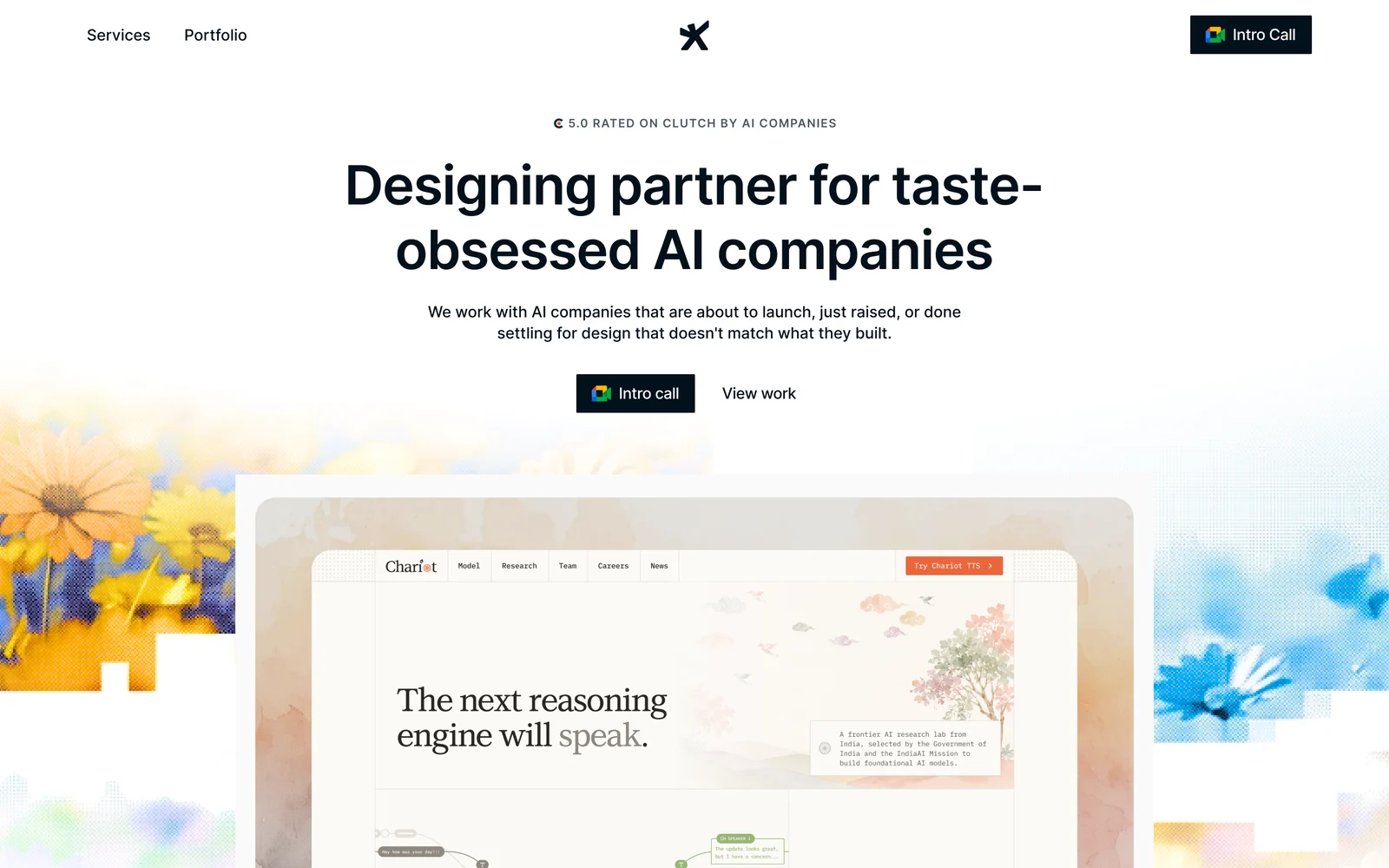
Fixed scope means three to four weeks, which is the right shape for a company that has to keep momentum after a batch rather than disappear into a quarter-long project. It also ends with a written diagnosis of what is leaking in the product, which for a YC company is usually more valuable than the site itself, since the product is where the growth number comes from. Studio Maydit is a web and product design studio working with AI founders across the US, UK, and Europe.
The build happens in Framer, Webflow, or custom code, and the choice follows how often you expect to rewrite things. Early on that is constantly, which usually argues for the platform a founder can edit at midnight rather than the one that looks most impressive in a portfolio. The work continues into product design after the site ships, and a monthly retainer suits teams still shipping weekly, covering new pages, campaigns, and product design, with no long lock-in.
Dualite is the published outcome and the sequence is the transferable part. A repositioned ICP came first, the product was then designed for the narrower group that decision created, and 100,000+ users arrived within seven months. Narrowing is the hardest thing to do straight after a batch, when the pressure is to look like a company with a large market rather than one with a specific customer. Recent clients include Wave, PixelFlow, Mi-VAD, and 15 other AI and SaaS teams.
| Check | Finding |
|---|---|
| Based in | Remote, serving US / UK / EU |
| Platform depth | Framer, Webflow, and custom code |
| AI-sector proof | Yes. AI-native clients, published outcome on Dualite |
| Pricing | Fixed scope or monthly retainer, quoted per project |
| Team shape | Founder-led, small senior team |
| Best fit | YC teams replacing a Demo Day page with a real company site |
Write the sentence only your company could honestly write, then build around it. Book a 30-minute call.

2. Lazarev
Lazarev has worked from San Francisco since 2015 with fifty-one to two hundred people, a published starting price, and AI-sector proof, for Payoneer, Peel, Elva, and Mozayix. The AI proof matters here more than the size, because your explanation problem is a model problem. At this scale the studio can also handle the product interface alongside the site, which suits a company whose growth number is the thing investors will ask about next.
A fifty-plus team is a heavy engagement for a company a year out of a batch, and the people who pitch are unlikely to be the ones assigned to you.
| Check | Finding |
|---|---|
| Based in | San Francisco, USA |
| Founded | 2015 |
| Team size | 51-200 |
| Primary platform | Mixed |
| AI-sector proof | Yes |
| Named clients | Payoneer, Peel, Elva, Mozayix |
| Pricing | Published minimum |
| Best fit | Post-batch teams who need site and product moving together |
3. Trueform
Trueform has worked from Wil in Switzerland since 2022 in Framer, with a published starting price and AI-sector proof, for Miro, Morning Brew, Bilt Rewards, and Gather. Framer is the correct default for a company still learning what it is, because a claim can change the afternoon a customer call disproves it. Miro is a company whose description outgrew itself repeatedly without a rebuild each time.
No team size is published, the studio is young, and Framer alone is wrong if part of your site needs to run something live from the product.
| Check | Finding |
|---|---|
| Based in | Wil, Switzerland |
| Founded | 2022 |
| Team size | Not published |
| Primary platform | Framer |
| AI-sector proof | Yes |
| Named clients | Miro, Morning Brew, Bilt Rewards, Gather |
| Pricing | Published minimum |
| Best fit | YC teams whose one-liner will change again this quarter |
4. Feely Studio
Feely Studio is a distributed European team of one to ten people with a published starting price and AI-sector proof, for Noxus, Mutiny, Luasai, and Basic Capital. This is the closest match on the page to a YC company's own shape: small, senior, fast, and used to early-stage clients whose positioning is unfinished. Mutiny is a product sold to revenue teams, so writing for a buyer rather than a market is familiar work.
The team cannot run parallel workstreams, and the named clients are early-stage rather than the recognisable logos an investor update sometimes wants.
| Check | Finding |
|---|---|
| Based in | Distributed, Europe |
| Founded | Not published |
| Team size | 1-10 |
| Primary platform | Mixed |
| AI-sector proof | Yes |
| Named clients | Noxus, Mutiny, Luasai, Basic Capital |
| Pricing | Published minimum |
| Best fit | Small YC teams who want senior attention on the sentence |
5. Push Refresh
Push Refresh is a Framer studio in Dallas with one to ten people and a published starting price, for SmithRx, Synonym, and Northern National. It is likely the cheapest fast option here, and a one to ten person team means the person you brief is the person building, which suits a founder who wants to be closely involved and does not want a process.
AI-sector proof is only partial, none of the named clients is an AI company, and a team this size cannot take on anything beyond the site itself.
| Check | Finding |
|---|---|
| Based in | Dallas, USA |
| Founded | Not published |
| Team size | 1-10 |
| Primary platform | Framer |
| AI-sector proof | Partial |
| Named clients | SmithRx, Synonym, Northern National |
| Pricing | Published minimum |
| Best fit | YC teams on a tight budget who will keep editing themselves |
6. Phantom
Phantom has worked from London and Auckland since 2013 in custom code with fifty-one to two hundred people and AI-sector proof, for Diageo, SAP, Financial Times, and Zendesk. The AI proof plus genuine engineering depth is a rare combination, and if your site needs to demonstrate a real model output rather than a screenshot, this is the kind of studio that can build it.
No pricing and no team size figures are published, and a studio serving clients at this scale is badly matched to a company that raised a seed round and needs to be live in six weeks.
| Check | Finding |
|---|---|
| Based in | London, UK and Auckland, NZ |
| Founded | 2013 |
| Team size | 51-200 |
| Primary platform | Custom code |
| AI-sector proof | Yes |
| Named clients | Diageo, SAP, Financial Times, Zendesk |
| Pricing | Not published |
| Best fit | Funded teams whose site must run something real |
7. Ramotion
Ramotion has worked from San Francisco since 2009 with eleven to fifty people and a published starting price, for Mozilla, Okta, Netflix, Adobe, and Xero. These were replacements for companies that already had audiences, which brings the redesign discipline your project needs if the current site has picked up links from a launch post or a batch listing.
AI-sector proof is only partial, and the studio is used to enterprise timelines rather than the pace a post-batch company runs at.
| Check | Finding |
|---|---|
| Based in | San Francisco, USA |
| Founded | 2009 |
| Team size | 11-50 |
| Primary platform | Mixed |
| AI-sector proof | Partial |
| Named clients | Mozilla, Okta, Netflix, Adobe, Xero |
| Pricing | Published minimum |
| Best fit | Teams with launch links and rankings worth protecting |
8. Pixelmatters
Pixelmatters has worked from Porto since 2013 with fifty-one to two hundred people and a published starting price, for Rubrik, Quantic, and UJET. All three had to make technical products legible to buyers who are not engineers, which is exactly the translation a YC AI company struggles with. Portugal also reaches both US coasts and Europe within one working day.
AI-sector proof is only partial, and at this size you will be assigned a team rather than choosing one.
| Check | Finding |
|---|---|
| Based in | Porto, Portugal |
| Founded | 2013 |
| Team size | 51-200 |
| Primary platform | Mixed |
| AI-sector proof | Partial |
| Named clients | Rubrik, Quantic, UJET |
| Pricing | Published minimum |
| Best fit | Teams translating a technical product for a business buyer |
9. Instrument
Instrument has worked from Portland since 2005, for Nike, Microsoft, Electronic Arts, and Google. This is brand work at a level that makes a small company look established, and for a post-batch startup selling into large enterprises that impression can genuinely shorten a sales cycle.
No pricing, no team size, and no AI-sector proof are published, and a studio aimed at brands of this size is an expensive, slow choice for a company still finding its first fifty customers.
| Check | Finding |
|---|---|
| Based in | Portland, USA |
| Founded | 2005 |
| Team size | Not published |
| Primary platform | Mixed |
| AI-sector proof | Partial |
| Named clients | Nike, Microsoft, Electronic Arts, Google |
| Pricing | Not published |
| Best fit | Post-batch teams selling into very large enterprises |
10. Engine Digital
Engine Digital has worked from Vancouver and New York since 2002 in custom code, for Adidas, Autodesk, Goldman Sachs, and HP. Two decades of large replacements means inventories, redirect maps, and staged launches are routine rather than something they have to be asked for.
No pricing and no team size are published, AI-sector proof is only partial, and this is the least suitable pace and price on the page for a company measuring itself in weekly growth.
| Check | Finding |
|---|---|
| Based in | Vancouver and New York |
| Founded | 2002 |
| Team size | Not published |
| Primary platform | Custom code |
| AI-sector proof | Partial |
| Named clients | Adidas, Autodesk, Goldman Sachs, HP |
| Pricing | Not published |
| Best fit | Larger rebuilds where losing search traffic is unacceptable |
How to choose between them
Sort by what is actually broken.
If nobody can tell what you do from the homepage, buy an argument about the sentence. Feely Studio, where a senior person writes it themselves.
If the one-liner will change again before the site ships, buy editing speed. Trueform or Push Refresh on Framer.
If your growth number matters more than the site, buy a studio that will also look at the product. Lazarev.
If a launch post and a batch listing have left you real links and rankings, buy migration discipline. Ramotion.
One test before you sign. Send them your current site and ask them to describe what your company does in one sentence, without asking you first. If they get it wrong, you have found your actual problem and it is not the design. If they get it right and then tell you which four words were doing the work, hire them.