Reading time:
14 min read
Last updated:
10 Best AI Product Development Agencies for Seed-Stage Startups - September 2026
AI product development agencies for seed-stage startups: ten firms compared on who writes production code, who publishes a price, and who pushes back on the spec.


Best fit first: Studio Maydit, basement.studio, Feely Studio, Lazarev, Ramotion, BX Studio, Engine Digital, Push Refresh, Instrument, and Foundey. Among the nine, basement.studio and Feely Studio come out on top for a seed-stage team. basement.studio writes custom code from Mar del Plata and Los Angeles, has eleven to fifty people, publishes a starting price, and lists Vercel, Cursor, ElevenLabs, Harvey AI, and Scale AI. Feely Studio is a one to ten person European team with direct AI proof, a published price, and early-stage clients including Noxus, Mutiny, Luasai, and Basic Capital. Instrument and Foundey are the weakest match. Instrument is built around very large organisations and publishes no price. Foundey delivers Figma files and writes no code at all, which rules it out of a development brief.
Search for an AI product development agency and you will find two different businesses using the same words.
One is a studio that decides what to build and then builds it. The other is an outsourced engineering team that will build whatever you describe, quickly and competently, without ever asking whether it is the right thing.
At seed stage the second one is dangerous, and not because the code is bad. It is dangerous because you are still wrong about the product. Everyone is at this stage. That is what the round is for.
The specific trap for AI companies is that the demo already works. The model does the clever part, the founder has shown it fifty times, and it feels like the remaining work is engineering. So the brief gets written as a feature list, the agency prices the feature list, and four months later there is a finished product that a stranger still cannot get a result out of.
What a seed-stage team actually needs is someone who will argue about the list before writing any of it. That is what the ranking below is built on.

The five checks behind this ranking
Everything here comes from public pages, and you can repeat all five yourself.
Platform depth. Does the firm write production code, work across design and build, or deliver design files only? A development brief makes this the first filter rather than a detail, and it removes more candidates than any other check.
AI-sector proof. Has the firm shipped a product where a model produces the output? It matters at seed stage more than later, because early AI products are mostly a set of decisions about how much the model should be trusted and how visible it should be. A team that has not made those decisions before will make them by accident.
Pricing transparency. A seed round is a fixed number and a known runway. A published starting figure tells a founder in under a minute whether a conversation is affordable, which is worth more here than in any other kind of engagement.
Team shape. Small teams give you senior attention and limited capacity. Large ones give you capacity and junior staffing on small accounts. At seed stage the first failure is recoverable and the second usually is not, so size was weighted toward the smaller end.
The firm's own website. Read whether it describes deciding what to build or only building it. Firms that take product responsibility write about tradeoffs. Firms that take orders write about technologies.
Checks one and two decided the order. Price and size resolved anything close. The firm's own site was a cap on the score, not an addition.
The tables carry only what each firm publishes about itself. Nothing is inferred and no directories were used. Not published means the firm has chosen not to say, and it stays blank here.
What goes wrong when a seed-stage team buys AI product development
The agency builds exactly what you asked for. This reads like success and is usually the expensive failure. You hand over a feature list written before anyone outside the company used the product, and a competent firm ships all of it on time. The features work. Activation does not move. Ask in the first call which part of your brief they would cut, and treat an agency with no answer as an order-taker.
An MVP is quoted and a demo is delivered. The word means different things to each side. You mean the smallest thing a real customer can use and pay for. Many firms mean the smallest thing that shows the idea works, which skips accounts, permissions, billing, error states, and any analytics. Write down the five things a first paying customer must be able to do, and put that list in the contract instead of the word MVP.
Nobody owns the code after handover. The firm picks the stack, the patterns, and the deployment setup, then leaves. Six months later you are hiring your first engineer and the honest answer to what they will inherit is nobody knows. Agree at the start who owns the repository, what the documentation covers, and how many weeks of support follow launch. Ask for a walkthrough recording, not a wiki nobody will read.
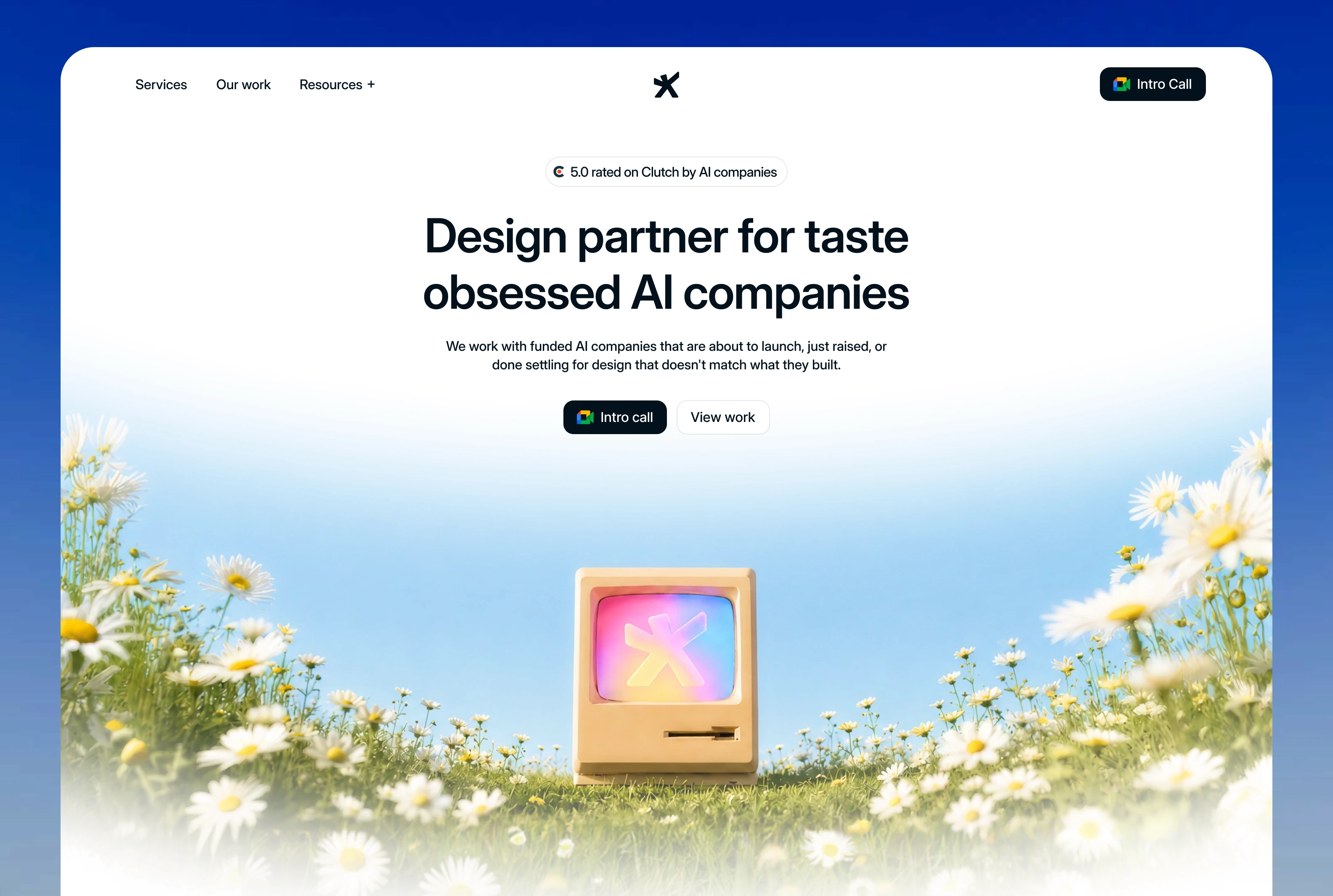
1. Studio Maydit: A Top-Rated Design Agency for AI Founders
At seed stage the shortage is rarely engineering. It is someone who will say which half of the plan to drop. Studio Maydit is a web and product design studio working with AI founders in the US, UK, and Europe, and that argument is where its work starts.
It builds as well as designs, in Framer, Webflow, and custom code, and continues into product design after the site ships. Fixed-scope projects end with a diagnosis of what is leaking in the product, which for a seed-stage team is usually more valuable than the deliverable itself.
Buying is deliberately simple. Fixed scope runs three to four weeks and fits a team with a launch date or an investor update in the calendar. Teams still shipping every week take the monthly retainer instead, covering new pages, campaigns, and product design, with no long lock-in.
One outcome is public. Dualite reached 100,000+ users in seven months, following design work that supported a repositioned ICP. Recent clients include Wave, PixelFlow, and Mi-VAD, plus 15 other AI and SaaS teams.
Check | Finding |
|---|---|
Based in | Remote, serving US / UK / EU |
Platform depth | Framer, Webflow, and custom code |
AI-sector proof | Yes. AI-native clients, published outcome on Dualite |
Pricing | Fixed scope or monthly retainer, quoted per project |
Team shape | Founder-led, small senior team |
Best fit | Seed-stage AI teams whose first build needs judgment, not more engineers |
Send the feature list you were about to get quoted on and we will tell you which parts we would cut. Book a 30-minute call.

2. basement.studio
basement.studio writes custom code from Mar del Plata, Argentina and Los Angeles, was founded in 2018, has eleven to fifty people, and publishes a starting price. Vercel, Cursor, ElevenLabs, Harvey AI, and Scale AI are clients. That is not a list of companies that hire a vendor to take orders. It is a list of developer-first and AI-first companies whose own engineers are the audience, which means the studio is used to being challenged on technical decisions rather than nodding along.
The weakness is shape rather than quality. Its public work leans toward high-craft marketing and launch surfaces, so a long internal workflow is less proven. At eleven to fifty people with that client list, a seed-stage budget may not command its senior people.
Check | Finding |
|---|---|
Based in | Mar del Plata, Argentina and Los Angeles, USA |
Founded | 2018 |
Team size | 11-50 |
Primary platform | Custom code |
AI-sector proof | Yes |
Named clients | Vercel, Cursor, ElevenLabs, Harvey AI, Scale AI |
Pricing | Published minimum |
Best fit | AI teams whose engineers will judge the build as harshly as customers |
3. Feely Studio
Feely Studio is a distributed European team of one to ten people with direct AI proof and a published starting price. Noxus, Mutiny, Luasai, and Basic Capital are clients, and those are early-stage software companies rather than enterprises. For a seed-stage founder this is the most honest comparison on the page, because the studio's existing clients are at roughly your stage and were solving roughly your problem.
The weakness is capacity and record. No founding date is published, and a team this size can only run so many projects at once, so a slip elsewhere becomes your slip. There is less public history to check than the bigger names offer.
Check | Finding |
|---|---|
Based in | Distributed, Europe |
Founded | Not published |
Team size | 1-10 |
Primary platform | Mixed |
AI-sector proof | Yes |
Named clients | Noxus, Mutiny, Luasai, Basic Capital |
Pricing | Published minimum |
Best fit | Seed-stage teams that want senior people and a number up front |
4. Lazarev
Lazarev has worked from San Francisco since 2015, has fifty-one to two hundred people, publishes a starting price, and has direct AI-sector proof. Payoneer, Peel, Elva, and Mozayix are named clients. Payoneer is a regulated financial product with a long onboarding path, so this is a team that has built the parts of a product most founders underestimate: verification, permissions, and the states in between.
The weakness is stage fit. Premium tier at that headcount means a seed-stage engagement sits at the bottom of the account list, and the platform is mixed, so who writes production code is a question to settle early rather than assume.
Check | Finding |
|---|---|
Based in | San Francisco, USA |
Founded | 2015 |
Team size | 51-200 |
Primary platform | Mixed |
AI-sector proof | Yes |
Named clients | Payoneer, Peel, Elva, Mozayix |
Pricing | Published minimum |
Best fit | Funded teams building flows with verification and permissions |
5. Ramotion
Ramotion has worked from San Francisco since 2009, has eleven to fifty people, and publishes a starting price. Mozilla, Okta, Netflix, Adobe, and Xero are clients. Sixteen years and a client list of that weight means the firm has survived several complete changes in how products get built, and a published price makes it easy for a seed-stage team to check affordability in one visit.
The weakness is sector and platform certainty. AI-sector proof is only partial, so the model-specific decisions will be new territory, and it works across several platforms rather than committing to a build stack. Premium tier keeps the entry point high.
Check | Finding |
|---|---|
Based in | San Francisco, USA |
Founded | 2009 |
Team size | 11-50 |
Primary platform | Mixed |
AI-sector proof | Partial |
Named clients | Mozilla, Okta, Netflix, Adobe, Xero |
Pricing | Published minimum |
Best fit | Teams that want a long track record and a published entry price |

6. BX Studio
BX Studio is a New York team of eleven to fifty people with Webflow as its main platform, direct AI proof, and a published starting price. Reddit, Headspace, ASAPP, and Verifone are clients, and ASAPP is an AI company, so the studio has worked on how a model-driven product is explained to the people buying it.
The weakness is the platform for this particular brief. Webflow is a website tool, not a product stack, so the development a seed-stage founder means here sits outside its main practice. No founding date is published either.
Check | Finding |
|---|---|
Based in | New York, USA |
Founded | Not published |
Team size | 11-50 |
Primary platform | Webflow |
AI-sector proof | Yes |
Named clients | Reddit, Headspace, ASAPP, Verifone |
Pricing | Published minimum |
Best fit | Teams whose next build is the marketing surface, not the product |
7. Engine Digital
Engine Digital has written custom code from Vancouver and New York since 2002 for Adidas, Autodesk, Goldman Sachs, and HP. It genuinely builds software, which is more than most of this list can say, and twenty-plus years of integration work shows in the kind of systems it takes on.
The weakness is stage. Premium tier, no published price, no published headcount, and a client list of very large organisations means a seed-stage engagement is unlikely to be priced for you or staffed for you. AI-sector proof is partial.
Check | Finding |
|---|---|
Based in | Vancouver and New York |
Founded | 2002 |
Team size | Not published |
Primary platform | Custom code |
AI-sector proof | Partial |
Named clients | Adidas, Autodesk, Goldman Sachs, HP |
Pricing | Not published |
Best fit | Funded companies building software that plugs into other systems |
8. Push Refresh
Push Refresh is a one to ten person studio in Dallas that publishes a starting price, with SmithRx, Synonym, and Northern National as clients. Small, direct, and affordable, with a number on the site, which is exactly the shape a seed-stage team wants to find.
The weakness is capability against this brief. It builds in Framer, so it makes websites rather than products, and a development scope is outside what it does. No founding date is published and AI-sector proof is partial.
Check | Finding |
|---|---|
Based in | Dallas, USA |
Founded | Not published |
Team size | 1-10 |
Primary platform | Framer |
AI-sector proof | Partial |
Named clients | SmithRx, Synonym, Northern National |
Pricing | Published minimum |
Best fit | Early teams that need a launch site rather than a product build |
9. Instrument
Instrument has worked from Portland since 2005 across several platforms, for Nike, Microsoft, Electronic Arts, and Google. It is a serious studio with two decades of work behind it, practised at moving through organisations where many people have an opinion.
The weakness is the mismatch with a seed-stage company. Nothing about a firm shaped for Microsoft transfers to a five-person team that needs a decision this week, and with no published price or headcount the first two calls are spent finding that out. AI-sector proof is partial.
Check | Finding |
|---|---|
Based in | Portland, USA |
Founded | 2005 |
Team size | Not published |
Primary platform | Mixed |
AI-sector proof | Partial |
Named clients | Nike, Microsoft, Electronic Arts, Google |
Pricing | Not published |
Best fit | Later-stage companies with multiple internal stakeholders |
10. Foundey
Foundey is a San Francisco studio founded in 2021 working with early AI companies such as DemandIQ, Traycer, and Sero AI. Its AI proof is direct and its clients are at the stage you are, so on audience understanding it scores well.
The weakness settles it for a development search. Foundey designs in Figma only and ships no code, so it cannot take a product build. Used alongside your own engineers it is a reasonable design partner, but on its own it leaves the entire build unsolved. Headcount and pricing are not published.
Check | Finding |
|---|---|
Based in | San Francisco, USA |
Founded | 2021 |
Team size | Not published |
Primary platform | Figma-only |
AI-sector proof | Yes |
Named clients | DemandIQ, Traycer, Sero AI |
Pricing | Not published |
Best fit | Teams with engineers in place who only need design |
How to choose between them
Decide first whether the risk is building badly or building the wrong thing, because they point at different firms.
Your engineers will judge the result. basement.studio, and ask how it would set up the repository for your first hire.
Runway is tight and you want senior people on it. Feely Studio, with the scope written as five customer outcomes rather than features.
The product has verification, permissions, or billing in it. Lazarev, or Ramotion if a long track record matters more than AI specifics.
What you actually need next is a launch site. BX Studio, or Push Refresh on a smaller budget.
One question that sorts the order-takers from the partners. Send your feature list and ask which two things they would remove and why. A firm that takes product responsibility answers in specifics. A firm that does not says it depends on your priorities.

Need more info?
Can't find your answer? Book a call and let's talk.
Continue Reading
10 Best Framer Design Agencies for AI Agent Startups - September 2026
Ten Framer studios that have shipped for AI agent companies, with the demo and trust patterns those products need. Checked on platform depth, pricing and team.

Siddarth Ponangi
10 Best Framer Design Agencies for Newly Funded Startups - September 2026
Your funding announcement is the biggest traffic day you will have all year. We checked 10 Framer agencies on five public criteria to see which can hit that date.
Siddarth Ponangi
10 Best Custom Code Website Development Agencies for AI Agent Startups - September 2026
AI web development agencies for agent startups. Which teams build custom coded sites a small team can still update weekly after launch.
Siddarth Ponangi