Reading time:
13 min read
Last updated:
10 Best Custom Code Website Development Agencies for AI Devtools - September 2026
Developers evaluate an AI devtool in a terminal, not on a homepage. We checked 10 custom code agencies on five public criteria to see which ones design for that.


The best custom code website development agencies for AI devtools in 2026 are Studio Maydit, basement.studio, Phantom, Feels Like, Engine Digital, Foundey, Kvalifik, BX Studio, Feely Studio, and Refokus. Studio Maydit and basement.studio lead for devtools teams whose buyer is a developer and whose real front page is the quickstart. Engine Digital and Phantom are the wrong fit unless you are enterprise-sized and buying a campaign.
Your buyer does not read your homepage. They scroll past it looking for the install command.
That is not a criticism of your homepage. It is how developers evaluate anything. They arrive from a repository link, a colleague's message, or a comparison thread. They spend nine seconds establishing what this is, then they leave your marketing site entirely and go to the quickstart, the pricing, and the reference. If they are still interested twenty minutes later, they have already run something.
Which means the pages that decide your business are usually not the ones anybody designed. A quickstart written by whoever shipped the feature. A pricing page that says talk to us. A reference generated from source with no attention paid to whether it can be read.
Meanwhile the homepage, the one that took six weeks and three rounds of feedback, gets nine seconds and does one job: convince a sceptical engineer that this is a real, maintained, serious project worth twenty minutes of their evening.
Design both, but know which is which. Most devtools companies spend their budget in exactly the wrong proportion.

How we picked these agencies
This is a teardown, not a directory listing. For each agency we read their own site and their public record, then checked five things you can verify yourself in an afternoon:
Platform depth. Is coded web work the main craft, or one line on a long service menu?
AI-sector proof. Named AI clients and published work, or just the word "AI" in the copy?
Pricing. Do they publish a minimum at all, or keep it behind a call?
Team shape. Who actually does the work, and how many clients are they carrying at once?
Their own site. Distinctive, or the same template as everyone else on this list?
That last one gets skipped most often. An agency's own website is the only project where nobody overruled them. No client committee, no inherited brand book. If their own site is forgettable, you have found their ceiling.
Every fact below comes from the agency's own site or a public listing. Where a number is not public, we say so rather than guessing.
What goes wrong when a devtool sells to developers
Three failures repeat, and every one of them happens after the visitor leaves your homepage.
The quickstart is the real front page and nobody owns it. The single number that predicts whether a developer adopts your tool is how long it takes them to see it work once. That path usually got written by the engineer who shipped the feature, at the end of a sprint, and has never been tested on someone who has not seen the product. Nobody measures where people stop. Nobody notices the step that assumes an environment variable set three paragraphs earlier. It is the most valuable page you have and the only one with no owner.
The site is slow and your audience is the one group that checks. A heavy build, a layout that jumps while fonts load, a page shipping megabytes of script to display four paragraphs. For most audiences this is invisible. For yours it is a signal, because a developer evaluating a performance-sensitive tool will notice that the company selling it could not make its own marketing page load quickly. It reads as a lack of care, and the judgment happens before they reach a single argument you made.
Nobody can tell what is free and what is not. Bottom-up adoption depends on an engineer trying something without asking anyone. If they cannot work out where the open version ends, what the limits are, or what happens when they exceed them, most will not start, because starting means potentially having to unwind it later or explain it to a manager. This ambiguity is usually accidental and it is often deliberate, and either way it costs you the exact adoption path your category depends on.
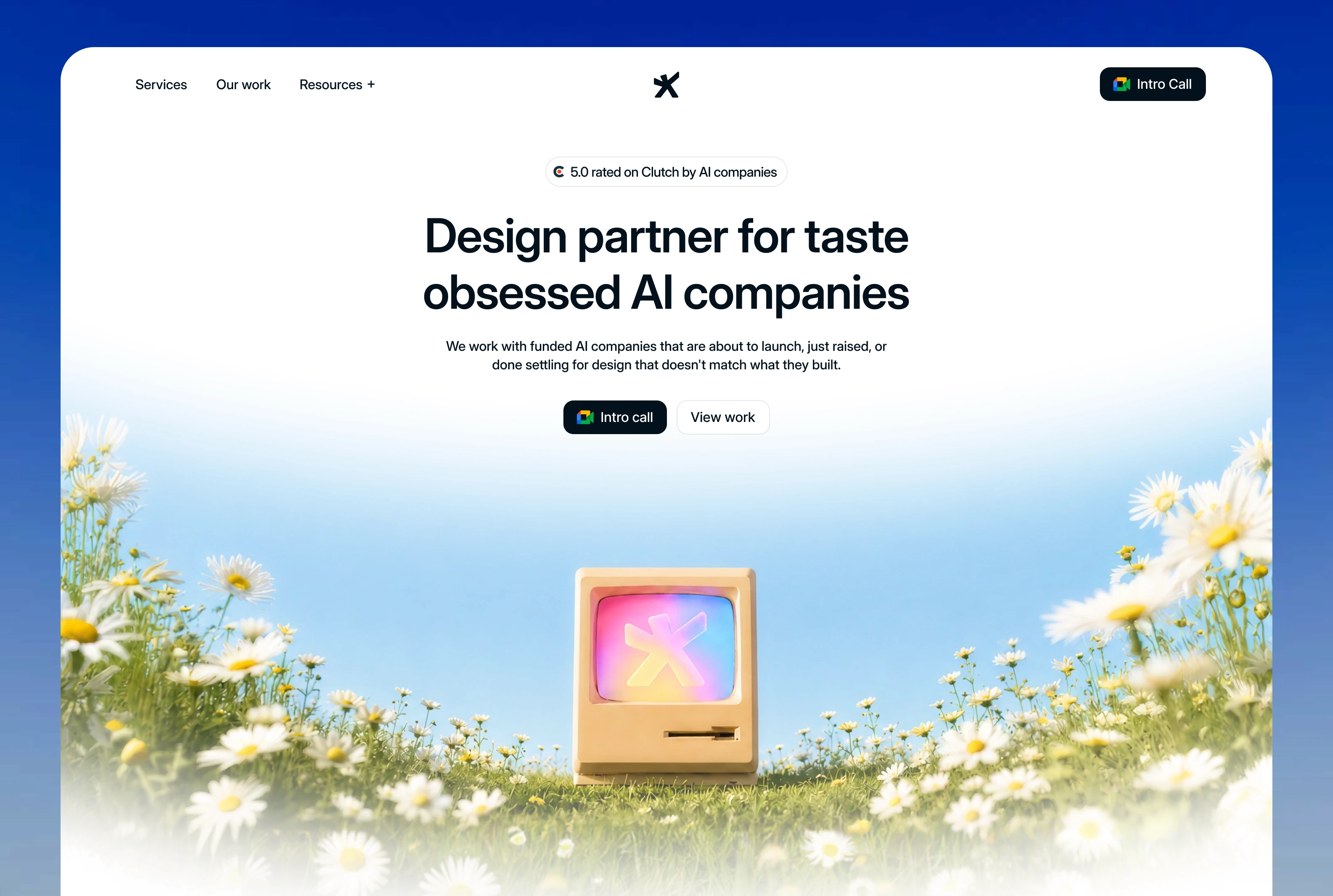
1. Studio Maydit: A Top-Rated Design Agency for AI Founders
Studio Maydit is a web and product design studio working with AI founders in the US, UK, and Europe. The studio builds websites in Framer, Webflow, and custom code, and continues into product design after the site ships.
The clearest outcome is Dualite, where design work supporting a repositioned ICP helped the product reach 100,000+ users in seven months. Recent clients include Wave, PixelFlow, Mi-VAD, and 15 other AI and SaaS teams.
Websites can be bought two ways. Fixed scope runs three to four weeks and suits teams with a launch date. Teams that keep shipping take a monthly retainer instead, covering new pages, campaigns, and product design, with no long lock-in. Fixed-scope projects end with a diagnosis of what is leaking in the product, not a handoff and goodbye.
Check | Finding |
|---|---|
Based in | Remote, serving US / UK / EU |
Platform depth | Framer, Webflow, and custom code |
AI-sector proof | Yes. AI-native clients, published outcome on Dualite |
Pricing | Fixed scope or monthly retainer, quoted per project |
Team shape | Founder-led, small senior team |
Best fit | Devtools teams who want the quickstart and pricing designed with the same care as the homepage |
Maydit is the right call if your marketing site is fine and the pages that actually convert developers have never been designed. Book a 30-minute call.

2. basement.studio
basement.studio is a team of 11 to 50 across Argentina and Los Angeles working for Vercel, Cursor, ElevenLabs, and Scale AI. For an AI devtool this is the most relevant client list on the page by a wide margin. Every one of those companies sells to engineers, and the studio has repeatedly had to earn credibility with an audience that opens the network tab. They also publish a minimum, so you can qualify quickly.
Their visual signature is strong and widely copied, which is an asset until your product calls for something plainer than what they are known for.
Check | Finding |
|---|---|
Based in | Mar del Plata, Argentina and Los Angeles, USA |
Founded | 2018 |
Team size | 11-50 |
Primary platform | Custom code |
AI-sector proof | Yes. Published AI client work |
Named clients | Vercel, Cursor, ElevenLabs, Harvey AI, Scale AI |
Pricing | Published minimum |
Best fit | AI devtools who want a site their developer audience respects immediately |
3. Phantom
Phantom is a London and Auckland studio of 51 to 200 building engineered web work for SAP, Zendesk, and the Financial Times. They have genuine depth in the browser, so an interactive playground where someone can run a real query without installing anything is within reach rather than aspirational.
They work at agency scale with the cost and process that implies, they do not publish pricing, and their centre of gravity is campaign work rather than the documentation surfaces a devtool lives on.
Check | Finding |
|---|---|
Based in | London, UK and Auckland, NZ |
Founded | 2013 |
Team size | 51-200 |
Primary platform | Custom code |
AI-sector proof | Yes. Published AI client work |
Named clients | Diageo, SAP, Financial Times, Zendesk |
Pricing | Not published |
Best fit | Funded devtools companies building a browser playground worth engineering properly |
4. Feels Like
Feels Like is a Los Angeles studio founded in 2023 with coded work for Google, Nike, and Suno AI. They write the front end themselves, and the Suno work matters here because it involved making a generative system understandable to someone encountering it for the first time. That is close to what a quickstart has to do.
They are young and small, publish neither team size nor pricing, and capacity at this stage is limited when projects overlap.
Check | Finding |
|---|---|
Based in | Los Angeles, USA |
Founded | 2023 |
Team size | Not published |
Primary platform | Custom code |
AI-sector proof | Yes. Published AI client work |
Named clients | Google, Nike, LVMH, Suno AI |
Pricing | Not published |
Best fit | Devtools teams who want a distinctive coded site and a demonstration that actually runs |
5. Engine Digital
Engine Digital has been running since 2002 out of Vancouver and New York, with work for Autodesk, Goldman Sachs, and HP. They are comfortable with real systems, so if your site has to authenticate users, meter a hosted trial, or connect to production infrastructure, that conversation goes somewhere useful.
Their AI-sector proof is partial, they publish no pricing or team size, and the enterprise process behind that capability is slower and more expensive than most devtools companies need.
Check | Finding |
|---|---|
Based in | Vancouver and New York |
Founded | 2002 |
Team size | Not published |
Primary platform | Custom code |
AI-sector proof | Partial. Enterprise and SaaS clients, no AI case study |
Named clients | Adidas, Autodesk, Goldman Sachs, HP |
Pricing | Not published |
Best fit | Enterprise devtools whose website has to sit inside real infrastructure |

6. Foundey
Foundey is a San Francisco studio founded in 2021 working with early AI companies including Traycer and Sero AI. Traycer is a developer tool, which makes this one of the more relevant portfolios here for an early team, and they are used to products that need explaining before they can be sold.
They work in Figma and do not own the build, so you supply the engineering, and they publish neither pricing nor team size.
Check | Finding |
|---|---|
Based in | San Francisco, USA |
Founded | 2021 |
Team size | Not published |
Primary platform | Figma-only |
AI-sector proof | Yes. Published AI client work |
Named clients | DemandIQ, Traycer, Sero AI |
Pricing | Not published |
Best fit | Devtools teams with strong front-end engineers who only need the design |
7. Kvalifik
Kvalifik is a Copenhagen studio of 11 to 50 with published AI client work and clients including Veo and Relesys. They are good at making a technical product legible to people outside engineering, which matters more for a devtool than founders expect. Your champion is a developer, but the person approving the invoice usually is not.
They are Webflow-first, so a heavily coded build is outside their core, and they do not publish pricing.
Check | Finding |
|---|---|
Based in | Copenhagen, Denmark |
Founded | 2015 |
Team size | 11-50 |
Primary platform | Webflow |
AI-sector proof | Yes. Published AI client work |
Named clients | Veo, Maersk, Relesys |
Pricing | Not published |
Best fit | European devtools who need the budget holder convinced as well as the engineer |
8. BX Studio
BX Studio is a New York studio of 11 to 50 with published AI client work including ASAPP, plus content-heavy builds for Reddit and Headspace. Devtools generate documentation, guides, and changelog entries continuously, and this is a team that builds sites where publishing that volume stays routine instead of becoming a project each time.
Webflow is their platform, so the coded parts of a devtools site would need someone else, and their founding year is not published.
Check | Finding |
|---|---|
Based in | New York, USA |
Founded | Not published |
Team size | 11-50 |
Primary platform | Webflow |
AI-sector proof | Yes. Published AI client work |
Named clients | Reddit, Headspace, ASAPP, Verifone |
Pricing | Published minimum |
Best fit | Devtools teams publishing guides and release notes every week |
9. Feely Studio
Feely Studio is a small distributed European team working with AI companies including Noxus and Basic Capital. They publish a starting figure, which for an early devtools team saves the qualification calls, and they are used to products at the stage where the explanation is still being worked out.
They are a one to ten person studio, so capacity is the constraint, and their published work is marketing sites rather than documentation systems or interactive demos.
Check | Finding |
|---|---|
Based in | Distributed, Europe |
Founded | Not published |
Team size | 1-10 |
Primary platform | Mixed |
AI-sector proof | Yes. Published AI client work |
Named clients | Noxus, Mutiny, Luasai, Basic Capital |
Pricing | Published minimum |
Best fit | Early European devtools who want a small senior team and a clear starting point |
10. Refokus
Refokus is a German remote studio of 11 to 50 with work for Mural, Spotify, and BCG. They build systematically, treating components and structure as the deliverable, which is the right instinct for a site where documentation, guides, and marketing pages all have to look like one product.
Their AI-sector work is partial, they do not publish pricing, and Webflow rather than coded work is where their depth sits.
Check | Finding |
|---|---|
Based in | Germany, remote |
Founded | 2021 |
Team size | 11-50 |
Primary platform | Webflow |
AI-sector proof | Partial. Enterprise and SaaS clients, no AI case study |
Named clients | Mural, BASF, Spotify, Yahoo, BCG |
Pricing | Not published |
Best fit | Devtools teams who need docs and marketing to feel like the same product |
How to choose between them
Sort by where developers are actually dropping out.
They arrive and do not believe you are a serious project. That is the homepage, and it is nine seconds. basement.studio or Feels Like.
They start the quickstart and stop halfway. That is the highest value work available to you. Studio Maydit or Foundey.
Docs and marketing look like two companies. Refokus or BX Studio.
Engineers love it and procurement kills it. Kvalifik, or Engine Digital if the buyer is genuinely enterprise.
One test before signing. Ask them to run your quickstart in front of you and narrate where they got confused. An agency that will actually do it, and comes back with three specific stumbling points, is going to be useful from week one. An agency that talks about the homepage instead has told you which part of your business they think a website is.
Custom code, or a platform with code on top
Devtool teams ask for custom code more often than they need it. The useful question is which parts of your site change every week and which parts almost never change. Docs, changelogs and quickstarts change constantly and belong close to your repository. Marketing pages change slowly and rarely justify a full custom build. Several of the studios above will tell you that on the first call, and a few will quote for everything regardless. Our guide to choosing an AI web development company covers the questions that separate those two answers.
If you want a straight opinion on which half of your site needs code, a 30 minute call is enough to get one.

Need more info?
Can't find your answer? Book a call and let's talk.
Continue Reading
10 Best Framer Design Agencies for AI Agent Startups - September 2026
What is the best Framer agency for an AI agent startup? Ten Framer studios ranked for agent products, with pricing, team size and AI work compared.

Siddarth Ponangi
10 Best Framer Design Agencies for Newly Funded Startups - September 2026
Your funding announcement is the biggest traffic day you will have all year. We checked 10 Framer agencies on five public criteria to see which can hit that date.
Siddarth Ponangi
10 Best Custom Code Website Development Agencies for AI Agent Startups - September 2026
AI web development agencies for agent startups. Which teams build custom coded sites a small team can still update weekly after launch.
Siddarth Ponangi