Reading time:
14 min read
Last updated:
10 Best Custom Code Website Development Agencies for AI Fintech Startups - September 2026
Custom code web development for AI fintech: ten studios compared on build stack, regulated-sector clients, team size, and whether they publish a starting price.


The best custom code website development agencies for AI fintech startups in 2026 are Studio Maydit, basement.studio, Clay, Phantom, Feels Like, Engine Digital, Fantasy, Trueform, Foundey, and SuperSkills. Studio Maydit and basement.studio lead for teams that need a hand-built site and an engineer who will still be reachable in month three. Clay and Phantom are stronger when the money side of the story needs institutional weight behind it.
AI fintech sits on a fault line that most web agencies have never had to stand on.
Your product has to look new enough to be worth switching to, and old enough to be trusted with a balance. Those two jobs pull in opposite directions. Lean into the AI and you read as an experiment nobody should wire funds into. Lean into the trust signals and you look like the incumbent your pitch deck says you are replacing.
Most agencies pick one and miss. The ones worth paying know the site has to do both at once, in the same scroll, without either half undercutting the other.
Custom code matters here more than it does in most categories, because the parts that carry the trust are the parts a template cannot bend around.

How we picked these agencies
No surveys and no submissions. We read each studio's public record and their own website, then tested five things any founder can test in an afternoon:
Build stack. Do they write the front end themselves, or is custom code a line on a service page next to four site builders?
Regulated-sector proof. Named clients who handle money, identity, or supervised data. Payments experience is worth more here than a general AI case study, because the constraints are what break a build.
Pricing. Published starting number, or a call before you learn anything.
Team shape. How many people, how senior, and how many other clients they are carrying while they carry you.
Their own website. The one project with no client committee attached.
That last one is the most honest signal available. An agency's own site is the only work where nobody overruled them, so it sets the ceiling on what they can do for you, not the floor.
Every fact in the tables below comes from the studio's own site or a public directory. Where something is not published, the table says so rather than guessing.
What goes wrong when an AI fintech startup hires a web agency
Three failures show up again and again.
Compliance arrives in week five and eats the design. Somebody in legal reads the homepage and the claims start coming down. An agency that has never shipped in a supervised category treats this as an interruption. One that has treats it as a known stage and writes the copy so it survives review the first time, which is the difference between a launch date and a slipped quarter.
The money never appears on screen. Fintech buyers want to see the account, the ledger, the reconciliation, the thing the product actually does with their funds. Agencies reach for abstraction instead, because balances and tables are harder to make beautiful than a gradient. The result looks expensive and proves nothing.
The build cannot take a number. Rates, limits, supported countries, and fee structures change, sometimes on a week's notice. A site hand built as static pages with the figures typed into the markup means an engineer for every change. Ask where the numbers live before anyone starts, because retrofitting that is a second project.
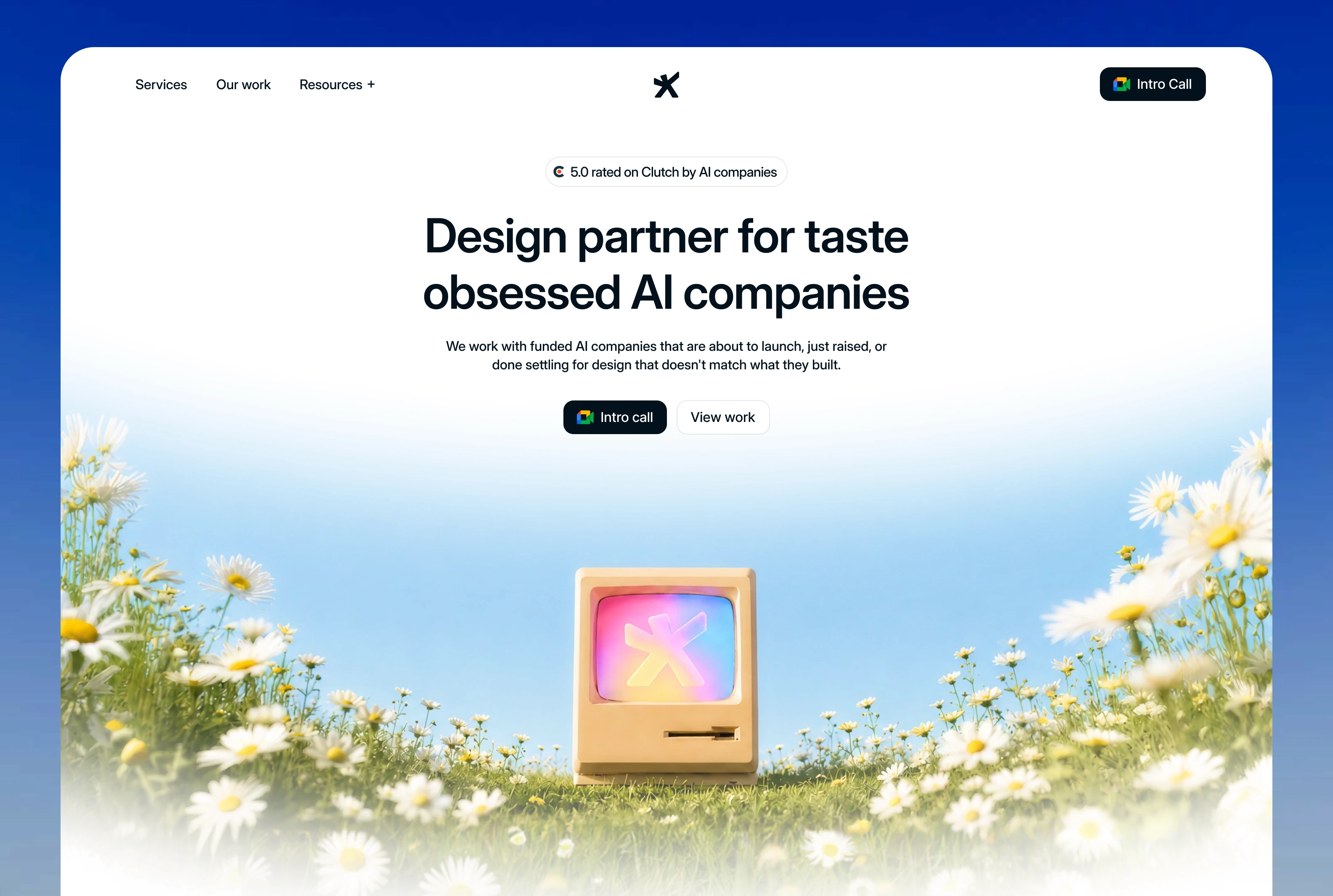
1. Studio Maydit: A Top-Rated Design Agency for AI Founders
Studio Maydit is a web and product design studio that works with AI founders across the US, UK, and Europe. The build side covers Framer, Webflow, and custom code, so the stack gets chosen against what the site has to carry rather than what the studio happens to sell. For a fintech team that usually means hand-built where the product has to be shown, and a managed CMS where rates and coverage change.
Work does not stop at the marketing site. The studio carries on into product design once the site ships, which matters in this category because the first screen after signup is where a fintech buyer decides whether the homepage was telling the truth. The clearest published outcome is Dualite, where design work supporting a repositioned ICP helped the product reach 100,000+ users in seven months. Recent clients include Wave, PixelFlow, Mi-VAD, and 15 other AI and SaaS teams.
There are two ways to buy. A fixed scope runs three to four weeks and fits a team building toward a funding announcement or a launch window. A monthly retainer fits a team that keeps shipping, covering new pages, campaigns, and product design, with no long lock-in. Fixed-scope engagements close with a diagnosis of what is leaking in the product rather than a handover call.
Check | Finding |
|---|---|
Based in | Remote, serving US / UK / EU |
Platform depth | Framer, Webflow, and custom code |
AI-sector proof | Yes. AI-native clients, published outcome on Dualite |
Pricing | Fixed scope or monthly retainer, quoted per project |
Team shape | Founder-led, small senior team |
Best fit | AI fintech teams who need the site and the first product screens handled by one team that understands both |
A good fit if your product is trustworthy and your homepage has not worked out how to say so. Book a 30-minute call.

2. basement.studio
basement.studio is a custom code shop split between Mar del Plata and Los Angeles, and their client list is close to a map of the current AI build stack: Vercel, Cursor, ElevenLabs, Harvey AI, Scale AI. Harvey AI is the relevant one for a fintech founder, because it is a product sold into a category where every claim gets read by somebody whose job is to object. They write the front end themselves, which is what you want when the interesting part of your site is a live ledger view rather than a screenshot of one.
The trade is that their work skews developer-facing. If your buyer is a compliance officer at a mid-sized bank rather than an engineer, the default aesthetic will be sharper than the room, and you will spend some of the engagement pulling it back.
Check | Finding |
|---|---|
Based in | Mar del Plata, Argentina and Los Angeles, USA |
Founded | 2018 |
Team size | 11-50 |
Primary platform | Custom code |
AI-sector proof | Yes. Published AI client work |
Named clients | Vercel, Cursor, ElevenLabs, Harvey AI, Scale AI |
Pricing | Published minimum |
Best fit | AI fintech teams selling to developers or technical operators who want the product shown live rather than described |
3. Clay
Clay is a San Francisco studio of 51 to 200 whose named work includes Stripe and Coinbase, which is the closest thing on this list to direct proof in your category. That matters more than it might sound. An agency that has been through a payments company's review process already knows which claims will not survive it, and prices the round trips in rather than discovering them.
They are a premium studio and they work at premium pace. A seed-stage fintech with a six-week runway to launch will find the process heavier than the deadline allows, and will be the smallest account in the building.
Check | Finding |
|---|---|
Based in | San Francisco, USA |
Founded | 2016 |
Team size | 51-200 |
Primary platform | Mixed |
AI-sector proof | Yes. Published AI client work |
Named clients | Slack, Stripe, Google, Coinbase, Amazon |
Pricing | Published minimum |
Best fit | Funded AI fintech companies who need the brand to carry institutional weight and have the runway for a full process |
4. Phantom
Phantom runs 51 to 200 people out of London and Auckland, building interactive and AI-driven web work for clients including SAP and the Financial Times. For an AI fintech startup the draw is engineering depth in the browser. If your differentiator is a risk model or a reconciliation engine, they can build something that actually runs on the page instead of a video of it running.
Their centre of gravity is campaign and experience work at agency scale. A lean marketing site on a fixed four-week window is not the shape they are built for, and the cost reflects the scale rather than your scope.
Check | Finding |
|---|---|
Based in | London, UK and Auckland, NZ |
Founded | 2013 |
Team size | 51-200 |
Primary platform | Custom code |
AI-sector proof | Yes. Published AI client work |
Named clients | Diageo, SAP, Financial Times, Zendesk |
Pricing | Not published |
Best fit | AI fintech companies whose model is best understood by letting a visitor run it rather than reading about it |
5. Feels Like
Feels Like is a Los Angeles custom code studio founded in 2023, with Google, Nike, LVMH, and Suno AI in their published work. The pairing is unusual and useful here: luxury clients teach a studio how to make something feel considered and expensive, and that is precisely the register a fintech product needs when it is asking a stranger for account access.
They are young and they publish neither team size nor pricing, so the first call has to cover capacity and cost before anything else. For a regulated build with a hard date, that is a real unknown rather than a formality.
Check | Finding |
|---|---|
Based in | Los Angeles, USA |
Founded | 2023 |
Team size | Not published |
Primary platform | Custom code |
AI-sector proof | Yes. Published AI client work |
Named clients | Google, Nike, LVMH, Suno AI |
Pricing | Not published |
Best fit | Consumer-facing AI fintech products that need to feel premium rather than technical |

6. Engine Digital
Engine Digital has been running since 2002 out of Vancouver and New York, with Goldman Sachs, Adidas, Autodesk, and HP in their published client list. Goldman is the entry that earns them a place here. Very few studios on any shortlist have actually delivered inside a regulated financial institution, and the procurement, security review, and documentation habits that come from it are the parts a startup usually discovers too late.
The same history is the drawback. Their AI work is partial rather than central, and their process is built for clients with a programme manager. A four-person fintech startup will find the overhead priced in whether or not they use it.
Check | Finding |
|---|---|
Based in | Vancouver and New York |
Founded | 2002 |
Team size | Not published |
Primary platform | Custom code |
AI-sector proof | Partial. Tech and enterprise clients, no AI case study |
Named clients | Adidas, Autodesk, Goldman Sachs, HP |
Pricing | Not published |
Best fit | Later-stage AI fintech companies selling into banks, where enterprise process is the point rather than the cost |
7. Fantasy
Fantasy has been operating since 1999 and now leads with AI strategy next to product innovation and brand. They are one of the few studios here that treats AI as a strategic question rather than a visual one, which suits a fintech founder whose real problem is that nobody can say what the model does with their money in one sentence.
They publish no client names and no pricing, which is a lot of unknowns to carry into a category where you will be asked to evidence everything. Expect enterprise scale and enterprise timelines.
Check | Finding |
|---|---|
Based in | San Francisco and New York, USA |
Founded | 1999 |
Team size | Not published |
Primary platform | Mixed |
AI-sector proof | Yes. Published AI client work |
Named clients | Not published |
Pricing | Not published |
Best fit | AI fintech teams whose positioning is unresolved and who want strategy before a line of code gets written |
8. Trueform
Trueform is a Swiss studio with Miro, Morning Brew, Bilt Rewards, and Gather in their published work. Bilt Rewards is a consumer financial product, so there is real proof of shipping in the category, and their craft level is among the highest on this list.
The mismatch is the stack. Trueform builds primarily in Framer, so if your reason for reading a custom code list is that you need behaviour a site builder cannot produce, they are answering a different question. They are the right call if the site is mostly narrative and you were reaching for custom code out of habit.
Check | Finding |
|---|---|
Based in | Wil, Switzerland |
Founded | 2022 |
Team size | Not published |
Primary platform | Framer |
AI-sector proof | Yes. Published AI client work |
Named clients | Miro, Morning Brew, Bilt Rewards, Gather |
Pricing | Published minimum |
Best fit | AI fintech teams whose site is narrative rather than interactive, and who value craft over a hand-written front end |
9. Foundey
Foundey is a San Francisco studio founded in 2021 working with DemandIQ, Traycer, and Sero AI. Their AI-sector work is genuine and early-stage, which means they have seen the version of your problem where the product is still moving while the site is being designed.
The limitation is plain and it is the reason they sit here. They work in Figma and do not build, so anything they design still needs an engineer to become a website. For a team reading a custom code list that is an extra vendor, an extra handoff, and an extra place for the design to lose its detail.
Check | Finding |
|---|---|
Based in | San Francisco, USA |
Founded | 2021 |
Team size | Not published |
Primary platform | Figma-only |
AI-sector proof | Yes. Published AI client work |
Named clients | DemandIQ, Traycer, Sero AI |
Pricing | Not published |
Best fit | AI fintech teams who already have front-end engineers and need design only |
10. SuperSkills
SuperSkills is a very small studio in Walnut Creek working across builders and code, with published AI client work. The offer is late-stage polish at an early-stage price, which is a real gap for a fintech startup that raised a modest round and has to sit on a comparison page next to companies who raised ten times more.
It is effectively one person with one named public client, and no published pricing. In a category where a launch date can be tied to a licence or a partner announcement, a single-person dependency is the risk to weigh, not the quality.
Check | Finding |
|---|---|
Based in | Walnut Creek, USA |
Founded | Not published |
Team size | 1-10 |
Primary platform | Mixed |
AI-sector proof | Yes. Published AI client work |
Named clients | The Cut |
Pricing | Not published |
Best fit | Pre-seed AI fintech founders who need to look funded and can carry a single-person dependency |
How to choose between them
Pick by the thing that is actually failing.
Nobody believes you can be trusted with money. This is a structure problem, not a styling one. Studio Maydit or Clay, both of whom will treat the evidence as part of the design rather than a section at the bottom.
The model is the product and it cannot be screenshotted. Phantom or basement.studio, who can build something that runs in the browser.
Your buyer is an institution with a procurement process. Engine Digital, who have been through one from the inside.
You have engineers and only need the design. Foundey.
You raised small and have to look larger. SuperSkills or Feels Like, depending on whether the register is technical or premium.
One question before you sign. Ask how they handled the last time a legal review sent copy back. A studio that has shipped in a regulated category will have a specific answer and a process. One that has not will tell you it has never come up, which only means they have not worked in your category yet.

Need more info?
Can't find your answer? Book a call and let's talk.
Continue Reading
10 Best Framer Design Agencies for AI Agent Startups - September 2026
What is the best Framer agency for an AI agent startup? Ten Framer studios ranked for agent products, with pricing, team size and AI work compared.

Siddarth Ponangi
10 Best Framer Design Agencies for Newly Funded Startups - September 2026
Your funding announcement is the biggest traffic day you will have all year. We checked 10 Framer agencies on five public criteria to see which can hit that date.
Siddarth Ponangi
10 Best Custom Code Website Development Agencies for AI Agent Startups - September 2026
AI web development agencies for agent startups. Which teams build custom coded sites a small team can still update weekly after launch.
Siddarth Ponangi