Reading time:
14 min read
Last updated:
10 Best Custom Code Website Development Agencies for AI Martech Startups - September 2026
Custom code web development for AI martech: ten studios compared on build stack, marketing-buyer clients, team size, and which ones publish a starting price.


The best custom code website development agencies for AI martech startups in 2026 are Studio Maydit, basement.studio, Clay, Feels Like, Phantom, Lazarev, Pixelmatters, Engine Digital, Push Refresh, and SuperSkills. Studio Maydit and basement.studio lead for teams who need the product demonstrated on the page rather than described. Clay and Feels Like are stronger when the brand has to hold its own against incumbents with ten times the budget.
Selling martech means your website is being graded by people who build websites for a living.
That is the whole difficulty. A head of growth evaluating your product will notice a slow page, a layout that breaks at 1440, and a case study with no numbers in it, because catching those things is literally their job. They will also open your site, look at how it was built, and draw a conclusion about your engineering before reading a word.
Most categories forgive an average website. Yours does not. A martech company with a mediocre site is making an argument against itself on the first screen.
Custom code earns its cost here for one reason: the thing your buyer is impressed by is usually something a page builder cannot do.

How we picked these agencies
Nobody nominated themselves. We went through each studio's public record and their own website, then tested five things that are visible without a sales call:
Build stack. Do they write the front end, or is custom code a line on a services page beside three site builders? Where the work actually happens changes what is possible.
Marketing-buyer proof. Named clients whose product is bought by a marketing team. Writing for a growth lead is a distinct skill, because that reader has already seen every pattern you are about to use on them.
Pricing. Published starting number, or nothing until you get on a call.
Team shape. Headcount, seniority, and how many accounts sit between you and the people building.
Their own website. The single project with no client approval in the way.
We lean hard on that last one for this category in particular. You are selling to marketers, so you are hiring a studio whose own marketing has to be good. If their site does not convince you, it will not convince the growth leads you are chasing either.
Everything in the tables comes from each studio's own site or a public directory listing. Where a figure is not public, we say so rather than estimate it.
What goes wrong when an AI martech startup hires a web agency
Three failures, and the first one is almost a category tradition.
The site becomes a showcase instead of an argument. Scroll-triggered everything, a hero that takes four seconds to settle, and a growth lead who has already checked the load time and left. In martech, performance is part of the pitch. A slow site says you cannot build fast software, however unfair that is.
The results are vague in a category that runs on numbers. Your buyer lives in dashboards and will not accept "improves engagement" from a company selling measurement. If the agency does not push you for specific figures and the conditions behind them, you will ship a page that sounds like every competitor.
The integrations get treated as a footnote. Martech buyers want to know what it connects to before almost anything else, because a tool that does not fit the stack is not a candidate. Agencies routinely put this in a logo strip near the bottom. It usually belongs much closer to the top, and that is a structural decision, not a styling one.
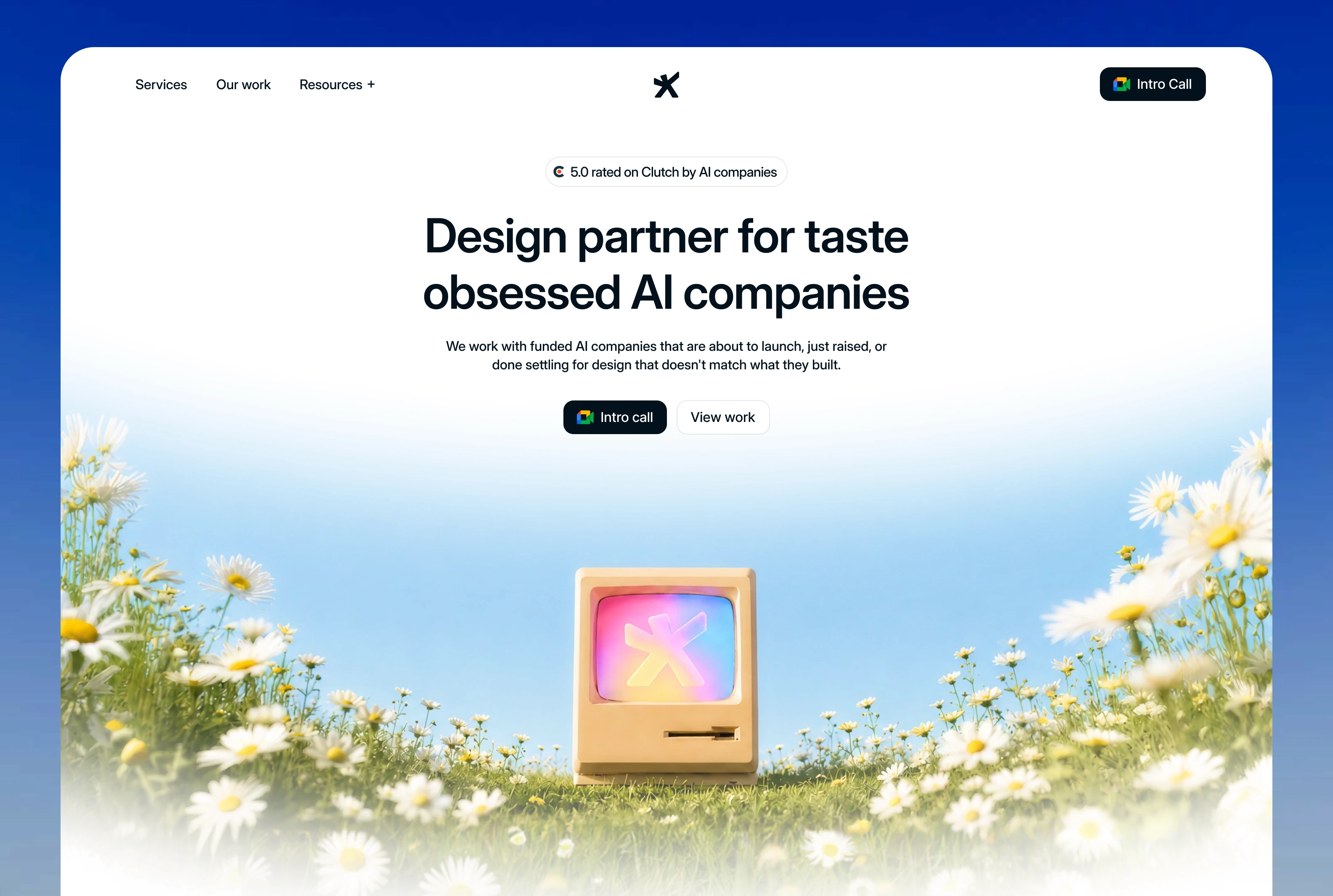
1. Studio Maydit: A Top-Rated Design Agency for AI Founders
Studio Maydit is a web and product design studio working with AI founders in the US, UK, and Europe. The build side spans Framer, Webflow, and custom code, which for a martech team usually means hand-built where the product has to run on the page and a managed system behind the pages your growth team will want to change weekly without asking anyone.
What tends to matter most in this category is that the work continues into product design after the site ships. Martech buyers convert on the page and then decide for real during the trial, and a homepage promise that the first session does not keep shows up as churn rather than as a website problem. The clearest published outcome is Dualite, where design work supporting a repositioned ICP helped the product reach 100,000+ users in seven months. Recent clients include Wave, PixelFlow, Mi-VAD, and 15 other AI and SaaS teams.
Engagements take two shapes. A fixed scope runs three to four weeks and suits a team aiming at a launch or a conference. A monthly retainer suits a team that keeps shipping, covering new pages, campaigns, and product design, with no long lock-in, which fits a martech company running campaigns continuously. Fixed-scope work ends with a diagnosis of what is leaking in the product.
Check | Finding |
|---|---|
Based in | Remote, serving US / UK / EU |
Platform depth | Framer, Webflow, and custom code |
AI-sector proof | Yes. AI-native clients, published outcome on Dualite |
Pricing | Fixed scope or monthly retainer, quoted per project |
Team shape | Founder-led, small senior team |
Best fit | AI martech teams who need a fast, hand-built site and campaign pages their own team can ship without an engineer |
Worth a call if your buyers judge software by its website and yours is losing that argument. Book a 30-minute call.

2. basement.studio
basement.studio writes front-end code out of Mar del Plata and Los Angeles, with Vercel, Cursor, ElevenLabs, Harvey AI, and Scale AI published. Vercel is the relevant one for martech, because it is a product sold to people who will inspect how the page was made, and basement's work there holds up under that inspection. If your differentiator is an attribution model or a live audience builder, they can make it run on the page rather than filming it.
The trade is register. Their default is developer-facing and confident, and a martech buyer who is a brand marketer rather than a growth engineer may find it cooler than the room. Expect to spend part of the engagement warming it.
Check | Finding |
|---|---|
Based in | Mar del Plata, Argentina and Los Angeles, USA |
Founded | 2018 |
Team size | 11-50 |
Primary platform | Custom code |
AI-sector proof | Yes. Published AI client work |
Named clients | Vercel, Cursor, ElevenLabs, Harvey AI, Scale AI |
Pricing | Published minimum |
Best fit | AI martech companies selling to growth engineers who want the product running live on the page |
3. Clay
Clay is a San Francisco studio of 51 to 200 whose published work includes Slack, Stripe, Google, Coinbase, and Amazon. Slack and Stripe are useful precedents for martech specifically: both are products whose marketing sites had to make a technical capability feel like an obvious business decision. They publish a starting price, which is rare at their tier.
They work at premium scale and premium pace. A seed-stage martech company with a conference date eight weeks out will find the process heavier than the deadline tolerates, and will be the smallest client in the room.
Check | Finding |
|---|---|
Based in | San Francisco, USA |
Founded | 2016 |
Team size | 51-200 |
Primary platform | Mixed |
AI-sector proof | Yes. Published AI client work |
Named clients | Slack, Stripe, Google, Coinbase, Amazon |
Pricing | Published minimum |
Best fit | Funded AI martech companies who need to look like a category standard rather than a challenger |
4. Feels Like
Feels Like is a Los Angeles custom code studio founded in 2023, with Google, Nike, LVMH, and Suno AI published. The luxury and consumer brand work is the point here. Martech is a crowded category where most sites look the same, and a studio fluent in making something feel considered rather than templated is a genuine differentiator when your buyer has seen forty competitors this quarter.
They are young and publish neither team size nor pricing. For a project tied to a campaign date, capacity and cost both need settling on the first call rather than assumed.
Check | Finding |
|---|---|
Based in | Los Angeles, USA |
Founded | 2023 |
Team size | Not published |
Primary platform | Custom code |
AI-sector proof | Yes. Published AI client work |
Named clients | Google, Nike, LVMH, Suno AI |
Pricing | Not published |
Best fit | AI martech companies competing on brand distinctiveness rather than on feature depth |
5. Phantom
Phantom runs 51 to 200 people across London and Auckland, building interactive and AI-driven web work for Diageo, SAP, the Financial Times, and Zendesk. Diageo is the relevant reference for martech, being consumer brand work at the scale where campaign infrastructure matters. If your product is best understood by letting somebody play with it, they have the browser engineering to build that properly.
Their shape is campaign and experience work at agency scale, which is not a lean marketing site on a four-week window. The cost tracks the scale of the studio rather than the size of your brief.
Check | Finding |
|---|---|
Based in | London, UK and Auckland, NZ |
Founded | 2013 |
Team size | 51-200 |
Primary platform | Custom code |
AI-sector proof | Yes. Published AI client work |
Named clients | Diageo, SAP, Financial Times, Zendesk |
Pricing | Not published |
Best fit | AI martech companies whose product needs to be experienced on the page to be believed |

6. Lazarev
Lazarev is a San Francisco studio of 51 to 200 with published AI work and clients including Payoneer, Peel, Elva, and Mozayix. They lead with research before design, which suits a martech company whose real problem is that the category language has collapsed and every competitor claims the same three outcomes. They publish a starting price, which at their size is unusual.
Custom code is not their specialism. They work across platforms, so if you came to this list because you need hand-written front end for something a builder cannot do, they are strong on the thinking and less pointed on the build.
Check | Finding |
|---|---|
Based in | San Francisco, USA |
Founded | 2015 |
Team size | 51-200 |
Primary platform | Mixed |
AI-sector proof | Yes. Published AI client work |
Named clients | Payoneer, Peel, Elva, Mozayix |
Pricing | Published minimum |
Best fit | AI martech companies whose positioning needs research before anyone opens a design file |
7. Pixelmatters
Pixelmatters is a Porto studio of 51 to 200 with Rubrik, Quantic, and UJET published, and a published starting price. UJET is a customer engagement platform, which is adjacent enough to martech that they have written for an operations buyer evaluating a stack. At their size they can run a site build and a product workstream together.
Their AI work is partial and their centre of gravity is product engineering rather than marketing craft. Expect structure and reliability rather than a strong argument about how your category should sound, which in a crowded market is the thing you most need.
Check | Finding |
|---|---|
Based in | Porto, Portugal |
Founded | 2013 |
Team size | 51-200 |
Primary platform | Mixed |
AI-sector proof | Partial. Tech and SaaS clients, no AI case study |
Named clients | Rubrik, Quantic, UJET |
Pricing | Published minimum |
Best fit | AI martech companies who need the marketing site and the product interface built by one team |
8. Engine Digital
Engine Digital has run since 2002 out of Vancouver and New York, with Adidas, Autodesk, Goldman Sachs, and HP published. Adidas is real consumer marketing experience at scale, and two decades of work means they have shipped through every kind of review process a large client can invent.
For an AI martech startup the mismatch is stage and speed. Their AI work is partial, their process assumes a programme manager on the client side, and they publish no pricing. A fast-moving martech team will pay for coordination it does not need and wait for approvals from people it does not employ.
Check | Finding |
|---|---|
Based in | Vancouver and New York |
Founded | 2002 |
Team size | Not published |
Primary platform | Custom code |
AI-sector proof | Partial. Tech and enterprise clients, no AI case study |
Named clients | Adidas, Autodesk, Goldman Sachs, HP |
Pricing | Not published |
Best fit | Later-stage AI martech companies selling into enterprise marketing organisations |
9. Push Refresh
Push Refresh is a small Dallas team of 1 to 10 with SmithRx, Synonym, and Northern National published, and a published starting price. You deal directly with the people doing the work, which makes for fast decisions and no account layer.
Two constraints put them here. They build primarily in Framer rather than writing custom front end, which is a different answer to the question this list asks. And at 1 to 10 people with partial AI-sector work, a martech build with a campaign deadline is a capacity question before it is anything else.
Check | Finding |
|---|---|
Based in | Dallas, USA |
Founded | Not published |
Team size | 1-10 |
Primary platform | Framer |
AI-sector proof | Partial. Tech and SaaS clients, no AI case study |
Named clients | SmithRx, Synonym, Northern National |
Pricing | Published minimum |
Best fit | Small AI martech teams whose site is narrative rather than interactive and who want direct senior contact |
10. SuperSkills
SuperSkills is a very small Walnut Creek studio working across platforms with published AI client work. The promise is a level of finish beyond what the price implies, which matters for a martech startup that lands on comparison pages next to companies with real marketing budgets.
It is effectively one person, with a single named public client and no published pricing. Martech sites tend to grow quickly, with campaign pages, a resource library, and landing pages per segment. That trajectory is a poor match for a single-person dependency, and it is the reason they sit last rather than anything about the work.
Check | Finding |
|---|---|
Based in | Walnut Creek, USA |
Founded | Not published |
Team size | 1-10 |
Primary platform | Mixed |
AI-sector proof | Yes. Published AI client work |
Named clients | The Cut |
Pricing | Not published |
Best fit | Very early AI martech founders who need one strong page rather than a growing site |
How to choose between them
Choose against the specific thing that is costing you deals.
The product is impressive and the page cannot show it. basement.studio or Phantom, both of whom can make it run in the browser.
You look smaller than you are. Clay or Feels Like, depending on whether you want institutional weight or distinctiveness.
Everyone in your category says the same three things. Lazarev, who start from research rather than layout.
Your growth team needs to ship landing pages without an engineer. Studio Maydit or Pixelmatters, where the content system is designed as part of the build.
You are selling into enterprise marketing departments. Engine Digital.
One test worth running on every shortlist. Open their last three client sites on a phone on a normal connection and time the first meaningful paint yourself. You are selling to people who will do exactly this to you.

Need more info?
Can't find your answer? Book a call and let's talk.
Continue Reading
10 Best Framer Design Agencies for AI Agent Startups - September 2026
What is the best Framer agency for an AI agent startup? Ten Framer studios ranked for agent products, with pricing, team size and AI work compared.

Siddarth Ponangi
10 Best Framer Design Agencies for Newly Funded Startups - September 2026
Your funding announcement is the biggest traffic day you will have all year. We checked 10 Framer agencies on five public criteria to see which can hit that date.
Siddarth Ponangi
10 Best Custom Code Website Development Agencies for AI Agent Startups - September 2026
AI web development agencies for agent startups. Which teams build custom coded sites a small team can still update weekly after launch.
Siddarth Ponangi