Reading time:
13 min read
Last updated:
10 Best Custom Code Website Development Agencies for AI Startups - September 2026
AI web development companies that write custom code instead of assembling templates. We checked the stack, the published minimum, the team shape and the AI work.


The best custom code website development agencies for AI startups in 2026 are Studio Maydit, Engine Digital, Phantom, Feels Like, basement.studio, SuperSkills, Digidop, Refokus, Feely Studio, and Fantasy. Studio Maydit and basement.studio lead for AI teams who need one genuinely coded surface and want the rest kept editable. Engine Digital and Fantasy are the wrong fit unless you are buying at enterprise scale.
There is one good reason to write a marketing site by hand, and it is not that your team could.
The reason is that something on the site has to actually run. A visitor types a prompt and watches your model respond. A page renders a live result from your API. A visualisation shows a real inference happening rather than a recorded loop. Anything of that kind belongs in code, because no visual builder will do it properly, and that page will convert better than everything else on the site combined.
Everything around it, though, is ordinary. A homepage, a pricing page, an about page, a set of use cases, a changelog. These are documents. They contain text, images, and links, they change often, and they are read once and left. Building them in code buys you nothing a visitor can see, and it costs you something specific: from that day forward, editing a sentence requires a person who can run your build.
Most AI startups notice the demo requirement, correctly conclude they need code, and then quietly extend that conclusion to the whole site. Eight months later the demo is the best thing they own and every other page still says what they believed at launch, because changing it means asking an engineer.
The teams that get this right treat it as two separate purchases and often two separate tools.

How we picked these agencies
This is a teardown, not a directory listing. For each agency we read their own site and their public record, then checked five things you can verify yourself in an afternoon:
Platform depth. Is coded web work the main craft, or one line on a long service menu?
AI-sector proof. Named AI clients and published work, or just the word "AI" in the copy?
Pricing. Do they publish a minimum at all, or keep it behind a call?
Team shape. Who actually does the work, and how many clients are they carrying at once?
Their own site. Distinctive, or the same template as everyone else on this list?
That last one gets skipped most often. An agency's own website is the only project where nobody overruled them. No client committee, no inherited brand book. If their own site is forgettable, you have found their ceiling.
Every fact below comes from the agency's own site or a public listing. Where a number is not public, we say so rather than guessing.
What goes wrong when an AI startup writes its site by hand
Three failures repeat, and none of them shows up until months after launch.
The whole site got coded because one page needed to be. The demo is the justification, and it is a real one. But the justification then covers the pricing page, the careers page, and the twelve use-case pages that came later, none of which do anything a document cannot do. You end up maintaining a full application to publish paragraphs. The version that works is narrower: build the interactive surface properly in code, put everything else somewhere a non-engineer can edit, and connect the two with shared styling so a visitor never notices the seam. Almost nobody proposes this, because it is a smaller project to sell.
Somebody built it and nobody was assigned to run it. A coded site is software, and software has an ongoing cost that no proposal mentions. Dependencies age. A framework releases a major version. The hosting configuration needs attention. The engineer who set up the deployment pipeline moves to the inference team and takes the context with them. Six months on, a small change carries an unreasonable amount of risk, because nobody currently at the company fully understands the build. Before signing, name the person responsible for this in a year. If that person does not exist yet, you are choosing the more expensive option twice over.
The site ends up queued behind the product. Your engineers have a roadmap, and a homepage copy change will never outrank a customer-facing bug. That is the correct prioritisation and it is exactly the problem. Marketing asks for a headline change, it goes into a backlog, and three weeks later it ships or it does not. What actually happens next is predictable: people stop asking. The site freezes at whatever you believed on launch day, while your product, positioning, and pricing all keep moving. For an AI company, where the story changes every quarter, a frozen site is a serious cost and it is entirely self-inflicted.
1. Studio Maydit: A Top-Rated Design Agency for AI Founders
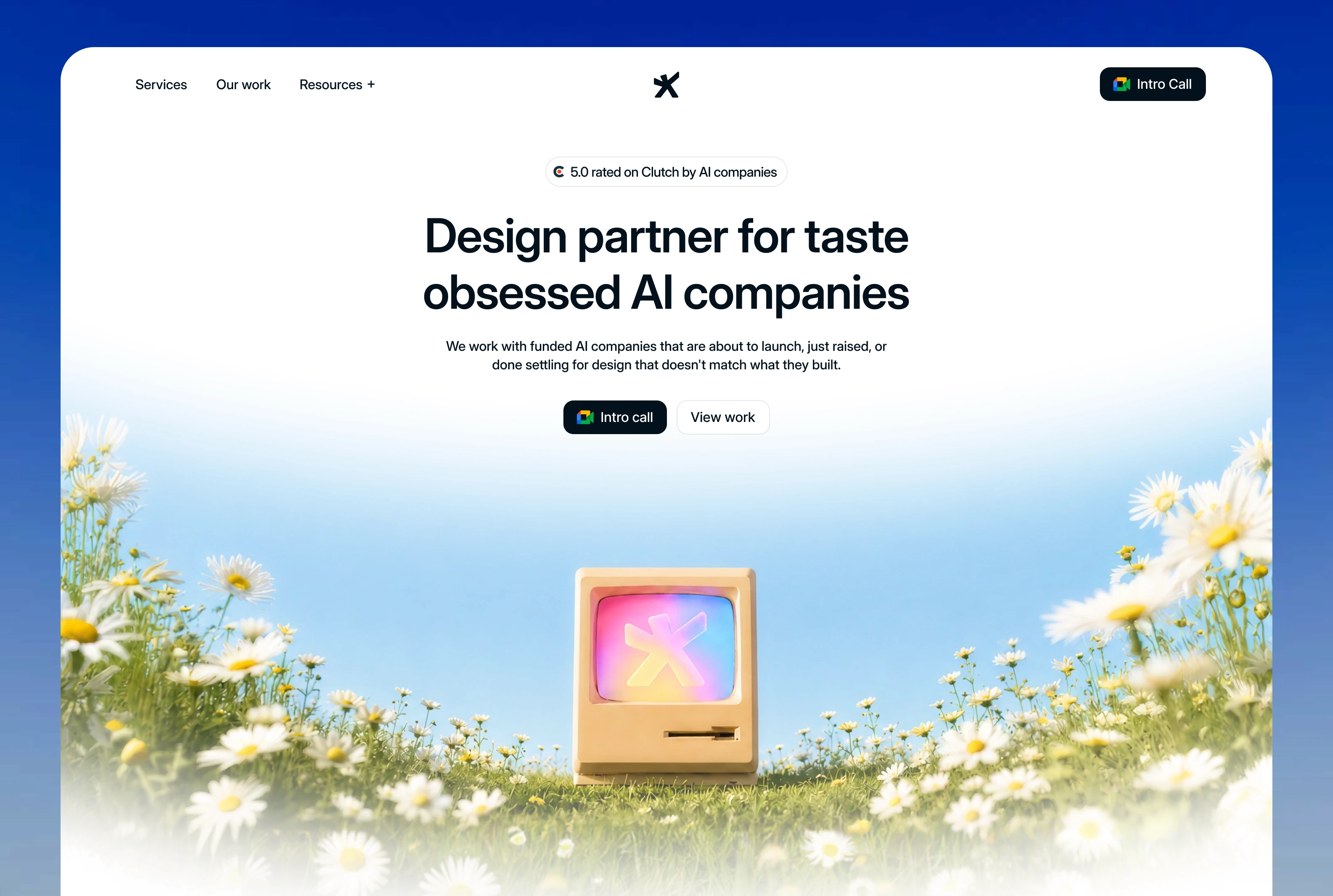
Studio Maydit is a web and product design studio working with AI founders in the US, UK, and Europe. The studio builds websites in Framer, Webflow, and custom code, and continues into product design after the site ships.
The clearest outcome is Dualite, where design work supporting a repositioned ICP helped the product reach 100,000+ users in seven months. Recent clients include Wave, PixelFlow, Mi-VAD, and 15 other AI and SaaS teams.
Websites can be bought two ways. Fixed scope runs three to four weeks and suits teams with a launch date. Teams that keep shipping take a monthly retainer instead, covering new pages, campaigns, and product design, with no long lock-in. Fixed-scope projects end with a diagnosis of what is leaking in the product, not a handoff and goodbye.
Check | Finding |
|---|---|
Based in | Remote, serving US / UK / EU |
Platform depth | Framer, Webflow, and custom code |
AI-sector proof | Yes. AI-native clients, published outcome on Dualite |
Pricing | Fixed scope or monthly retainer, quoted per project |
Team shape | Founder-led, small senior team |
Best fit | AI teams who want the demo coded properly and the rest of the site left editable |
Maydit is the right call if you want the interactive page engineered and the other twenty pages out of the engineering queue. Book a 30-minute call.

2. Engine Digital
Engine Digital has run since 2002 out of Vancouver and New York with work for Autodesk, Goldman Sachs, and HP. They are comfortable with sites that touch real systems, so if yours has to authenticate users, meter a hosted trial, or pass a security review, that conversation goes somewhere useful rather than into a caveat.
They publish neither pricing nor team size, their AI-sector proof is partial, and the enterprise process behind that capability is slower and costlier than most AI startups need.
Check | Finding |
|---|---|
Based in | Vancouver and New York |
Founded | 2002 |
Team size | Not published |
Primary platform | Custom code |
AI-sector proof | Partial. Enterprise and SaaS clients, no AI case study |
Named clients | Adidas, Autodesk, Goldman Sachs, HP |
Pricing | Not published |
Best fit | Larger AI companies whose site must sit inside real infrastructure |
3. Phantom
Phantom is a London and Auckland studio of 51 to 200 building engineered web work for SAP, Zendesk, and the Financial Times. Genuine browser depth, which means an in-page experience where a visitor runs something real against your model is achievable rather than aspirational.
They do not publish pricing, they operate at agency scale and cost, and their centre of gravity is campaign work rather than the long-lived pages an AI startup accumulates.
Check | Finding |
|---|---|
Based in | London, UK and Auckland, NZ |
Founded | 2013 |
Team size | 51-200 |
Primary platform | Custom code |
AI-sector proof | Yes. Published AI client work |
Named clients | Diageo, SAP, Financial Times, Zendesk |
Pricing | Not published |
Best fit | Funded AI companies building one ambitious interactive page |
4. Feels Like
Feels Like is a Los Angeles studio founded in 2023 with coded work for Google, Nike, and Suno AI. The Suno project is the relevant one, since it involved making a generative system understandable to someone meeting it for the first time, which is what your demo page has to do in about twenty seconds.
They are young and small, publish neither team size nor pricing, and capacity is limited when projects overlap.
Check | Finding |
|---|---|
Based in | Los Angeles, USA |
Founded | 2023 |
Team size | Not published |
Primary platform | Custom code |
AI-sector proof | Yes. Published AI client work |
Named clients | Google, Nike, LVMH, Suno AI |
Pricing | Not published |
Best fit | AI startups whose main asset is a demonstration people can actually run |
5. basement.studio
basement.studio is a team of 11 to 50 across Argentina and Los Angeles working for Vercel, Cursor, ElevenLabs, and Scale AI, and they publish a minimum. That is the most directly comparable client list here. Every one of those companies ships coded marketing surfaces for a technical audience, and the studio has had to meet that standard repeatedly.
Their visual signature is distinctive enough to shape your brand rather than serve it, and like any coded build, what they hand over becomes yours to run.
Check | Finding |
|---|---|
Based in | Mar del Plata, Argentina and Los Angeles, USA |
Founded | 2018 |
Team size | 11-50 |
Primary platform | Custom code |
AI-sector proof | Yes. Published AI client work |
Named clients | Vercel, Cursor, ElevenLabs, Harvey AI, Scale AI |
Pricing | Published minimum |
Best fit | AI startups who want a coded site their technical audience respects on sight |

6. SuperSkills
SuperSkills is a one to ten person studio in Walnut Creek with published AI client work. A very small team suits the split approach well, because one senior person can hold both halves of the site in their head and will not propose a large coded build to fill a schedule.
They publish neither pricing nor a broad client list, and heavy front-end engineering is not where a team this size has depth.
Check | Finding |
|---|---|
Based in | Walnut Creek, USA |
Founded | Not published |
Team size | 1-10 |
Primary platform | Mixed |
AI-sector proof | Yes. Published AI client work |
Named clients | The Cut |
Pricing | Not published |
Best fit | AI startups who want one senior designer across a small mixed build |
7. Digidop
Digidop is a Paris studio of one to ten with published pricing and clients including StreamNative and Ramify. StreamNative is worth noting, since data infrastructure carries the same problem your site does, where the audience is technical and the pages still need to be editable by someone who is not.
They are Webflow-first, so a genuinely coded demo would need another vendor, and their AI-sector proof is partial.
Check | Finding |
|---|---|
Based in | Paris, France |
Founded | 2021 |
Team size | 1-10 |
Primary platform | Webflow |
AI-sector proof | Partial. Enterprise and SaaS clients, no AI case study |
Named clients | TSE Energy, Ramify, StreamNative |
Pricing | Published minimum |
Best fit | European AI teams who need the editable half done well and cheaply |
8. Refokus
Refokus is a German remote studio of 11 to 50 with work for Mural, Spotify, and BCG. They build systematically, treating structure and components as the deliverable, which is the discipline that makes a split site work. The coded demo and the editable pages have to feel like one product, and that is a systems problem before it is a visual one.
Their AI-sector proof is partial, they do not publish pricing, and Webflow rather than coded work is where their depth sits.
Check | Finding |
|---|---|
Based in | Germany, remote |
Founded | 2021 |
Team size | 11-50 |
Primary platform | Webflow |
AI-sector proof | Partial. Enterprise and SaaS clients, no AI case study |
Named clients | Mural, BASF, Spotify, Yahoo, BCG |
Pricing | Not published |
Best fit | AI teams whose coded and editable pages must look like one site |
9. Feely Studio
Feely Studio is a small distributed European team with published pricing and clients including Noxus and Basic Capital. They work with AI companies at the stage where the explanation is still moving, and the published figure means the budget conversation happens before you invest time in a shortlist.
At one to ten people capacity is the limit, and their published work is marketing sites rather than engineered interactive builds.
Check | Finding |
|---|---|
Based in | Distributed, Europe |
Founded | Not published |
Team size | 1-10 |
Primary platform | Mixed |
AI-sector proof | Yes. Published AI client work |
Named clients | Noxus, Mutiny, Luasai, Basic Capital |
Pricing | Published minimum |
Best fit | Early European AI teams who want a small senior team and a clear number |
10. Fantasy
Fantasy has run since 1999 across San Francisco and New York with published AI client work. They are product-led, which is relevant if the honest diagnosis is that your website is fine and the product is where people are getting lost. A coded marketing site will not fix that, and this team would say so.
They publish neither pricing, team size, nor client names, and they are priced for companies far larger than most AI startups.
Check | Finding |
|---|---|
Based in | San Francisco and New York, USA |
Founded | 1999 |
Team size | Not published |
Primary platform | Mixed |
AI-sector proof | Yes. Published AI client work |
Named clients | Not published |
Pricing | Not published |
Best fit | Established AI companies whose product needs more attention than the site |
How to choose between them
Sort by which part genuinely needs engineering.
One page has to run something real. Studio Maydit or Feels Like.
Your buyer is technical and the site has to earn respect instantly. basement.studio or Phantom.
The two halves need to look like one product. Refokus or Studio Maydit.
The site must reach real infrastructure or pass a security review. Engine Digital, or Phantom at a smaller scale.
One test before signing. Ask which pages they would build without code and why. An agency that names most of them and explains the maintenance cost is telling you something against its own interest, which is the strongest signal available. An agency that proposes coding everything has quoted the largest project it could justify, and you will be paying for that decision every quarter for years.

Need more info?
Can't find your answer? Book a call and let's talk.
Continue Reading
10 Best Framer Design Agencies for AI Agent Startups - September 2026
What is the best Framer agency for an AI agent startup? Ten Framer studios ranked for agent products, with pricing, team size and AI work compared.

Siddarth Ponangi
10 Best Framer Design Agencies for Newly Funded Startups - September 2026
Your funding announcement is the biggest traffic day you will have all year. We checked 10 Framer agencies on five public criteria to see which can hit that date.
Siddarth Ponangi
10 Best Custom Code Website Development Agencies for AI Agent Startups - September 2026
AI web development agencies for agent startups. Which teams build custom coded sites a small team can still update weekly after launch.
Siddarth Ponangi