
Summarize with AI


The best custom code website development agencies for engineer-led startups in 2026 are Studio Maydit, Engine Digital, Feels Like, Phantom, basement.studio, Refokus, Edgar Allan, Ramotion, Pixelmatters, and Instrument. Studio Maydit and basement.studio lead for teams who will read every line and want to. Engine Digital and Instrument are the wrong fit unless you are running a large in-house team with a brand function attached.
You can build this yourself. That is the reason it has not been built.
An engineer-led startup does not hire a website agency because it lacks the ability. It hires one because the site has been on the roadmap for nine months behind things that matter more, and it will stay there. That is a completely rational allocation of your own time. The trouble starts because the same competence that made the delay rational also makes you a difficult client, and nobody warns you about that part.
Here is how it goes. The kickoff turns into a stack conversation. Someone asks which framework, someone else has a view on the build pipeline, and forty minutes disappear into a discussion your team enjoys and could have had internally for free. The agency, wanting to prove they are serious, meets you there. Two weeks in, the technical approach is settled, everyone is happy, and nobody has yet said a single sentence about what the site is supposed to argue.
Then the site ships. It is fast. The Lighthouse score is excellent. The animation is tasteful and the code is clean, and your traffic does not convert any better than before, because a well-built page that makes a generic claim performs exactly like a badly built page that makes a generic claim.
That is the split across these ten. Not who can write the code you would approve of, since most of them can, but who will spend your first week on the argument instead of the architecture.

How we picked these agencies
This is a teardown, not a directory listing. For each agency we read their own site and their public record, then checked five things you can verify yourself in an afternoon:
- Platform depth. Is custom code their main craft, or one line on a long service menu?
- AI-sector proof. Named AI clients and published work, or just the word "AI" in the copy?
- Pricing. Do they publish a minimum at all, or keep it behind a call?
- Team shape. Who actually does the work, and how many clients are they carrying at once?
- Their own site. Distinctive, or the same template as everyone else on this list?
That last one gets skipped most often. An agency's own website is the only project where nobody overruled them. No client committee, no inherited brand book. If their own site is forgettable, you have found their ceiling.
Every fact below comes from the agency's own site or a public listing. Where a number is not public, we say so rather than guessing.
What goes wrong when the client can read the code
Three failures are close to universal on these projects, and every one of them is caused by the client's strengths rather than the agency's weaknesses.
The project becomes a code review and the positioning never happens. Your team is genuinely good at evaluating implementation, so that is what gets evaluated. Pull requests get comments. The bundle size gets discussed. Meanwhile the headline was written by whoever had a spare hour, reviewed by nobody, and shipped because it was not the part anyone felt qualified to argue about. The asymmetry is the whole problem: you apply a high standard to the half you understand and no standard at all to the half that determines whether the site works. Fix it structurally. Spend week one on the claim with the same seriousness you would spend on a design document, and make the technical conversation wait until the argument is agreed.
You build eighty percent yourself and outsource the hardest twenty. It starts sensibly. Your team stands up the repo, the deploy, and the component library in a weekend, because that part is genuinely quick for you. Then the agency arrives to do the remaining work and inherits your conventions, your half-finished decisions, and a codebase written at internal-tooling standards by people who were not planning to hand it over. What should have been a clean four-week build becomes six weeks of archaeology, and everyone is frustrated because the estimate was made against a different reality. Either own the whole build or hand over the whole build. The split version is the most expensive arrangement available.
Handover is treated as a delivery date rather than a design constraint. Your team will maintain this site, and probably rewrite parts of it within a year. That makes conventions, naming, and the shape of the content model more important than in almost any other engagement, and it is exactly the thing that gets left to the final week. The site ships, the agency leaves, and three months later your team is working around decisions nobody documented and cannot ask about. Agree the conventions in week one, in writing, the same way you would for any dependency you plan to keep. Handover is not a phase. It is a requirement that shapes every file.
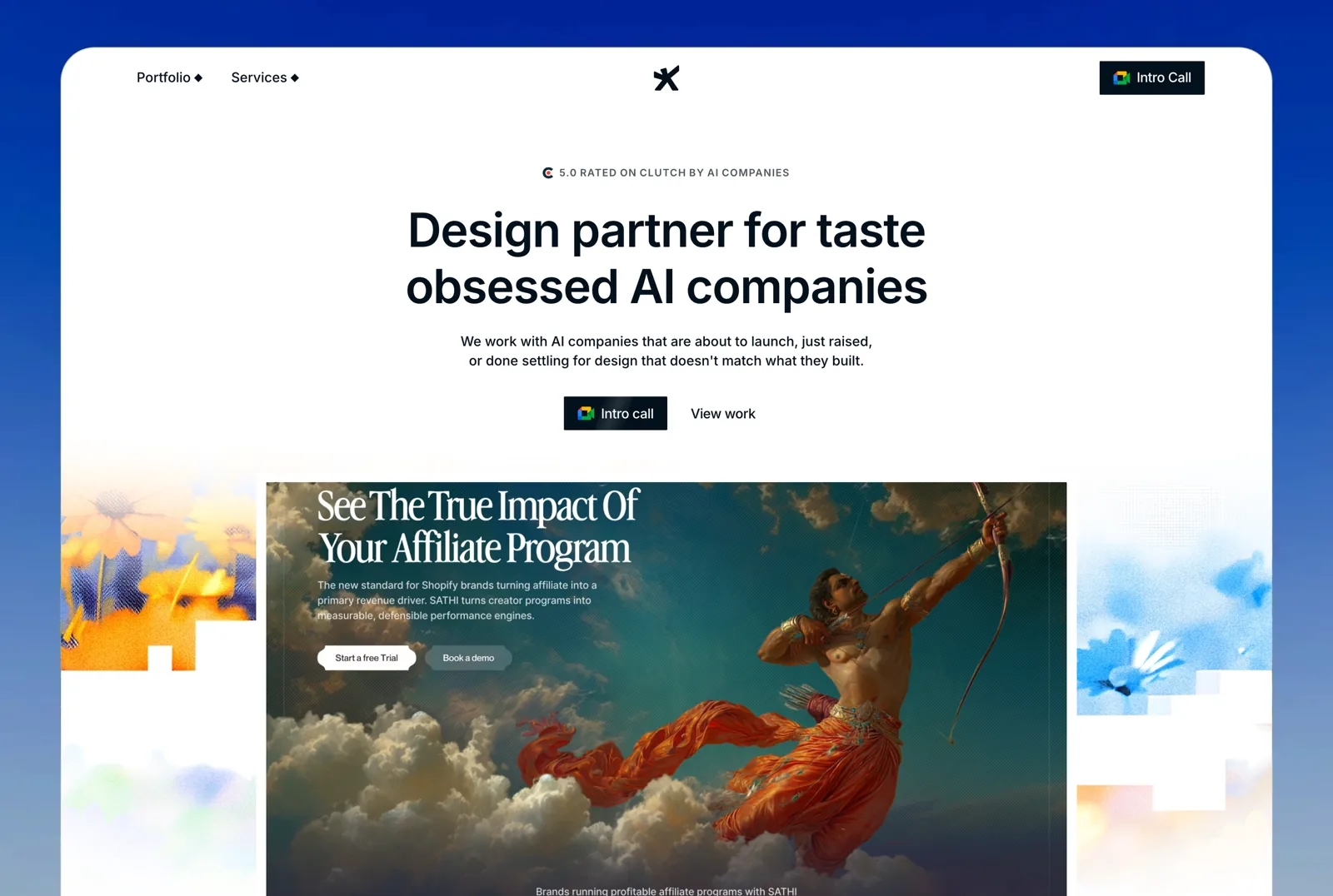
1. Studio Maydit: A Top-Rated Design Agency for AI Founders
Studio Maydit is a web and product design studio working with AI founders in the US, UK, and Europe. The studio builds websites in Framer, Webflow, and custom code, and continues into product design after the site ships.
The clearest outcome is Dualite, where design work supporting a repositioned ICP helped the product reach 100,000+ users in seven months. Recent clients include Wave, PixelFlow, Mi-VAD, and 15 other AI and SaaS teams.
Websites can be bought two ways. Fixed scope runs three to four weeks and suits teams with a launch date. Teams that keep shipping take a monthly retainer instead, covering new pages, campaigns, and product design, with no long lock-in. Fixed-scope projects end with a diagnosis of what is leaking in the product, not a handoff and goodbye.
| Check | Finding |
|---|---|
| Based in | Remote, serving US / UK / EU |
| Platform depth | Framer, Webflow, and custom code |
| AI-sector proof | Yes. AI-native clients, published outcome on Dualite |
| Pricing | Fixed scope or monthly retainer, quoted per project |
| Team shape | Founder-led, small senior team |
| Best fit | Engineer-led teams who need the argument settled before the stack |
Maydit is the right call if your build quality is already high and the site still says nothing specific. Book a 30-minute call.

2. Engine Digital
Engine Digital has written custom code since 2002 out of Vancouver and New York, with Adidas, Autodesk, and HP published. Two decades of custom work means they have handed over more codebases than most studios have built, and process maturity is worth a lot when your team is going to inherit and extend everything they write.
They publish neither pricing nor team size, their AI-sector proof is partial, and the engagement scale assumes a client with a brand function and a budget cycle rather than a founding team.
| Check | Finding |
|---|---|
| Based in | Vancouver and New York |
| Founded | 2002 |
| Team size | Not published |
| Primary platform | Custom code |
| AI-sector proof | Partial. Enterprise and SaaS clients, no AI case study |
| Named clients | Adidas, Autodesk, Goldman Sachs, HP |
| Pricing | Not published |
| Best fit | Larger engineering organisations with a formal handover requirement |
3. Feels Like
Feels Like is a Los Angeles studio founded in 2023 with published AI client work including Suno AI, alongside Google and Nike. Their visual ambition is the useful part for an engineer-led team, because the failure mode you are most exposed to is a technically excellent site that looks like every other technically excellent site.
They publish neither pricing nor team size, and a studio founded in 2023 has a shorter public record of long-term maintenance and handover than the older names here.
| Check | Finding |
|---|---|
| Based in | Los Angeles, USA |
| Founded | 2023 |
| Team size | Not published |
| Primary platform | Custom code |
| AI-sector proof | Yes. Published AI client work |
| Named clients | Google, Nike, LVMH, Suno AI |
| Pricing | Not published |
| Best fit | Technical teams whose site is competent and completely forgettable |
4. Phantom
Phantom is a London and Auckland firm of 51 to 200 writing custom code, with published AI client work and the Financial Times, SAP, and Zendesk published. Content-heavy clients at that scale mean they think about the content model seriously, which is the part of a custom build your team will curse for years if it is wrong.
They publish no pricing, the engagement scale is well above an early startup, and the process weight that makes them reliable for large clients slows a small team down.
| Check | Finding |
|---|---|
| Based in | London, UK and Auckland, NZ |
| Founded | 2013 |
| Team size | 51-200 |
| Primary platform | Custom code |
| AI-sector proof | Yes. Published AI client work |
| Named clients | Diageo, SAP, Financial Times, Zendesk |
| Pricing | Not published |
| Best fit | Teams whose site is content-heavy enough to need a real model |
5. basement.studio
basement.studio is an 11 to 50 team across Argentina and Los Angeles, with a published minimum and Vercel, Cursor, and Scale AI in public. This is the closest cultural match on the list for an engineer-led startup. Their clients are companies whose own users are developers, and their work is admired by exactly the people on your team who will be reviewing it.
Their strongest work is ambitious and interaction-heavy, which raises the maintenance burden your team inherits, and they will be honest that not every slot is open next month.
| Check | Finding |
|---|---|
| Based in | Mar del Plata, Argentina and Los Angeles, USA |
| Founded | 2018 |
| Team size | 11-50 |
| Primary platform | Custom code |
| AI-sector proof | Yes. Published AI client work |
| Named clients | Vercel, Cursor, ElevenLabs, Harvey AI, Scale AI |
| Pricing | Published minimum |
| Best fit | Teams whose engineers have to respect the work to accept it |
6. Refokus
Refokus is a remote German studio of 11 to 50 with Mural, Spotify, and BCG published. Their work is visually assertive in a way that engineer-led sites almost never are, and if your problem is that the site reads as an internal tool rather than a product, that is the correction.
They publish no pricing, their AI-sector proof is partial, Webflow rather than custom code is the primary platform, and heavily styled work is harder for an in-house team to extend without breaking the effect.
| Check | Finding |
|---|---|
| Based in | Germany, remote |
| Founded | 2021 |
| Team size | 11-50 |
| Primary platform | Webflow |
| AI-sector proof | Partial. Enterprise and SaaS clients, no AI case study |
| Named clients | Mural, BASF, Spotify, Yahoo, BCG |
| Pricing | Not published |
| Best fit | Teams whose site reads like an internal tool rather than a product |
7. Edgar Allan
Edgar Allan is an Atlanta team of 51 to 200 who work on language before layout, with Porsche and NCR published. For an engineer-led startup this is the least comfortable and most valuable purchase on the list, because the part your team consistently underweights is the sentence, and this agency will refuse to move past it.
They publish no pricing, their AI-sector proof is partial, Webflow rather than custom code is the practice, and their scale suits companies with a marketing lead already in place.
| Check | Finding |
|---|---|
| Based in | Atlanta, USA |
| Founded | 2014 |
| Team size | 51-200 |
| Primary platform | Webflow |
| AI-sector proof | Partial. Enterprise and SaaS clients, no AI case study |
| Named clients | Porsche, Duracell, NCR |
| Pricing | Not published |
| Best fit | Technical teams who need to be stopped from skipping the words |
8. Ramotion
Ramotion is a San Francisco team of 11 to 50 working since 2009, with Mozilla, Okta, and Xero published and a published minimum. Mozilla is the reference that lands with an engineering audience, an organisation whose credibility rests entirely on how technical people perceive it, which is the same constraint your site operates under.
Their AI-sector proof is partial, custom code is not the specialism, and a brand-led engagement runs longer than a team that already delayed this nine months will want to hear.
| Check | Finding |
|---|---|
| Based in | San Francisco, USA |
| Founded | 2009 |
| Team size | 11-50 |
| Primary platform | Mixed |
| AI-sector proof | Partial. Enterprise and SaaS clients, no AI case study |
| Named clients | Mozilla, Okta, Netflix, Adobe, Xero |
| Pricing | Published minimum |
| Best fit | Teams who need credibility with a technical audience specifically |
9. Pixelmatters
Pixelmatters is a Porto team of 51 to 200 with a published minimum and Rubrik and UJET published. They design and build in one team, which removes the handoff where an agreed decision quietly fails to ship, and they are used to working alongside a client engineering group rather than around it.
Their AI-sector proof is partial, custom code is one capability rather than the centre, and a smaller team will not command the attention of a firm this size.
| Check | Finding |
|---|---|
| Based in | Porto, Portugal |
| Founded | 2013 |
| Team size | 51-200 |
| Primary platform | Mixed |
| AI-sector proof | Partial. Enterprise and SaaS clients, no AI case study |
| Named clients | Rubrik, Quantic, UJET |
| Pricing | Published minimum |
| Best fit | Teams who want one group accountable for both design and build |
10. Instrument
Instrument is a Portland firm working since 2005 with Nike, Microsoft, and Google published. They belong at this end of the list as a marker. If your engineer-led company has grown into one with a brand team and a multi-quarter planning cycle, this is the tier that work moves into, and it is a different purchase entirely.
They publish neither pricing nor team size, their AI-sector proof is partial, custom code is not the specialism, and the engagement model assumes a client brand team to receive the work.
| Check | Finding |
|---|---|
| Based in | Portland, USA |
| Founded | 2005 |
| Team size | Not published |
| Primary platform | Mixed |
| AI-sector proof | Partial. Enterprise and SaaS clients, no AI case study |
| Named clients | Nike, Microsoft, Electronic Arts, Google |
| Pricing | Not published |
| Best fit | Companies that have grown a brand function and plan in quarters |
How to choose between them
Sort by what your team is worst at, not best at.
The site is well built and says nothing. Edgar Allan or Studio Maydit.
Your engineers will reject anything they do not respect. basement.studio.
The site looks like an internal admin panel. Refokus or Feels Like.
You need the content model to survive three years of edits. Phantom or Pixelmatters.
One test before signing. Ask what they would want to settle before touching the stack. An agency that has worked with engineer-led teams will say the claim, the audience, and what the page has to prove, and they will tell you they intend to hold that conversation before discussing frameworks. An agency that opens with their preferred toolchain has agreed to have the meeting your team finds comfortable, and you will get a beautifully built page that argues for nothing.