
Summarize with AI


The best custom code website development agencies for seed-stage AI startups are Studio Maydit, basement.studio, Feels Like, Phantom, Clay, Lazarev, Feely Studio, SuperSkills, Fantasy, and Pixelmatters. Studio Maydit fits best when a seed team needs a coded site in three to four weeks and design help after launch, and basement.studio and Feels Like lead the rest because both write custom code and both name AI clients. Fantasy and Pixelmatters are the weakest fit at seed. Fantasy names no clients, Pixelmatters shows only partial AI proof, and both are priced for bigger companies than a seed round buys.
Here is when the question gets real. A seed-stage team has a model that reads a messy invoice and returns clean line items. The homepage says so in one sentence, and visitors leave. The founder wants a box where a visitor drops in a sample invoice and watches the fields fill in, row by row.
A no-code builder cannot do that safely. An embedded widget would put your API key in the browser, let a stranger run it a thousand times, and show nothing for the eight seconds the model takes. The box needs a small server, a usage cap, and a screen that streams results. That part is custom code.
Most of the rest of the site does not need it. The pricing page, the blog, the careers page, and the changelog are words and pictures. Framer or Webflow handle those well, and anyone on the team can edit them.
So the real choice at seed is not custom code against no-code. It is which parts of the site must run your product, who owns that code after launch, and who fixes it when nobody on the team is a web engineer. Your ML engineers did not join to update a website's packages on a Friday night.
We ranked these ten studios on that choice. Studios that write their own code, name AI clients, and are small enough to answer a seed company quickly sit at the top.

How we judged custom code studios for a seed-stage AI team
Every check uses public evidence. No studio paid to appear or reviewed its entry.
- Code they write and ship. Is custom code the studio's main way of building, or one line in a service list? We favoured studios whose own people write the front end, so design and code never pass between two firms.
- AI companies on the client list. A seed AI site has to show a model doing its work. We looked for named AI clients and published AI work, not the word AI in a headline.
- A price you can see. We noted only whether a minimum appears on the studio's site. A seed round is a fixed sum, so a public floor saves wasted calls.
- A crew that fits a seed company. We checked headcount against client size. A studio of two hundred can still treat a ten-person company as its smallest account.
- The studio's own site. Does it run anything, or is it a set of pictures? A studio that sells code should show what code can do.
Check five carries more weight than it looks. A studio's own site is the one project with no client in the room. If its pages load slowly, or do nothing a builder could not, your site will likely stop at the same line.
Sources were each studio's website and public directory listings, read this month. Where team size or founding year is not public, the table says Not published.
What goes wrong when a seed AI company hires a custom code studio
The whole site gets coded when only the demo needed code. The studio quotes a full custom build because that is what it sells. Six weeks later every page lives in a repository. The founder wants to swap a customer logo before an investor update and has to open a ticket, then wait two days, at the stage when the pitch changes monthly. Ask for a split: the parts that run your product in code, everything else in a CMS or builder your team edits alone.
The live demo is built for the review call, not for strangers. In the review the demo is perfect, running on a test key with one person clicking. Then a launch post does well and thousands of visitors hit the box in an hour. The provider rate-limits the key, the box spins, and strangers meet your product as an error message. Or a new model version changes the demo's output overnight. Ask how the demo caps usage, what it shows while it waits, and what it falls back to when the model is slow. A recorded run behind the live one is cheap insurance.
The handoff assumes a web engineer you have not hired. The studio hands over a repository, a short readme, and a hosting account in its own name. Three months later a framework update breaks the build, and your best ML engineer stops training models to fix it. Before signing, ask who owns the repository, domain, and hosting from day one, how many hours a year the site needs, and how you keep shipping changes after launch.
1. Studio Maydit: A Top-Rated Design Agency for AI Founders
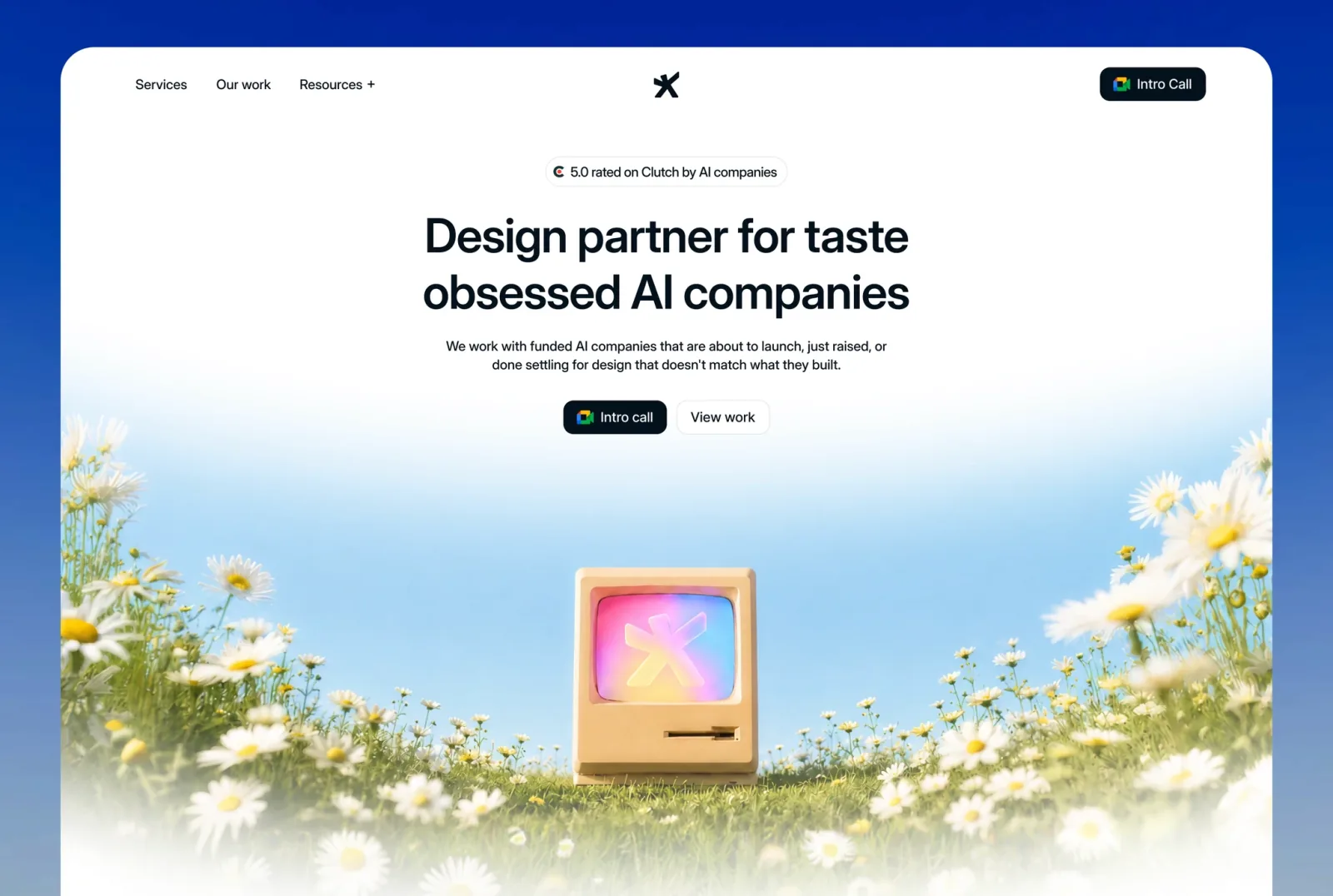
A seed round usually comes with a date attached, such as a public launch, and Studio Maydit sells a fixed scope built around that date. It runs three to four weeks. The studio is a web and product design studio for AI founders in the US, UK, and Europe, and it picks the build tool by the job. Custom code goes where the site has to run something, like a live demo. Framer or Webflow goes where the team needs to change words without a developer. Once the site is live, the same people continue into product design.
For a frontier AI lab with a speech model to show, the studio led brand direction, designed the landing page, and built the production site with its own illustration and motion system. Each section shows what the model does before the text explains it, which you can see in the Chariot case study. The best-known result is Dualite, where design work supporting a repositioned ICP helped the product reach 100,000+ users in seven months. Wave, PixelFlow, and Mi-VAD are recent clients too, along with 15 other AI and SaaS teams.
Every fixed-scope project closes with a diagnosis of what is leaking in the product, so a seed team leaves knowing where new users drop off. Teams that keep shipping after launch can move to a monthly retainer for new pages, campaigns, and product design, with no long lock-in. For a company with no web engineer, that means a design team on call without a hire.
| Check | Finding |
|---|---|
| Based in | Remote, serving US / UK / EU |
| Platform depth | Framer, Webflow, and custom code |
| AI-sector proof | Yes. AI-native clients, published outcome on Dualite |
| Pricing | Fixed scope or monthly retainer, quoted per project |
| Team shape | Founder-led, small senior team |
| Best fit | Seed-stage AI teams that need a coded demo inside an editable site before a launch date |
If you are not sure which parts of your site need code, the call will settle that first. Book a 30-minute call.

2. basement.studio
basement.studio has written custom code since 2018, from Mar del Plata in Argentina and Los Angeles. Its named clients are Vercel, Cursor, ElevenLabs, Harvey AI, and Scale AI, a list that reads like a seed AI founder's own browser tabs. Several of those clients sell to developers and technical buyers, who notice a slow page or a fake demo in seconds. It also publishes a minimum, so you can check the budget before a call.
The catch is demand. With 11 to 50 people and a client list this well known, a seed company may wait for a start date, and a launch date will not wait with it.
| Check | Finding |
|---|---|
| Based in | Mar del Plata, Argentina and Los Angeles, USA |
| Founded | 2018 |
| Team size | 11-50 |
| Primary platform | Custom code |
| AI-sector proof | Yes. Published AI client work |
| Named clients | Vercel, Cursor, ElevenLabs, Harvey AI, Scale AI |
| Pricing | Published minimum |
| Best fit | Seed AI teams selling to developers who want a coded site that runs a real demo |
3. Feels Like
This young Los Angeles studio, founded in 2023, writes its sites in custom code. Its named clients mix Google, Nike, and LVMH with one AI company, Suno AI. Suno makes music from a prompt, a product people must hear to believe. Many seed AI sites face the same problem: the value lands only once a visitor tries it.
Team size and pricing are not published, and most named clients are large consumer brands. Ask who looks after the code once your site is live.
| Check | Finding |
|---|---|
| Based in | Los Angeles, USA |
| Founded | 2023 |
| Team size | Not published |
| Primary platform | Custom code |
| AI-sector proof | Yes. Published AI client work |
| Named clients | Google, Nike, LVMH, Suno AI |
| Pricing | Not published |
| Best fit | Consumer or creative AI startups whose product must be tried on the page to be understood |
4. Phantom
Phantom has built in custom code since 2013, from London and Auckland, with 51 to 200 people. It has published AI client work, and its named clients include Diageo, SAP, Financial Times, and Zendesk. A team that size can engineer a browser demo with real depth. For a London seed company, the UK office means shared working hours.
Phantom publishes no price, and its clients are large companies. A seed team would be a small account, and an ambitious build can outgrow a team with no web engineer.
| Check | Finding |
|---|---|
| Based in | London, UK and Auckland, NZ |
| Founded | 2013 |
| Team size | 51-200 |
| Primary platform | Custom code |
| AI-sector proof | Yes. Published AI client work |
| Named clients | Diageo, SAP, Financial Times, Zendesk |
| Pricing | Not published |
| Best fit | Well-funded seed AI teams, especially in the UK, that want an ambitious interactive demo |
5. Clay
Clay is a San Francisco studio founded in 2016, with 51 to 200 people and published AI client work. Slack, Stripe, Google, Coinbase, and Amazon are named clients. It works across more than one platform, so it is not bound to put every page in code. That suits a seed company whose brand is as unsettled as its site. Clay also publishes a minimum.
Clay is a premium studio, and its client list is made of companies far past seed. Expect the minimum to take a large share of a seed round.
| Check | Finding |
|---|---|
| Based in | San Francisco, USA |
| Founded | 2016 |
| Team size | 51-200 |
| Primary platform | Mixed |
| AI-sector proof | Yes. Published AI client work |
| Named clients | Slack, Stripe, Google, Coinbase, Amazon |
| Pricing | Published minimum |
| Best fit | Seed AI teams with a large round who need brand and site decided together |
6. Lazarev
Lazarev has worked from San Francisco since 2015 and has 51 to 200 people. It has published AI client work, a public minimum, and named clients including Payoneer, Peel, Elva, and Mozayix. That product habit helps when your homepage demo is really a small slice of the product.
Lazarev works across platforms, so custom code is not its focus, and a team this size is built for larger clients than a seed company.
| Check | Finding |
|---|---|
| Based in | San Francisco, USA |
| Founded | 2015 |
| Team size | 51-200 |
| Primary platform | Mixed |
| AI-sector proof | Yes. Published AI client work |
| Named clients | Payoneer, Peel, Elva, Mozayix |
| Pricing | Published minimum |
| Best fit | Seed AI teams whose website demo is a slice of the product experience |
7. Feely Studio
Feely Studio is a small distributed team in Europe with published AI client work. Noxus, Mutiny, Luasai, and Basic Capital are named clients, and it publishes a minimum. It sits in the budget range here, which matters when the round must cover hiring first.
Custom code is not its main platform, so a live model demo is outside its usual work. With one to ten people, ask about capacity early.
| Check | Finding |
|---|---|
| Based in | Distributed, Europe |
| Founded | Not published |
| Team size | 1-10 |
| Primary platform | Mixed |
| AI-sector proof | Yes. Published AI client work |
| Named clients | Noxus, Mutiny, Luasai, Basic Capital |
| Pricing | Published minimum |
| Best fit | European seed AI teams on a tight budget whose site does not need to run the product |
8. SuperSkills
SuperSkills is a very small studio in Walnut Creek, California, with published AI client work and budget pricing. A founder would likely talk straight to the person doing the work, which suits a first site that must look credible next to better-funded rivals.
It names one client, The Cut, and works across platforms rather than in custom code. For a demo that needs real engineering, a team this small is a thin bench.
| Check | Finding |
|---|---|
| Based in | Walnut Creek, USA |
| Founded | Not published |
| Team size | 1-10 |
| Primary platform | Mixed |
| AI-sector proof | Yes. Published AI client work |
| Named clients | The Cut |
| Pricing | Not published |
| Best fit | Pre-seed and seed AI founders whose first site is mostly words and needs to look established |
9. Fantasy
Fantasy has designed interfaces since 1999, from San Francisco and New York, and has AI work on record. That history helps when an AI product has no obvious screen to copy.
Little is public. No clients are named, and team size and pricing are not published. It is a premium studio that works across platforms rather than leading with custom code.
| Check | Finding |
|---|---|
| Based in | San Francisco and New York, USA |
| Founded | 1999 |
| Team size | Not published |
| Primary platform | Mixed |
| AI-sector proof | Yes. AI work shown, clients not named |
| Named clients | Not published |
| Pricing | Not published |
| Best fit | Later-stage AI companies with an unusual interface problem and a large budget |
10. Pixelmatters
Pixelmatters is a Porto studio founded in 2013, with 51 to 200 people and a published minimum. Rubrik, Quantic, and UJET are named clients, all software companies. A seed team in Europe gets shared working hours and a known price floor.
It is the weakest fit here. AI proof is partial, the platform is mixed rather than custom code first, and the client list is made of companies much later than seed.
| Check | Finding |
|---|---|
| Based in | Porto, Portugal |
| Founded | 2013 |
| Team size | 51-200 |
| Primary platform | Mixed |
| AI-sector proof | Partial. Software clients, no AI case study |
| Named clients | Rubrik, Quantic, UJET |
| Pricing | Published minimum |
| Best fit | European software companies past seed that want a large team and a known price floor |
How to choose between them
Start with what your site has to do, not whose portfolio looks best.
The site has to run your model in front of strangers. basement.studio, Feels Like, or Studio Maydit.
Only one part needs code, and the rest must stay editable. Ask for a split build. Studio Maydit, or Clay if the brand is also undecided.
The demo is really a piece of your product. Lazarev, or Studio Maydit if you want the product work to carry on after launch.
The budget is tight and the site is mostly words. Skip custom code for now. Feely Studio or SuperSkills.
One test before you sign. Ask the studio to list every page it would build in code, and why. If the answer is every page, keep looking.