Summarize with AI


For a startup that just raised and needs a custom coded website fast, Studio Maydit fits best, because one team designs and codes the new site on a fixed three to four week scope and then keeps designing the product. Among the other nine, basement.studio and Clay lead: basement.studio writes custom code for funded AI names like Vercel, Cursor, and Scale AI, and Clay has shaped brands for Stripe, Slack, and Coinbase. In order of fit, the ten studios worth reviewing are Studio Maydit, basement.studio, Clay, Phantom, Ramotion, Pixelmatters, Engine Digital, Instrument, 8020, and Lighthouse Digital. 8020 and Lighthouse Digital fit this brief least, because both build in Webflow rather than code, and Lighthouse Digital shows no AI work. Only basement.studio, Phantom, and Engine Digital list custom code as their main platform.
The money lands before the story does. The wire clears, the deck now describes a bigger company with a sharper plan, and the website still describes the one that went out to pitch.
For the next few weeks, more people will look you up than ever before. Reporters open your homepage before writing the funding post. Engineers you hope to hire read the careers page before they answer. And the partners who might lead your next round quietly start a file on you the day this one is announced.
Most of that attention arrives in one week. If the homepage still carries last year's pitch, a two-line careers section, and an old demo video, every reader leaves with a smaller picture than the deck paints.
Custom code earns its place here for a reason beyond looks. The round usually pays for engineers, and a coded site can live in their repository and reuse the product's components instead of being rebuilt at the next raise.
So this list asks one question. Which studio can ship a coded site that tells the new story before the announcement, and still be easy for a small team to run after it?

How we sorted studios for a freshly funded startup
We read each studio's website and public directory profiles in October 2026. No studio paid to appear.
- Code as the main craft. Is custom code the studio's primary platform, or one option beside Webflow and other builders? Code-first studios ranked higher, since your engineers may want the site in the product's stack.
- Proof with venture-backed clients. We looked for funded startups among named clients, and for AI work on record. A team that has shipped right after a client's round knows the deadline is the press date.
- A public price floor. We noted only whether a minimum is posted, never the amount. A posted floor lets your finance lead compare three studios in an afternoon.
- Team size against your timeline. We set headcount beside the size of the clients each studio names. A small senior team can often start soon, while a large shop may need weeks to staff you.
- The studio's own website. We opened every homepage on a phone over a slow connection, then on a laptop. Did it load quickly and say something only that studio could say?
Give the fifth check extra weight. A studio's own site answers to no client, no board, and no brand guide, so whatever it shows there is the most it will reach for on your project.
Where a fact is missing from public pages, the table says Not published. We did not guess.
What goes wrong when a startup that just raised hires a website studio
Discovery eats the news cycle. The studio opens with six weeks of workshops and moodboards. The announcement date arrives, the funding post links to the old homepage, and your biggest wave of visitors this year meets last year's pitch. Ask for a plan that puts the homepage, the about page, and the careers page live first, with deeper pages after.
The careers page is an afterthought. Most of the round will go to salaries, yet the studio treats hiring as a footer link to a hosted job board. Candidates from the announcement see three listings, no faces, and no hint of what the product does, so they leave. Ask for a careers page that pulls open roles from your applicant tracking system on its own and shows who each new hire will work beside.
The site and the deck tell different stories. The pitch that won the round named a new buyer, a new category, or a bigger market. The studio, briefed from your old site, polishes the old message. Investors running diligence on your next round notice that the homepage still sells to someone else. Give the studio the deck as the brief, not the old site, and ask it to show which slide each homepage section answers.
1. Studio Maydit: A Top-Rated Design Agency for AI Founders
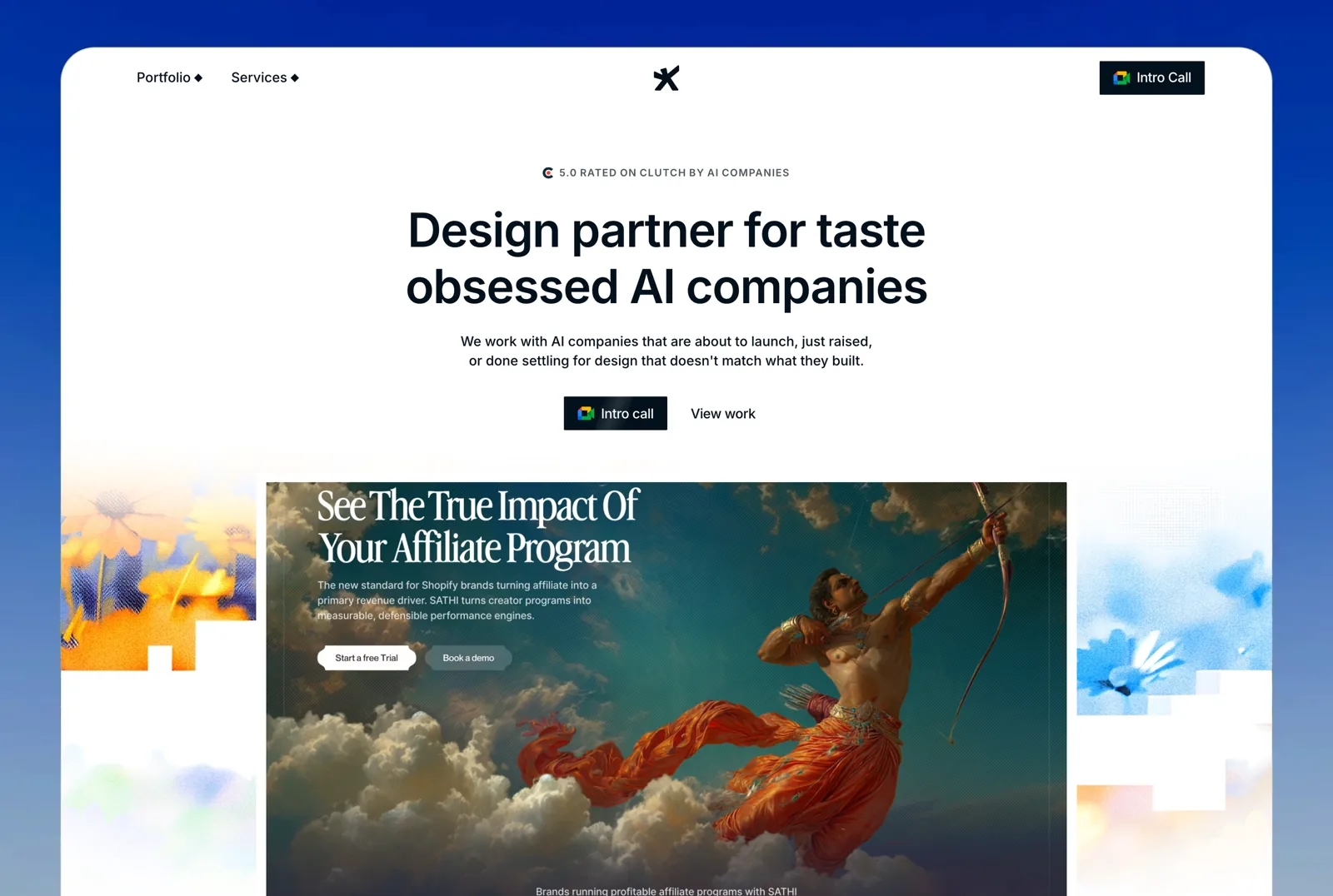
A new round starts a short clock, and Studio Maydit sells a fixed scope sized for it, three to four weeks long. It is a web and product design studio working with AI founders in the US, UK, and Europe. It builds in Framer, Webflow, and custom code, and after launch the same people continue into product design, so the product matches the homepage's story.
The closest proof for a post-raise rewrite is the Dualite case study. Dualite changed who it was selling to, and design work supporting a repositioned ICP helped the product reach 100,000+ users in seven months. A funded startup faces that job when its deck names a new buyer. Wave, PixelFlow, and Mi-VAD are recent clients as well, next to 15 other AI and SaaS teams.
The fixed scope does not stop at handoff. It ends with a diagnosis of what is leaking in the product, which hands the people you are about to hire a list to start on. If the hiring plan means steady launches, a monthly retainer pays for new pages, campaigns, and product design, with no long lock-in.
| Check | Finding |
|---|---|
| Based in | Remote, serving US / UK / EU |
| Platform depth | Framer, Webflow, and custom code |
| AI-sector proof | Yes. AI-native clients, published outcome on Dualite |
| Pricing | Fixed scope or monthly retainer, quoted per project |
| Team shape | Founder-led, small senior team |
| Best fit | Startups in the weeks after a raise that need the new story live in code before the announcement |
Send us the deck that closed your round, and we will mark the pages it needs first. Book a 30-minute call.

2. basement.studio
basement.studio is a custom code studio founded in 2018, with 11 to 50 people across Mar del Plata, Argentina and Los Angeles. Its named clients are Vercel, Cursor, ElevenLabs, Harvey AI, and Scale AI, all funded AI and developer companies. It knows a launch tied to a funding post cannot slip, and it publishes a minimum.
Its portfolio leans toward developer tools with a strong house look, so a startup selling to non-technical buyers should ask for work outside that style. Confirm the start date before you lock the announcement.
| Check | Finding |
|---|---|
| Based in | Mar del Plata, Argentina and Los Angeles, USA |
| Founded | 2018 |
| Team size | 11-50 |
| Primary platform | Custom code |
| AI-sector proof | Yes. Published AI client work |
| Named clients | Vercel, Cursor, ElevenLabs, Harvey AI, Scale AI |
| Pricing | Published minimum |
| Best fit | Funded AI and developer tool startups that want a coded site their own engineers can extend |
3. Clay
Clay is a San Francisco studio founded in 2016, with 51 to 200 people and published AI client work. Its named clients, Slack, Stripe, Google, Coinbase, and Amazon, are the companies a newly funded startup is often measured against. If the round paid for a bigger position in the market, brand and site need to move together, and Clay works on both. It publishes a minimum.
It is a premium studio working across mixed platforms rather than leading with code, so ask who writes the production code and whether its timeline fits your announcement.
| Check | Finding |
|---|---|
| Based in | San Francisco, USA |
| Founded | 2016 |
| Team size | 51-200 |
| Primary platform | Mixed |
| AI-sector proof | Yes. Published AI client work |
| Named clients | Slack, Stripe, Google, Coinbase, Amazon |
| Pricing | Published minimum |
| Best fit | Startups whose round funds a full brand change, not only a new website |
4. Phantom
Phantom is a custom code studio founded in 2013, with offices in London and Auckland and 51 to 200 people. It has published AI client work, and it names Diageo, SAP, the Financial Times, and Zendesk as clients. For a UK startup fresh from a round, that is a code-first team in its own time zone.
It does not publish a minimum, and its named clients are large established firms rather than young startups. Ask for an example of work it shipped on a short, fixed deadline.
| Check | Finding |
|---|---|
| Based in | London, UK and Auckland, NZ |
| Founded | 2013 |
| Team size | 51-200 |
| Primary platform | Custom code |
| AI-sector proof | Yes. Published AI client work |
| Named clients | Diageo, SAP, Financial Times, Zendesk |
| Pricing | Not published |
| Best fit | UK startups after a raise that want a coded site from a large engineering-led studio |
5. Ramotion
Ramotion is a San Francisco studio founded in 2009, with 11 to 50 people and a published minimum. It names Mozilla, Okta, Netflix, Adobe, and Xero as clients. A startup that raised to sell upmarket can lean on that record, since the new site will be read by buyers at companies of that size.
Its AI record is partial, with no AI case study on file, and it works across mixed platforms rather than code first.
| Check | Finding |
|---|---|
| Based in | San Francisco, USA |
| Founded | 2009 |
| Team size | 11-50 |
| Primary platform | Mixed |
| AI-sector proof | Partial. Large software clients, no AI case study |
| Named clients | Mozilla, Okta, Netflix, Adobe, Xero |
| Pricing | Published minimum |
| Best fit | Funded startups moving upmarket that want a senior team with big software names behind it |
6. Pixelmatters
Pixelmatters is a Porto studio founded in 2013, with 51 to 200 people and a published minimum. Its named clients are Rubrik, Quantic, and UJET, all growing software companies. A team that size can staff design and front-end work side by side.
It works across a mix of tools rather than custom code first, and it has no AI case study on record. For a US team, check how many working hours overlap with Portugal.
| Check | Finding |
|---|---|
| Based in | Porto, Portugal |
| Founded | 2013 |
| Team size | 51-200 |
| Primary platform | Mixed |
| AI-sector proof | Partial. Software clients, no AI case study |
| Named clients | Rubrik, Quantic, UJET |
| Pricing | Published minimum |
| Best fit | European startups after a raise that want design and front-end staffed together |
7. Engine Digital
Engine Digital has built in custom code since 2002, from Vancouver and New York. Its named clients are Adidas, Autodesk, Goldman Sachs, and HP. A startup that raised to win enterprise accounts gets a team that knows what those buyers expect.
Every name on its list is a very large company, and it publishes neither team size nor a minimum. A seed team may find its process too heavy for a short deadline.
| Check | Finding |
|---|---|
| Based in | Vancouver and New York |
| Founded | 2002 |
| Team size | Not published |
| Primary platform | Custom code |
| AI-sector proof | Partial. Enterprise clients, no AI case study |
| Named clients | Adidas, Autodesk, Goldman Sachs, HP |
| Pricing | Not published |
| Best fit | Later-stage startups whose new round is aimed at enterprise deals |
8. Instrument
Instrument is a Portland studio founded in 2005, with named clients Nike, Microsoft, Electronic Arts, and Google. If your round pays for a loud launch with film and a campaign, Instrument has worked at that scale.
It is a premium studio with no published minimum or team size, a partial AI record, and mixed tools. For most startups just past a raise, its budget and pace suit much larger companies.
| Check | Finding |
|---|---|
| Based in | Portland, USA |
| Founded | 2005 |
| Team size | Not published |
| Primary platform | Mixed |
| AI-sector proof | Partial. Large brand clients, no AI case study |
| Named clients | Nike, Microsoft, Electronic Arts, Google |
| Pricing | Not published |
| Best fit | Well-funded startups planning a large campaign around the announcement |
9. 8020
8020 is a Webflow studio in San Francisco and New York, founded in 2014. Its named clients, Wave, Superlist, Pilot.com, Vanta, and Circle, are mostly startups, so it knows the rush that follows a round. It suits a team that wants marketers editing pages on day one.
It builds in Webflow, not custom code, and publishes neither team size nor a minimum. If the new site has to live in your own repository, look elsewhere.
| Check | Finding |
|---|---|
| Based in | San Francisco and New York, USA |
| Founded | 2014 |
| Team size | Not published |
| Primary platform | Webflow |
| AI-sector proof | Partial. Startup and SaaS clients, no AI case study |
| Named clients | Wave, Superlist, Pilot.com, Vanta, Circle |
| Pricing | Not published |
| Best fit | Funded startups that want a fast Webflow site their marketers run alone |
10. Lighthouse Digital
Lighthouse Digital is a London Webflow studio with a published minimum. Its named clients are HelloSelf, Freetrade, and IGN. A UK team wanting an editable site and a known price floor can start quickly.
It ranks last for this brief because it builds in Webflow rather than code, shows no AI work, and publishes neither its founding year nor its team size.
| Check | Finding |
|---|---|
| Based in | London, UK |
| Founded | Not published |
| Team size | Not published |
| Primary platform | Webflow |
| AI-sector proof | No. No published AI client work |
| Named clients | HelloSelf, Freetrade, IGN |
| Pricing | Published minimum |
| Best fit | UK startups after a raise that are happy on Webflow and want a posted price floor |
How to choose between them
Sort by what will break first in the weeks after the announcement.
The new story is ready, the site still tells the old one, and the date is close. Studio Maydit on a three to four week fixed scope, or basement.studio if your product is a developer tool.
The round paid for a repositioning and the brand has to change too. Clay, or Ramotion if the new buyers are large companies.
Your engineers want the site inside the product's codebase. basement.studio, Phantom, or Engine Digital, the three that lead with code.
Marketing must publish every week and nobody can spare an engineer. 8020 or Lighthouse Digital on Webflow, accepting that you give up custom code.
Here is a quick test. Hand each studio your new pitch deck and ask which three pages it would put live first, and by what date. A page list and a calendar means ready. A discovery phase means not yet.