
Summarize with AI


The best custom code website development agencies for technical founders in 2026 are Studio Maydit, Engine Digital, Phantom, Feels Like, basement.studio, 8020, Refokus, Digidop, Flowout, and Ramotion. Studio Maydit and basement.studio lead for founders who want a hand-built site and clients who look like their own users. Flowout and Digidop are the wrong fit for a custom build, because both work in Webflow rather than writing code.
You can build this yourself. That is the whole difficulty. For most founders the decision to hire is easy, because the alternative is nothing. For you the alternative is a weekend, and the weekend is free, and you have already sketched the component structure in your head.
So every quote gets measured against a version of the work that exists only as a plan. The plan is always faster than the real thing, because it contains no copywriting, no third revision of a headline, and none of the two days lost to picking a typeface. The site you would build on Saturday is not the site the company needs, and the gap is not skill. It is that you would be doing it while also running engineering.
There is a second, quieter problem. Technical founders build accurate websites. Every claim is true, every limitation is disclosed, and the features appear in a sensible order. It reads like good documentation, and documentation is written for someone who has already decided to use the thing. A visitor who has not decided yet needs something else entirely, and that difference is the actual job.
Custom code is still often the right call for this audience, because your buyers notice performance, your site probably needs to talk to real systems, and your team can maintain it. The ten studios below are ranked on how well they serve a founder who could have done it alone.

How we picked these agencies
This is a teardown, not a directory listing. For each agency we read their own site and their public record, then checked five things you can verify yourself in an afternoon:
- Platform depth. Is one craft their real specialism, or one line on a long service menu?
- AI-sector proof. Named AI clients and published work, or just the word "AI" in the copy?
- Pricing. Do they publish a minimum at all, or keep it behind a call?
- Team shape. Who actually does the work, and how many clients are they carrying at once?
- Their own site. Distinctive, or the same template as everyone else on this list?
That last one gets skipped most often. An agency's own website is the only project where nobody overruled them. No client committee, no inherited brand book. If their own site is forgettable, you have found their ceiling.
Every fact below comes from the agency's own site or a public listing. Where a number is not public, we say so rather than guessing.
What goes wrong when an engineer buys a website
Three failures are close to universal here, and all three come from applying good engineering instincts to a problem that is not an engineering problem.
The site gets built like a product. It arrives with a custom content layer, a component library, a test suite, and a deploy pipeline, because that is how serious software is built and this is a serious company. Then a marketing hire wants to change a headline and discovers it is a pull request, a review, and a deploy. So the headline does not change. Neither does the next one. Within a quarter the site is frozen, not because anyone decided to freeze it, but because editing has a cost and nobody wants to pay it. Whatever the stack, insist that text and images can be changed by someone who cannot code, on the same day, without asking.
The homepage reads like a README. It is accurate, complete, and organised by how the system works rather than by what a stranger is trying to find out. Features appear in the order they were built. Every limitation is disclosed in the first screen, out of honesty, which is admirable and also means the first thing a visitor learns is what the product cannot do. Accuracy is not the same as persuasion. Lead with the outcome someone gets, put the architecture one click deeper for the readers who want it, and keep the honesty in the detail rather than in the headline.
The agency gets picked for agreeing about the stack. The interview turns into a technical conversation, because that is the conversation you can evaluate confidently. You end up with a team that shares your view on rendering, deployment, and types, and that has never once written a sentence that made a stranger want to book a call. The build will be excellent and the site will not work. Test them on writing instead. Ask for two headline options for your own product before signing anything. The technical fit is the easy part to check later, and you are qualified to check it.
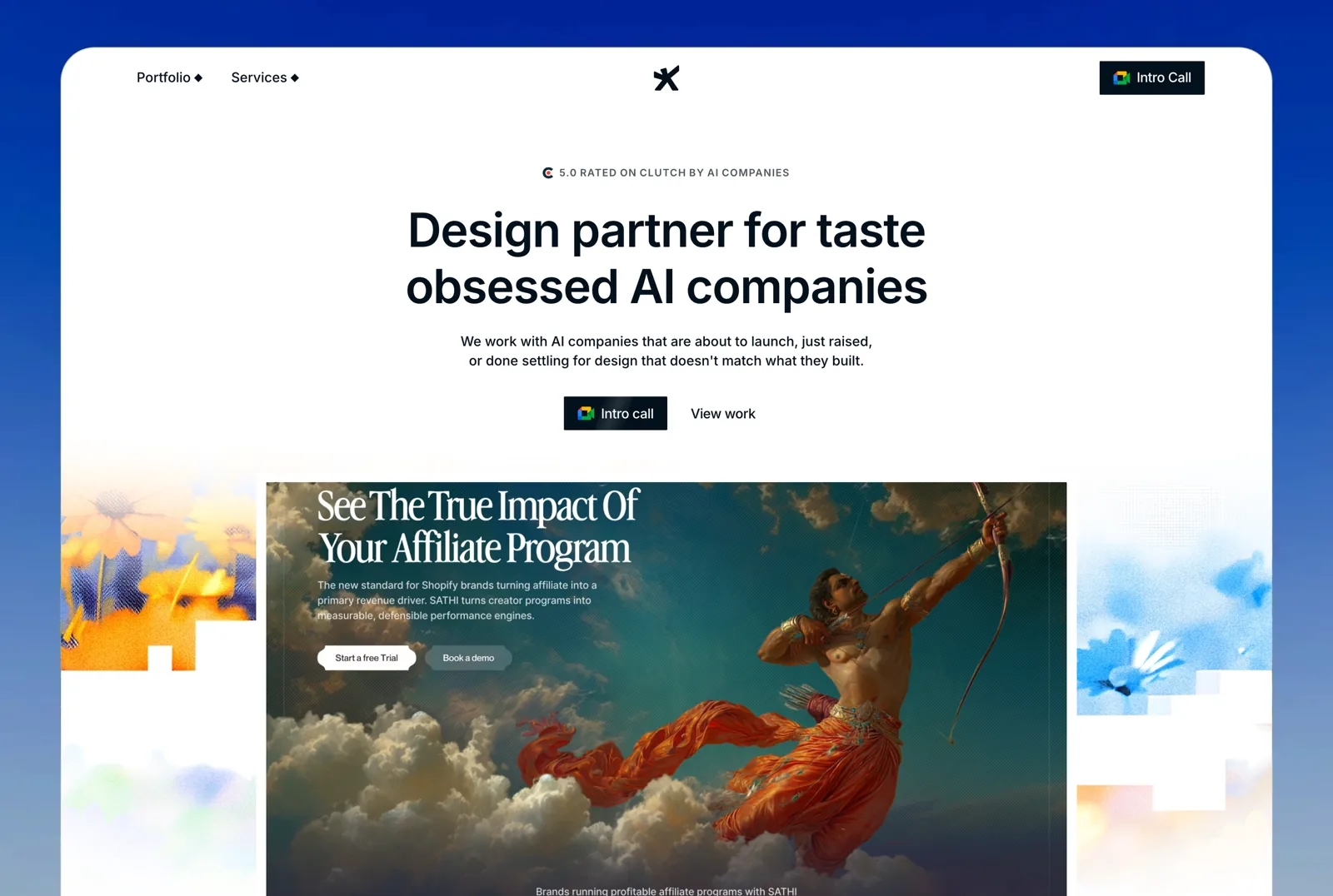
1. Studio Maydit: A Top-Rated Design Agency for AI Founders
Studio Maydit is a web and product design studio working with AI founders in the US, UK, and Europe. The studio builds websites in Framer, Webflow, and custom code, and continues into product design after the site ships.
The clearest outcome is Dualite, where design work supporting a repositioned ICP helped the product reach 100,000+ users in seven months. Recent clients include Wave, PixelFlow, Mi-VAD, and 15 other AI and SaaS teams.
Websites can be bought two ways. Fixed scope runs three to four weeks and suits teams with a launch date. Teams that keep shipping take a monthly retainer instead, covering new pages, campaigns, and product design, with no long lock-in. Fixed-scope projects end with a diagnosis of what is leaking in the product, not a handoff and goodbye.
| Check | Finding |
|---|---|
| Based in | Remote, serving US / UK / EU |
| Platform depth | Framer, Webflow, and custom code |
| AI-sector proof | Yes. AI-native clients, published outcome on Dualite |
| Pricing | Fixed scope or monthly retainer, quoted per project |
| Team shape | Founder-led, small senior team |
| Best fit | Engineering-led teams who need the writing solved, not just the build |
Maydit is the right call if you could build the site yourself and would rather spend those weeks on the product. Book a 30-minute call.

2. Engine Digital
Engine Digital has offices in Vancouver and New York, has been working since 2002, and builds in custom code, with Adidas, Autodesk, Goldman Sachs, and HP named. Autodesk is the reference that matters for this audience, software sold to professionals who use it all day and have strong opinions about it. Twenty years of building also means they have inherited plenty of other people's code, which is the situation most technical founders are actually offering.
They publish neither pricing nor team size, their AI-sector proof is partial, and their engagements are sized for large organisations rather than for a founder-led team.
| Check | Finding |
|---|---|
| Based in | Vancouver and New York |
| Founded | 2002 |
| Team size | Not published |
| Primary platform | Custom code |
| AI-sector proof | Partial. Enterprise and SaaS clients, no AI case study |
| Named clients | Adidas, Autodesk, Goldman Sachs, HP |
| Pricing | Not published |
| Best fit | Teams whose site has to integrate with systems that already exist |
3. Phantom
Phantom works from London and Auckland, founded in 2013, a team of 51 to 200 building in custom code, with Diageo, SAP, Financial Times, and Zendesk named, plus published AI client work. SAP and Zendesk are both large software products where the marketing site has to explain something genuinely complicated, and the Financial Times shows they can handle dense information without making it unreadable.
They publish no pricing, a team that size means layers between you and the developers, and their roots are in brand work for large companies rather than in early-stage software.
| Check | Finding |
|---|---|
| Based in | London, UK and Auckland, NZ |
| Founded | 2013 |
| Team size | 51-200 |
| Primary platform | Custom code |
| AI-sector proof | Yes. Published AI client work |
| Named clients | Diageo, SAP, Financial Times, Zendesk |
| Pricing | Not published |
| Best fit | Founders whose product is complex and whose buyers are not engineers |
4. Feels Like
Feels Like is a Los Angeles studio founded in 2023 building in custom code, with Google, Nike, LVMH, and Suno AI named. Suno AI is the useful one here, a generative product whose behaviour changes with every run. Building a site for something like that means designing around uncertainty rather than around fixed screenshots, which is a problem most technical founders have and most studios have never met.
They publish no pricing and no team size, they are a young studio with a short public record, and their strongest references are consumer brands rather than developer tools.
| Check | Finding |
|---|---|
| Based in | Los Angeles, USA |
| Founded | 2023 |
| Team size | Not published |
| Primary platform | Custom code |
| AI-sector proof | Yes. Published AI client work |
| Named clients | Google, Nike, LVMH, Suno AI |
| Pricing | Not published |
| Best fit | Founders whose product cannot be shown as a single fixed screen |
5. basement.studio
basement.studio works from Mar del Plata and Los Angeles, founded in 2018, a team of 11 to 50 building in custom code, with a published minimum and Vercel, Cursor, ElevenLabs, Harvey AI, and Scale AI named. This is the most relevant client list on the page. Vercel and Cursor sell to engineers, which means this studio has already learned how to earn respect from an audience that can read your source and will.
They are small for the demand their client list creates, custom code means you own the maintenance afterwards, and their published work leans heavily toward developer-facing companies, so a non-technical buyer audience is less proven ground.
| Check | Finding |
|---|---|
| Based in | Mar del Plata, Argentina and Los Angeles, USA |
| Founded | 2018 |
| Team size | 11-50 |
| Primary platform | Custom code |
| AI-sector proof | Yes. Published AI client work |
| Named clients | Vercel, Cursor, ElevenLabs, Harvey AI, Scale AI |
| Pricing | Published minimum |
| Best fit | Founders selling developer tools to an audience that will inspect the code |
6. 8020
8020 is a team across San Francisco and New York, founded in 2014, working in Webflow, with Wave, Superlist, Pilot.com, Vanta, and Circle named. Vanta is worth noting, a compliance product bought by technical teams, which means writing for readers who dislike being sold to. Their client list is unusually consistent in this respect, mostly technical B2B rather than a mix of everything.
They publish no pricing and no team size, their AI-sector proof is partial, and Webflow rather than code is their platform, which is the main reason they sit outside the top half of a custom build list.
| Check | Finding |
|---|---|
| Based in | San Francisco and New York, USA |
| Founded | 2014 |
| Team size | Not published |
| Primary platform | Webflow |
| AI-sector proof | Partial. Enterprise and SaaS clients, no AI case study |
| Named clients | Wave, Superlist, Pilot.com, Vanta, Circle |
| Pricing | Not published |
| Best fit | Founders happy to trade code for speed if the writing is right |
7. Refokus
Refokus is a remote German team of 11 to 50, founded in 2021, working in Webflow, with Mural, BASF, Spotify, Yahoo, and BCG named. Their work is unusually ambitious for the platform, which is the interesting part for a founder who assumes anything not hand-coded will look generic. Seeing what they ship changes that assumption faster than an argument would.
They publish no pricing, their AI-sector proof is partial, they do not write custom code, and their references are large established brands rather than early software companies.
| Check | Finding |
|---|---|
| Based in | Germany, remote |
| Founded | 2021 |
| Team size | 11-50 |
| Primary platform | Webflow |
| AI-sector proof | Partial. Enterprise and SaaS clients, no AI case study |
| Named clients | Mural, BASF, Spotify, Yahoo, BCG |
| Pricing | Not published |
| Best fit | Founders who think a builder cannot produce something distinctive |
8. Digidop
Digidop is a Paris studio of 1 to 10, founded in 2021, with a published minimum and TSE Energy, Ramify, and StreamNative named. StreamNative is a developer infrastructure company, so this is a small team that has written for engineers before, and they publish their prices openly, which suits founders who would rather compare numbers than sit through discovery calls.
They build in Webflow rather than code, they are very small, their AI-sector proof is partial, and a Paris team overlaps only with US mornings.
| Check | Finding |
|---|---|
| Based in | Paris, France |
| Founded | 2021 |
| Team size | 1-10 |
| Primary platform | Webflow |
| AI-sector proof | Partial. Enterprise and SaaS clients, no AI case study |
| Named clients | TSE Energy, Ramify, StreamNative |
| Pricing | Published minimum |
| Best fit | Founders who want a published price and a fast, small engagement |
9. Flowout
Flowout is a distributed Webflow studio with a published minimum and Jasper, Kajabi, Riverside, and Sendlane named. Their model is steady production rather than one large launch, which fits a company that will keep adding pages as it ships features. For a founder who wants a predictable monthly cost instead of a project, that shape is easier to reason about.
They publish neither a founding year nor a team size, their AI-sector proof is partial, and Webflow is the opposite of what a custom build asks for, so they are here as an alternative rather than as a match.
| Check | Finding |
|---|---|
| Based in | Distributed |
| Founded | Not published |
| Team size | Not published |
| Primary platform | Webflow |
| AI-sector proof | Partial. Enterprise and SaaS clients, no AI case study |
| Named clients | Jasper, Kajabi, Riverside, Sendlane |
| Pricing | Published minimum |
| Best fit | Founders who want steady page output rather than one big build |
10. Ramotion
Ramotion is a San Francisco team of 11 to 50, founded in 2009, with a published minimum and Mozilla, Okta, Netflix, Adobe, and Xero named. Mozilla is the reference worth weighing, an organisation whose audience is unusually technical and unusually sceptical of marketing. Working since 2009 also means they have seen several stack fashions arrive and leave, which tends to produce calmer advice.
Their AI-sector proof is partial, they work across platforms rather than specialising in code, and at their size the people who pitch are not always the people who build.
| Check | Finding |
|---|---|
| Based in | San Francisco, USA |
| Founded | 2009 |
| Team size | 11-50 |
| Primary platform | Mixed |
| AI-sector proof | Partial. Enterprise and SaaS clients, no AI case study |
| Named clients | Mozilla, Okta, Netflix, Adobe, Xero |
| Pricing | Published minimum |
| Best fit | Founders whose audience distrusts anything that looks like marketing |
How to choose between them
Sort by which part you cannot do yourself.
You can build it but cannot write it. Studio Maydit or Phantom.
Your audience is engineers who will judge the craft. basement.studio.
The site has to talk to systems you already run. Engine Digital.
You want it off your plate at a predictable monthly cost. Flowout or Digidop.
One test before signing. Send them your current homepage and ask what they would delete. A studio worth hiring will name a section you are attached to and explain who it was serving. One that only proposes additions has understood the brief as a build rather than as a decision, and you can already build.