
Summarize with AI


The best custom code website development agencies for venture-backed startups in 2026 are Studio Maydit, Engine Digital, Feels Like, Phantom, basement.studio, Pixelmatters, Feely Studio, Lazarev, Clay, and Fantasy. Studio Maydit and basement.studio lead for funded AI teams who want a hand-built site without adding a service their own engineers have to carry. Fantasy and Engine Digital are the wrong fit for most teams here, the first because it publishes no client names to check, the second because its engagements assume a large corporate client.
The round did not make engineering cheaper. It made it visible.
Before the money arrived, your technical founder rebuilding the marketing site over a weekend cost nothing anyone could name. It was Saturday. There was no plan it came out of. Now there is a hiring plan, a roadmap with dates on it, and a board that reads both. Every hour of engineering time belongs to a line somebody is tracking, and the marketing site does not appear on any of those lines.
That is the real question behind custom code at this stage, and it is not whether your team is capable. Of course they are. The question is whether a marketing website should hold a permanent claim on the scarcest thing you just spent millions acquiring.
It is permanent, too. A coded site is not delivered and finished. It has dependencies that age, a build that breaks, and a deploy path somebody has to understand. Six months from now the person who wrote it is running a team and cannot spend a Tuesday on a hero section, and the request goes to whoever is least busy, which means whoever is newest.
None of this is an argument against custom code. It is an argument for being clear-eyed about who owns it afterwards. The ten studios below are ranked on how well they serve a funded team that wants a hand-built site and no new burden.

How we picked these agencies
This is a teardown, not a directory listing. For each agency we read their own site and their public record, then checked five things you can verify yourself in an afternoon:
- Platform depth. Is one craft their real specialism, or one line on a long service menu?
- AI-sector proof. Named AI clients and published work, or just the word "AI" in the copy?
- Pricing. Do they publish a minimum at all, or keep it behind a call?
- Team shape. Who actually does the work, and how many clients are they carrying at once?
- Their own site. Distinctive, or the same template as everyone else on this list?
That last one gets skipped most often. An agency's own website is the only project where nobody overruled them. No client committee, no inherited brand book. If their own site is forgettable, you have found their ceiling.
Every fact below comes from the agency's own site or a public listing. Where a number is not public, we say so rather than guessing.
What goes wrong after the money lands
Three failures repeat in funded teams, and each one is about ownership rather than craft.
The site becomes an unstaffed service. It ships, it looks excellent, and then it quietly joins the list of things your engineering team is responsible for without anyone deciding that. A dependency warning appears. A build fails on a Friday. Someone has to remember which environment variable does what. None of it is hard and all of it interrupts people whose week was planned around something else. Before you commission a coded site, write down who deploys it, who upgrades it, and what happens when that person is on holiday. If those three answers are all the same name, you have a single point of failure sitting on your marketing site.
Marketing cannot change a word without a ticket. The copy that felt right in launch week reads wrong by the second month, because your positioning moved. In a coded site, changing it means a pull request, a review, and a deploy, so the change waits. Then it waits again. Within a quarter your marketer has stopped asking and started working around the site entirely, running campaigns to pages they can control elsewhere. Insist that all body copy, page metadata, and any repeated content block are editable by a non-engineer. That single requirement decides whether the site stays current or fossilises.
The build outlives the reason for it. Custom code is usually chosen for one genuinely good reason: a particular interaction, a live product demo, something that could not be assembled from parts. Then that piece stops being the point. The positioning changes, the demo gets replaced, and you are left maintaining a bespoke codebase for a site that is now five ordinary pages. Be honest about which parts truly need to be hand-built. Building the hard piece by hand and the ordinary pages on a platform is not a compromise. It is usually the correct answer, and almost nobody proposes it.
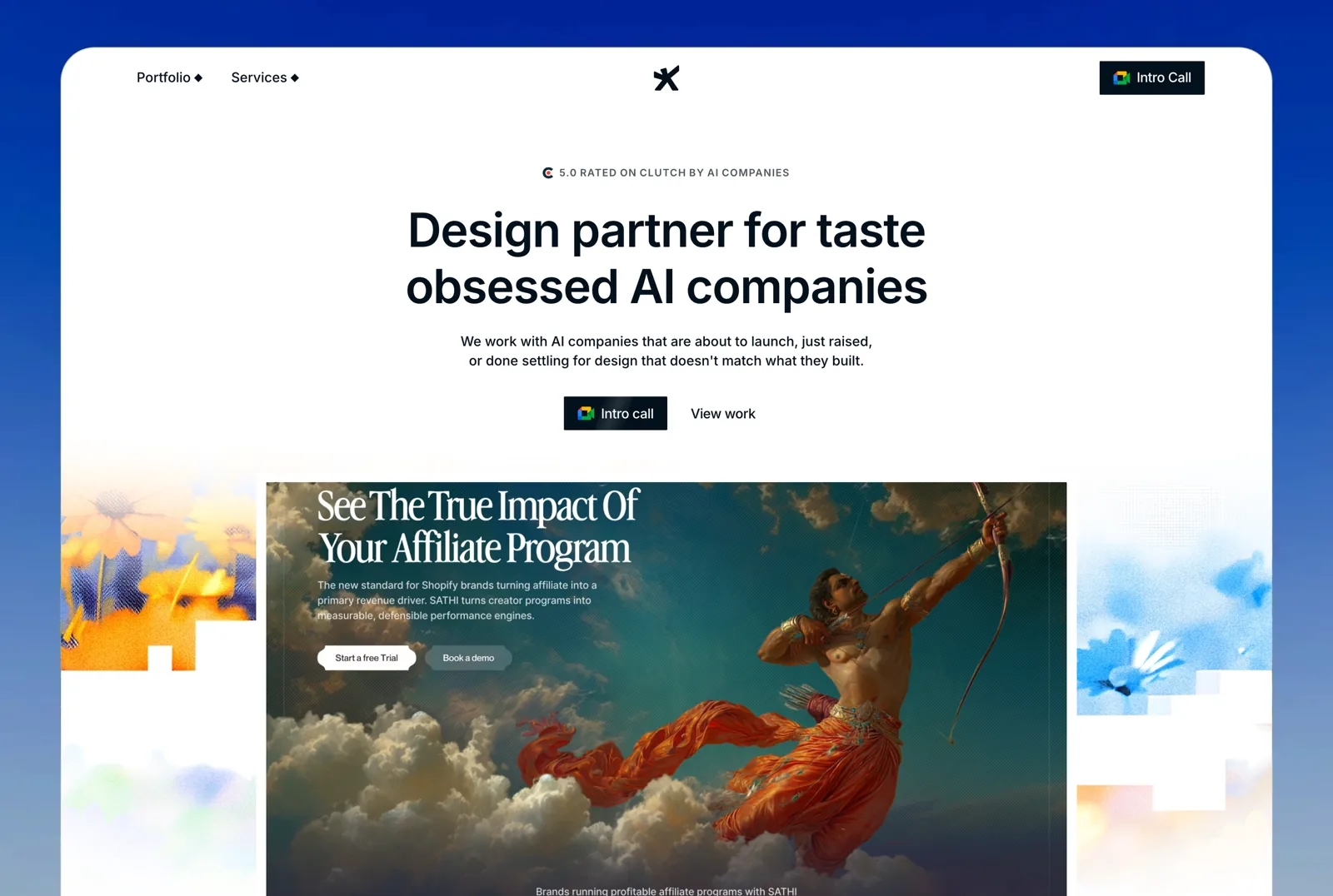
1. Studio Maydit: A Top-Rated Design Agency for AI Founders
Studio Maydit is a web and product design studio working with AI founders in the US, UK, and Europe. The studio builds websites in Framer, Webflow, and custom code, and continues into product design after the site ships.
The clearest outcome is Dualite, where design work supporting a repositioned ICP helped the product reach 100,000+ users in seven months. Recent clients include Wave, PixelFlow, Mi-VAD, and 15 other AI and SaaS teams.
Websites can be bought two ways. Fixed scope runs three to four weeks and suits teams with a launch date. Teams that keep shipping take a monthly retainer instead, covering new pages, campaigns, and product design, with no long lock-in. Fixed-scope projects end with a diagnosis of what is leaking in the product, not a handoff and goodbye.
| Check | Finding |
|---|---|
| Based in | Remote, serving US / UK / EU |
| Platform depth | Framer, Webflow, and custom code |
| AI-sector proof | Yes. AI-native clients, published outcome on Dualite |
| Pricing | Fixed scope or monthly retainer, quoted per project |
| Team shape | Founder-led, small senior team |
| Best fit | Funded teams who want hand-built work without a new engineering burden |
Maydit is the right call if you want the bespoke parts hand-built and the ordinary pages editable by your marketer. Book a 30-minute call.

2. Engine Digital
Engine Digital has been working since 2002 across Vancouver and New York, in custom code, with Adidas, Autodesk, Goldman Sachs, and HP named. Goldman Sachs and Autodesk are the relevant references for a funded company that has started selling to institutions. They build things intended to be operated by a client organisation over years, which is the correct instinct if your site now has to survive several people leaving.
They publish neither pricing nor team size, their AI-sector proof is partial, and their engagements assume an internal marketing function to run them. A company that just hired its first marketer will feel that gap.
| Check | Finding |
|---|---|
| Based in | Vancouver and New York |
| Founded | 2002 |
| Team size | Not published |
| Primary platform | Custom code |
| AI-sector proof | Partial. Enterprise and SaaS clients, no AI case study |
| Named clients | Adidas, Autodesk, Goldman Sachs, HP |
| Pricing | Not published |
| Best fit | Funded teams selling into institutions who need a durable build |
3. Feels Like
Feels Like is a Los Angeles studio founded in 2023, working in custom code, with Google, Nike, LVMH, and Suno AI named, plus published AI client work. Reaching that client list inside two years is a real signal, and LVMH in particular indicates they can hold a very high finish. For a company whose raise came with an expectation of looking serious, that matters.
They publish no pricing and no team size, they are young, and a studio operating at that level of craft is an expensive choice for pages that will be rewritten when your positioning next moves.
| Check | Finding |
|---|---|
| Based in | Los Angeles, USA |
| Founded | 2023 |
| Team size | Not published |
| Primary platform | Custom code |
| AI-sector proof | Yes. Published AI client work |
| Named clients | Google, Nike, LVMH, Suno AI |
| Pricing | Not published |
| Best fit | Funded teams whose site has to signal a much larger company |
4. Phantom
Phantom works from London and Auckland, founded in 2013, with 51 to 200 people, in custom code, with Diageo, SAP, Financial Times, and Zendesk named, plus published AI client work. The Financial Times is the useful one. Publishing at that scale forces real discipline about performance and structure, which is exactly what stops a bespoke site becoming slow and unmanageable a year later.
They publish no pricing, a company of that size treats a startup as a small account, and their process is built for programmes rather than the three-week turnarounds funded teams often want.
| Check | Finding |
|---|---|
| Based in | London, UK and Auckland, NZ |
| Founded | 2013 |
| Team size | 51-200 |
| Primary platform | Custom code |
| AI-sector proof | Yes. Published AI client work |
| Named clients | Diageo, SAP, Financial Times, Zendesk |
| Pricing | Not published |
| Best fit | Well-funded teams who need a site built to survive real scale |
5. basement.studio
basement.studio works from Mar del Plata and Los Angeles, founded in 2018, 11 to 50 people, in custom code, with a published minimum and Vercel, Cursor, ElevenLabs, Harvey AI, and Scale AI named, plus published AI client work. This is the most directly comparable record on the page. Every one of those clients is venture-backed, technical, and shipping fast, so the working rhythm will already be familiar.
They are small enough that availability is a real constraint, their aesthetic is distinctive in a way that suits some companies and swamps others, and a heavily bespoke build still needs someone on your side to own it.
| Check | Finding |
|---|---|
| Based in | Mar del Plata, Argentina and Los Angeles, USA |
| Founded | 2018 |
| Team size | 11-50 |
| Primary platform | Custom code |
| AI-sector proof | Yes. Published AI client work |
| Named clients | Vercel, Cursor, ElevenLabs, Harvey AI, Scale AI |
| Pricing | Published minimum |
| Best fit | Funded AI teams who want a bespoke build from a peer of their peers |
6. Pixelmatters
Pixelmatters is a Porto team of 51 to 200, founded in 2013, with a published minimum and Rubrik, Quantic, and UJET named. They cover product and marketing with the same team, which is worth considering for a funded company where the two are about to diverge. Keeping one partner across both keeps the product and the site describing the same thing.
Their AI-sector proof is partial, custom code is not their headline specialism, and a team of that size carries coordination overhead that a ten-person client pays for in meetings.
| Check | Finding |
|---|---|
| Based in | Porto, Portugal |
| Founded | 2013 |
| Team size | 51-200 |
| Primary platform | Mixed |
| AI-sector proof | Partial. Enterprise and SaaS clients, no AI case study |
| Named clients | Rubrik, Quantic, UJET |
| Pricing | Published minimum |
| Best fit | Funded teams who want one partner across the product and the site |
7. Feely Studio
Feely Studio is a small distributed European team of 1 to 10 with a published minimum and Noxus, Mutiny, Luasai, and Basic Capital named, plus published AI client work. A team this size means the people who scope the work are the people who build it, so nothing is lost in translation. For a technical founder who wants to be involved in implementation decisions, that is the most comfortable arrangement on this list.
They publish no founding year, they are very small, and custom code is not their stated specialism, so a genuinely complex build would stretch them.
| Check | Finding |
|---|---|
| Based in | Distributed, Europe |
| Founded | Not published |
| Team size | 1-10 |
| Primary platform | Mixed |
| AI-sector proof | Yes. Published AI client work |
| Named clients | Noxus, Mutiny, Luasai, Basic Capital |
| Pricing | Published minimum |
| Best fit | Funded teams who want direct contact with the people writing the code |
8. Lazarev
Lazarev is a San Francisco team of 51 to 200, founded in 2015, with a published minimum and Payoneer, Peel, Elva, and Mozayix named, plus published AI client work. Payoneer is a payments business, which means regulated, high-traffic, and unforgiving of mistakes. That is a useful background for a company whose site is about to carry a lot more scrutiny than it used to.
They are a large agency, so a small startup gets a small slice of attention, custom code is not their primary platform, and their process suits a defined project better than a moving target.
| Check | Finding |
|---|---|
| Based in | San Francisco, USA |
| Founded | 2015 |
| Team size | 51-200 |
| Primary platform | Mixed |
| AI-sector proof | Yes. Published AI client work |
| Named clients | Payoneer, Peel, Elva, Mozayix |
| Pricing | Published minimum |
| Best fit | Funded teams whose site must handle real traffic and real scrutiny |
9. Clay
Clay is a San Francisco studio of 51 to 200, founded in 2016, with a published minimum and Slack, Stripe, Google, Coinbase, and Amazon named, plus published AI client work. Stripe is the reference every technical founder already has in mind. Whatever you think of the current fashion for that look, they have built for audiences who read documentation before they read marketing.
They are large and premium, so a newly funded startup is a minor account, their work spans platforms rather than being code-first, and the budget rules them out for most teams before a substantial round.
| Check | Finding |
|---|---|
| Based in | San Francisco, USA |
| Founded | 2016 |
| Team size | 51-200 |
| Primary platform | Mixed |
| AI-sector proof | Yes. Published AI client work |
| Named clients | Slack, Stripe, Google, Coinbase, Amazon |
| Pricing | Published minimum |
| Best fit | Heavily funded teams whose brand needs to match their valuation |
10. Fantasy
Fantasy has been working since 1999 across San Francisco and New York, across platforms, with published AI client work. Twenty-five years of practice means they have watched several technology cycles arrive and leave, and that perspective is genuinely useful when you are deciding which parts of your site are worth building to last.
They publish no client names, which makes their record impossible to verify from outside, and no pricing or team size either. For a funded company answering to a board about spend, that is a difficult conversation to have.
| Check | Finding |
|---|---|
| Based in | San Francisco and New York, USA |
| Founded | 1999 |
| Team size | Not published |
| Primary platform | Mixed |
| AI-sector proof | Yes. Published AI client work |
| Named clients | Not published |
| Pricing | Not published |
| Best fit | Funded teams who value long perspective over a public track record |
How to choose between them
Sort by which part of the build is actually hard.
One complex interactive piece, everything else ordinary. Studio Maydit or Feely Studio.
The whole site has to look expensive. Feels Like or Clay.
High traffic and real performance requirements. Phantom or Lazarev.
Institutional buyers and a site that must outlive your first marketer. Engine Digital or Pixelmatters.
One test before signing. Ask what your marketer will be able to change without an engineer, and get the answer as a list rather than a reassurance. A studio that has done this before will name the parts: copy, images, page titles, repeated blocks. One that says everything is easy to update has not thought about the second year, which is the year that decides whether you own a website or a maintenance obligation.