

Summarize with AI


The best design agencies for prompt and input UX in 2026 are Studio Maydit, Refokus, Flowout, Lighthouse Digital, Ramotion, Engine Digital, Edgar Allan, Digidop, Pixelmatters, and Finsweet. Studio Maydit and Ramotion lead for this brief, because both work on product surfaces rather than pages, and Ramotion has published work for Adobe and Mozilla, which are two of the most heavily used input interfaces in software. Flowout and Lighthouse Digital are the wrong fit here, since one is a Webflow production service and the other publishes no AI client work at all, and this brief is entirely about a screen inside the product.
Software spent thirty years replacing text boxes with buttons, because a button tells you what it does and a text box does not. Then AI arrived and put the text box back.
A blank field with a cursor in it is the least informative control available. It has no edges, no options, and no indication of what the system is good at. Users hesitate, type something cautious, get a mediocre result, and quietly conclude the product is not for them. Almost none of that is a model problem, and almost all of it happens in the first ninety seconds. We wrote separately about why an Ask anything box fails new users and what to put beside it.
The standard patch is a row of example prompts under the box, and it helps once. New users click one, see what a good request looks like, and never look at that row again. The moment help is actually needed is later, when somebody has typed a real request, got something wrong, and does not know whether to change the wording, add a file, or give up.
There is a second thing nobody sees, which is that the box has limits and does not admit them. Length caps, file types, a document from earlier in the session that has quietly fallen out of context, a tool the model cannot reach for this account. All of that is invisible, so users build a wrong picture of what the product can do and then blame themselves for using it badly.
And then there is the second attempt, which is where most of the real usage lives. People refine. They keep two thirds of what they wrote and change the rest. Most products treat that as a brand new request, so the good part gets retyped, the earlier version disappears, and there is no way to compare the two.
Below are ten studios, ordered by how well they suit a product where the text field is the product.

How we picked these agencies
Five checks, all of which can be run from published material:
- Platform depth. Does the studio work inside products, or is its output marketing surfaces with a product page attached?
- Proof on text-first interfaces. Is there published work where typing was the main interaction, such as editors, search, or dense forms?
- Pricing. Is a starting figure public, or does it take two conversations to reach a number?
- Team shape. Is there a senior designer who will sit with real session recordings, since this craft is decided by what people actually type?
- Their own site. Is the writing precise? Prompt design is mostly writing, and a studio's own copy is a fair sample of it.
That last point is worth stating plainly, because it surprises people. The hard part of this work is not the visual design of a field. It is the words: the placeholder, the label, the error, the suggestion, the sentence that explains why a result came back thin. Most of the improvement available in a prompt interface is available to a careful writer, which makes a studio's own prose an unusually direct piece of evidence.
One thing to note before the tables. Almost nobody in this market has published work specifically on prompt interfaces, because the craft is about three years old. The rows below record what each studio has actually made public, and adjacent proof is described as adjacent rather than dressed up.
What goes wrong on prompt and input design
Three failures, and the first one is the reason most of these products lose people in the first session.
The blank box is treated as a finished design. It looks clean, it demos beautifully, and it puts the entire burden of knowing what to ask on somebody who has used the product for four seconds. Examples underneath help at the start and stop helping immediately after. What works better is help that appears when it is needed: at the point of hesitation, after a weak result, or when somebody types a request the system can nearly do. That is more design work than a row of suggestion chips, and it is where the difference between a product people keep and one they try actually sits.
The limits of the input are invisible. There is a length ceiling, a set of file types, a context that expires, and a set of tools the model can reach for some accounts and not others. None of it is shown, so users construct a private theory about what the product can handle and act on it for months. Say the boundaries out loud, in the interface, at the moment they apply. A visible constraint feels like a product that knows itself. An invisible one feels like a product that fails at random, and random failure is what people leave over.
Editing is designed as retyping. Watch a real session and the pattern is always the same. Somebody writes a request, gets something close, and wants to change one part while keeping the rest. Most products offer a fresh empty box. So the good sentence gets typed again, the earlier attempt vanishes, and comparing two versions is impossible. Treat the second attempt as the primary interaction rather than the exception. Keep the previous request editable, make branching cheap, and let people see two results side by side. Products that do this feel dramatically more capable without any change to the model behind them.
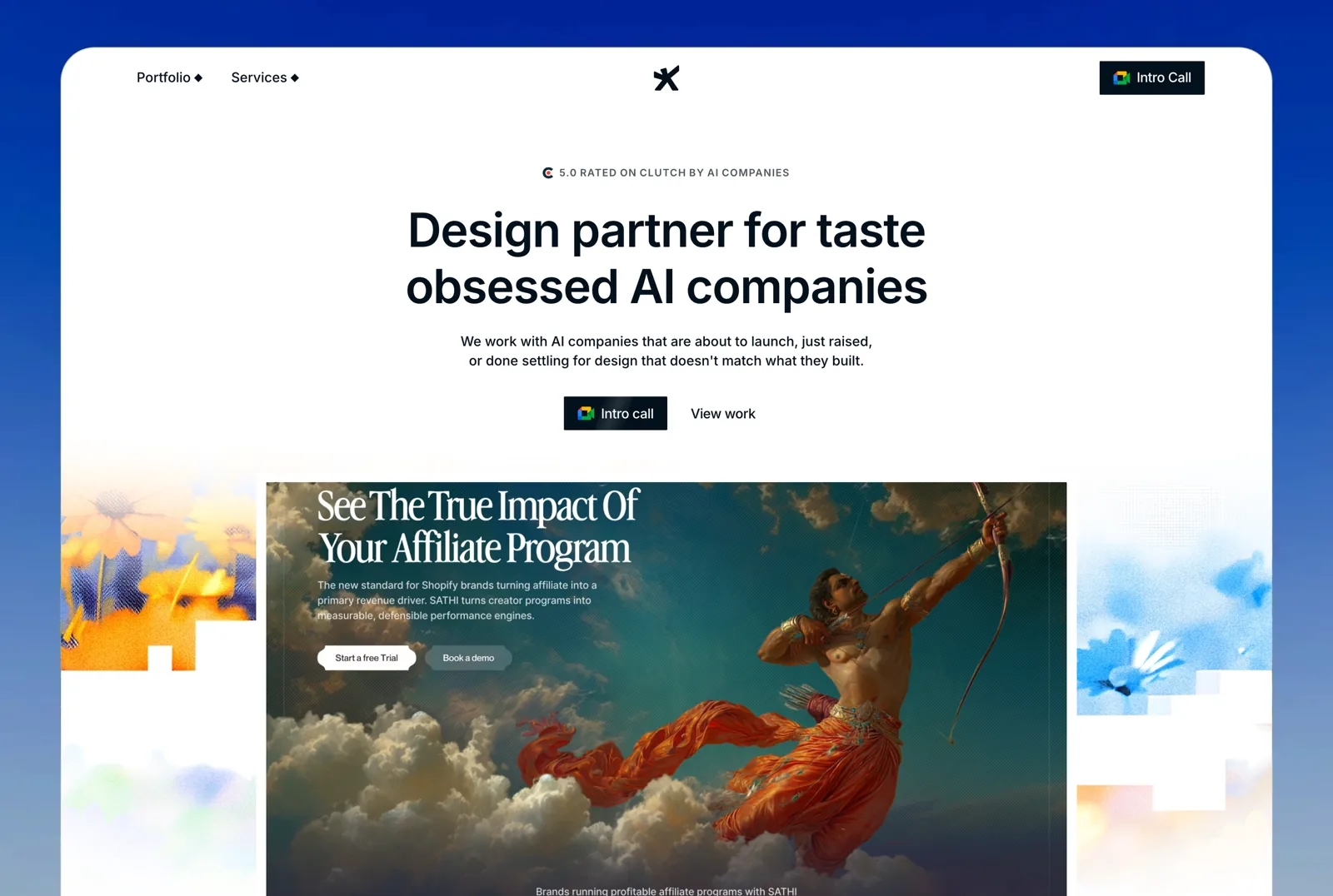
1. Studio Maydit: A Top-Rated Design Agency for AI Founders
This craft is more writing than drawing, and it needs a senior person willing to sit with real sessions rather than design from a brief. Studio Maydit is founder-led with a small senior team, which is the shape that makes that possible. It is a web and product design studio. The clients are AI founders, working across the US, UK, and Europe, so an input that has to explain a model is the normal subject here rather than an unusual one. Framer, Webflow, and custom code are the build routes, and the work continues into product design after the site ships.
There are two ways to buy, and for a single interface the first is usually right. A fixed scope of three to four weeks covers one surface properly, which for most teams is exactly the size of this problem. A monthly retainer covers teams shipping continuously, including new pages, campaigns, and product design, with no long lock-in. Fixed-scope work closes with a diagnosis of what is leaking in the product, and for a prompt interface that is almost always the second attempt rather than the first.
The public number belongs to Dualite. Design work built on a repositioned ICP, and 100,000+ users seven months afterwards. Wave, PixelFlow, Mi-VAD, and 15 other AI and SaaS teams are on the recent client list.
| Check | Finding |
|---|---|
| Based in | Remote, serving US / UK / EU |
| Platform depth | Framer, Webflow, and custom code |
| AI-sector proof | Yes. AI-native clients, published outcome on Dualite |
| Pricing | Fixed scope or monthly retainer, quoted per project |
| Team shape | Founder-led, small senior team |
| Best fit | Teams whose whole product is one text field |
Worth a call if people type once, get something average, and never return. Book a 30-minute call.

2. Refokus
Refokus is a remote German team of 11 to 50, founded in 2021, working in Webflow, with Mural, BASF, Spotify, Yahoo, and BCG named. Mural is a collaborative canvas where creating and manipulating content is the whole experience, which is nearer to input design than a portfolio of brand sites usually gets.
Their AI-sector proof is partial, they publish no pricing, and a highly expressive house style pulls against a control that needs to be quiet, predictable, and fast.
| Check | Finding |
|---|---|
| Based in | Germany, remote |
| Founded | 2021 |
| Team size | 11-50 |
| Primary platform | Webflow |
| AI-sector proof | Partial. Enterprise and SaaS clients, no AI case study |
| Named clients | Mural, BASF, Spotify, Yahoo, BCG |
| Pricing | Not published |
| Best fit | Teams whose input sits inside a creative canvas |
3. Flowout
Flowout is a distributed Webflow service with a published minimum and Jasper, Kajabi, Riverside, and Sendlane named. Jasper is a writing product driven entirely by what a user types, so there is at least direct exposure to a company whose interface is a prompt.
They publish no founding year and no team size, their AI-sector proof is partial, and the work is website production rather than product design, so the screen this article is about is outside what they do.
| Check | Finding |
|---|---|
| Based in | Distributed |
| Founded | Not published |
| Team size | Not published |
| Primary platform | Webflow |
| AI-sector proof | Partial. Enterprise and SaaS clients, no AI case study |
| Named clients | Jasper, Kajabi, Riverside, Sendlane |
| Pricing | Published minimum |
| Best fit | Teams who need the marketing site around the product |
4. Lighthouse Digital
Lighthouse Digital is a London studio working in Webflow, with a published minimum and HelloSelf, Freetrade, and IGN named. HelloSelf is a therapy platform, which means designing text entry that people find difficult to complete, and difficulty of writing is the underrated half of this problem.
They publish no AI client work, no founding year, and no team size, and Webflow is a website platform, so this brief sits outside the work they have made public.
| Check | Finding |
|---|---|
| Based in | London, UK |
| Founded | Not published |
| Team size | Not published |
| Primary platform | Webflow |
| AI-sector proof | No. No published AI client work |
| Named clients | HelloSelf, Freetrade, IGN |
| Pricing | Published minimum |
| Best fit | Teams who need a clear site at a published price |
5. Ramotion
Ramotion is a San Francisco studio of 11 to 50, founded in 2009, working across platforms, with a published minimum and Mozilla, Okta, Netflix, Adobe, and Xero named. A browser address bar and Adobe's creative tools are two of the most used and most demanding input surfaces ever shipped, and the studio has worked on both companies.
Their AI-sector proof is partial, working across platforms means product design is one offer among several, and a studio built around long brand programmes runs slower than a team iterating on one component weekly.
| Check | Finding |
|---|---|
| Based in | San Francisco, USA |
| Founded | 2009 |
| Team size | 11-50 |
| Primary platform | Mixed |
| AI-sector proof | Partial. Enterprise and SaaS clients, no AI case study |
| Named clients | Mozilla, Okta, Netflix, Adobe, Xero |
| Pricing | Published minimum |
| Best fit | Teams whose input has to serve experts and beginners |
6. Engine Digital
Engine Digital works from Vancouver and New York, founded in 2002, building in custom code, with Adidas, Autodesk, Goldman Sachs, and HP named. Building in code matters unusually much here, because an input is decided by how it feels under a fast typist, and that cannot be judged from a static file.
They publish no pricing and no team size, their AI-sector proof is partial, and an enterprise programme is a heavy way to buy work on a single component.
| Check | Finding |
|---|---|
| Based in | Vancouver and New York |
| Founded | 2002 |
| Team size | Not published |
| Primary platform | Custom code |
| AI-sector proof | Partial. Enterprise and SaaS clients, no AI case study |
| Named clients | Adidas, Autodesk, Goldman Sachs, HP |
| Pricing | Not published |
| Best fit | Teams who need the interaction built and tested, not drawn |
7. Edgar Allan
Edgar Allan is an Atlanta studio of 51 to 200, founded in 2014, working in Webflow, with Porsche, Duracell, and NCR named. NCR builds transaction interfaces used by staff working quickly under pressure, where a single extra keystroke is a measurable cost, and that discipline transfers directly to input design.
They publish no pricing, their AI-sector proof is partial, and their platform and process are organised around marketing sites rather than a component inside a product.
| Check | Finding |
|---|---|
| Based in | Atlanta, USA |
| Founded | 2014 |
| Team size | 51-200 |
| Primary platform | Webflow |
| AI-sector proof | Partial. Enterprise and SaaS clients, no AI case study |
| Named clients | Porsche, Duracell, NCR |
| Pricing | Not published |
| Best fit | Teams whose users work quickly and repeatedly |
8. Digidop
Digidop is a Paris team of one to ten, founded in 2021, working in Webflow, with a published minimum and TSE Energy, Ramify, and StreamNative named. A team that small can revise one component every week, and prompt design is mostly a single component revised many times rather than a large set of screens.
Their AI-sector proof is partial, one to ten people limits parallel work, and Webflow means the studio is set up for pages rather than for product surfaces.
| Check | Finding |
|---|---|
| Based in | Paris, France |
| Founded | 2021 |
| Team size | 1-10 |
| Primary platform | Webflow |
| AI-sector proof | Partial. Enterprise and SaaS clients, no AI case study |
| Named clients | TSE Energy, Ramify, StreamNative |
| Pricing | Published minimum |
| Best fit | European teams iterating on one surface repeatedly |
9. Pixelmatters
Pixelmatters is a Porto team of 51 to 200, founded in 2013, working across platforms, with a published minimum and Rubrik, Quantic, and UJET named. Rubrik is technical software for people who know exactly what they want, and designing for users with precise intent is half of this problem, with the other half being users who have none.
Their AI-sector proof is partial, and at 51 to 200 people the designers on your project are decided after the contract rather than during the conversation.
| Check | Finding |
|---|---|
| Based in | Porto, Portugal |
| Founded | 2013 |
| Team size | 51-200 |
| Primary platform | Mixed |
| AI-sector proof | Partial. Enterprise and SaaS clients, no AI case study |
| Named clients | Rubrik, Quantic, UJET |
| Pricing | Published minimum |
| Best fit | Teams wanting research capacity alongside the design |
10. Finsweet
Finsweet is a Denver-based distributed team of 51 to 200, founded in 2017, working in Webflow, with Dropbox, Clay, GitHub, and Steadily named. They are known for building components a visual platform was never meant to support, and an input with history, branching, and inline editing is exactly that kind of component.
Their AI-sector proof is partial, they publish no pricing, and their published work is marketing surfaces rather than the inside of a product.
| Check | Finding |
|---|---|
| Based in | Denver, USA, distributed |
| Founded | 2017 |
| Team size | 51-200 |
| Primary platform | Webflow |
| AI-sector proof | Partial. Enterprise and SaaS clients, no AI case study |
| Named clients | Dropbox, Clay, GitHub, Steadily |
| Pricing | Not published |
| Best fit | Teams who need an unusual component built carefully |
How to choose between them
Sort by where people are actually dropping out.
They type once and never come back. Studio Maydit or Ramotion.
The interaction has to be felt to be judged. Engine Digital or Finsweet.
The input lives inside a creative or collaborative surface. Refokus or Pixelmatters.
You want weekly revisions to one component. Digidop or Studio Maydit.
One test before you sign. Sit a candidate in front of your product and ask them to get a good result without help. Watch what they type, where they pause, and what they assume. A studio worth hiring narrates the hesitation and names the exact word in your placeholder that misled them. A studio that produces a competent request on the first try has told you nothing, because your real users will not.