Summarize with AI


The best design agencies for web app design in 2026 are Studio Maydit, Engine Digital, Lighthouse Digital, Edgar Allan, Digidop, Refokus, Flowout, Ramotion, Push Refresh, and Flow Ninja. Studio Maydit and Engine Digital lead for this brief, because both work on application surfaces in code rather than stopping at pages, and Engine Digital has worked with Autodesk, whose products are exactly this kind of software. Flowout and Flow Ninja are the wrong fit here, since both are Webflow production services, and a web app is not a set of pages you can produce that way.
The most useful thing to know before hiring anybody is that a web app and a website are different disciplines that happen to share a browser. Most studios advertising design services have only practised the second one.
The difference is how often somebody arrives. A website visitor comes once, forms an impression, and leaves. A web app user opens the same screen forty times a day for two years. Everything that impresses on a first visit becomes an obstacle by the fiftieth: the large type that means less fits, the generous spacing that turns one screen into three, the animation that was charming in March and is a delay in June.
So the aesthetic inverts. In an application, density is a courtesy and speed is a feature. The best compliment a daily tool can get is that nobody notices it, which is a difficult thing to sell in a portfolio and an easy thing to skip in a pitch.
The second difference is where the work actually is. A marketing page has one state. An application screen has an empty state, a loading state, a partial state, an error, a version for somebody without permission, and a version for the account with eleven thousand records in it. That is most of the design, and it is nearly absent from the portfolios you will be shown, because none of it photographs well.
The third is time. Websites get replaced every two or three years. Applications accumulate. What gets decided in the first month, about components, naming, and how things are laid out, determines what year three costs. Studios used to campaign work do not think in those terms, because their work has never had to survive that long.
The ten studios below are ordered by how well they design software somebody has to use tomorrow as well as today.

How we picked these agencies
Five checks, aimed at software people open every morning:
- Platform depth. Does the studio work in code on application surfaces, or does the engagement stop at pages a builder can produce?
- Proof on software used daily. Is there published work for a tool somebody sits inside for hours, rather than a site somebody visits once?
- Pricing. Is a starting figure published, or is the first number only available after two meetings?
- Team shape. Is there a senior designer who will stay attached long enough to learn the parts of your product that are genuinely awkward?
- Their own site. Look for a documented system, a changelog, anything showing they think past launch day.
Weight the second check heavily, because it is the one that separates the two disciplines. Ask a candidate to show you a screen from something used all day and watch what happens. Studios with application experience will produce a dense, unglamorous view and talk about it happily. Studios without it will show you a beautiful dashboard with six numbers on it, which is a picture of a web app rather than one.
Every fact below is taken from what each studio publishes about itself. Where a studio publishes nothing on a point, the row records the absence instead of quietly filling it.
What goes wrong on web app design projects
Three failures, and the third one is the expensive one.
The application is designed like a marketing site. Enormous headings, wide margins, a scroll-triggered flourish, and a screen that shows nine rows where the user needed forty. It presents beautifully and it is a punishment to use, because the person is not admiring it, they are working. The correction is not ugliness, it is discipline. Set a real information target for each screen based on what somebody actually needs visible at once, and make the studio design against that number rather than against the empty page.
Only the happy path gets drawn. The portfolio shows the account with clean data, three items, and no errors. Then the build starts, and engineers invent the empty state, the failure message, the half-loaded view, and the screen an unauthorised user sees, at speed, without a designer. Those improvised moments are the ones your users hit first, because new accounts are empty and networks fail. Insist that states are part of the deliverable, listed explicitly, and check the list before you sign anything.
Nothing is built to be reused, so year two costs more than year one. Screens get delivered as individual artefacts with no shared components, no naming, and no written rules, which feels fast for the first three months. Then every new feature reopens decisions that were already made, inconsistencies multiply, and your engineers start guessing. The fix is unexciting and pays for itself before the end of the first year. Ask for a small system, actually used in the work rather than delivered alongside it, and treat any studio that calls it premature as a studio that has never maintained anything.
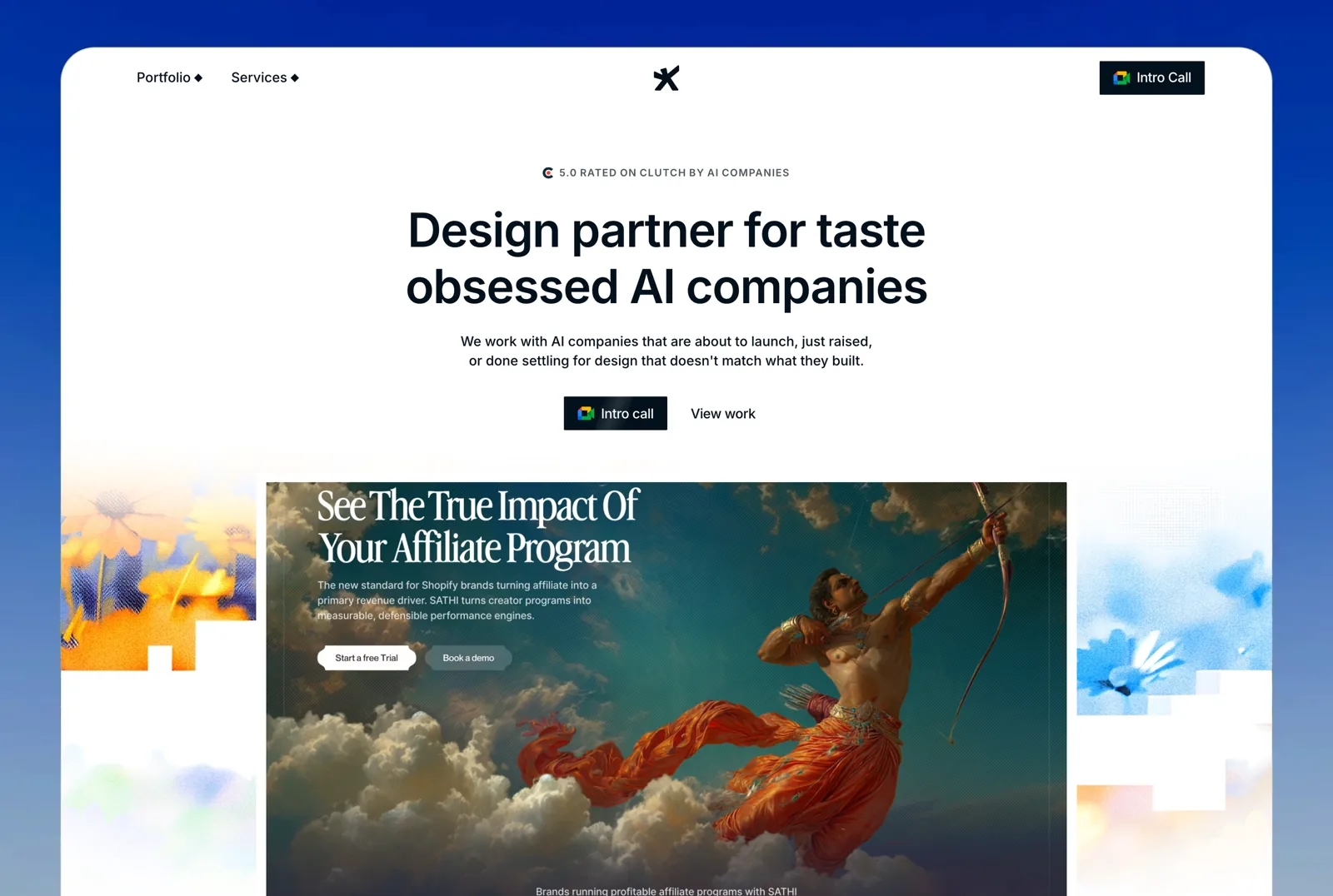
1. Studio Maydit: A Top-Rated Design Agency for AI Founders
The relevant fact for an application brief is that the engagement does not stop when a site ships, it carries on into product design. Studio Maydit is a web and product design studio, which means the same people handle the page that makes the promise and the screens that have to keep it. Its clients are AI founders in the US, UK, and Europe, and the build routes are Framer, Webflow, and custom code, chosen by what the surface has to do rather than by preference. It is founder-led with a small senior team, so the person who learns your awkward screens is the person drawing them.
Teams shipping continuously usually take the monthly retainer, which covers new pages, campaigns, and product design and has no long lock-in. Where a single release has a date attached, a fixed scope of three to four weeks is the other option. Fixed-scope work ends with a diagnosis of what is leaking in the product, and in an application that is nearly always a specific screen where people stop and never come back.
One number is public. Dualite reached 100,000+ users in seven months, after design work built on a repositioned ICP. The recent client list holds Wave, PixelFlow, Mi-VAD, and 15 other AI and SaaS teams.
| Check | Finding |
|---|---|
| Based in | Remote, serving US / UK / EU |
| Platform depth | Framer, Webflow, and custom code |
| AI-sector proof | Yes. AI-native clients, published outcome on Dualite |
| Pricing | Fixed scope or monthly retainer, quoted per project |
| Team shape | Founder-led, small senior team |
| Best fit | Teams who need the site and the app designed by one group |
Worth a call if your marketing page is excellent and your product looks like a different company made it. Book a 30-minute call.

2. Engine Digital
Engine Digital has worked from Vancouver and New York since 2002, building in custom code, with Adidas, Autodesk, Goldman Sachs, and HP named. Autodesk is the strongest signal on this page for an application brief, because its products are dense professional software where a badly placed control costs somebody an hour, and Goldman Sachs means the studio has built things behind a login for people who are not free to choose an alternative.
They publish no pricing and no team size, their AI-sector proof is partial, and a studio organised around enterprise programmes will run at a pace set by review cycles rather than by your release schedule.
| Check | Finding |
|---|---|
| Based in | Vancouver and New York |
| Founded | 2002 |
| Team size | Not published |
| Primary platform | Custom code |
| AI-sector proof | Partial. Enterprise and SaaS clients, no AI case study |
| Named clients | Adidas, Autodesk, Goldman Sachs, HP |
| Pricing | Not published |
| Best fit | Teams building dense professional software |
3. Lighthouse Digital
Lighthouse Digital is a London studio working in Webflow, with a published minimum and HelloSelf, Freetrade, and IGN named. Freetrade is the useful reference here, a product people open repeatedly to check something and act quickly, which is application behaviour rather than website behaviour.
They publish no team size, no founding year, and no AI client work, and Webflow is a website platform, so the parts of a web app that are genuinely hard sit outside what this studio does.
| Check | Finding |
|---|---|
| Based in | London, UK |
| Founded | Not published |
| Team size | Not published |
| Primary platform | Webflow |
| AI-sector proof | No. No published AI client work |
| Named clients | HelloSelf, Freetrade, IGN |
| Pricing | Published minimum |
| Best fit | Teams whose immediate need is the site around the app |
4. Edgar Allan
Edgar Allan is an Atlanta team of 51 to 200 founded in 2014, working in Webflow, with Porsche, Duracell, and NCR named. NCR builds transaction software used by staff all day under time pressure, so somebody there has met the problem of designing for repetition rather than for first impressions.
They publish no pricing, their AI-sector proof is partial, and a large Webflow practice is built around producing many pages consistently, which is a different capability from designing an application.
| Check | Finding |
|---|---|
| Based in | Atlanta, USA |
| Founded | 2014 |
| Team size | 51-200 |
| Primary platform | Webflow |
| AI-sector proof | Partial. Enterprise and SaaS clients, no AI case study |
| Named clients | Porsche, Duracell, NCR |
| Pricing | Not published |
| Best fit | Teams who need a large marketing site kept consistent |
5. Digidop
Digidop is a Paris team of one to ten founded in 2021 working in Webflow, with a published minimum and TSE Energy, Ramify, and StreamNative named. A published starting figure and a very small team make this the quickest studio here to evaluate, and StreamNative sells developer infrastructure, which is a harder thing to explain than most.
Their AI-sector proof is partial, and one to ten people working in Webflow is a website capability, so an application project would exceed both the platform and the capacity.
| Check | Finding |
|---|---|
| Based in | Paris, France |
| Founded | 2021 |
| Team size | 1-10 |
| Primary platform | Webflow |
| AI-sector proof | Partial. Enterprise and SaaS clients, no AI case study |
| Named clients | TSE Energy, Ramify, StreamNative |
| Pricing | Published minimum |
| Best fit | European teams who need a quick, well-built public site |
6. Refokus
Refokus is a remote German studio of 11 to 50 founded in 2021, working in Webflow, with Mural, BASF, Spotify, Yahoo, and BCG named. Mural is a genuine web application, collaborative and stateful, and having worked with a company that builds one means somebody there understands what a shared canvas has to survive.
They publish no pricing, their AI-sector proof is partial, and their own practice is centred on Webflow, so the application work would sit at the edge of what they do rather than at the centre.
| Check | Finding |
|---|---|
| Based in | Germany, remote |
| Founded | 2021 |
| Team size | 11-50 |
| Primary platform | Webflow |
| AI-sector proof | Partial. Enterprise and SaaS clients, no AI case study |
| Named clients | Mural, BASF, Spotify, Yahoo, BCG |
| Pricing | Not published |
| Best fit | Teams who want a strong brand around a product |
7. Flowout
Flowout is a distributed Webflow service with a published minimum and Jasper, Kajabi, Riverside, and Sendlane named. The published figure and the distributed model make it the easiest arrangement on this page to begin, and Kajabi and Sendlane are both products with a lot of surface area to keep current.
It is a production service in a website platform, so it will build what you specify and cannot take on application design, and their AI-sector proof is partial.
| Check | Finding |
|---|---|
| Based in | Distributed |
| Founded | Not published |
| Team size | Not published |
| Primary platform | Webflow |
| AI-sector proof | Partial. Enterprise and SaaS clients, no AI case study |
| Named clients | Jasper, Kajabi, Riverside, Sendlane |
| Pricing | Published minimum |
| Best fit | Teams who need marketing pages produced steadily |
8. Ramotion
Ramotion is a San Francisco studio of 11 to 50 founded in 2009, working across platforms, with a published minimum and Mozilla, Okta, Netflix, Adobe, and Xero named. That is the strongest application client list here after Engine Digital. Xero is accounting software people live inside, and Okta is an administrative tool with permissions, roles, and audit views, which is the unglamorous territory this brief actually covers.
Their AI-sector proof is partial, and a practice with that much brand work will tend to lead with identity, so the systems and states conversation is one you may have to start yourself.
| Check | Finding |
|---|---|
| Based in | San Francisco, USA |
| Founded | 2009 |
| Team size | 11-50 |
| Primary platform | Mixed |
| AI-sector proof | Partial. Enterprise and SaaS clients, no AI case study |
| Named clients | Mozilla, Okta, Netflix, Adobe, Xero |
| Pricing | Published minimum |
| Best fit | Teams who need brand and application handled together |
9. Push Refresh
Push Refresh is a Dallas team of one to ten working in Framer, with a published minimum and SmithRx, Synonym, and Northern National named. SmithRx is a pharmacy benefits product with real operational screens behind it, and a team this small means a senior person is on the work rather than reviewing it.
They publish no founding year, their AI-sector proof is partial, and Framer with one to ten people cannot carry a full application, so this is a partial answer to the brief rather than a complete one.
| Check | Finding |
|---|---|
| Based in | Dallas, USA |
| Founded | Not published |
| Team size | 1-10 |
| Primary platform | Framer |
| AI-sector proof | Partial. Enterprise and SaaS clients, no AI case study |
| Named clients | SmithRx, Synonym, Northern National |
| Pricing | Published minimum |
| Best fit | Small teams who need a few key screens designed well |
10. Flow Ninja
Flow Ninja is a Belgrade team of 11 to 50 founded in 2018, working in Webflow. The size gives them dependable capacity, and European hours suit teams that want a studio awake during their own working day rather than replying overnight.
They publish no client names and no pricing, so there is very little to assess before a call, their AI-sector proof is partial, and Webflow rules out the application work at the centre of this brief.
| Check | Finding |
|---|---|
| Based in | Belgrade, Serbia |
| Founded | 2018 |
| Team size | 11-50 |
| Primary platform | Webflow |
| AI-sector proof | Partial. Enterprise and SaaS clients, no AI case study |
| Named clients | Not published |
| Pricing | Not published |
| Best fit | European teams who need steady Webflow production |
How to choose between them
Sort by what your application is doing badly.
The screens look good and are slow to work in. Studio Maydit or Engine Digital.
Empty states and errors were designed by nobody. Studio Maydit or Ramotion.
The product and the brand look unrelated. Refokus or Ramotion.
The app is fine and the site around it is not. Lighthouse Digital or Edgar Allan.
One test before you sign. Ask a candidate to show you the ugliest screen they have designed and explain why it is that way. Studios with real application experience enjoy this question, because the answer is usually a story about density, permissions, or a support queue. Studios without it will show you something clean with six numbers on it, and that is the honest answer to whether they have designed an application or a picture of one.
If you are earlier than that and still scoping the work itself, what web app design services include sets out the pieces most quotes bundle into one line.