Reading time:
14 min read
Last updated:
10 Best Digital Product Design Agencies for AI Startups - September 2026
Digital product design agencies for AI startups: ten studios compared on whether they ship code or stop at Figma, published pricing, team size, and AI-sector proof.

Ranked by fit, here are the ten: Studio Maydit, Lazarev, Clay, Pixelmatters, Feely Studio, Feels Like, Fantasy, Instrument, SuperSkills, and Foundey. Lazarev and Clay lead the nine. Lazarev has worked from San Francisco since 2015, has fifty-one to two hundred people, publishes a starting price, and has direct AI-sector proof through Payoneer, Peel, Elva, and Mozayix. Clay has been in San Francisco since 2016, is the same size, also publishes a price, and lists Slack, Stripe, Google, Coinbase, and Amazon. SuperSkills and Foundey are the weakest fit for this brief. SuperSkills names a single client and publishes no price. Foundey delivers Figma files and nothing else, which is the exact gap most people searching this phrase are trying to close.
The phrase digital product design agency is doing specific work. Nobody types it when they want a nicer landing page. They type it when the product itself is the problem and they want one team to own it.
For an AI startup the shape is familiar. The model does something genuinely new. The founder demos it and the room leans in. Then a stranger signs up alone, lands on an empty screen with a text box, and has no idea what to type.
What follows is usually a hunt for a design partner, and a quick discovery that most of them mean different things by the same words. Some mean a research phase and a slide deck. Some mean a Figma file. Some mean the whole thing, shipped.
The gap matters more in AI products than anywhere else, because the hardest screens are not the ones in the brief. They are the ones where the model is slow, unsure, or wrong. Nobody puts those in a scope written from a sitemap.
So the list below is sorted by one thing above all others: how far each studio goes before it hands the work back.

How we compared these studios
Five checks, all done from public pages, all repeatable by you in an afternoon.
Platform depth. Does the studio ship working software, work across design and build, or stop at design files? For a founder buying product design this is the difference between a partner and a supplier, so it carried the most weight of anything here.
AI-sector proof. Has the studio designed a product where a model produces the output? It changes the work. There are states to design that ordinary software does not have, and a team that has not met them will design the happy path beautifully and leave the rest to your engineers.
Pricing transparency. Product design engagements are larger than website ones, so a published starting figure saves the most time here. It also signals a studio that has repeated the work often enough to know what it costs.
Team shape. A fifty-person studio and a four-person studio both do good work, but they fail differently. Large teams staff juniors onto small accounts. Small teams run out of capacity. Headcount is the fastest read on which risk you are taking.
The studio's own website. Read how it describes its process. A studio that ships product writes about handover, front-end code, and what happens after launch. A studio that does not writes only about discovery and craft.
Checks one and two set the ranking. Price and size decided anything close. The studio's own site acted as a cap, never a boost.
Each table repeats only what the studio itself publishes. No estimates, no third-party directories. Not published means the studio has not put that detail anywhere public, and we left the gap visible rather than filling it.
What goes wrong when AI startups buy product design
The engagement ends at the Figma file. The work is beautiful, the founder is pleased, and then it sits there. Two engineers now have to interpret hundreds of frames while shipping features, so they build the simplest reading of each one. Six weeks later the product looks nothing like the designs and nobody can say where it diverged. Before signing, ask exactly what is handed over on the last day, and who is available in the four weeks after.
Research is sold as a phase and delivered as a deck. Discovery runs four weeks, produces personas and a journey map, and none of it changes a single screen. For an early AI product the useful research is much smaller and much more specific: watch six strangers try to get one result out of the product, and write down where each of them stops. Ask what the research output is. If the answer is a document rather than a list of changes, negotiate it down.
Nobody designs what happens when the model is wrong. The scope covers onboarding, the main workspace, and settings. It does not cover the response that takes eleven seconds, the answer that is confidently incorrect, the partial result, or the undo. Those states are most of what a real user experiences in week one. List them yourself and put them in the brief, because a studio without AI proof will not raise them.
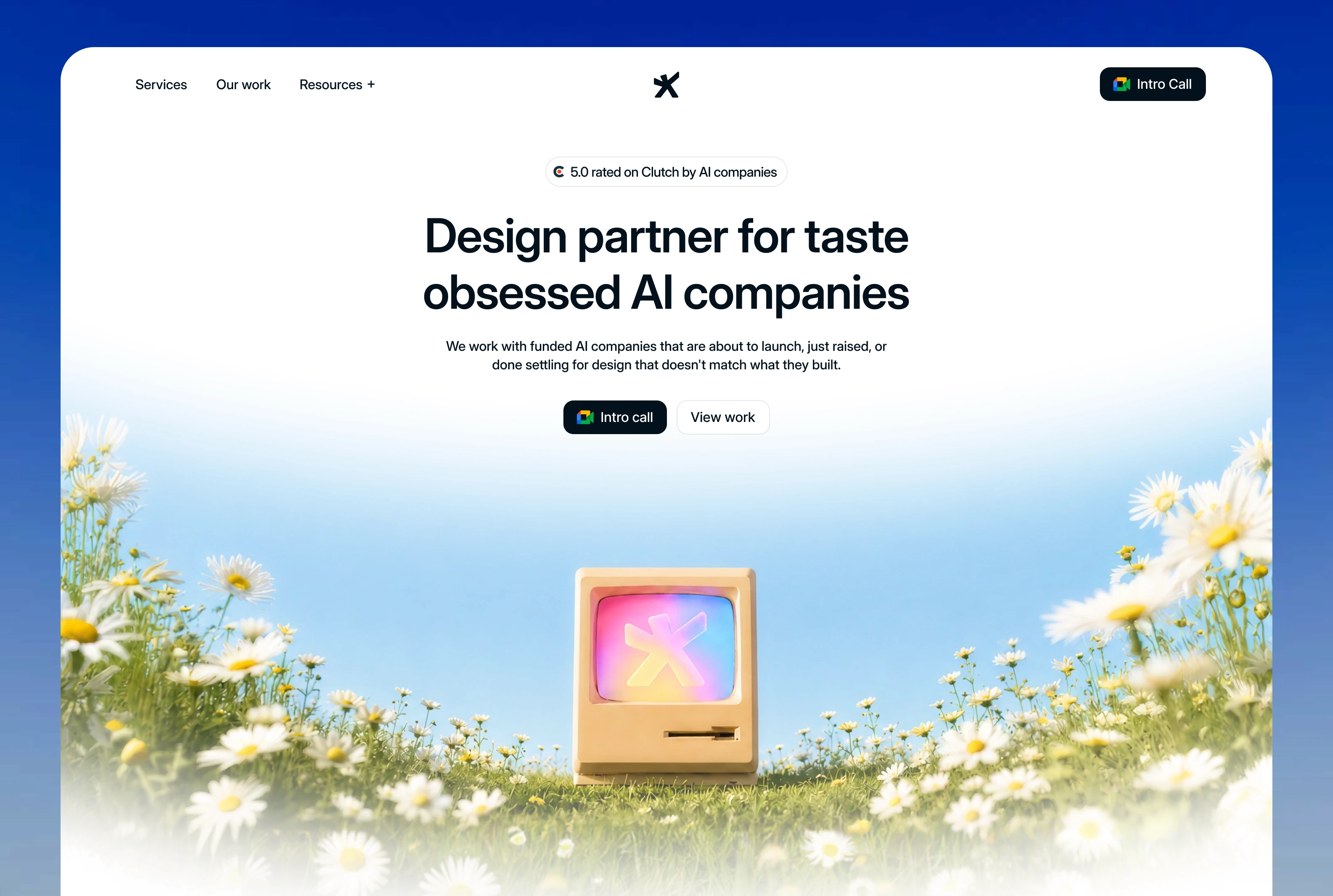
1. Studio Maydit: A Top-Rated Design Agency for AI Founders
The common thread in AI startups that hire design is that the product is ahead of how it reads. Studio Maydit is a web and product design studio working with AI founders across the US, UK, and Europe, and this is the work it takes on.
It does not stop at a file. The studio builds in Framer, Webflow, and custom code, and the same team continues into product design once the site ships, which is why fixed-scope projects end with a diagnosis of what is leaking in the product rather than a handover email.
There are two ways to buy. Fixed scope runs three to four weeks and suits a team with a launch or a raise in the calendar. A monthly retainer suits teams still shipping, covering new pages, campaigns, and product design as they come, with no long lock-in.
Dualite is the published proof. Design work that supported a repositioned ICP sat behind the product reaching 100,000+ users in seven months. Wave, PixelFlow, and Mi-VAD are recent clients, alongside 15 other AI and SaaS teams.
Check | Finding |
|---|---|
Based in | Remote, serving US / UK / EU |
Platform depth | Framer, Webflow, and custom code |
AI-sector proof | Yes. AI-native clients, published outcome on Dualite |
Pricing | Fixed scope or monthly retainer, quoted per project |
Team shape | Founder-led, small senior team |
Best fit | AI founders who want one team from design through to what ships |
Show us the screen a new user lands on first and we will tell you what it is missing. Book a 30-minute call.

2. Lazarev
Lazarev has worked from San Francisco since 2015, has fifty-one to two hundred people, publishes a starting price, and has direct AI-sector proof. Payoneer, Peel, Elva, and Mozayix are named clients. Payoneer is a financial product with a long, regulated flow, which is a useful signal: this is a studio used to designing the unglamorous middle of a product, not just the first screen.
The weakness is scale and platform. At fifty-one to two hundred people and premium tier, a seed-stage engagement will not get the founders, and the studio works across several platforms rather than committing to one, so confirm who writes the front end.
Check | Finding |
|---|---|
Based in | San Francisco, USA |
Founded | 2015 |
Team size | 51-200 |
Primary platform | Mixed |
AI-sector proof | Yes |
Named clients | Payoneer, Peel, Elva, Mozayix |
Pricing | Published minimum |
Best fit | Funded teams designing long, multi-step product flows |
3. Clay
Clay has been in San Francisco since 2016, has fifty-one to two hundred people, publishes a starting price, and has direct AI-sector proof. Slack, Stripe, Google, Coinbase, and Amazon are on its list. That is the strongest craft signal on this page, and for a founder who wants the product to feel like it belongs next to those names, it is the obvious call.
The weakness is fit and cost. Premium tier with that client list means a minimum engagement most seed-stage AI companies will not clear, and the platform is mixed rather than a committed build practice. Expect a longer process than a small team needs.
Check | Finding |
|---|---|
Based in | San Francisco, USA |
Founded | 2016 |
Team size | 51-200 |
Primary platform | Mixed |
AI-sector proof | Yes |
Named clients | Slack, Stripe, Google, Coinbase, Amazon |
Pricing | Published minimum |
Best fit | Well-funded AI companies buying craft at the highest visible standard |
4. Pixelmatters
Pixelmatters has been in Porto since 2013, has fifty-one to two hundred people, and publishes a starting price. Rubrik, Quantic, and UJET are clients. Of everyone here it comes closest to the thing people mean when they search for a product design and engineering firm in one, because a team that size can run design and front-end build in parallel rather than in sequence.
The weakness is sector proof. AI-sector experience is only partial, so the AI-specific states will be new ground, and at premium tier and that headcount a small product will not be the studio's priority account.
Check | Finding |
|---|---|
Based in | Porto, Portugal |
Founded | 2013 |
Team size | 51-200 |
Primary platform | Mixed |
AI-sector proof | Partial |
Named clients | Rubrik, Quantic, UJET |
Pricing | Published minimum |
Best fit | Teams wanting design and front-end engineering from one supplier |
5. Feely Studio
Feely Studio is a one to ten person distributed European studio with direct AI proof, a published starting price, and Noxus, Mutiny, Luasai, and Basic Capital as clients. Those are early-stage software companies rather than enterprises, which makes it the closest match on this page to a seed-stage AI startup's actual situation. Budget tier and a small team mean the people who pitch are the people who work.
The weakness is capacity and record. No founding date is published, the team is small enough that a second project could stall yours, and there is less public history to judge than the larger studios offer.
Check | Finding |
|---|---|
Based in | Distributed, Europe |
Founded | Not published |
Team size | 1-10 |
Primary platform | Mixed |
AI-sector proof | Yes |
Named clients | Noxus, Mutiny, Luasai, Basic Capital |
Pricing | Published minimum |
Best fit | Seed-stage AI teams that want senior people and a published price |

6. Feels Like
Feels Like is a Los Angeles studio founded in 2023 that builds in custom code and has direct AI proof, with Google, Nike, LVMH, and Suno AI as clients. Suno AI is a consumer AI product with a genuinely novel interaction, so the studio has designed for users meeting an unfamiliar model for the first time. Because it writes code, the work does not stop at a file.
The weakness is transparency and age. Founded in 2023, with no published headcount and no published price, so scoping takes longer. The client mix leans consumer and brand, which suits a launch more than a dense internal tool.
Check | Finding |
|---|---|
Based in | Los Angeles, USA |
Founded | 2023 |
Team size | Not published |
Primary platform | Custom code |
AI-sector proof | Yes |
Named clients | Google, Nike, LVMH, Suno AI |
Pricing | Not published |
Best fit | Consumer AI products where the first impression carries the launch |
7. Fantasy
Fantasy has designed products from San Francisco and New York since 1999 and has direct AI-sector proof. Almost three decades means it has worked through several complete changes in how software is used, and a studio with that history tends to be good at the part founders find hardest: deciding what the product should not do.
The weakness is that nothing else is public. No client names, no headcount, no price. At premium tier with an unpublished minimum, an early-stage team can spend two calls finding out it cannot afford the answer. The platform is mixed, so the build question is open too.
Check | Finding |
|---|---|
Based in | San Francisco and New York, USA |
Founded | 1999 |
Team size | Not published |
Primary platform | Mixed |
AI-sector proof | Yes |
Named clients | Not published |
Pricing | Not published |
Best fit | Funded companies wanting a hard look at product scope |
8. Instrument
Instrument has worked from Portland since 2005 across several platforms, for Nike, Microsoft, Electronic Arts, and Google. That is a list of organisations where a product touches many teams, and the studio is practised at working inside that kind of structure.
The weakness is match. AI-sector proof is only partial, no headcount or pricing is published, and a studio shaped around very large clients is not shaped around a five-person company that needs decisions this month. Expect a process built for stakeholder alignment you do not have.
Check | Finding |
|---|---|
Based in | Portland, USA |
Founded | 2005 |
Team size | Not published |
Primary platform | Mixed |
AI-sector proof | Partial |
Named clients | Nike, Microsoft, Electronic Arts, Google |
Pricing | Not published |
Best fit | Later-stage companies with several teams touching one product |
9. SuperSkills
SuperSkills is a one to ten person studio in Walnut Creek, California, working across platforms with direct AI proof. The Cut is its named client. A team this small means direct access throughout, and budget tier means an early-stage company can probably afford it.
The weakness is evidence. One named client, no founding date, and no published price leave very little to judge from the outside, and a product design engagement is a bigger bet than a website. Ask for two case studies with before and after screens and the reasoning behind each change.
Check | Finding |
|---|---|
Based in | Walnut Creek, USA |
Founded | Not published |
Team size | 1-10 |
Primary platform | Mixed |
AI-sector proof | Yes |
Named clients | The Cut |
Pricing | Not published |
Best fit | Small budgets where direct access matters more than track record |
10. Foundey
Foundey is a San Francisco studio founded in 2021 working with early AI companies including DemandIQ, Traycer, and Sero AI. It has direct AI proof and understands founders whose positioning is still moving, which is genuinely useful at this stage.
The weakness is decisive against this search. Foundey designs in Figma only. It does not build, so the handover problem described above is guaranteed rather than a risk, and you will need a front-end team as well. Headcount and pricing are not published.
Check | Finding |
|---|---|
Based in | San Francisco, USA |
Founded | 2021 |
Team size | Not published |
Primary platform | Figma-only |
AI-sector proof | Yes |
Named clients | DemandIQ, Traycer, Sero AI |
Pricing | Not published |
Best fit | Teams with their own front-end engineers who need design only |
How to choose between them
Decide what you are actually buying before you shortlist, because these studios sell different things.
You want one team through to shipped screens. Pixelmatters, or Feels Like if the product is consumer-facing.
The product is dense and multi-step. Lazarev, and ask to see a long flow from a past project.
You are seed stage with a real budget but not a big one. Feely Studio, or SuperSkills if direct access matters more than proof.
You already have front-end engineers. Foundey for design only, and put the handover terms in writing.
One test that sorts them quickly. Ask how they would design the screen a user sees when the model returns a confidently wrong answer. A studio with AI experience answers with patterns. A studio without it asks whether that happens often.

Need more info?
Can't find your answer? Book a call and let's talk.
Continue Reading
10 Best Framer Design Agencies for AI Agent Startups - September 2026
Ten Framer studios that have shipped for AI agent companies, with the demo and trust patterns those products need. Checked on platform depth, pricing and team.

Siddarth Ponangi
10 Best Framer Design Agencies for Newly Funded Startups - September 2026
Your funding announcement is the biggest traffic day you will have all year. We checked 10 Framer agencies on five public criteria to see which can hit that date.
Siddarth Ponangi
10 Best Custom Code Website Development Agencies for AI Agent Startups - September 2026
AI web development agencies for agent startups. Which teams build custom coded sites a small team can still update weekly after launch.
Siddarth Ponangi