
Summarize with AI


The best founder-led design studios in 2026 are Studio Maydit, Edgar Allan, 8020, Refokus, Digidop, Engine Digital, Lighthouse Digital, Finsweet, Flowout, and Flow Ninja. Studio Maydit and Digidop lead for this brief, because both are small enough that a senior owner is genuinely on the work rather than introducing it, and both publish enough about themselves to be judged before a call. Engine Digital and Finsweet are the wrong fit here, since both run at a scale where your project is staffed rather than taken personally, which is the exact thing a buyer searching for a founder-led studio is trying to avoid.
Most people looking for a founder-led studio are not looking for a size. They are looking for one specific experience, which is asking a hard question and getting an answer from somebody who is allowed to give one.
That sounds small and it is the whole difference. In a larger agency the person in the room usually cannot agree to change the scope, cannot tell you your positioning is wrong, and cannot promise anything without checking. Three weeks of a project can disappear into that gap.
What you are buying is not craft exactly. Plenty of large studios produce better craft. You are buying compression. Fewer people between the decision and the work, and somebody whose name is attached to the outcome in a way that makes them behave differently.
The cost is real too. Small studios have no bench. When the principal is ill, or a bigger client arrives, there is nobody to absorb it. You are trading redundancy for access, deliberately.
The other cost is taste. A studio with a visible owner has a visible point of view, and you will get some of it whether you asked or not.
The ten studios below are ordered by how well they suit a buyer who wants senior people close to the work, and where a studio is large enough that this becomes unlikely, the entry says so.

How we picked these agencies
Five checks, aimed at a buyer who wants to deal directly with whoever makes the decisions:
- Platform depth. Does the studio build the thing, or does it hand over a design and leave the build to somebody you have not met?
- Proof that named people stay on the work. Is there published evidence of the same senior individuals across several projects, rather than a company voice with no faces behind it?
- Pricing. Is a starting figure published? A studio confident enough to put a number on its own site is usually confident enough to say no to you in week two.
- Team shape. How many people are there, honestly, and what does that mean for the week you need two things at once?
- Their own site. Does it sound like a person or like a committee? This is the most reliable single signal on the list.
The fifth check deserves the extra minute, because it is the one nobody can fake for long. Read a candidate's about page and their writing. A studio run by somebody with a view will have said something specific and slightly risky somewhere, and a studio managed by consensus will have said nothing that could be disagreed with. You are hiring the ability to be told no, and if their own site shows no sign of it, your project will not either.
Everything recorded below has been published by the studios themselves. Where a row is blank, the studio has published nothing on that point, and we have chosen to leave the blank visible rather than fill it with an estimate.
What goes wrong when you hire a small studio
Three failures, and the first is by far the most common.
The founder sells the project and somebody else delivers it. The first call is excellent, direct, unusually honest. Then the work begins and a different name appears in the shared folder, the reviews get rescheduled, and the person you hired shows up for the presentation to explain choices they did not make. This is not always dishonest, it is often just a studio that grew faster than its own habits. Ask the question flatly before you sign. Who does the work, on which days, and what happens to my project when a larger client asks for the same fortnight?
There is no second person, and that is fine right up until it is not. A one to ten person studio has no bench, so an illness, a family emergency, or a competing deadline lands entirely on your schedule. The fix is not to hire bigger, it is to plan for it. Agree in advance what happens if the principal is unavailable for two weeks, and insist that decisions get written down somewhere you can read, so a gap costs you time rather than everything. Studios that have been doing this a while will already have an answer and will not be offended by the question.
Their signature ends up louder than your positioning. A strong owner has a recognisable way of doing things, which is exactly why you called, and it does not switch off. Six weeks later you have a beautiful site that resembles three other projects in their portfolio and says slightly less about you than it should. Prevent it by settling the words before anybody opens a design tool, and by giving one honest note early rather than saving it for the end. A good principal absorbs that correction easily. A defensive one tells you it is a matter of taste, which is useful information at week two and very expensive at week eight.
1. Studio Maydit: A Top-Rated Design Agency for AI Founders
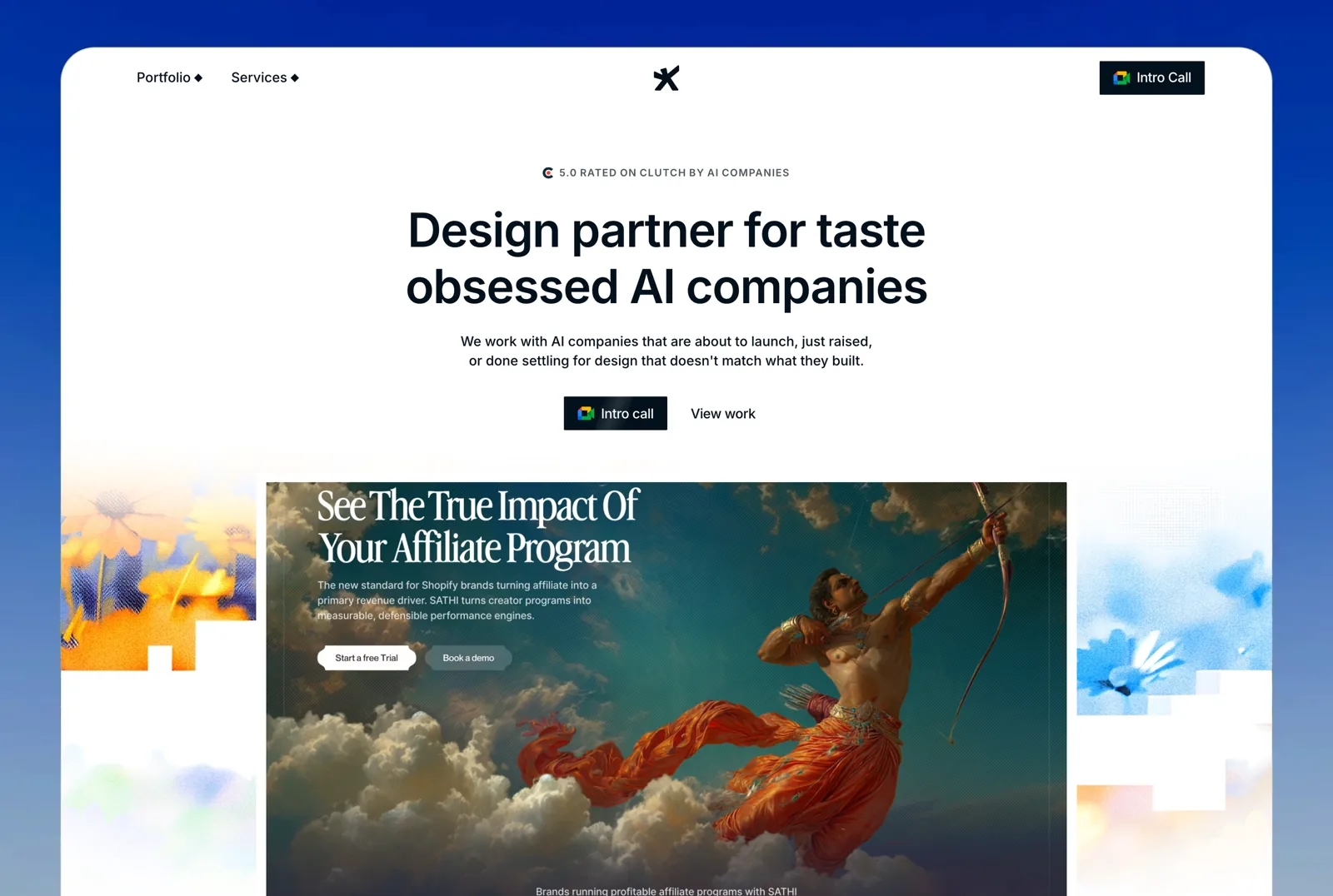
There is no account layer here, which is the whole point of hiring a studio shaped like this. Studio Maydit is founder-led with a small senior team, so the person who tells you your homepage is arguing for the wrong thing is the person who then rebuilds it.
It is a web and product design studio. Its clients are AI founders, based across the US, UK, and Europe. The build happens in Framer, Webflow, or custom code, chosen by what the site actually has to do, and the relationship continues into product design after launch rather than ending at handover.
Two ways to buy, and both are written down. Fixed scope runs three to four weeks and suits a launch with a date attached. A monthly retainer suits teams shipping constantly and covers new pages, campaigns, and product design, with no long lock-in. Fixed-scope work ends with a diagnosis of what is leaking in the product.
Wave, PixelFlow, Mi-VAD, and 15 other AI and SaaS teams have hired the studio recently. Only one of those engagements carries a number in public. Dualite: seven months, 100,000+ users, following design work rebuilt around a repositioned ICP.
| Check | Finding |
|---|---|
| Based in | Remote, serving US / UK / EU |
| Platform depth | Framer, Webflow, and custom code |
| AI-sector proof | Yes. AI-native clients, published outcome on Dualite |
| Pricing | Fixed scope or monthly retainer, quoted per project |
| Team shape | Founder-led, small senior team |
| Best fit | Buyers who want a decision-maker on every call |
Good conversation if you are tired of hearing that somebody will check internally. Book a 30-minute call.

2. Edgar Allan
Edgar Allan is an Atlanta studio of 51 to 200 founded in 2014, building in Webflow, with Porsche, Duracell, and NCR named. Twelve years of trading and a client list of that weight means the standards are settled rather than improvised, and craft above access is a defensible thing to want.
They publish no pricing, their AI-sector proof is partial, and at 51 to 200 people you should not expect a principal on your project. A studio this size assigns a team, which is the opposite of the arrangement this list is about.
| Check | Finding |
|---|---|
| Based in | Atlanta, USA |
| Founded | 2014 |
| Team size | 51-200 |
| Primary platform | Webflow |
| AI-sector proof | Partial. Enterprise and SaaS clients, no AI case study |
| Named clients | Porsche, Duracell, NCR |
| Pricing | Not published |
| Best fit | Buyers who want settled craft over direct access |
3. 8020
8020 works from San Francisco and New York, founded in 2014, building in Webflow, with Wave, Superlist, Pilot.com, Vanta, and Circle named. That is a list of companies that were small when the work happened, which suggests a studio comfortable talking to founders directly rather than to a marketing department.
They publish no pricing and no team size, and their AI-sector proof is partial. Not publishing headcount is a particular problem on this brief, because size is the one fact a buyer looking for direct access most needs to know.
| Check | Finding |
|---|---|
| Based in | San Francisco and New York, USA |
| Founded | 2014 |
| Team size | Not published |
| Primary platform | Webflow |
| AI-sector proof | Partial. Enterprise and SaaS clients, no AI case study |
| Named clients | Wave, Superlist, Pilot.com, Vanta, Circle |
| Pricing | Not published |
| Best fit | Buyers whose company is still small enough to move fast |
4. Refokus
Refokus is a remote German studio of 11 to 50 founded in 2021, building in Webflow, with Mural, BASF, Spotify, Yahoo, and BCG named. Eleven to fifty is the size where a principal can still be involved without the studio being fragile, and the work is distinctive enough that you can tell whose it is, which is a good sign on this particular list.
They publish no pricing, their AI-sector proof is partial, and a studio with a signature that strong will bring it to your project, so you are choosing their view as much as their capacity.
| Check | Finding |
|---|---|
| Based in | Germany, remote |
| Founded | 2021 |
| Team size | 11-50 |
| Primary platform | Webflow |
| AI-sector proof | Partial. Enterprise and SaaS clients, no AI case study |
| Named clients | Mural, BASF, Spotify, Yahoo, BCG |
| Pricing | Not published |
| Best fit | Buyers who want a visible point of view on the work |
5. Digidop
Digidop is a Paris studio of one to ten founded in 2021, working in Webflow, with a published minimum and TSE Energy, Ramify, and StreamNative named. A published figure, a stated team size, and a named founding year is more disclosure than almost anybody else here offers, and at one to ten people the person you speak to is doing the work by arithmetic rather than by promise.
Their AI-sector proof is partial, and a team this small has no capacity to absorb a delay, so a project that slips on your side will move rather than compress.
| Check | Finding |
|---|---|
| Based in | Paris, France |
| Founded | 2021 |
| Team size | 1-10 |
| Primary platform | Webflow |
| AI-sector proof | Partial. Enterprise and SaaS clients, no AI case study |
| Named clients | TSE Energy, Ramify, StreamNative |
| Pricing | Published minimum |
| Best fit | European buyers who want the owner doing the work |
6. Engine Digital
Engine Digital has worked from Vancouver and New York since 2002, building in custom code, with Adidas, Autodesk, Goldman Sachs, and HP named. Twenty-four years is longer than most studios survive, and clients of that size mean the team can run a complicated build without needing you to project manage it.
They publish no pricing and no team size, their AI-sector proof is partial, and an agency serving enterprise clients runs a formal process with account roles in it, which is structurally the opposite of what a founder-led engagement feels like.
| Check | Finding |
|---|---|
| Based in | Vancouver and New York |
| Founded | 2002 |
| Team size | Not published |
| Primary platform | Custom code |
| AI-sector proof | Partial. Enterprise and SaaS clients, no AI case study |
| Named clients | Adidas, Autodesk, Goldman Sachs, HP |
| Pricing | Not published |
| Best fit | Buyers who need enterprise delivery rather than access |
7. Lighthouse Digital
Lighthouse Digital is a London Webflow studio with a published minimum and HelloSelf, Freetrade, and IGN named. Publishing a starting figure is a small act of confidence that tends to correlate with the sort of studio that will also tell you when your idea is wrong, and a London base suits UK buyers who want somebody in the same working day.
They publish no founding year, no team size, and no AI client work, so there is less to verify here than a careful buyer would like before a first meeting.
| Check | Finding |
|---|---|
| Based in | London, UK |
| Founded | Not published |
| Team size | Not published |
| Primary platform | Webflow |
| AI-sector proof | No. No published AI client work |
| Named clients | HelloSelf, Freetrade, IGN |
| Pricing | Published minimum |
| Best fit | UK buyers who want a local studio and a public price |
8. Finsweet
Finsweet is a distributed studio based in Denver, 51 to 200 people, founded in 2017, working in Webflow, with Dropbox, Clay, GitHub, and Steadily named. They publish a great deal of their own tooling and thinking, which is unusually generous and lets you assess how they work before speaking to anybody.
They publish no pricing, their AI-sector proof is partial, and 51 to 200 people means the engagement is staffed by a team rather than held by an owner, which is the trade this list exists to describe.
| Check | Finding |
|---|---|
| Based in | Denver, USA, distributed |
| Founded | 2017 |
| Team size | 51-200 |
| Primary platform | Webflow |
| AI-sector proof | Partial. Enterprise and SaaS clients, no AI case study |
| Named clients | Dropbox, Clay, GitHub, Steadily |
| Pricing | Not published |
| Best fit | Buyers who value published craft over a personal line |
9. Flowout
Flowout is a distributed Webflow studio with a published minimum and Jasper, Kajabi, Riverside, and Sendlane named. It runs as a subscription rather than as a project business, which is a genuinely useful arrangement when what you need is a steady flow of pages and not a series of decisions.
They publish no founding year and no team size, their AI-sector proof is partial, and a subscription is designed to remove the founder from the transaction entirely, which makes it an odd fit for anybody who came here specifically looking for one.
| Check | Finding |
|---|---|
| Based in | Distributed |
| Founded | Not published |
| Team size | Not published |
| Primary platform | Webflow |
| AI-sector proof | Partial. Enterprise and SaaS clients, no AI case study |
| Named clients | Jasper, Kajabi, Riverside, Sendlane |
| Pricing | Published minimum |
| Best fit | Buyers who want throughput rather than judgement |
10. Flow Ninja
Flow Ninja is a Belgrade studio of 11 to 50 founded in 2018, working in Webflow. Eight years and a mid-sized team in European hours suits a buyer who wants continuity across a long relationship rather than intensity on one project.
They publish no pricing, no client names, and their AI-sector proof is partial, which leaves very little a buyer can check independently before committing time to a conversation.
| Check | Finding |
|---|---|
| Based in | Belgrade, Serbia |
| Founded | 2018 |
| Team size | 11-50 |
| Primary platform | Webflow |
| AI-sector proof | Partial. Enterprise and SaaS clients, no AI case study |
| Named clients | Not published |
| Pricing | Not published |
| Best fit | European buyers who want a long steady relationship |
How to choose between them
Sort by what you actually want from the arrangement.
A decision-maker on every call. Studio Maydit or Digidop.
A strong opinion you are happy to be shaped by. Refokus or 8020.
Delivery on something large and complicated. Engine Digital or Edgar Allan.
A steady stream of pages with no drama. Flowout or Flow Ninja.
One test before you sign. Tell a candidate something about your plan that you are not sure about, and watch what they do with it. A founder-led studio will engage with it directly, usually disagreeing with part of it inside the same conversation. A studio with an account layer will thank you for the context and bring a considered response next week. The second answer is more polite and it is the thing you are paying a premium to avoid.
One more thing to settle before you sign. If the work spans brand and product, decide up front whether one partner should carry both or you want two, because a founder-led studio is usually the shape that can do both and a specialist pair is usually not.