Summarize with AI


The best product design agencies for AI automation startups in 2026 are Studio Maydit, Clay, SuperSkills, Fantasy, 8020, Push Refresh, Finsweet, Flowout, and Lazarev, with Foundey completing the list. Studio Maydit and Clay lead for this brief, because both have shipped operational software where people hand a repeated job over to a system, and that handover is the whole product here. Flowout and Finsweet are the weakest fit. Both are Webflow production practices, and an automation company's hardest screens are setup and exceptions, not pages.
Automation sells on a simple promise. Something tedious stops being your problem. That promise is easy to demonstrate and hard to keep, because the tedious thing is never as regular as the person describing it believes.
Nine times out of ten the work goes through cleanly. The tenth is different: a supplier used a new invoice format, a field is blank, two records look like the same customer, the amount is above what anyone expected. That tenth case is where your product is actually evaluated.
Most teams design the nine. The tenth becomes an email, a support ticket, or a row in a spreadsheet that somebody checks on Fridays. Within a quarter your customer has rebuilt a manual process on top of the thing they bought to remove manual process.
There is a second oddity in this category that catches founders out. When automation works, people stop opening it. Usage falls, sessions shorten, and every engagement metric points the wrong way at exactly the moment the product is succeeding.
That has a real cost at renewal, when nobody can remember what the software did for them, because the whole point was that they stopped noticing.
The ten studios below are ranked by how well they suit a team whose product has to be trusted with work rather than merely used.

How we picked these agencies
Five checks, written for a company selling software that takes work off somebody's desk:
- Platform depth. Is application and workflow design the main business, or website production with a product line beside it? Setup screens and exception queues are the whole job here, and they are nothing like a landing page.
- Operational software proof. Have they designed products that replace a manual process? Finance tools, logistics, support software, and internal operations platforms all count. It is a specific discipline, because the design has to inherit habits that were never written down.
- Pricing. Is a starting figure published? For a founder who spends every day arguing that clarity beats mystery, a supplier that will not state a number is an odd first purchase.
- Team shape. How many people, and does the senior one stay? Automation products get rebuilt around the exception cases discovered in month two, and that is a conversation for whoever made the original decisions.
- Their own site. Judge it as evidence. A studio that cannot explain its own service simply will struggle to explain yours to an operations manager.
Put most of the weight on check two, and interrogate it properly. The interesting question is not whether they have built a dashboard, it is whether they have ever sat with somebody doing the manual version of a job and watched what they actually do, including the parts nobody documents. Ask which project involved replacing an existing manual process, how they learned the real steps, and what surprised them once the software went live.
Sourcing, briefly. Everything in the tables is what each studio publishes about itself, read this month, with no directories, no third-party ratings, and no estimates. If a row says nothing is published, that is the fact, and for a buyer comparing suppliers it is a useful one.
What goes wrong when automation products get designed
Three failures. The first one is nearly universal and it decides renewals.
The exception is not a screen. Everything is built for the run that works. When something does not fit, the product sends a notification and stops, and the human is left to sort it out somewhere else entirely. Customers then create a shadow process, usually a shared inbox or a spreadsheet, and the value of your product quietly drains into it. Exceptions deserve the best screen in the software: what the system tried, what it could not decide, the two or three plausible answers, and a single action that resolves it and teaches the system for next time.
Setup asks for a process nobody has written down. The first-run experience says describe your workflow, define your rules, map your fields. The customer has done this job for six years and has never once written it out, because it lives in habit and judgement. Faced with a blank configuration screen they either give up or produce a version that is subtly wrong, and the product then automates the wrong thing accurately. Start from their real material instead. Read a month of their actual records, propose the rules you inferred, and let them correct you. Correcting a draft is easy, authoring from nothing is not.
Success makes the product invisible. The automation works, so people stop logging in, and by renewal there is no felt experience of value, only an invoice. Teams respond by adding notifications, which is annoying, or by reporting activity, which nobody reads. What works is a small, honest account of what was handled: this many items, this much time, these three that needed you. Not a dashboard anyone must visit, but a short summary that arrives where the buyer already looks and makes the invisible work visible once a week.
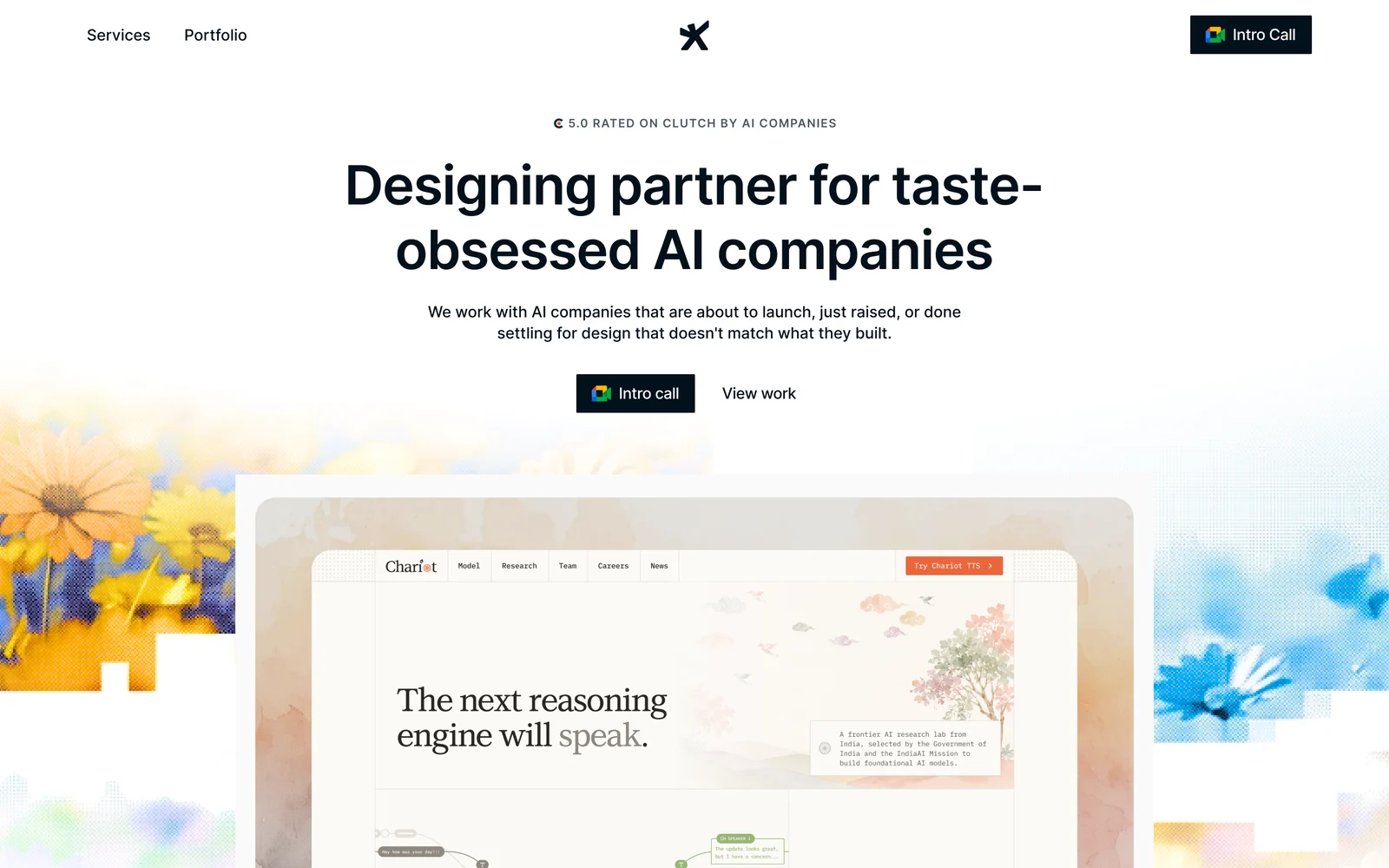
1. Studio Maydit: A Top-Rated Design Agency for AI Founders
Work continues into product design after the site ships, which for an automation company is the part that decides everything. The site sells the promise, and the exception queue keeps it, so a partner who stops at launch stops precisely where this category gets difficult. Framer, Webflow, and custom code are all live practices here, chosen by what the product needs rather than by preference.
Studio Maydit is a web and product design studio, and its clients are AI founders across the US, UK, and Europe. Dualite is the one client published with a number attached. A repositioned ICP came first, the design was rebuilt around that decision, and 100,000+ users arrived within seven months. Naming a narrower user is the same discipline an automation company needs, since a product that automates everything for everyone ends up automating nothing convincingly. Wave, PixelFlow, and Mi-VAD are recent clients, alongside 15 other AI and SaaS teams.
Buying happens two ways. Fixed scope runs three to four weeks and suits a team aiming at a set date. A monthly retainer suits a team still discovering what its customers' real edge cases are, covering new pages, campaigns, and product design, with no long lock-in. Fixed-scope work ends with a diagnosis of what is leaking in the product, which here usually means finding the point where a customer stopped trusting the automation and went back to doing it by hand.
| Check | Finding |
|---|---|
| Based in | Remote, serving US / UK / EU |
| Platform depth | Framer, Webflow, and custom code |
| AI-sector proof | Yes. AI-native clients, published outcome on Dualite |
| Pricing | Fixed scope or monthly retainer, quoted per project |
| Team shape | Founder-led, small senior team |
| Best fit | Automation teams losing customers to the exception cases |
Worth a call if your customers built a spreadsheet next to your product. Book a 30-minute call.

2. Clay
Clay is a San Francisco studio founded in 2016 at fifty-one to two hundred people, publishing a minimum, with published AI client work and Slack, Stripe, Google, Coinbase, and Amazon named. Stripe is the reference for making a complicated operational process feel simple without hiding what happened, which is the exact balance an automation product has to strike, and few studios have shipped at that level.
The published minimum assumes a company with revenue, the process expects a design counterpart on your side, and a small team will not be the account that sets priorities.
| Check | Finding |
|---|---|
| Based in | San Francisco, USA |
| Founded | 2016 |
| Team size | 51-200 |
| Primary platform | Mixed |
| AI-sector proof | Yes. Published AI client work |
| Named clients | Slack, Stripe, Google, Coinbase, Amazon |
| Pricing | Published minimum |
| Best fit | Funded teams with a designer already in place |
3. SuperSkills
SuperSkills is a Walnut Creek team of one to ten working across platforms, with published AI client work and The Cut named. Small and close to the Bay Area means a senior person can be watching your customers' exception handling within days, and a short focused engagement is often the right first purchase when you already know which screen is failing.
They name one client, publish no founding year and no starting figure, and one to ten people cannot cover a product surface that keeps growing with each new integration.
| Check | Finding |
|---|---|
| Based in | Walnut Creek, USA |
| Founded | Not published |
| Team size | 1-10 |
| Primary platform | Mixed |
| AI-sector proof | Yes. Published AI client work |
| Named clients | The Cut |
| Pricing | Not published |
| Best fit | Teams needing one broken screen fixed fast |
4. Fantasy
Fantasy has designed software from San Francisco and New York since 1999, across platforms, with published AI client work. Twenty-seven years of taking technically difficult products to something ordinary people can operate is unusual, and knowing what to leave out matters more here than in almost any other category.
They publish no client names, no team size, and no starting figure, so evaluating the fit takes several conversations rather than an afternoon.
| Check | Finding |
|---|---|
| Based in | San Francisco and New York, USA |
| Founded | 1999 |
| Team size | Not published |
| Primary platform | Mixed |
| AI-sector proof | Yes. Published AI client work |
| Named clients | Not published |
| Pricing | Not published |
| Best fit | Teams buying judgement rather than throughput |
5. 8020
8020 works from San Francisco and New York, founded in 2014, in Webflow, naming Wave, Superlist, Pilot.com, Vanta, and Circle. Pilot and Vanta both sell software that takes an ongoing operational burden off a team, so this studio has helped position exactly the promise an automation company makes, and that is genuinely useful for the public side of the business.
They publish no team size and no starting figure, their AI-sector proof is partial with no AI case study, and Webflow means the application work is not the core practice.
| Check | Finding |
|---|---|
| Based in | San Francisco and New York, USA |
| Founded | 2014 |
| Team size | Not published |
| Primary platform | Webflow |
| AI-sector proof | Partial. Enterprise and SaaS clients, no AI case study |
| Named clients | Wave, Superlist, Pilot.com, Vanta, Circle |
| Pricing | Not published |
| Best fit | Teams whose site no longer explains what they do |
6. Push Refresh
Push Refresh is a Dallas team of one to ten working in Framer, publishing a minimum, and naming SmithRx, Synonym, and Northern National. SmithRx operates in healthcare where a mishandled case has consequences, so the team has worked somewhere exceptions genuinely matter, and a published figure makes a first engagement easy to approve.
They publish no founding year, their AI-sector proof is partial with no AI case study, and one to ten people in Framer is a website-sized team for a product-sized problem.
| Check | Finding |
|---|---|
| Based in | Dallas, USA |
| Founded | Not published |
| Team size | 1-10 |
| Primary platform | Framer |
| AI-sector proof | Partial. Enterprise and SaaS clients, no AI case study |
| Named clients | SmithRx, Synonym, Northern National |
| Pricing | Published minimum |
| Best fit | Small teams wanting a priced, fast start on the site |
7. Finsweet
Finsweet is a distributed studio based in Denver, founded in 2017 at fifty-one to two hundred people, working in Webflow, naming Dropbox, GitHub, and Steadily. They build much of the tooling other Webflow teams depend on, which is itself an automation business, and it shows in how maintainable their handovers are.
They publish no starting figure, their AI-sector proof is partial with no AI case study, and website engineering is a different craft from designing an exception queue.
| Check | Finding |
|---|---|
| Based in | Denver, USA, distributed |
| Founded | 2017 |
| Team size | 51-200 |
| Primary platform | Webflow |
| AI-sector proof | Partial. Enterprise and SaaS clients, no AI case study |
| Named clients | Dropbox, Clay, GitHub, Steadily |
| Pricing | Not published |
| Best fit | Teams who want a site their own people can extend |
8. Flowout
Flowout is a distributed Webflow studio publishing a minimum, naming Jasper, Kajabi, Riverside, and Sendlane. A subscription model with a published figure means marketing pages can be produced continuously without a new negotiation each time, which suits an automation company shipping integration pages every month.
They publish no founding year and no team size, their AI-sector proof is partial with no AI case study, and subscription website production is volume work rather than product design.
| Check | Finding |
|---|---|
| Based in | Distributed |
| Founded | Not published |
| Team size | Not published |
| Primary platform | Webflow |
| AI-sector proof | Partial. Enterprise and SaaS clients, no AI case study |
| Named clients | Jasper, Kajabi, Riverside, Sendlane |
| Pricing | Published minimum |
| Best fit | Teams shipping many pages on a steady schedule |
9. Lazarev
Lazarev is a San Francisco studio founded in 2015 at fifty-one to two hundred people, working across platforms, publishing a minimum, with published AI client work and Payoneer, Peel, Elva, and Mozayix named. Payoneer handles money movement at scale, where the exception path is regulated rather than optional, so this team has designed the awkward cases rather than avoided them.
Their practice is mixed rather than operations-first, and at that headcount an early automation startup gets a smaller team than the pitch suggests.
| Check | Finding |
|---|---|
| Based in | San Francisco, USA |
| Founded | 2015 |
| Team size | 51-200 |
| Primary platform | Mixed |
| AI-sector proof | Yes. Published AI client work |
| Named clients | Payoneer, Peel, Elva, Mozayix |
| Pricing | Published minimum |
| Best fit | Funded teams wanting scale with a published number |
10. Foundey
Foundey is a San Francisco studio founded in 2021 working only in Figma, with published AI client work and DemandIQ, Traycer, and Sero AI named. Figma-only means product screens are the entire business, and Traycer is a product where software does a job on its own, so the team has met the question of what to show when a run does not go to plan.
They publish no team size and no starting figure, and Figma-only means your engineers build everything that arrives, which is a real cost if they are already the bottleneck.
| Check | Finding |
|---|---|
| Based in | San Francisco, USA |
| Founded | 2021 |
| Team size | Not published |
| Primary platform | Figma-only |
| AI-sector proof | Yes. Published AI client work |
| Named clients | DemandIQ, Traycer, Sero AI |
| Pricing | Not published |
| Best fit | Teams with engineers ready to build from files |
How to choose between them
Sort by what is actually broken rather than by studio size.
Customers keep a spreadsheet beside your product. Studio Maydit or Clay.
Setup takes a call with your team every time. Foundey or Lazarev.
Nobody remembers the value at renewal. Fantasy or SuperSkills.
The site still describes the version you sold last year. 8020 or Flowout.
One test before you sign. Describe your most common exception case and ask what the screen should look like. A studio that knows this category answers with a decision: what the system tried, the choices it could not make, and one action that both resolves the case and improves the next one. A studio that answers with a notification and an error message has designed for the demo, not for month three.