Summarize with AI


The best product design agencies for AI copilots in 2026 are Studio Maydit, basement.studio, SuperSkills, Fantasy, Push Refresh, Clay, Lazarev, Flowout, Feely Studio, and Finsweet. Studio Maydit and basement.studio lead for this brief, because both have shipped interfaces where the software offers a suggestion rather than an answer, and that is the whole design problem here. Flowout and Finsweet are the weakest fit. Both are Webflow production practices, and no copilot problem has ever been solved on a marketing page.
A copilot has no screen of its own. It appears in an editor, a document, an inbox, or a dashboard that somebody else designed, and it has to earn the few hundred pixels it occupies every single day.
That changes what design means. There is no home screen to get right, no onboarding flow anyone will sit through, and no moment where the user arrives ready to learn something. The user is mid-task and slightly impatient, which is the least forgiving audience software has.
The moment that decides everything is the wrong suggestion. It will happen in the first week. What matters is what the interface does next, because that is where somebody decides whether this thing is a colleague or an interruption.
Most teams design the accept path beautifully. One key, one click, instant. Then refusing is a decision: dismiss it, undo it, work out what it changed, put the cursor back. When declining costs more than accepting, people stop inviting suggestions at all.
Meanwhile the dashboard shows acceptance rate climbing, because the users who found it annoying quietly turned it off and stopped appearing in the numerator.
Ten studios are listed below. The useful filter is not who has designed an AI product. It is who has designed the part where the software is wrong in front of somebody. For the placement decision itself, sidebar or inline, see AI copilot UX: sidebar panel or inline suggestions.

How we picked these agencies
Five checks, written for a team whose product lives inside another product:
- Platform depth. Is application design the core practice, or website work with a product service attached? A copilot is an in-product surface, and a studio strongest at persuasive pages will make the site better while the panel stays the same.
- Assistive-interface proof. Have they designed software that proposes something to a user rather than executing an instruction? That is a distinct craft. It needs states for uncertain, partly right, and confidently wrong, and a studio that has only built deterministic interfaces has never had to draw them.
- Pricing. Is a starting figure published at all, or does it arrive after two calls? Disclosure is the fact worth recording, because it tells you how a studio treats a buyer before any money is involved.
- Team shape. How many people, and does the senior one stay on the work? Copilot decisions are small, frequent, and mostly about restraint, and restraint is the first thing lost when the work is handed down.
- Their own site. They chose it, briefed it, and approved it. If it cannot explain what the studio does in one screen, be careful about asking them to explain something harder.
Weight the second check above the others. Ask what happened on their last project when the software got something wrong in front of a real user, and listen for whether they designed for it or discovered it. Anyone who has shipped an assistive product has that story, and it usually ends with the undo path being rebuilt after launch.
About the sources. Each row repeats a claim the studio makes on its own website, read this month. Directories and rating platforms were not used, and no figure here is estimated. Where a studio publishes nothing, the row is empty, which is the honest version of the answer rather than a gap.
What goes wrong when copilots get designed
Three failures, and all three come from designing the good case first.
Everything becomes a conversation. A text field is the fastest thing to ship and the easiest thing to demo, so it becomes the interface by default. Then every task the copilot could do gets routed through typing, including the eight tasks that were one button. Users who knew exactly what they wanted are now composing a request and waiting to see whether it was understood. Chat is right when the task is genuinely open ended. For everything else it is a slower menu, and the team only finds out when usage settles into three phrasings of one instruction.
The refusal path is undesigned. Accepting a suggestion gets a keyboard shortcut, an animation, and a week of polish. Declining gets whatever the framework does by default. So a user who disagrees has to dismiss the panel, undo the change, work out what else moved, and find their cursor again, and after that happens twice they stop asking. Declining must always be cheaper than accepting, because that cost sets how often somebody invites the software in.
The demo behaviour ships. A copilot that speaks up unprompted is thrilling in a sales call and exhausting on day three. Nothing in the design decides when to stay quiet, so the trigger that impressed a buyer interrupts a customer eleven times before lunch. Silence needs a specification. Which signals earn an interruption, which wait to be asked, and what happens after two ignored suggestions.
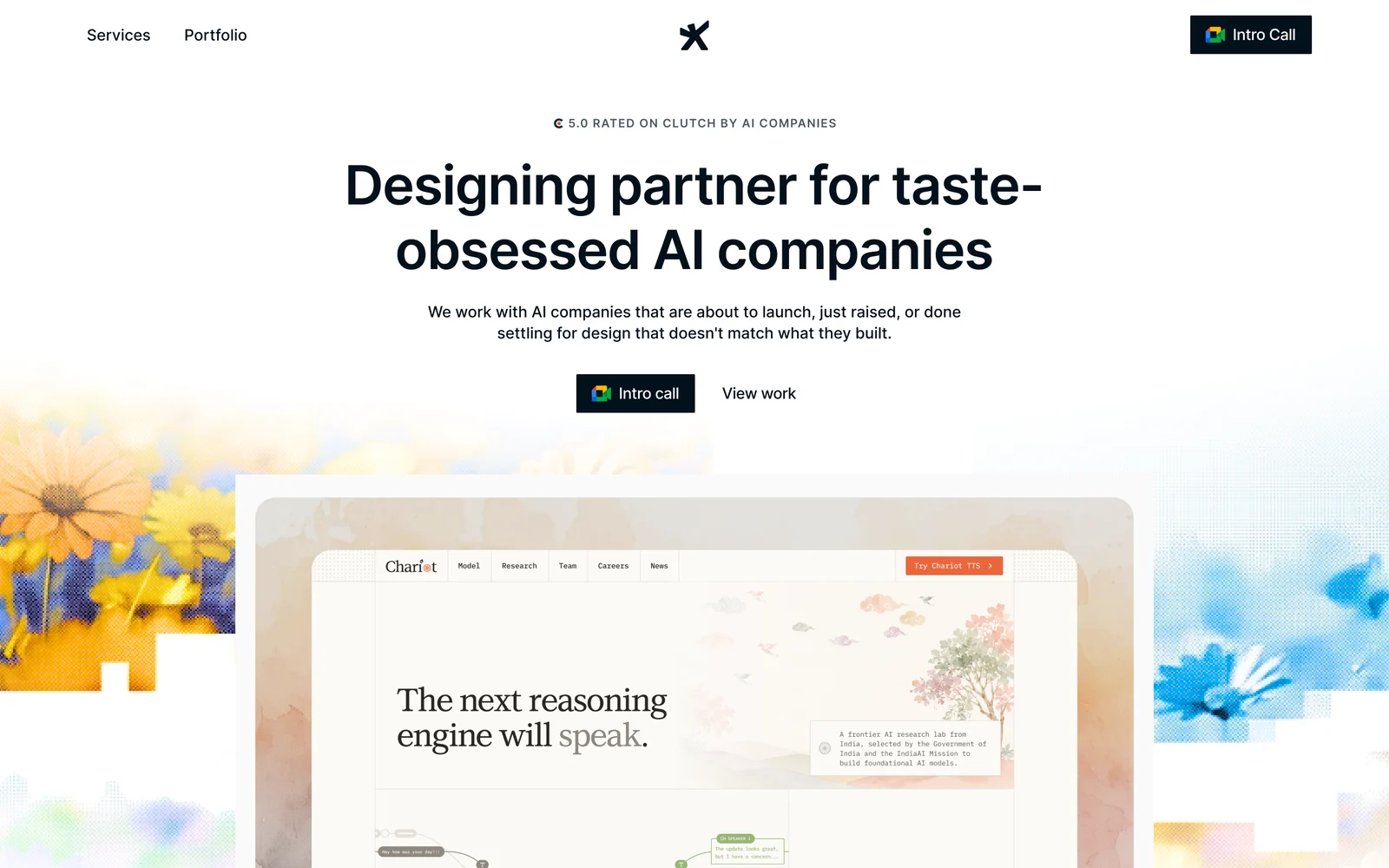
1. Studio Maydit: A Top-Rated Design Agency for AI Founders
A copilot is not finished when it launches. It is finished when people stop turning it off, and that question arrives months after the website does. The work here continues into product design after the site ships, which for this category is when the actual brief begins. Studio Maydit is a web and product design studio. Its clients are AI founders in the US, UK, and Europe, most of them building something that has to earn its place inside a workflow somebody already had.
Nothing is standardised on one tool. Framer covers positioning that changes faster than a build cycle. Webflow covers a marketing team that wants the pages under its own hands. Custom code covers an interface that has to behave like part of the product rather than a page about it, which for a copilot company is more often than not.
One client is published with a number rather than a badge. Dualite started from a repositioned ICP, the design was rebuilt around the narrower user that decision produced, and 100,000+ users followed within seven months. Deciding who a product is not for is the same discipline a copilot needs before it can decide when to say nothing. Wave, PixelFlow, and Mi-VAD are recent clients, along with 15 other AI and SaaS teams. On buying it, fixed scope runs three to four weeks and fits a team with a date committed. A monthly retainer fits a team still learning where its suggestions get dismissed, covering new pages, campaigns, and product design, with no long lock-in. Fixed-scope projects end with a diagnosis of what is leaking in the product, which here names the suggestion that taught somebody to ignore the rest.
| Check | Finding |
|---|---|
| Based in | Remote, serving US / UK / EU |
| Platform depth | Framer, Webflow, and custom code |
| AI-sector proof | Yes. AI-native clients, published outcome on Dualite |
| Pricing | Fixed scope or monthly retainer, quoted per project |
| Team shape | Founder-led, small senior team |
| Best fit | Copilot teams whose suggestions are good and still being dismissed |
Worth a call if acceptance rate is climbing and daily use is not. Book a 30-minute call.

2. basement.studio
basement.studio works from Mar del Plata and Los Angeles, has run since 2018 with eleven to fifty people, publishes a minimum, and names Vercel, Cursor, ElevenLabs, Harvey AI, and Scale AI. That client list is the closest match in this group to a copilot brief, because several of those products put a model directly into somebody's working session and had to make it behave.
They build in custom code, which means your engineers inherit a real codebase rather than a file, and that is only an advantage if you have the capacity to maintain it.
| Check | Finding |
|---|---|
| Based in | Mar del Plata, Argentina and Los Angeles, USA |
| Founded | 2018 |
| Team size | 11-50 |
| Primary platform | Custom code |
| AI-sector proof | Yes. Published AI client work |
| Named clients | Vercel, Cursor, ElevenLabs, Harvey AI, Scale AI |
| Pricing | Published minimum |
| Best fit | Copilot teams whose interface is part of the product, not a page |
3. SuperSkills
SuperSkills is a one to ten person studio in Walnut Creek with published AI client work and mixed platform experience. A team that small means the person who understands your copilot is the person drawing it, and for a surface built from many small judgement calls that continuity is worth more than capacity.
They publish no founding year, no starting figure, and name only The Cut, so there is very little to verify before the first call, and one to ten people cannot absorb a scope change.
| Check | Finding |
|---|---|
| Based in | Walnut Creek, USA |
| Founded | Not published |
| Team size | 1-10 |
| Primary platform | Mixed |
| AI-sector proof | Yes. Published AI client work |
| Named clients | The Cut |
| Pricing | Not published |
| Best fit | Small copilot teams wanting one senior person throughout |
4. Fantasy
Fantasy has designed products from San Francisco and New York since 1999 and publishes AI client work. Twenty-seven years of shipping means they have watched several interface conventions arrive and then get abandoned, which is useful judgement when your copilot is being designed against patterns that are barely two years old.
They publish no team size, no named clients, and no starting figure, so there is almost nothing a buyer can check independently, and a studio of that vintage carries an enterprise cadence a small team may find slow.
| Check | Finding |
|---|---|
| Based in | San Francisco and New York, USA |
| Founded | 1999 |
| Team size | Not published |
| Primary platform | Mixed |
| AI-sector proof | Yes. Published AI client work |
| Named clients | Not published |
| Pricing | Not published |
| Best fit | Funded copilot teams wanting long-view interface judgement |
5. Push Refresh
Push Refresh is a one to ten person Framer studio in Dallas that publishes a minimum and names SmithRx, Synonym, and Northern National. The published figure means you know in ten seconds whether a conversation is worth booking, and Framer suits the marketing site a copilot company has to keep rewriting as the product changes.
They publish no founding year, their AI-sector proof is partial with no AI case study, and a Framer practice this size is a website team rather than a product team.
| Check | Finding |
|---|---|
| Based in | Dallas, USA |
| Founded | Not published |
| Team size | 1-10 |
| Primary platform | Framer |
| AI-sector proof | Partial. Enterprise and SaaS clients, no AI case study |
| Named clients | SmithRx, Synonym, Northern National |
| Pricing | Published minimum |
| Best fit | Copilot companies needing the site fixed, not the panel |
6. Clay
Clay has designed software in San Francisco since 2016, runs fifty-one to two hundred people, publishes a minimum, and names Slack, Stripe, Google, Coinbase, and Amazon, with published AI client work behind it. Products at that scale have all had to introduce a new behaviour to users who did not ask for one, which is precisely the problem a copilot presents on its first day.
At that size the senior people who win the work are not necessarily the ones doing it, and a studio shaped around large companies will price and pace accordingly.
| Check | Finding |
|---|---|
| Based in | San Francisco, USA |
| Founded | 2016 |
| Team size | 51-200 |
| Primary platform | Mixed |
| AI-sector proof | Yes. Published AI client work |
| Named clients | Slack, Stripe, Google, Coinbase, Amazon |
| Pricing | Published minimum |
| Best fit | Funded teams putting a copilot in front of existing users |
7. Lazarev
Lazarev is a San Francisco studio founded in 2015 at fifty-one to two hundred people, publishing a minimum and naming Payoneer, Peel, Elva, and Mozayix, with published AI client work. The size supports research and design running as separate phases rather than compressed into one person's month, which matters when the open question is when the copilot should stay silent.
Their client list is weighted toward fintech and marketplaces rather than developer or authoring tools, so expect to supply the context for how your users actually work.
| Check | Finding |
|---|---|
| Based in | San Francisco, USA |
| Founded | 2015 |
| Team size | 51-200 |
| Primary platform | Mixed |
| AI-sector proof | Yes. Published AI client work |
| Named clients | Payoneer, Peel, Elva, Mozayix |
| Pricing | Published minimum |
| Best fit | Copilot teams that need real research capacity |
8. Flowout
Flowout is a distributed Webflow subscription practice that publishes a minimum and names Jasper, Kajabi, Riverside, and Sendlane. For a copilot company with a marketing site that needs constant small changes, a subscription arrangement removes the scoping conversation from every request.
They publish no founding year and no team size, their AI-sector proof is partial with no AI case study, and subscription website production is volume work rather than product design.
| Check | Finding |
|---|---|
| Based in | Distributed |
| Founded | Not published |
| Team size | Not published |
| Primary platform | Webflow |
| AI-sector proof | Partial. Enterprise and SaaS clients, no AI case study |
| Named clients | Jasper, Kajabi, Riverside, Sendlane |
| Pricing | Published minimum |
| Best fit | Copilot companies wanting steady site changes, not product work |
9. Feely Studio
Feely Studio is a one to ten person distributed European team with published AI client work, a published minimum, and Noxus, Mutiny, Luasai, and Basic Capital named. The clients are AI companies that were small when the work started, so the studio is used to a product whose shape is still moving.
They publish no founding year, and a team of that size working across several clients has no slack in it, which shows up the week your launch date moves.
| Check | Finding |
|---|---|
| Based in | Distributed, Europe |
| Founded | Not published |
| Team size | 1-10 |
| Primary platform | Mixed |
| AI-sector proof | Yes. Published AI client work |
| Named clients | Noxus, Mutiny, Luasai, Basic Capital |
| Pricing | Published minimum |
| Best fit | Early copilot teams wanting AI-native work at a small scale |
10. Finsweet
Finsweet has built Webflow sites from Denver since 2017 with fifty-one to two hundred distributed people, naming Dropbox, Clay, GitHub, and Steadily. They are the deepest Webflow engineering practice in this list, which is genuinely valuable if your constraint is a site your marketing team cannot edit.
They publish no starting figure, their AI-sector proof is partial with no AI case study, and website engineering is a different craft from designing the moment a suggestion is refused.
| Check | Finding |
|---|---|
| Based in | Denver, USA, distributed |
| Founded | 2017 |
| Team size | 51-200 |
| Primary platform | Webflow |
| AI-sector proof | Partial. Enterprise and SaaS clients, no AI case study |
| Named clients | Dropbox, Clay, GitHub, Steadily |
| Pricing | Not published |
| Best fit | Copilot companies whose real bottleneck is the marketing site |
How to choose between them
Sort by what is actually broken rather than by whose case studies look most like yours.
Suggestions are accepted and the panel still gets closed. Studio Maydit or basement.studio.
Everything has turned into a chat box. SuperSkills or Fantasy.
The copilot interrupts people who were concentrating. Clay or Lazarev.
The site still describes the product you demoed last year. Push Refresh or Flowout.
One test before you sign. Describe a suggestion your copilot gets wrong, and ask them to walk through the next thirty seconds from the user's side. A studio that has shipped this will talk about undo, about what the user has to re-establish, and about what the software should do differently next time. A studio that has not will talk about improving the model.