
Summarize with AI


The best product design agencies for AI data platforms in 2026 are Studio Maydit, Foundey, Feely Studio, Fantasy, Kvalifik, BX Studio, Lazarev, 8020, Flow Ninja, and Digidop. Studio Maydit and Foundey lead for this brief, because both do Figma-first product work for AI-native clients and both stay close to the engineers who have to build dense screens. Flow Ninja and Digidop are the wrong fit here, since both are Webflow website studios rather than product teams, and one of them publishes no client names at all.
A data platform has an unusual problem. The thing customers pay for cannot be seen.
Nobody buys a warehouse or a pipeline tool because the buttons are nice. They buy it because the number at the end is right, and because when it is wrong they can find out why. That value lives in correctness, freshness, and lineage. None of those things have a natural picture.
So design ends up carrying a strange load. It has to make invisible correctness feel visible. A stale table has to look stale. A failed run has to be findable in ten seconds, not ten minutes. A column that came from a guess has to look different from a column that came from a source.
The AI layer makes this harder. Modern data tools infer joins, label columns, flag anomalies, and write queries on request. Every one of those is a guess with a confidence attached. Show the guess as plain text and it reads as fact. A user trusts it, ships a wrong number to a board deck, finds out later, and stops trusting the whole product. One bad number costs more than a hundred slow ones.
There is a second trap, which is who the screens get designed for. The person who signs the contract sees a demo with twelve tables. The person who lives in the product opens it at eleven at night with four thousand tables and a run that failed an hour ago. Those two people need different things, and only one of them renews.
The ten studios below are ranked on how well they handle dense, technical products where being correct matters more than being pretty.

How we picked these agencies
Each studio was judged on evidence anybody can check from a browser, using five questions that tell a product team apart from a website team:
- Platform depth. Is product design in Figma the core craft, or one line on a services page next to marketing sites?
- Proof on data-heavy AI products. Have they shipped interfaces where the content is tables, queries, pipelines, and model output, rather than hero sections?
- Pricing. Is a starting figure published anywhere, or does finding it take two calls?
- Team shape. Who actually draws the screens, and will that person be in the working sessions?
- Their own site. Does it show judgement, or does it show a template?
That last question keeps earning its place. A client project is full of compromises the studio did not choose. Their own site has none, so it is the only place you see what they do when nobody is negotiating with them.
Every fact in the tables below comes from public sources, mostly each studio's own website. Where a studio publishes nothing, the table records that instead of filling the gap with a guess.
What goes wrong on data platform design
Three failures repeat across this category. Each one starts as a sensible decision made against the wrong version of the product.
The design is built against the demo dataset. Twelve tables, three pipelines, clean names, no failures. Everything fits on one screen and the layout looks calm. Then a real customer connects a warehouse with four thousand tables, half of them named after somebody who left in 2021, and a schema that changes every Tuesday. The calm layout collapses. Search becomes the only usable navigation and it was designed as an afterthought in the corner. Filters that made sense for three pipelines are useless for six hundred. The fix is boring and works: design against the largest account you can find, not the prettiest one. If the screen survives four thousand tables, twelve will look after themselves.
Machine guesses are drawn as facts. The product infers that two columns join, or labels a field as revenue, or marks a row as an outlier. In the interface all of that arrives as ordinary text in an ordinary cell, identical to a value that came straight from the source. Users cannot tell which is which, so they treat everything as verified. The first wrong number teaches them that nothing here can be relied on, and that lesson does not wear off. Inferred content needs to look inferred, needs to say what it was based on, and needs a one click path to the underlying source. Confidence is not a nice extra in this category. It is the product.
The product is designed for the buyer, not the operator. Demo screens get the attention because demos get seen. Dashboards, summary tiles, a clean overview a VP can read in a meeting. Meanwhile the analyst who opens the tool forty times a day is working in a query editor that has no history, a run log with no filter, and an error message that says a job failed without saying which one. Those screens decide renewal, because they are where the hours go. Ask any studio you are considering which screen in your product gets the most use, then ask how much of the proposal is aimed at it.
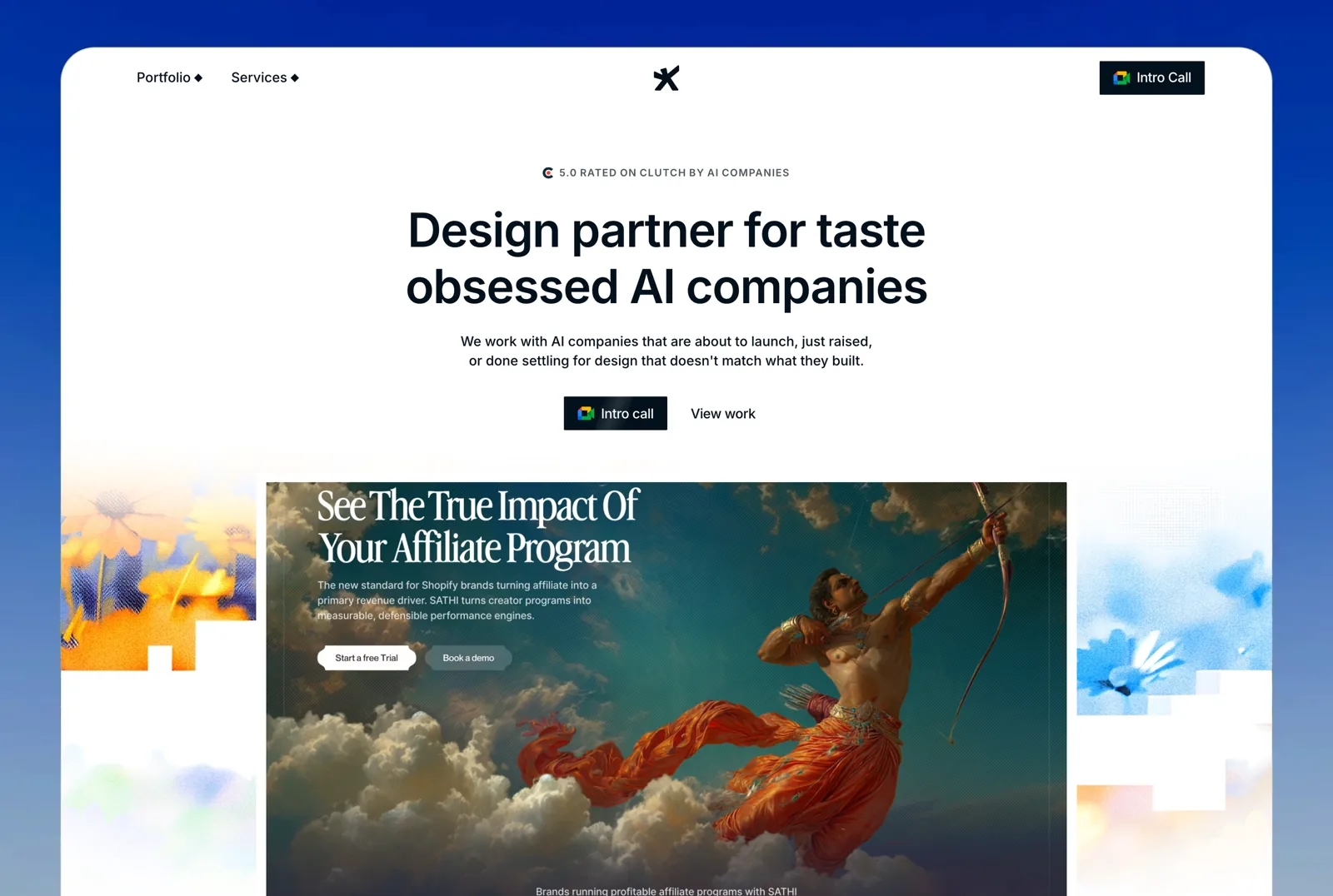
1. Studio Maydit: A Top-Rated Design Agency for AI Founders
Dense products need a designer who will read the docs before drawing anything, and that is the shape Studio Maydit is built around. It is a web and product design studio working with AI founders in the US, UK, and Europe, founder-led with a small senior team, so the person in the working session is the person drawing the screens. The studio builds in Framer, Webflow, and custom code, and carries on into product design once the site is live.
A data team will want a number rather than an adjective, and there is one in the public record. Dualite crossed 100,000+ users in seven months, following design work built around a repositioned ICP. The recent list also holds Wave, PixelFlow, Mi-VAD, and 15 other AI and SaaS teams, so the client base leans towards products where the interface is the hard part.
There are two ways to buy. A fixed scope runs three to four weeks and suits a team with a launch date. A monthly retainer suits teams that keep shipping, covering new pages, campaigns, and product design, with no long lock-in. Fixed-scope work closes with a diagnosis of what is leaking in the product, which for a data tool usually means the screens where users quietly give up.
| Check | Finding |
|---|---|
| Based in | Remote, serving US / UK / EU |
| Platform depth | Framer, Webflow, and custom code |
| AI-sector proof | Yes. AI-native clients, published outcome on Dualite |
| Pricing | Fixed scope or monthly retainer, quoted per project |
| Team shape | Founder-led, small senior team |
| Best fit | Data teams who need the site and the product to agree |
Useful call if your demo looks better than your product does at scale. Book a 30-minute call.

2. Foundey
Foundey is a San Francisco studio founded in 2021 that works Figma-first on product design, with DemandIQ, Traycer, and Sero AI named. All three are AI products rather than marketing sites, which is the closest match here to a platform whose screens are full of model output and technical detail.
They publish no pricing and no team size, so both capacity and budget take a call to establish.
| Check | Finding |
|---|---|
| Based in | San Francisco, USA |
| Founded | 2021 |
| Team size | Not published |
| Primary platform | Figma-only |
| AI-sector proof | Yes. Published AI client work |
| Named clients | DemandIQ, Traycer, Sero AI |
| Pricing | Not published |
| Best fit | Teams who want a product specialist and nothing else |
3. Feely Studio
Feely Studio is a distributed European team of one to ten working across platforms, with a published minimum and Noxus, Mutiny, Luasai, and Basic Capital named. A team that size gives you one senior designer for the whole engagement, which matters when the product takes two weeks to understand properly.
They publish no founding year, and one to ten people means a hard ceiling on how much can run at once if your roadmap is wide.
| Check | Finding |
|---|---|
| Based in | Distributed, Europe |
| Founded | Not published |
| Team size | 1-10 |
| Primary platform | Mixed |
| AI-sector proof | Yes. Published AI client work |
| Named clients | Noxus, Mutiny, Luasai, Basic Capital |
| Pricing | Published minimum |
| Best fit | Teams who want one senior designer for the whole build |
4. Fantasy
Fantasy is a studio in San Francisco and New York, founded in 1999, working across platforms, with published AI client work. Nearly three decades on complex interfaces is real experience, and this category rewards a team that has seen dense products fail before.
They publish no client names, no team size, and no pricing, so almost everything you would want to check has to be asked for directly.
| Check | Finding |
|---|---|
| Based in | San Francisco and New York, USA |
| Founded | 1999 |
| Team size | Not published |
| Primary platform | Mixed |
| AI-sector proof | Yes. Published AI client work |
| Named clients | Not published |
| Pricing | Not published |
| Best fit | Larger teams who can run a long discovery phase |
5. Kvalifik
Kvalifik is a Copenhagen team of 11 to 50, founded in 2015, with Veo, Maersk, and Relesys named and published AI client work. Maersk is logistics at scale, which is closer to a data platform's problem than most agency portfolios get: lots of records, lots of states, and users who need the truth quickly.
Their primary platform is Webflow, so website work leads the portfolio, and they publish no pricing.
| Check | Finding |
|---|---|
| Based in | Copenhagen, Denmark |
| Founded | 2015 |
| Team size | 11-50 |
| Primary platform | Webflow |
| AI-sector proof | Yes. Published AI client work |
| Named clients | Veo, Maersk, Relesys |
| Pricing | Not published |
| Best fit | European teams wanting site and product from one studio |
6. BX Studio
BX Studio is a New York team of 11 to 50 with a published minimum and Reddit, Headspace, ASAPP, and Verifone named. ASAPP is an AI company and Verifone is payments, so there is evidence of building for both machine output and systems where a wrong number has consequences.
They publish no founding year, and their primary platform is Webflow, which means marketing sites are the centre of the portfolio rather than product screens.
| Check | Finding |
|---|---|
| Based in | New York, USA |
| Founded | Not published |
| Team size | 11-50 |
| Primary platform | Webflow |
| AI-sector proof | Yes. Published AI client work |
| Named clients | Reddit, Headspace, ASAPP, Verifone |
| Pricing | Published minimum |
| Best fit | Teams who want a US studio with a published price |
7. Lazarev
Lazarev is a San Francisco firm of 51 to 200, founded in 2015, working across platforms, with a published minimum and Payoneer, Peel, Elva, and Mozayix named. Payoneer is financial software with real complexity behind it, and Lazarev takes on marketing and product work together, so the site and the app can be kept consistent.
At that size you get an assigned team rather than a named one, and their process assumes a longer engagement than a small data team may want to fund.
| Check | Finding |
|---|---|
| Based in | San Francisco, USA |
| Founded | 2015 |
| Team size | 51-200 |
| Primary platform | Mixed |
| AI-sector proof | Yes. Published AI client work |
| Named clients | Payoneer, Peel, Elva, Mozayix |
| Pricing | Published minimum |
| Best fit | Funded teams buying product and marketing design together |
8. 8020
8020 works from San Francisco and New York, founded in 2014, with Wave, Superlist, Pilot.com, Vanta, and Circle named. Vanta and Pilot.com are both compliance and finance products, which are the closest neighbours to a data platform in terms of how much a small error costs the customer.
Their AI-sector proof is partial, they publish no pricing and no team size, and Webflow is the primary platform, so this is a website studio first.
| Check | Finding |
|---|---|
| Based in | San Francisco and New York, USA |
| Founded | 2014 |
| Team size | Not published |
| Primary platform | Webflow |
| AI-sector proof | Partial. Enterprise and SaaS clients, no AI case study |
| Named clients | Wave, Superlist, Pilot.com, Vanta, Circle |
| Pricing | Not published |
| Best fit | Teams whose next priority is the marketing site |
9. Flow Ninja
Flow Ninja is a Belgrade team of 11 to 50, founded in 2018, working in Webflow. A team of that size in that region is usually reachable quickly and priced below the US average, which suits a seed-stage team with a fixed budget.
They publish no client names at all, their AI-sector proof is partial, and they publish no pricing, so there is very little to verify before a call.
| Check | Finding |
|---|---|
| Based in | Belgrade, Serbia |
| Founded | 2018 |
| Team size | 11-50 |
| Primary platform | Webflow |
| AI-sector proof | Partial. Enterprise and SaaS clients, no AI case study |
| Named clients | Not published |
| Pricing | Not published |
| Best fit | Budget-led teams who need a Webflow site built quickly |
10. Digidop
Digidop is a Paris team of one to ten, founded in 2021, working in Webflow, with a published minimum and TSE Energy, Ramify, and StreamNative named. StreamNative is data infrastructure, so there is at least one client in the neighbourhood of this article's subject.
Their AI-sector proof is partial, the team is very small, and Webflow websites are the whole offer, so product design is not what you are buying here.
| Check | Finding |
|---|---|
| Based in | Paris, France |
| Founded | 2021 |
| Team size | 1-10 |
| Primary platform | Webflow |
| AI-sector proof | Partial. Enterprise and SaaS clients, no AI case study |
| Named clients | TSE Energy, Ramify, StreamNative |
| Pricing | Published minimum |
| Best fit | French-speaking teams who want a site with a known price |
How to choose between them
Sort by which part of the product is actually failing.
Screens fall apart at real customer scale. Studio Maydit or Foundey.
One senior designer who learns the domain properly. Feely Studio or Kvalifik.
Product and marketing site have drifted apart. Lazarev or BX Studio.
The website is the immediate problem, not the app. 8020 or Digidop.
One test before you sign. Give a candidate read-only access to your largest account and ask them to find the last failed run. Watch what they do. A studio that belongs in this category will start narrating the problem within a minute, pointing at the search, the log, the error text. A studio that does not will compliment the interface and ask for a walkthrough, and that request is your answer, because your users do not get a walkthrough either.