Summarize with AI


The best product design agencies for AI infrastructure companies in 2026 are Studio Maydit, Trueform, Phantom, basement.studio, BX Studio, Feels Like, Kvalifik, SuperSkills, Clay, and Fantasy. Studio Maydit and basement.studio lead for this brief, because both have designed for companies whose users are engineers and whose product is mostly numbers on a screen. SuperSkills and Fantasy are the weakest fit. One is a one to ten person team with a single named client, and the other publishes no clients, no team size, and no pricing, which is hard to defend to a technical buying group that checks everything before it agrees to anything.
Infrastructure is an odd thing to design, because so little of it is visible. Most of the product is an API. What is left for a designer to touch is a console, a few tables, a usage page, and a bill.
That smallness makes design feel optional. It stops feeling optional the month a customer cannot work out why their spend tripled.
What gets bought in this category is confidence, and confidence here is built from specifics. Exact units. Error messages that say what happened. A limit shown before it is reached rather than after. A cost that can be worked out on a Tuesday instead of discovered on the first of the month.
Most infrastructure interfaces are built by the engineers who built the platform, which is why they are accurate and unreadable at the same time. Every number on the screen is correct. Almost none of them answer a question a customer actually walked in with.
Read the ten studios below with one screen in mind. The one your customer opens when the bill is higher than they expected.

How we picked these agencies
Five checks, written for a product whose users read documentation before they read a homepage:
- Platform depth. Is product and interface design the core practice, or is it website production with a product service attached? An infrastructure company's hard problems live inside a console, in tables, logs, quotas, and error states. A studio whose strongest work is a persuasive homepage will improve the part you were least worried about.
- Proof on systems products. Have they designed something where the user is an engineer and the screen is mostly data? That is a different craft from consumer or campaign work. It means density instead of whitespace, exact units instead of rounded ones, and a willingness to show a number that looks bad rather than soften it into something friendly.
- Pricing. Is a starting figure published, or held back until a call? Infrastructure teams tend to buy the way they sell, by comparing documented options, and a public number lets that comparison begin without a meeting.
- Team shape. How many people, and does a senior one stay on the work? Deciding what belongs on a dashboard and what belongs in a log is a judgement made hundreds of times over a project, and it is the first thing to drift once the work is handed down.
- Their own site. It is the one project with no client to blame. If it explains what they do inside the first screen, they can probably explain what your platform does. If it does not, you have found their ceiling.
Give the second check the most weight, and test it with a single question. Ask what they did the last time a screen had to show a limit being approached. A studio that has designed systems products will talk about thresholds, units, and what the user is meant to do next. A studio that has not will talk about a progress bar.
Every row in the tables below is something the studio states on its own website. No directory listings, no aggregated review scores, no estimates dropped in to make a column look complete. Where a studio has published nothing, the row says so, because a blank you can verify beats a figure somebody guessed.
What goes wrong when infrastructure companies design their product
Three failures, and all three are the same mistake in different clothes. The interface describes the system instead of the person using it.
The dashboard reports the platform's health, not the customer's exposure. Uptime, throughput, and request counts go on the front screen because they are the numbers the team watches internally. The customer is watching two other things: what this will cost by the end of the month, and whether anything is about to break. Neither is usually visible without building a query. More charts will not fix it. Decide what a customer opens the console to find out, put that on the first screen, and move the internal metrics somewhere they can still be reached.
Limits exist only at the moment they are hit. Rate limits, quotas, context ceilings, and cold starts are documented somewhere and invisible everywhere else, so the first time a user meets one is in production, as an error code. That error becomes a support ticket, and the ticket becomes a doubt about reliability that has nothing to do with reliability. Show the ceiling before it is reached, in the screen where the work is happening, and say plainly what raises it.
The website sells benchmarks the product never mentions again. The homepage leads with a latency figure and a cost comparison. The console shows neither. A customer who chose you for a number should be able to see that number on their own workload, without asking anyone. When they cannot, the claim quietly turns back into marketing in their head, and the renewal conversation starts from there.
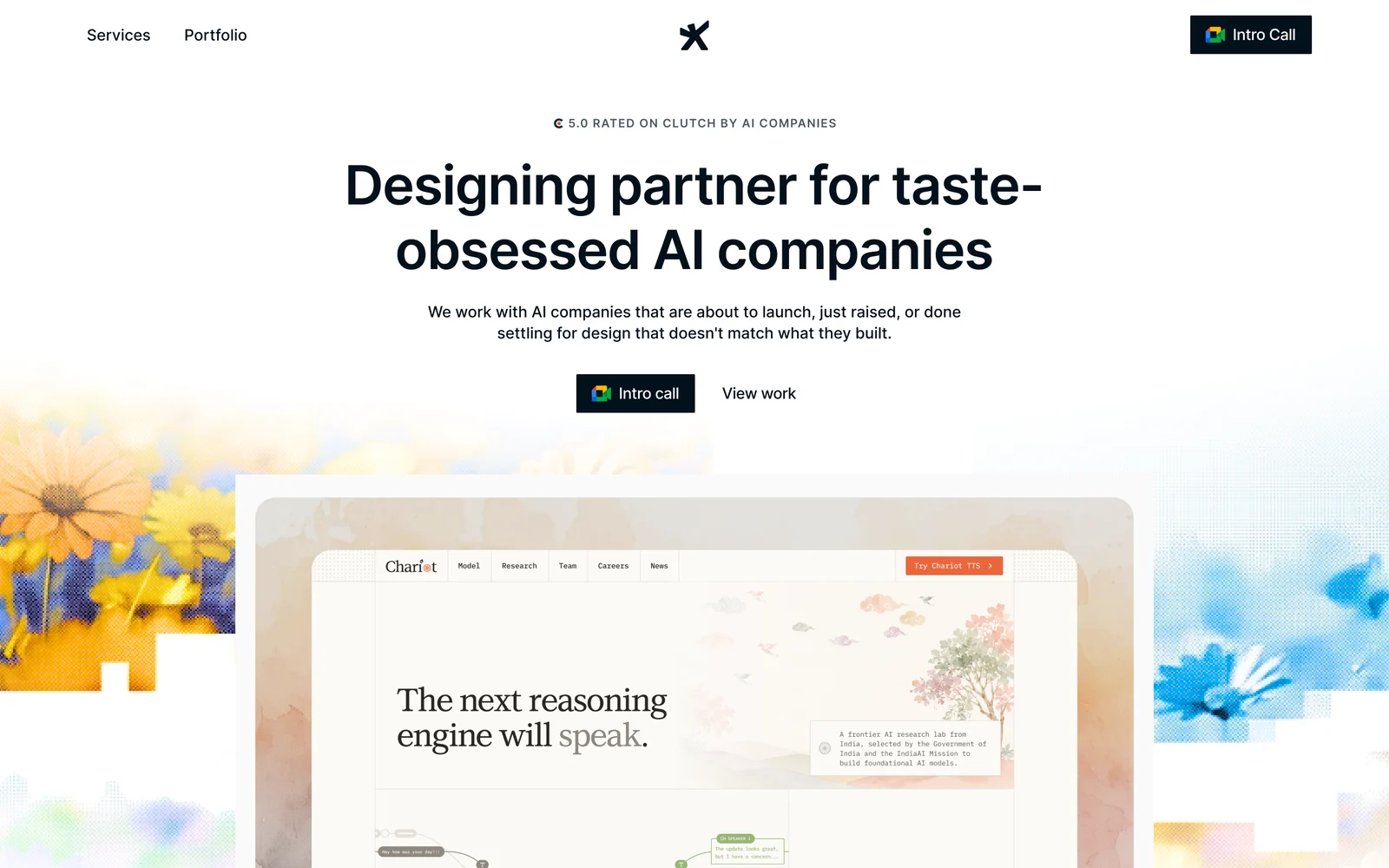
1. Studio Maydit: A Top-Rated Design Agency for AI Founders
Which tool the site is built in matters more than usual here, because the marketing surface sits directly beside documentation and has to look like the same company. Framer covers positioning still being argued about internally, where pages move faster than a release. Webflow covers a growth hire who wants to publish without filing a ticket. Custom code covers a page that has to render live output, a playground, or a real console screen rather than a picture of one. Studio Maydit is a web and product design studio, and its clients are AI founders in the US, UK, and Europe, a good number of them selling to engineers.
Work continues into product design after the site ships, which for this category is where the difficult half starts, since the console is the product and the homepage is an advertisement for it. One engagement is published with a figure attached to it. Dualite arrived at a repositioned ICP, the design was rebuilt for the narrower user that decision produced, and 100,000+ users followed in seven months. The sequence is the part that transfers to an infrastructure team, because deciding precisely which engineer you are for is what lets a console show six numbers instead of sixty. Wave, PixelFlow, and Mi-VAD are recent clients, along with 15 other AI and SaaS teams.
Two shapes are available. Fixed scope runs three to four weeks and fits one bounded job, such as rebuilding the usage and billing screens so a customer can predict a bill before it arrives. A monthly retainer fits a platform shipping new capabilities faster than it can describe them, covering new pages, campaigns, and product design, with no long lock-in. Fixed-scope projects end with a diagnosis of what is leaking in the product, and for an infrastructure company that usually names the screen where a customer stopped trusting the numbers.
| Check | Finding |
|---|---|
| Based in | Remote, serving US / UK / EU |
| Platform depth | Framer, Webflow, and custom code |
| AI-sector proof | Yes. AI-native clients, published outcome on Dualite |
| Pricing | Fixed scope or monthly retainer, quoted per project |
| Team shape | Founder-led, small senior team |
| Best fit | Infrastructure teams whose console cannot answer the cost question |
Worth a call if your support inbox is doing the explaining your console should do. Book a 30-minute call.

2. Trueform
Trueform has worked in Framer from Switzerland since 2022, publishes a minimum, and names Miro, Morning Brew, Bilt Rewards, and Gather. Miro is a product people keep open all day, which is the closest thing here to a console somebody lives inside, and the studio publishes AI client work rather than describing an interest in it.
They publish no team size, and a Framer practice is strongest on the marketing surface, so the console work an infrastructure company most needs is not what the published portfolio proves.
| Check | Finding |
|---|---|
| Based in | Wil, Switzerland |
| Founded | 2022 |
| Team size | Not published |
| Primary platform | Framer |
| AI-sector proof | Yes. Published AI client work |
| Named clients | Miro, Morning Brew, Bilt Rewards, Gather |
| Pricing | Published minimum |
| Best fit | Infrastructure teams rebuilding the marketing surface first |
3. Phantom
Phantom has built in custom code from London and Auckland since 2013, at fifty-one to two hundred people, naming Diageo, SAP, Financial Times, and Zendesk. SAP and Zendesk are dense administrative products where the job is making a large amount of information usable, which is the same problem your console has.
No starting figure is published, and a studio that size working with brand clients that large runs on a schedule and a budget built for them, not for a platform team shipping weekly.
| Check | Finding |
|---|---|
| Based in | London, UK and Auckland, NZ |
| Founded | 2013 |
| Team size | 51-200 |
| Primary platform | Custom code |
| AI-sector proof | Yes. Published AI client work |
| Named clients | Diageo, SAP, Financial Times, Zendesk |
| Pricing | Not published |
| Best fit | Funded infrastructure teams with a dense admin surface |
4. basement.studio
basement.studio works in custom code from Mar del Plata and Los Angeles, has since 2018 at eleven to fifty people, publishes a minimum, and names Vercel, Cursor, ElevenLabs, Harvey AI, and Scale AI. That is the closest client list in this group to yours. Every one of them sells to developers and several of them are infrastructure.
The practice is strongest on launch moments and marketing surfaces rather than on the long, unglamorous work of a settings page, and a team that size across clients that large leaves little slack when your date moves.
| Check | Finding |
|---|---|
| Based in | Mar del Plata, Argentina and Los Angeles, USA |
| Founded | 2018 |
| Team size | 11-50 |
| Primary platform | Custom code |
| AI-sector proof | Yes. Published AI client work |
| Named clients | Vercel, Cursor, ElevenLabs, Harvey AI, Scale AI |
| Pricing | Published minimum |
| Best fit | Infrastructure teams whose developer audience judges craft first |
5. BX Studio
BX Studio is a New York team of eleven to fifty working mainly in Webflow, publishing a minimum and AI client work, with Reddit, Headspace, ASAPP, and Verifone named. ASAPP sells an AI product into large enterprises, so the studio has had to make something technical legible to a cautious buyer who was not going to be charmed.
They publish no founding year, and Webflow is a website platform, so anything that has to happen inside your console arrives as a design for your engineers to build rather than as a built thing.
| Check | Finding |
|---|---|
| Based in | New York, USA |
| Founded | Not published |
| Team size | 11-50 |
| Primary platform | Webflow |
| AI-sector proof | Yes. Published AI client work |
| Named clients | Reddit, Headspace, ASAPP, Verifone |
| Pricing | Published minimum |
| Best fit | Infrastructure teams selling into cautious enterprise buyers |
6. Feels Like
Feels Like has built in custom code from Los Angeles since 2023 and names Google, Nike, LVMH, and Suno AI. Suno is an AI product with real computational weight sitting behind a simple surface, and a young studio holding clients of that size usually means senior people are doing the work themselves rather than reviewing it.
No team size and no starting figure are published, and a studio founded in 2023 has not yet had to carry a design system through three years of a platform changing underneath it.
| Check | Finding |
|---|---|
| Based in | Los Angeles, USA |
| Founded | 2023 |
| Team size | Not published |
| Primary platform | Custom code |
| AI-sector proof | Yes. Published AI client work |
| Named clients | Google, Nike, LVMH, Suno AI |
| Pricing | Not published |
| Best fit | Infrastructure teams wanting senior hands on a short brief |
7. Kvalifik
Kvalifik is a Copenhagen studio of eleven to fifty people working mainly in Webflow since 2015, with published AI client work and Veo, Maersk, and Relesys named. Maersk is logistics software, which means designing screens where an operational number being wrong has consequences somebody feels the same day.
No starting figure is published, their platform strength is Webflow rather than product interfaces, and the client base is European enterprise rather than developer infrastructure.
| Check | Finding |
|---|---|
| Based in | Copenhagen, Denmark |
| Founded | 2015 |
| Team size | 11-50 |
| Primary platform | Webflow |
| AI-sector proof | Yes. Published AI client work |
| Named clients | Veo, Maersk, Relesys |
| Pricing | Not published |
| Best fit | European infrastructure teams with an operational surface |
8. SuperSkills
SuperSkills is a one to ten person studio in Walnut Creek with published AI client work and mixed platform experience. At that size the person you meet is the person doing the work, which suits one well-defined problem, such as taking a single console screen apart and putting it back together properly.
No founding year, no starting figure, and only The Cut named, so a buying group has very little to verify, and a team that small cannot carry a whole platform surface.
| Check | Finding |
|---|---|
| Based in | Walnut Creek, USA |
| Founded | Not published |
| Team size | 1-10 |
| Primary platform | Mixed |
| AI-sector proof | Yes. Published AI client work |
| Named clients | The Cut |
| Pricing | Not published |
| Best fit | Infrastructure teams fixing one screen rather than the whole console |
9. Clay
Clay has designed from San Francisco since 2016 at fifty-one to two hundred people, publishes a minimum and AI client work, and names Slack, Stripe, Google, Coinbase, and Amazon. Stripe is the reference every infrastructure company reaches for, and this is one of the few studios here with work at that level of documentation and dashboard craft.
It is a premium practice with a process and a price to match, and an early platform team will be a small account inside a studio built around much larger ones.
| Check | Finding |
|---|---|
| Based in | San Francisco, USA |
| Founded | 2016 |
| Team size | 51-200 |
| Primary platform | Mixed |
| AI-sector proof | Yes. Published AI client work |
| Named clients | Slack, Stripe, Google, Coinbase, Amazon |
| Pricing | Published minimum |
| Best fit | Funded infrastructure teams rebuilding a developer surface properly |
10. Fantasy
Fantasy has designed products from San Francisco and New York since 1999 and publishes AI client work. Twenty-seven years of product work means they have watched several generations of technical interface convention arrive and be discarded, which is useful judgement in a category where nobody has agreed yet what a good console looks like.
They publish no team size, no named clients, and no starting figure, which leaves an engineering-led buying group with nothing to check, and that group checks everything.
| Check | Finding |
|---|---|
| Based in | San Francisco and New York, USA |
| Founded | 1999 |
| Team size | Not published |
| Primary platform | Mixed |
| AI-sector proof | Yes. Published AI client work |
| Named clients | Not published |
| Pricing | Not published |
| Best fit | Infrastructure teams buying long-view interface judgement |
How to choose between them
Sort by which screen is actually failing, not by which studio has the best logo wall.
Customers cannot predict what they will be charged. Studio Maydit or Clay.
The console is accurate and unreadable. Phantom or Fantasy.
The marketing site does not survive contact with a developer. basement.studio or Trueform.
One screen generates most of your support tickets. SuperSkills or Feels Like.
One test before you sign. Send them your usage page and ask what a customer would do if the number on it doubled overnight. A studio that has designed systems products will describe where that customer looks next and what should be waiting there. A studio that has not will offer to redesign the chart.