Summarize with AI


The best product design agencies for AI martech startups in 2026 are Studio Maydit, Foundey, Kvalifik, Clay, Feely Studio, SuperSkills, Fantasy, Lazarev, Pixelmatters, and Ramotion. Studio Maydit and Foundey lead for this brief, because product design is the practice at both rather than a service listed under a website business, and both publish AI client work. Kvalifik and SuperSkills are the wrong fit here, since Kvalifik builds primarily in Webflow and SuperSkills names a single client at one to ten people, which is thin for a product that will grow several dense surfaces in its first year.
Selling software to marketers has one property that catches almost every founder out. Your users spend all day making the exact arguments you are making to them, so they discount your claims automatically and completely.
What they cannot discount is a number they are allowed to repeat in a meeting. A marketer's professional survival depends on being able to say that a thing worked, to somebody who was not there, with evidence. Every tool they keep is a tool that helps them do that. Every tool they lose in a budget review is one that did not.
Which is why the usual AI martech pitch misses. Generating more is not the constraint. Most marketing teams could already produce twice as much as they publish. What is scarce is confidence about which version to send and proof afterwards that sending it mattered.
There is a second thing that makes this category harder than it looks. Everything your product creates goes out into the world with a company's name on it. That raises a question about control that a marketing director will not raise in a demo and will absolutely raise internally before approving a rollout.
And there is a third, structural and boring. Your users already own eight tools. Yours has to sit inside a stack, share data with it, and survive being compared against a line item in a spreadsheet every renewal.
The ten studios below are ordered by how well they design software for people who evaluate software for a living.

How we picked these agencies
Five checks, weighted for a product whose users are professional buyers of exactly this kind of product:
- Platform depth. Is product design the studio's real practice, or is it a service attached to a website business?
- Proof with tools used by marketing teams. Is there published work for software whose users are marketers or operators, rather than only consumer products or engineering tools?
- Pricing. Is a starting figure published, so a team measured on efficiency can qualify a supplier without spending a week doing it?
- Team shape. Is there a senior designer who will sit with a real marketer through a real campaign week, including the dull parts?
- Their own site. Does it make a specific claim with something behind it, or is it the same language your users hear from every vendor?
The second check matters more here than the sector label does. Marketers are unusual users. They work in bursts around campaign dates, they operate several tools at once, and they are constantly building an internal case for keeping what they use. A studio that has designed for them will already know that the reporting screen is not an afterthought, it is the retention mechanism. A studio that has only worked on consumer products will make something delightful that nobody can justify in October.
Everything below comes from public material published by the studios. Where a studio has published nothing on a point, the row records the absence, because a comparison filled in with reasonable assumptions is not a comparison.
What goes wrong on AI martech products
Three failures, and the first one is usually mistaken for a feature.
The product creates volume when the user needed judgement. Forty subject lines appear. Twenty audience segments. Twelve versions of an ad. The marketer now has a new problem, which is evaluating forty things instead of writing three, and the time saved was never the bottleneck. Design for selection rather than production. Show fewer options, ordered, with a reason attached to the ordering, and make rejecting one as fast as accepting it. A tool that produces five hundred assets and no opinion has moved the work rather than removed it.
Nothing in the product helps the user prove it worked. This is the failure that ends contracts. Your customer has a quarterly review where somebody asks what the tools cost and what they returned. If the answer has to be assembled by hand from three exports, your product loses to whichever vendor made that slide easy. Build the evidence surface as a first-class part of the product. What ran, what it replaced, what changed, exportable, in a form a person can paste into a deck without editing. It is unglamorous and it is the single strongest thing you can do for retention.
Brand safety is treated as a settings page. Automated content goes out under a customer's name, which means somebody senior has to be comfortable with what the system will and will not say. Handled as a set of toggles buried in configuration, it never gets trusted, so every campaign gets manually reviewed anyway and the automation becomes theatre. Design the guardrails as a visible, editable part of the main workflow: the claims that are forbidden, the tone that is required, the words that trigger a human review, and a clear record of what was approved by whom. That is what turns a pilot into a standing deployment.
1. Studio Maydit: A Top-Rated Design Agency for AI Founders
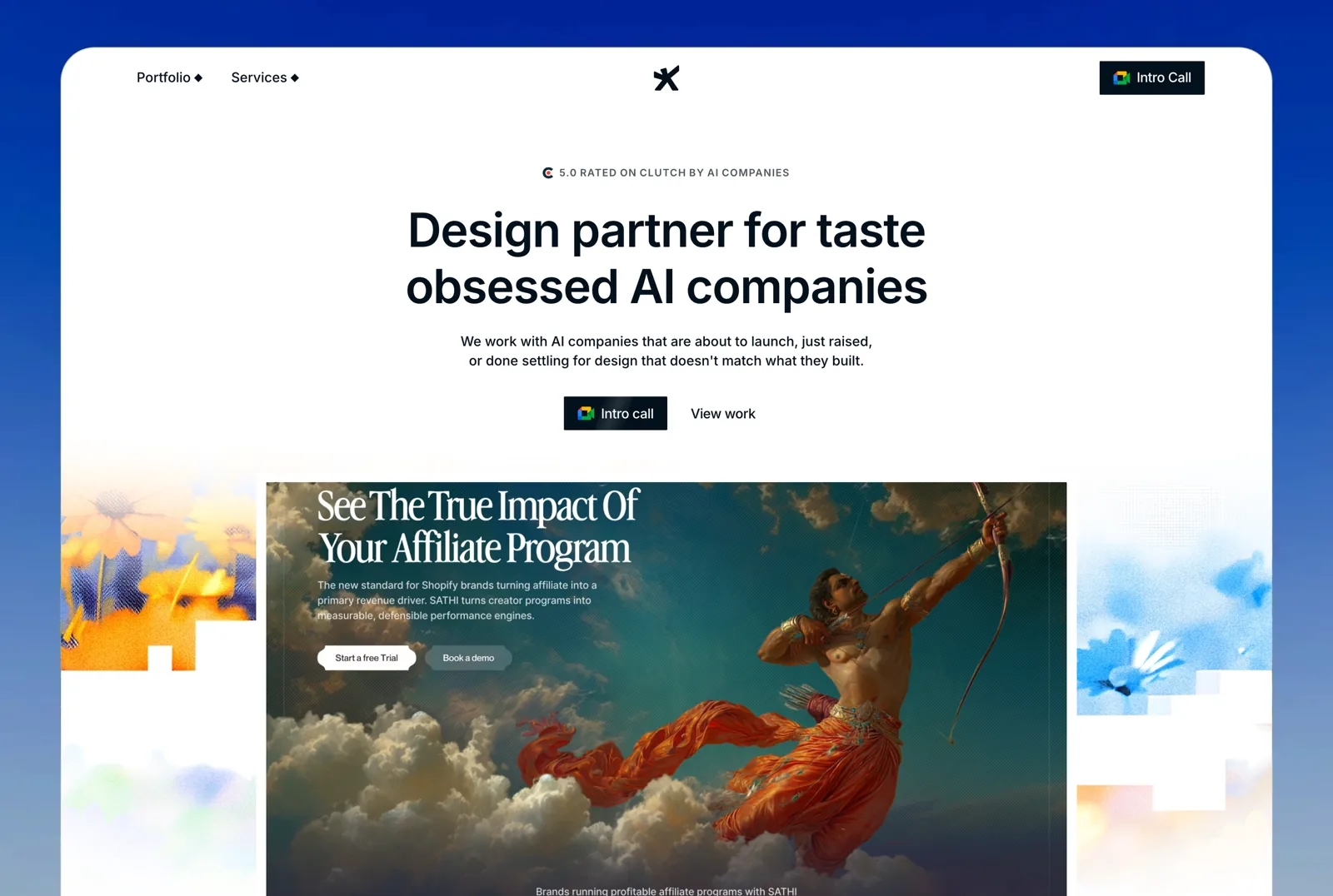
For a martech product the useful thing is that this is a web and product design studio, not one or the other. Studio Maydit continues into product design after a site ships, so the pitch your marketing page makes to a sceptical buyer and the reporting screen that has to back it up six months later come from the same people.
Its clients are AI founders in the US, UK, and Europe, and it is founder-led with a small senior team, which is the arrangement that makes it possible for one senior designer to spend a campaign week beside a real marketer. Framer, Webflow, and custom code are the build routes.
Fixed scope runs three to four weeks for teams with a date and closes with a diagnosis of what is leaking in the product. Teams shipping every week take the monthly retainer instead, which covers new pages, campaigns, and product design and has no long lock-in.
Only one engagement has a number in public. Seven months, 100,000+ users, at Dualite, after design work built on a repositioned ICP. Wave, PixelFlow, Mi-VAD, and 15 other AI and SaaS teams are also recent clients.
| Check | Finding |
|---|---|
| Based in | Remote, serving US / UK / EU |
| Platform depth | Framer, Webflow, and custom code |
| AI-sector proof | Yes. AI-native clients, published outcome on Dualite |
| Pricing | Fixed scope or monthly retainer, quoted per project |
| Team shape | Founder-led, small senior team |
| Best fit | Martech teams losing renewals they cannot justify |
Worth a call if your customers like the product and cannot defend the line item. Book a 30-minute call.

2. Foundey
Foundey is a San Francisco studio founded in 2021 working in Figma, with published AI client work and DemandIQ, Traycer, and Sero AI named. Product design is the entire business, and DemandIQ sells software into a commercial function where the buyer has to justify the spend, which is the same argument your customers will be having internally.
They publish no pricing and no team size, and being Figma-only means your own engineers build everything, which is a real cost when a martech product needs a great many screens quickly.
| Check | Finding |
|---|---|
| Based in | San Francisco, USA |
| Founded | 2021 |
| Team size | Not published |
| Primary platform | Figma-only |
| AI-sector proof | Yes. Published AI client work |
| Named clients | DemandIQ, Traycer, Sero AI |
| Pricing | Not published |
| Best fit | Teams with engineering capacity to build the screens |
3. Kvalifik
Kvalifik is a Copenhagen studio of 11 to 50 founded in 2015, working in Webflow, with published AI client work and Veo, Maersk, and Relesys named. Relesys is internal communications software, which lives or dies on whether an organisation can see that people actually used it, and that is exactly the evidence problem described above.
They publish no pricing, their primary platform is Webflow rather than a product tool, and Copenhagen hours leave a short overlap if your team and your first customers are both American.
| Check | Finding |
|---|---|
| Based in | Copenhagen, Denmark |
| Founded | 2015 |
| Team size | 11-50 |
| Primary platform | Webflow |
| AI-sector proof | Yes. Published AI client work |
| Named clients | Veo, Maersk, Relesys |
| Pricing | Not published |
| Best fit | European teams selling into large organisations |
4. Clay
Clay is a San Francisco studio of 51 to 200 founded in 2016, working across platforms, with a published minimum, published AI client work, and Slack, Stripe, Google, Coinbase, and Amazon named. Stripe in particular built a reputation on dashboards that professionals trusted enough to quote from, which is the standard a martech reporting surface has to meet.
They work across platforms rather than as a focused product practice, and a studio serving companies of that scale prices and paces for them, which strains a martech startup between rounds.
| Check | Finding |
|---|---|
| Based in | San Francisco, USA |
| Founded | 2016 |
| Team size | 51-200 |
| Primary platform | Mixed |
| AI-sector proof | Yes. Published AI client work |
| Named clients | Slack, Stripe, Google, Coinbase, Amazon |
| Pricing | Published minimum |
| Best fit | Teams whose reporting has to satisfy finance |
5. Feely Studio
Feely Studio is a distributed European team of one to ten, working across platforms, with a published minimum, published AI client work, and Noxus, Mutiny, Luasai, and Basic Capital named. Mutiny is the most directly relevant reference on this entire list, since it is a product built around personalising what a visitor sees and proving the difference.
They publish no founding year, and one to ten people cannot carry a growing product surface and a marketing site through a year of selling, so something will be waiting most months.
| Check | Finding |
|---|---|
| Based in | Distributed, Europe |
| Founded | Not published |
| Team size | 1-10 |
| Primary platform | Mixed |
| AI-sector proof | Yes. Published AI client work |
| Named clients | Noxus, Mutiny, Luasai, Basic Capital |
| Pricing | Published minimum |
| Best fit | Teams whose product personalises what visitors see |
6. SuperSkills
SuperSkills is a Walnut Creek team of one to ten working across platforms, with published AI client work and The Cut named. Media companies live on whether people engage with what they publish, so there is relevant instinct here about what makes somebody click, which is ultimately what your customers are being measured on.
They publish no pricing, no founding year, and one client name, which is very little to inspect, and a team that size cannot design a product with this many surfaces at the pace a funded martech company needs.
| Check | Finding |
|---|---|
| Based in | Walnut Creek, USA |
| Founded | Not published |
| Team size | 1-10 |
| Primary platform | Mixed |
| AI-sector proof | Yes. Published AI client work |
| Named clients | The Cut |
| Pricing | Not published |
| Best fit | Teams who need one workflow rethought properly |
7. Fantasy
Fantasy has worked from San Francisco and New York since 1999, across platforms, with published AI client work. Twenty-seven years spanning the whole history of digital marketing means this team has watched every wave of promised automation arrive, which is a useful scepticism to have on your side of the table.
They publish no pricing, no team size, and no client names, and a studio of that vintage runs engagements at a scale that a martech startup still proving retention cannot sensibly commit to.
| Check | Finding |
|---|---|
| Based in | San Francisco and New York, USA |
| Founded | 1999 |
| Team size | Not published |
| Primary platform | Mixed |
| AI-sector proof | Yes. Published AI client work |
| Named clients | Not published |
| Pricing | Not published |
| Best fit | Teams building for the long term at real scale |
8. Lazarev
Lazarev is a San Francisco studio of 51 to 200 founded in 2015, working across platforms, with a published minimum, published AI client work, and Payoneer, Peel, Elva, and Mozayix named. They publish a great deal of their own method, and for a buyer who assesses vendors professionally, being able to read how a studio thinks before booking anything is worth real time.
They work across platforms rather than as a product specialist, and at that headcount senior attention is shared across accounts rather than dedicated to yours.
| Check | Finding |
|---|---|
| Based in | San Francisco, USA |
| Founded | 2015 |
| Team size | 51-200 |
| Primary platform | Mixed |
| AI-sector proof | Yes. Published AI client work |
| Named clients | Payoneer, Peel, Elva, Mozayix |
| Pricing | Published minimum |
| Best fit | Teams who want to inspect the method before buying |
9. Pixelmatters
Pixelmatters is a Porto studio of 51 to 200 founded in 2013, working across platforms, with a published minimum and Rubrik, Quantic, and UJET named. UJET is customer experience software sold into operations teams that report on results constantly, and the scale here means several product surfaces can progress in parallel rather than in a queue.
Their AI-sector proof is partial, and at that headcount the individuals working on your product are assigned after the contract is signed rather than before.
| Check | Finding |
|---|---|
| Based in | Porto, Portugal |
| Founded | 2013 |
| Team size | 51-200 |
| Primary platform | Mixed |
| AI-sector proof | Partial. Enterprise and SaaS clients, no AI case study |
| Named clients | Rubrik, Quantic, UJET |
| Pricing | Published minimum |
| Best fit | Teams building several product surfaces at once |
10. Ramotion
Ramotion is a San Francisco studio of 11 to 50 founded in 2009, working across platforms, with a published minimum and Mozilla, Okta, Netflix, Adobe, and Xero named. Xero is a product whose users open it to check numbers they will be judged on, which is the same relationship your customers have with your reporting screens.
Their AI-sector proof is partial, and they work across platforms rather than as a product specialist, so the deep product surfaces may be handled by generalists.
| Check | Finding |
|---|---|
| Based in | San Francisco, USA |
| Founded | 2009 |
| Team size | 11-50 |
| Primary platform | Mixed |
| AI-sector proof | Partial. Enterprise and SaaS clients, no AI case study |
| Named clients | Mozilla, Okta, Netflix, Adobe, Xero |
| Pricing | Published minimum |
| Best fit | Teams whose users check numbers they are judged on |
How to choose between them
Sort by which part of the year is failing.
Users like it and renewals are still hard. Studio Maydit or Clay.
The core workflow produces too much and decides too little. Foundey or SuperSkills.
Approval and brand control are blocking rollouts. Kvalifik or Lazarev.
Several surfaces need building at the same time. Pixelmatters or Ramotion.
One test before you sign. Ask a candidate to design the screen a marketing director shows their own boss at the end of a quarter. Studios that have worked in this category will ask what your product replaced and what number your customer is measured on, then design backwards from that slide. Studios that have not will design a dashboard with charts on it. The first one keeps contracts. The second one is what your competitors already have.