Summarize with AI


The best product design agencies for AI-native SaaS products in 2026 are Studio Maydit, Foundey, Kvalifik, BX Studio, Lazarev, SuperSkills, Feely Studio, Digidop, Flowout, and Clay. Studio Maydit and Foundey lead for this brief, because both design the product itself rather than the page that sells it, and both have shipped interfaces for software whose output is generated fresh each time instead of looked up. Digidop and Flowout are the wrong fit here. Both are Webflow studios whose published work is marketing sites, and neither has an AI case study, so a team that needs somebody to design a confidence state or a usage meter would be paying them to learn the problem.
An AI-native product breaks the oldest assumption in software design. The same input no longer returns the same screen.
Ordinary software is a promise. Press the button, get the thing, every time. Your product is a range. It is excellent, then adequate, then wrong, and the user cannot tell which one they are looking at unless somebody designed for that. Most design work skips it, because the design happens against demo data that always behaves.
The pricing makes it worse. Usage-based billing means the interface is quietly spending the customer's money while they use it, and almost no early AI product shows them that as it happens. The first honest number they see arrives on an invoice, which is the single most reliable way to lose an account that was otherwise happy.
Then there is speed. The model changes, the capability changes, and the screens built around the old behaviour become slightly untrue. A studio that delivers a file set and leaves has handed you something that ages faster than the code does.
The ten studios below are ordered by how well they handle a product whose behaviour is a range rather than a rule.

How we picked these agencies
Five checks, weighted for software where the model is the product:
- Platform depth. Does the studio work where the product actually lives, or only where the marketing site lives? A Webflow practice and a product design practice are different jobs.
- Proof on generated output. Has this studio designed an interface for a product that produces answers rather than retrieving them? That is a named AI client with published work, not a landing page for a company that happens to sell a model.
- Pricing. Is a starting figure published anywhere, or does finding out take a call? Disclosure is the fact worth recording, not the number, which goes stale.
- Team shape. How many people, and are the senior ones on the work or on the pitch? A four-person AI team is a small account almost everywhere, and small accounts get junior staff.
- Their own site. Does it explain the offer, or is it a mood? A studio that cannot make itself legible will not make your model legible either.
Check two decides most of this list. Designing for generated output is a specific skill and it does not transfer from ordinary SaaS work. Generative products can only estimate, and the interface has to carry that honestly without making the thing sound broken. Studios that have never done it design the confident version and leave you with no screen for the day the model is wrong.
Sources for the tables: each studio's own published material and nothing else. Where a studio has published no figure, the row records the absence, which on this list is itself informative.
What goes wrong when AI-native teams buy product design
Three failures, and every one of them ships looking fine.
Everything is designed against the happy path. The prototype runs on curated examples and every screen shows a good answer. Then real users arrive and the product is wrong often enough to matter, with no state built for it. No low-confidence treatment, no way to flag a bad output, no path back. Nobody complains about this. They use it less each week, and the retention chart reads like a product nobody needed. Before design starts, write down the three ways your model fails most often and insist each one gets a screen.
The meter is invisible until the invoice. Usage-based pricing is standard for AI products and almost nobody builds it into the interface. A customer runs a large job on Tuesday, thinks nothing of it, and gets a bill at month end four times the last one. They do not conclude they used it more. They conclude they were tricked. Show consumption where it happens, before the action and after it, and let a customer set a ceiling. That costs a few screens and prevents churn no pricing page can fix.
The design is finished before the product stops changing. A studio delivers a complete file set, invoices, and moves on. Six weeks later the model gains a capability, the team ships it in whatever pattern is nearest, and the interface drifts. Within two quarters there are three ways of showing the same idea and nobody remembers which is right. Buy a system with rules, not a set of screens, and keep somebody who knows why the rules exist.
1. Studio Maydit: A Top-Rated Design Agency for AI Founders
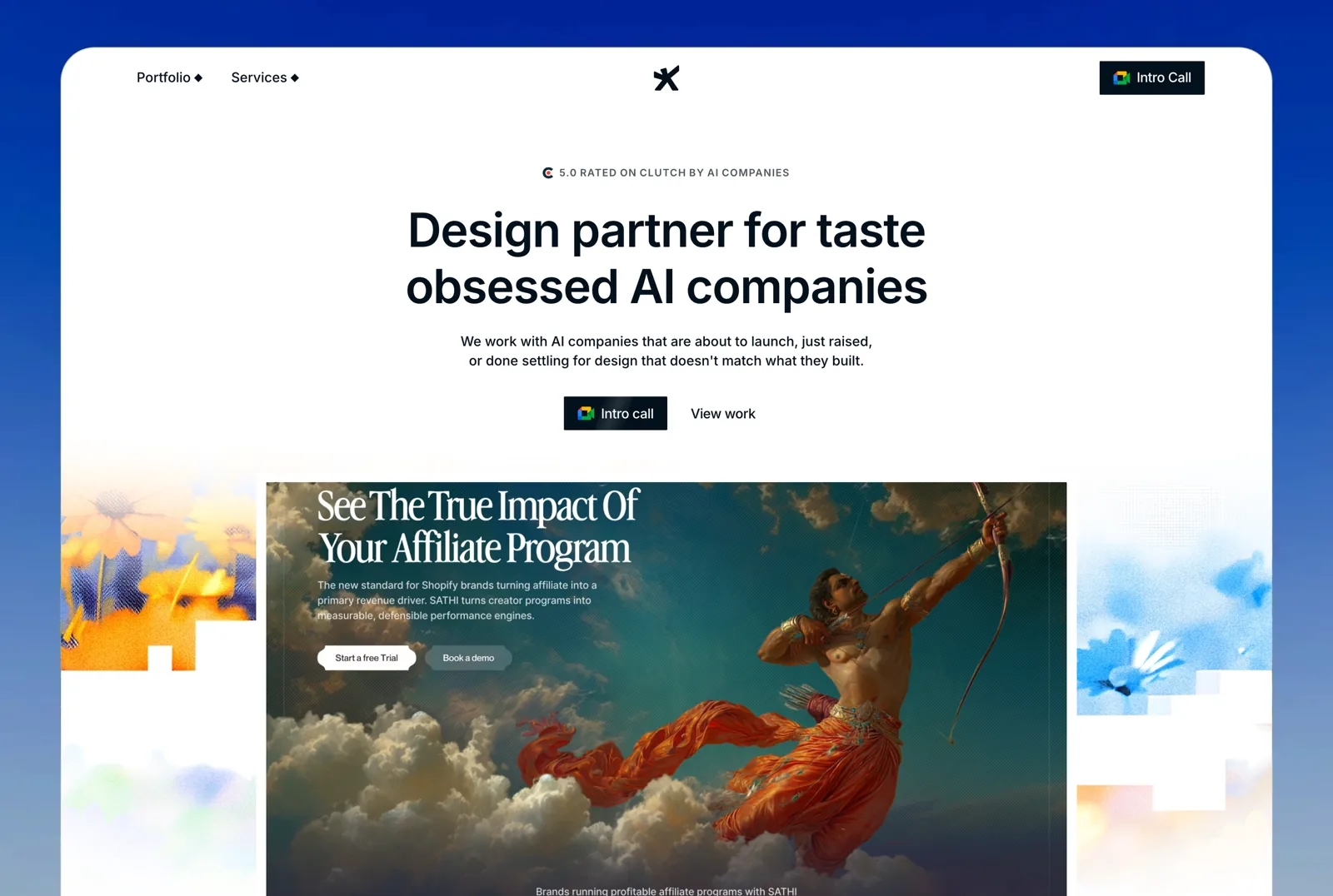
An AI-native product does not sit still long enough for a design engagement to end cleanly, so the useful question is who stays. Studio Maydit is a web and product design studio, and the work continues into product design after a site ships rather than stopping at handover. Its clients are AI founders, in the US, UK, and Europe.
Where the build happens follows what the product needs. Framer when a launch date is the constraint, Webflow when a marketing team has to own the pages after, custom code when the screen does something no page builder sells. That last case comes up often here, because a control showing how sure a model is has no off-the-shelf version.
The one client result the studio publishes is worth reading for exactly this reason. Dualite had software that worked and an audience that was wrong. A repositioned ICP came first, the design was rebuilt around it, and 100,000+ users followed inside seven months. None of that was a visual refresh. Wave, PixelFlow, and Mi-VAD are recent clients too, along with 15 other AI and SaaS teams.
Which arrangement fits depends on how settled the product is. Fixed scope runs three to four weeks and suits a team with a date and a screen set that will hold still that long. Teams still moving the product every week take the monthly retainer instead, covering new pages, campaigns, and product design, with no long lock-in. A fixed-scope project closes with a diagnosis of what is leaking in the product, which here usually means the exact step where a user stopped believing an output.
| Check | Finding |
|---|---|
| Based in | Remote, serving US / UK / EU |
| Platform depth | Framer, Webflow, and custom code |
| AI-sector proof | Yes. AI-native clients, published outcome on Dualite |
| Pricing | Fixed scope or monthly retainer, quoted per project |
| Team shape | Founder-led, small senior team |
| Best fit | AI-native teams whose product keeps moving after launch |
Worth an hour if the model changed twice this month and the interface did not. Book a 30-minute call.

2. Foundey
Foundey is a San Francisco studio founded in 2021 that works only in Figma, with published AI client work and DemandIQ, Traycer, and Sero AI named. Every one of those is an AI company, which is rarer on this list than it sounds, and a Figma-only practice means product design is the whole job rather than something attached to a website build.
They publish neither a team size nor a starting figure, and Figma-only means the files arrive and somebody on your side has to build them, which is a real cost for a team of four engineers.
| Check | Finding |
|---|---|
| Based in | San Francisco, USA |
| Founded | 2021 |
| Team size | Not published |
| Primary platform | Figma-only |
| AI-sector proof | Yes. Published AI client work |
| Named clients | DemandIQ, Traycer, Sero AI |
| Pricing | Not published |
| Best fit | AI teams with engineers who can build from files |
3. Kvalifik
Kvalifik is a Copenhagen studio founded in 2015, eleven to fifty people, with published AI client work and Veo, Maersk, and Relesys named. Veo is a computer vision product, so this is a team that has designed around a model which is right most of the time and visibly wrong some of the time, which is the exact problem in this brief.
Their primary platform is Webflow rather than a product surface, they publish no starting figure, and Copenhagen hours leave a Californian team a two-hour overlap in which to settle anything urgent.
| Check | Finding |
|---|---|
| Based in | Copenhagen, Denmark |
| Founded | 2015 |
| Team size | 11-50 |
| Primary platform | Webflow |
| AI-sector proof | Yes. Published AI client work |
| Named clients | Veo, Maersk, Relesys |
| Pricing | Not published |
| Best fit | European teams designing around a live model |
4. BX Studio
BX Studio works from New York with eleven to fifty people, publishes a minimum, and names Reddit, Headspace, ASAPP, and Verifone. ASAPP is an AI company and the others are consumer-scale products, so this is a team practised at designing for people who will not read an explanation first, which is most of what onboarding an AI product involves.
They publish no founding year, and Webflow is the primary platform, so product surface work sits alongside a marketing site practice rather than being the centre of it.
| Check | Finding |
|---|---|
| Based in | New York, USA |
| Founded | Not published |
| Team size | 11-50 |
| Primary platform | Webflow |
| AI-sector proof | Yes. Published AI client work |
| Named clients | Reddit, Headspace, ASAPP, Verifone |
| Pricing | Published minimum |
| Best fit | Teams whose users arrive without reading anything |
5. Lazarev
Lazarev is a San Francisco studio founded in 2015 at fifty-one to two hundred people, publishing a minimum alongside AI client work, with Payoneer, Peel, Elva, and Mozayix named. Size matters for a product with many screens, since a studio this large can put several designers on a surface at once instead of delivering it a section at a time.
At that headcount an early AI team is a small account, the platform practice is mixed rather than product-first, and the published minimum is set for companies further along than most teams reading this.
| Check | Finding |
|---|---|
| Based in | San Francisco, USA |
| Founded | 2015 |
| Team size | 51-200 |
| Primary platform | Mixed |
| AI-sector proof | Yes. Published AI client work |
| Named clients | Payoneer, Peel, Elva, Mozayix |
| Pricing | Published minimum |
| Best fit | Funded teams with a wide product surface to cover |
6. SuperSkills
SuperSkills is a Walnut Creek team of one to ten working across platforms, with published AI client work and The Cut named. A team that small means the senior person is the working person, and for a founder who needs three screens reconsidered rather than a programme of work, that is usually the faster path.
They name a single client, publish no founding year and no starting figure, and one to ten people cannot cover a full product surface alongside anything else you need.
| Check | Finding |
|---|---|
| Based in | Walnut Creek, USA |
| Founded | Not published |
| Team size | 1-10 |
| Primary platform | Mixed |
| AI-sector proof | Yes. Published AI client work |
| Named clients | The Cut |
| Pricing | Not published |
| Best fit | Teams who need a few screens fixed quickly |
7. Feely Studio
Feely Studio is a distributed European team of one to ten, working across platforms, publishing a minimum, with Noxus, Mutiny, Luasai, and Basic Capital named. Noxus and Mutiny are both AI-native companies, and a published figure means a founder can decide whether this is worth a call without booking one first.
No founding year is published, one to ten people is thin cover for a product that ships weekly, and a distributed European team gives a US company a short daily window for decisions.
| Check | Finding |
|---|---|
| Based in | Distributed, Europe |
| Founded | Not published |
| Team size | 1-10 |
| Primary platform | Mixed |
| AI-sector proof | Yes. Published AI client work |
| Named clients | Noxus, Mutiny, Luasai, Basic Capital |
| Pricing | Published minimum |
| Best fit | European teams who want a fast, priced start |
8. Digidop
Digidop is a Paris studio founded in 2021, one to ten people, working in Webflow, publishing a minimum, with TSE Energy, Ramify, and StreamNative named. StreamNative is developer infrastructure, so this is a team that has had to make something technical legible, and the published figure keeps the first conversation short.
Their AI-sector proof is partial with no AI case study, the practice is Webflow marketing sites rather than product screens, and one to ten people in Paris is a narrow overlap for a US-hours team.
| Check | Finding |
|---|---|
| Based in | Paris, France |
| Founded | 2021 |
| Team size | 1-10 |
| Primary platform | Webflow |
| AI-sector proof | Partial. Enterprise and SaaS clients, no AI case study |
| Named clients | TSE Energy, Ramify, StreamNative |
| Pricing | Published minimum |
| Best fit | European teams who need the site before the product |
9. Flowout
Flowout is a distributed Webflow studio publishing a minimum, with Jasper, Kajabi, Riverside, and Sendlane named. Jasper is a generative product, so the team has at least worked next to one, and a subscription arrangement with a published figure suits a company that wants continuous small changes rather than one project.
They publish no founding year and no team size, their AI-sector proof is partial, and the published work is marketing pages rather than product interfaces, which is the opposite end of this brief.
| Check | Finding |
|---|---|
| Based in | Distributed |
| Founded | Not published |
| Team size | Not published |
| Primary platform | Webflow |
| AI-sector proof | Partial. Enterprise and SaaS clients, no AI case study |
| Named clients | Jasper, Kajabi, Riverside, Sendlane |
| Pricing | Published minimum |
| Best fit | Teams who want continuous marketing page changes |
10. Clay
Clay is a San Francisco studio founded in 2016 at fifty-one to two hundred people, publishing a minimum alongside AI client work, with Slack, Stripe, Google, Coinbase, and Amazon named. Those are products where a single confusing state costs a very large number of support tickets, and a studio trained at that scale takes edge cases seriously by habit.
The process and the published minimum are both built for companies with a design team already in place, the platform practice is mixed, and a four-person AI company will not be the account that sets the schedule.
| Check | Finding |
|---|---|
| Based in | San Francisco, USA |
| Founded | 2016 |
| Team size | 51-200 |
| Primary platform | Mixed |
| AI-sector proof | Yes. Published AI client work |
| Named clients | Slack, Stripe, Google, Coinbase, Amazon |
| Pricing | Published minimum |
| Best fit | Later-stage teams with real scale to design for |
How to choose between them
Sort by which part of the product is actually failing.
Users do not trust the output. Studio Maydit or Foundey.
Onboarding loses people before the first good result. BX Studio or Kvalifik.
The surface is wide and nobody owns the patterns. Lazarev or Clay.
Three screens are wrong and you need them right this month. SuperSkills or Feely Studio.
One test before you sign. Show a candidate a real bad output from your product, not a good one, and ask what the screen should do. A studio that has designed for a generative product will start asking about confidence, correction, and what happens next. A studio that has not will talk about how to make the error message look nicer, which tells you it has only ever designed software that works.