

Summarize with AI


The best product design agencies for Amsterdam AI startups in 2026 are Studio Maydit, Feely Studio, Foundey, Pixelmatters, Phantom, Kvalifik, Clay, Trueform, Lazarev, and Fantasy. Studio Maydit and Feely Studio lead for this brief, because both work with AI companies across Europe in your working hours and both are small enough that the senior person stays on the project rather than appearing at the pitch. Fantasy and Clay are the wrong fit here, since one publishes no client names at all and the other is shaped for companies with an established internal design team, and neither is built for a Dutch startup selling into several countries at once.
An Amsterdam AI company has a design problem that a San Francisco one simply does not have.
The home market is not large enough to be the whole business. From very early on you are selling into Germany, the UK, the Nordics, and usually the United States, which means the product is being designed for buyers nobody on the team has met.
What tends to happen instead is that it gets designed for the customers who are reachable. The ones who will take a meeting in the city, whose feedback arrives quickly and in person, and whose expectations feel representative because they are the only ones you hear clearly.
Regulation is the second thing that behaves differently here. European rules on AI and personal data are not a legal appendix, they are product surface: what the system explains about its own decisions, what a person can contest, what gets retained and for how long. Treating that as a settings page at the end of the project is expensive, because it is really a set of screens you have not designed yet.
And then hiring. Senior product designers in this city are scarce and costly, and the search takes months you do not have while the product sits still.
The ten studios below are ranked on how well they suit a European AI company selling beyond its own borders.

How we picked these agencies
Nobody paid for a position here. Each studio was assessed against public evidence, using five checks chosen for a European company selling into several markets at once:
- Platform depth. Do they design real product interfaces, or is product a small line under a marketing site practice?
- Proof in the European market. Have they shipped for companies selling across European borders, where language, currency, and regulation vary by customer?
- Pricing. Is a starting figure available in public, or does every enquiry become a sales call?
- Team shape. Is the senior person on the project, and do their working hours overlap with yours?
- Their own site. Considered and specific, or the current template with the studio's name on it?
We keep returning to that last one because it costs nothing to check and it is unusually honest. A studio's own site is the only project with no client to accommodate, so it shows what they do when they are the ones deciding.
All figures in the tables come from public sources, mainly each studio's own website. Anything a studio does not publish is marked as unpublished rather than filled in.
What goes wrong when a Dutch AI product sells across borders
Three failures show up repeatedly in this market, and each begins as a reasonable decision made with the information available locally.
The product quietly becomes a Dutch product. Not in language, since everything is in English from the first day, but in assumption. Onboarding matches how local teams buy. The pricing page reflects what nearby customers expect. Support hours suit one timezone. None of this is visible from inside, because the customers giving feedback are the ones confirming it. The correction is straightforward but has to be deliberate. Run your research with buyers in at least two other countries before the design is settled, and treat a German or American reaction as equally valid rather than as an outlier to be explained away.
Compliance arrives at the end as a modal. European obligations around automated decisions and personal data get treated as legal work, so they surface late, and the design team is asked to add consent, explanation, and retention controls to a finished interface. The result is a bolt-on that annoys everybody and satisfies nobody. These are product questions and they belong in the first week. What does the system tell a person about how a decision was reached, how does somebody challenge it, and what does a customer's own administrator need to see. Designed early they become a reason to trust you. Designed late they become friction on top of a flow that was already agreed.
Six months disappear into a hiring search. The instinct is to build the capability in house, which is correct eventually and slow right now. Senior product designers here are expensive, in demand, and rarely available at short notice, and a search that takes four months is followed by three more before the new hire is fully effective. Meanwhile nothing ships. The practical route is to buy the specific gap while continuing to recruit, so the interface moves now, and the eventual hire inherits a working system with decisions already documented instead of a backlog and an apology.
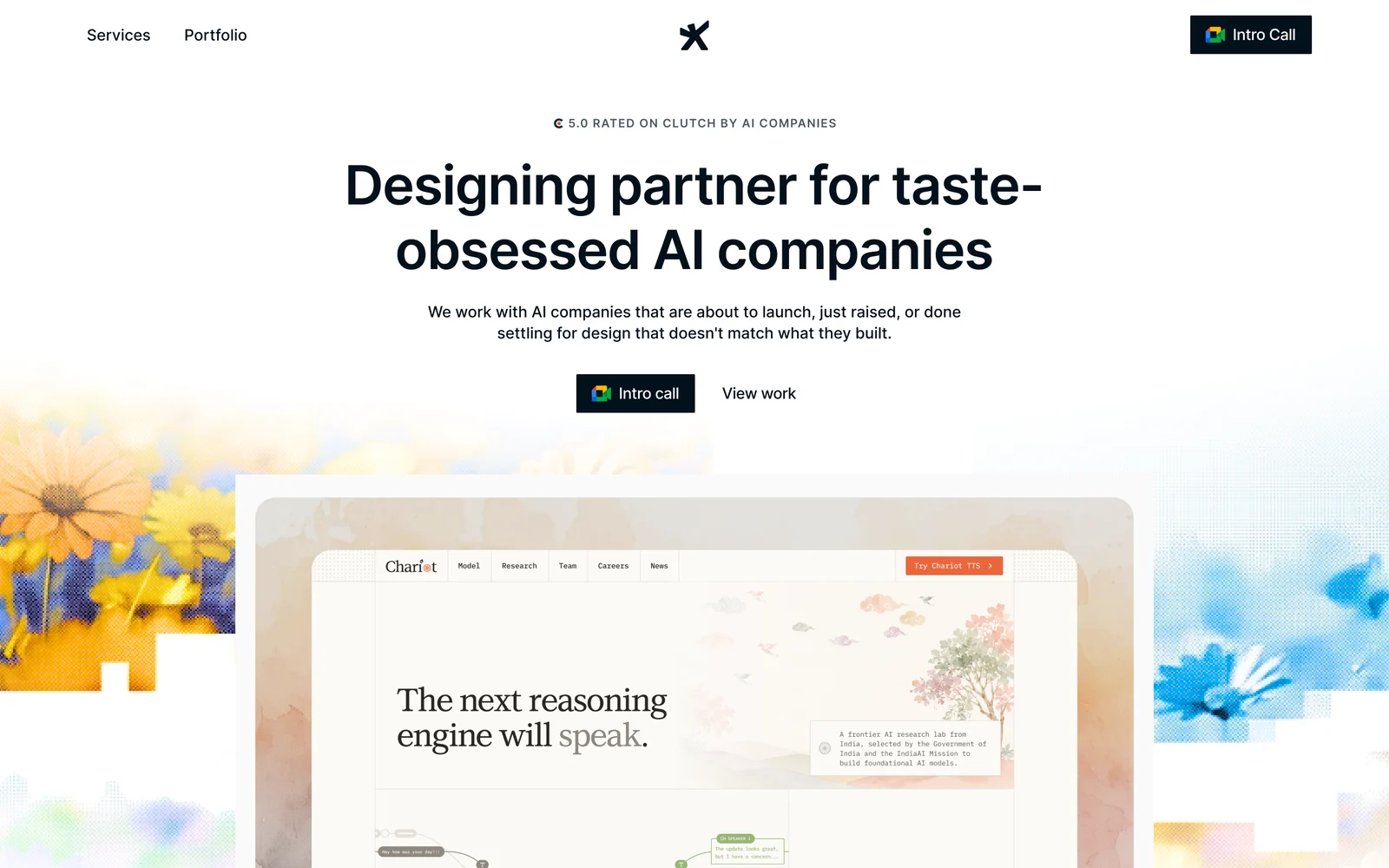
1. Studio Maydit: A Top-Rated Design Agency for AI Founders
For a company in Amsterdam, the relevant fact about Studio Maydit is where it works. It is a web and product design studio serving AI founders in the US, UK, and Europe, so a Dutch team selling into Germany, Britain, and the United States is describing the studio's normal working week rather than an unusual request.
The studio builds in Framer, Webflow, and custom code, and continues into product design once the site is live. Ask what it can prove and the answer is Dualite: 100,000+ users reached in seven months, on the back of design work supporting a repositioned ICP. Wave, PixelFlow, Mi-VAD, and 15 other AI and SaaS teams have worked with it since.
Because European companies often need the marketing site and the product moving together, there are two ways to buy. A fixed scope runs three to four weeks for teams with a fixed date, such as a conference or a funding announcement. A monthly retainer suits teams shipping continuously, covering new pages, campaigns, and product design, with no long lock-in. Fixed-scope work ends with a diagnosis of what is leaking in the product.
| Check | Finding |
|---|---|
| Based in | Remote, serving US / UK / EU |
| Platform depth | Framer, Webflow, and custom code |
| AI-sector proof | Yes. AI-native clients, published outcome on Dualite |
| Pricing | Fixed scope or monthly retainer, quoted per project |
| Team shape | Founder-led, small senior team |
| Best fit | European AI teams selling into several markets at once |
Worth a call if your product is designed for the customers you can visit. Book a 30-minute call.

2. Feely Studio
Feely Studio is a distributed European team of one to ten with a published minimum and Noxus, Mutiny, Luasai, and Basic Capital named. They work with early AI companies from inside Europe, so timezone overlap is complete and the published price means an Amsterdam team can assess fit before spending a week on calls.
They publish no founding year, and one to ten people means capacity is genuinely limited, so a project starting next month may simply not be possible.
| Check | Finding |
|---|---|
| Based in | Distributed, Europe |
| Founded | Not published |
| Team size | 1-10 |
| Primary platform | Mixed |
| AI-sector proof | Yes. Published AI client work |
| Named clients | Noxus, Mutiny, Luasai, Basic Capital |
| Pricing | Published minimum |
| Best fit | European AI teams who want a price and a small crew |
3. Foundey
Foundey is a San Francisco studio founded in 2021 working in Figma, with DemandIQ, Traycer, and Sero AI named. Their portfolio is early AI products, which means fewer explanations needed about model behaviour, and an American perspective is genuinely useful if the United States is your next market.
They publish no pricing and no team size, Figma-only leaves the build to your engineers, and San Francisco hours give an Amsterdam team a very short overlap window each day.
| Check | Finding |
|---|---|
| Based in | San Francisco, USA |
| Founded | 2021 |
| Team size | Not published |
| Primary platform | Figma-only |
| AI-sector proof | Yes. Published AI client work |
| Named clients | DemandIQ, Traycer, Sero AI |
| Pricing | Not published |
| Best fit | Teams targeting US buyers who can build in house |
4. Pixelmatters
Pixelmatters is a Porto team of 51 to 200, founded in 2013, working across platforms, with a published minimum and Rubrik, Quantic, and UJET named. They are European, they publish a starting price, and Rubrik is enterprise software sold internationally, so they have designed for buyers spread across markets.
Their AI-sector proof is partial, and a firm of that size assigns project teams, so continuity depends on the contract rather than on knowing everybody by name.
| Check | Finding |
|---|---|
| Based in | Porto, Portugal |
| Founded | 2013 |
| Team size | 51-200 |
| Primary platform | Mixed |
| AI-sector proof | Partial. Enterprise and SaaS clients, no AI case study |
| Named clients | Rubrik, Quantic, UJET |
| Pricing | Published minimum |
| Best fit | Teams needing capacity across product and marketing |
5. Phantom
Phantom works from London and Auckland, founded in 2013, a team of 51 to 200 writing custom code, with Diageo, SAP, Financial Times, and Zendesk named. SAP and Zendesk are enterprise products sold across European markets, so they understand the requirements that appear once a serious buyer's procurement team gets involved.
They publish no pricing, and a studio built around enterprise engagements brings a process weight that a fifteen person Amsterdam startup will find slow.
| Check | Finding |
|---|---|
| Based in | London, UK and Auckland, NZ |
| Founded | 2013 |
| Team size | 51-200 |
| Primary platform | Custom code |
| AI-sector proof | Yes. Published AI client work |
| Named clients | Diageo, SAP, Financial Times, Zendesk |
| Pricing | Not published |
| Best fit | Teams selling to European enterprise buyers |
6. Kvalifik
Kvalifik is a Copenhagen team of 11 to 50, founded in 2015, working in Webflow, with Veo, Maersk, and Relesys named. A northern European studio understands the pattern of a small home market and international ambition, because every client they have has lived it, and Maersk is about as international as a client gets.
They publish no pricing, and Webflow is their platform strength, so deep product interface work is not the centre of their practice.
| Check | Finding |
|---|---|
| Based in | Copenhagen, Denmark |
| Founded | 2015 |
| Team size | 11-50 |
| Primary platform | Webflow |
| AI-sector proof | Yes. Published AI client work |
| Named clients | Veo, Maersk, Relesys |
| Pricing | Not published |
| Best fit | Nordic and Dutch teams wanting a nearby studio |
7. Clay
Clay is a San Francisco studio of 51 to 200, founded in 2016, working across platforms, with a published minimum and Slack, Stripe, Google, Coinbase, and Amazon named. Stripe and Coinbase both operate under different rules in every country they serve, and designing for that variation is directly relevant to a European product.
Their engagements assume a client with in-house design leadership, and San Francisco hours mean most of your working day has already finished before theirs begins.
| Check | Finding |
|---|---|
| Based in | San Francisco, USA |
| Founded | 2016 |
| Team size | 51-200 |
| Primary platform | Mixed |
| AI-sector proof | Yes. Published AI client work |
| Named clients | Slack, Stripe, Google, Coinbase, Amazon |
| Pricing | Published minimum |
| Best fit | Later-stage teams with a design lead already hired |
8. Trueform
Trueform is a Swiss studio founded in 2022 working in Framer, with a published minimum and Miro, Morning Brew, Bilt Rewards, and Gather named. Miro is a Dutch-founded company that grew internationally, which makes it an unusually relevant reference for an Amsterdam team, and Swiss hours match yours exactly.
They publish no team size, the studio is young, and Framer is a marketing site tool, so this is a strong option for the site and a weak one for the product itself.
| Check | Finding |
|---|---|
| Based in | Wil, Switzerland |
| Founded | 2022 |
| Team size | Not published |
| Primary platform | Framer |
| AI-sector proof | Yes. Published AI client work |
| Named clients | Miro, Morning Brew, Bilt Rewards, Gather |
| Pricing | Published minimum |
| Best fit | European teams whose immediate need is the website |
9. Lazarev
Lazarev is a San Francisco firm of 51 to 200, founded in 2015, working across platforms, with a published minimum and Payoneer, Peel, Elva, and Mozayix named. Payoneer moves money between countries under many different regimes, so the team has designed inside exactly the kind of constraint European rules impose.
Their scale means assigned teams rather than a fixed group, and the timezone gap makes the fast daily exchanges that early product work depends on impractical.
| Check | Finding |
|---|---|
| Based in | San Francisco, USA |
| Founded | 2015 |
| Team size | 51-200 |
| Primary platform | Mixed |
| AI-sector proof | Yes. Published AI client work |
| Named clients | Payoneer, Peel, Elva, Mozayix |
| Pricing | Published minimum |
| Best fit | Teams whose product is shaped by regulation |
10. Fantasy
Fantasy has worked from San Francisco and New York since 1999, across platforms, on complex products at large scale. Their longevity is real and their experience with intricate interfaces is deep, which matters if your product is genuinely complicated rather than simply new.
They publish no client names, no pricing, and no team size, so there is very little a Dutch buyer can verify, and their engagement shape suits large organisations rather than a startup measuring its runway in months.
| Check | Finding |
|---|---|
| Based in | San Francisco and New York, USA |
| Founded | 1999 |
| Team size | Not published |
| Primary platform | Mixed |
| AI-sector proof | Yes. Published AI client work |
| Named clients | Not published |
| Pricing | Not published |
| Best fit | Large organisations buying depth rather than speed |
How to choose between them
Sort by which border is causing the trouble.
You need the same working hours as your team. Studio Maydit or Feely Studio.
The United States is the next market. Foundey or Clay.
European rules are shaping the interface. Lazarev or Phantom.
You need volume across product and marketing. Pixelmatters or Kvalifik.
One test before you sign. Ask a candidate how they would find out whether your onboarding works for a German buyer as well as a Dutch one. A studio with real European experience will talk about who they would speak to, what differs in how those buyers evaluate software, and which assumptions they would want to test first. A studio without it will say the design is universal, which is the answer that produces a product quietly built for the customers who happen to be nearest.