Summarize with AI


The best product design agencies for B2B AI SaaS companies in 2026 are Studio Maydit, Foundey, Clay, Lazarev, SuperSkills, Feely Studio, Pixelmatters, Instrument, Lighthouse Digital, and Ramotion. Studio Maydit and Clay lead for this brief, because both have published AI client work and Clay has designed products with real administrative surfaces, which is the half of a B2B application that decides whether a deal survives security review. Lighthouse Digital and Instrument are the wrong fit here. Lighthouse has no published AI client work and builds in Webflow, and Instrument's practice is large-brand work, so neither demonstrates the enterprise application design this audience needs.
In B2B the person who signs is not the person who uses, and an AI product has to satisfy both.
The user wants speed. Fewer clicks, an answer immediately, nothing in the way. The buyer wants the opposite of speed. They want to know who can see what, where the data went, who approved the output, and what happens when the model gets something wrong in front of a customer.
Design one product for both and you get neither. The common version is a fast, elegant tool that dies in procurement because no audit trail exists that a compliance officer can read. The other is so wrapped in approvals the analyst returns to a spreadsheet.
There is a related problem that shows up later and costs more. The pilot works. A champion inside the company loves the product, uses it daily, and renews enthusiastically. Then it rolls out to forty ordinary employees who did not volunteer, were not consulted, and have a job that already works. Adoption stalls at eleven percent and nobody can say why, because the product was designed for the person who was already convinced.
Underneath both sits something specific to this sector. An AI product asks an employee to trust a machine with a task their name is attached to. That is a design problem, not a feature request, and it is the one most B2B AI products leave unsolved.
The ten studios below are ordered by how well they serve a buyer and a user who want different things.

How we picked these agencies
Five checks, applied to an application sold to companies rather than people:
- Platform depth. Is the practice product surfaces, or websites with a product page attached? For B2B the surface includes settings, roles, and permissions, which is where website studios run out of experience.
- Proof in AI and at scale. Are there named AI clients, and has the studio designed anything with a real administrative layer? Both halves are needed. AI work alone leaves you with a product that cannot pass a security review.
- Pricing. Is there a published starting figure? Enterprise-shaped studios rarely publish, which is informative, since it usually means the engagement is scoped for a company that already has a design team.
- Team shape. Will somebody senior sit with an actual user? The gap between buyer and user is only visible if a designer watches both, and that never survives delegation to a junior team.
- Their own site. Is it written for a buyer or for a browser? A studio that cannot make its own case to a sceptical professional reader will not help you make yours.
Weight check two and insist on both halves. Designing the unglamorous surfaces of a B2B product is a specific competence: role management, audit logs, approval flows, the screen showing an administrator what the model did last Tuesday and on whose behalf. Those screens close deals. A studio trained on consumer work has never built them, and the absence is invisible in a demo and fatal in week six of procurement.
Where these facts came from: each studio's own site, read this month, with nothing taken from directories or aggregators. A row recording nothing means the studio has published nothing there, which for a buyer running diligence is a data point rather than an omission.
What goes wrong when B2B AI companies buy product design
Three failures. The first one is decided before design starts.
The product is designed for whoever the founders talk to. Founders speak to buyers, because buyers sign, so the roadmap fills with dashboards, reporting, and oversight. The analyst using it eight times a day gets an interface nobody watched them use. It renews once on the buyer's enthusiasm and churns in year two when usage data reaches the person paying. Design for the user, sell to the buyer, and give the buyer a surface of their own rather than bending the user's screens into a reporting tool.
Nobody designs the accountability layer. Every enterprise AI deal reaches a stage where someone asks who is responsible for a wrong output. If the answer lives in a database and not in the interface, the deal slows by months. Permissions, an audit trail written in language a non-technical reviewer can follow, a record of which human approved what, and a clear boundary around what the model may do unsupervised. Teams treat these as backend concerns and discover in a procurement questionnaire that they are screens. Design them early, while they are cheap, and they become a reason to buy rather than an obstacle.
The pilot is mistaken for the product. Pilots run with volunteers, and volunteers forgive everything. They read the tooltip, retry a poor output, and tell you what they wanted. Rollout has none of that. Somebody who did not choose this opens it once, gets a mediocre result, and never returns, and the champion cannot explain the drop. Before signing an expansion, watch three people who were assigned the tool rather than three who asked for it. What they struggle with is the real brief, and it is rarely what the pilot suggested.
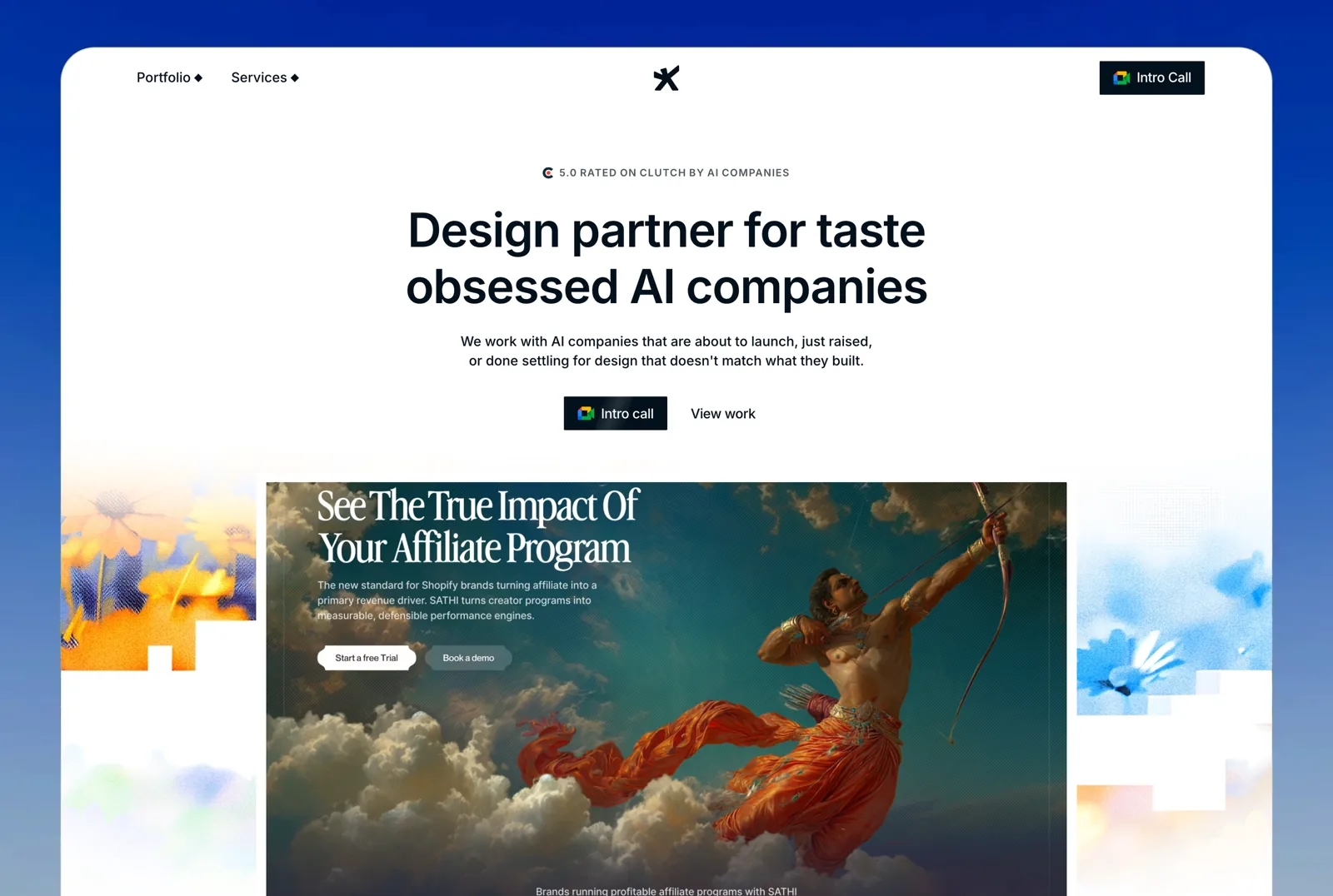
1. Studio Maydit: A Top-Rated Design Agency for AI Founders
Two audiences with opposite wishes is a positioning problem before it is a design problem, and it is answered by deciding who the product is actually for. Studio Maydit works that way round, which is what the one published client outcome demonstrates. Dualite already had working software. What changed the trajectory was a repositioned ICP, with the design rebuilt to serve that decision, after which 100,000+ users arrived within seven months. Wave, PixelFlow, and Mi-VAD are recent clients, alongside 15 other AI and SaaS teams.
It is a web and product design studio whose clients are AI founders in the US, UK, and Europe, so the sector's particular difficulty, making software that is right most of the time feel dependable, is familiar rather than something to be briefed in. The engagement continues into product design after a site ships, which for a B2B company is usually where the real work sits.
Framer, Webflow, and custom code are all available, chosen by what has to be built. That matters more in B2B than elsewhere, because the marketing site and the application have genuinely different requirements and one platform rarely serves both honestly.
On commercial shape: a monthly retainer suits a company still shaping the product, covering new pages, campaigns, and product design as needed, with no long lock-in. Where the surface is defined and dated, fixed scope runs three to four weeks and finishes with a diagnosis of what is leaking in the product, which in B2B is very often the gap between what the champion does and what everybody else does.
| Check | Finding |
|---|---|
| Based in | Remote, serving US / UK / EU |
| Platform depth | Framer, Webflow, and custom code |
| AI-sector proof | Yes. AI-native clients, published outcome on Dualite |
| Pricing | Fixed scope or monthly retainer, quoted per project |
| Team shape | Founder-led, small senior team |
| Best fit | Teams whose champion loves the product and whose rollout stalls |
Worth an hour if renewals are strong and daily usage is not. Book a 30-minute call.

2. Foundey
Foundey is a San Francisco studio founded in 2021 working only in Figma, with published AI client work and DemandIQ, Traycer, and Sero AI named. All three sell software to businesses rather than consumers, and a Figma-only practice means application screens are the entire job rather than an extension of a website engagement.
They publish neither team size nor a starting figure, and Figma-only means the files arrive and your engineers build them, which slows delivery of the settings and permissions work that tends to get deprioritised anyway.
| Check | Finding |
|---|---|
| Based in | San Francisco, USA |
| Founded | 2021 |
| Team size | Not published |
| Primary platform | Figma-only |
| AI-sector proof | Yes. Published AI client work |
| Named clients | DemandIQ, Traycer, Sero AI |
| Pricing | Not published |
| Best fit | B2B teams with engineers ready to build from files |
3. Clay
Clay is a San Francisco studio founded in 2016 at fifty-one to two hundred people, publishing a minimum, with published AI client work and Slack, Stripe, Google, Coinbase, and Amazon named. Slack and Stripe are both products with serious administrative surfaces used by companies rather than individuals, which is the rarest and most relevant qualification on this page.
The published minimum assumes a company with revenue, the process expects a design team on your side to work with, and at that headcount a Series A account does not set the schedule.
| Check | Finding |
|---|---|
| Based in | San Francisco, USA |
| Founded | 2016 |
| Team size | 51-200 |
| Primary platform | Mixed |
| AI-sector proof | Yes. Published AI client work |
| Named clients | Slack, Stripe, Google, Coinbase, Amazon |
| Pricing | Published minimum |
| Best fit | Funded teams designing a real administrative layer |
4. Lazarev
Lazarev is a San Francisco studio founded in 2015 at fifty-one to two hundred people, working across platforms, publishing a minimum, with published AI client work and Payoneer, Peel, Elva, and Mozayix named. Payoneer is a regulated financial product, so this is a team that has designed inside real compliance constraints rather than treating them as an afterthought.
Their platform practice is mixed rather than product-first, and a studio of that size will assign a Series A B2B company a smaller team than its pitch implies.
| Check | Finding |
|---|---|
| Based in | San Francisco, USA |
| Founded | 2015 |
| Team size | 51-200 |
| Primary platform | Mixed |
| AI-sector proof | Yes. Published AI client work |
| Named clients | Payoneer, Peel, Elva, Mozayix |
| Pricing | Published minimum |
| Best fit | Teams working inside regulatory constraints |
5. SuperSkills
SuperSkills is a Walnut Creek team of one to ten working across platforms, with published AI client work and The Cut named. At that size the senior person is the working person, so a company that needs its onboarding flow reconsidered in three weeks rather than a quarter-long programme will move faster here than anywhere else on this list.
They name a single client, publish no founding year and no starting figure, and one to ten people cannot design an application surface with roles and permissions alongside anything else you need.
| Check | Finding |
|---|---|
| Based in | Walnut Creek, USA |
| Founded | Not published |
| Team size | 1-10 |
| Primary platform | Mixed |
| AI-sector proof | Yes. Published AI client work |
| Named clients | The Cut |
| Pricing | Not published |
| Best fit | Teams fixing one flow quickly with senior hands |
6. Feely Studio
Feely Studio is a distributed European team of one to ten, working across platforms, publishing a minimum, with published AI client work and Noxus, Mutiny, Luasai, and Basic Capital named. Noxus and Mutiny both sell to businesses, and a published figure alongside a small team makes this among the fastest engagements here to start.
No founding year is published, one to ten people is thin cover for a B2B surface that keeps growing, and European hours give a US company a short daily window.
| Check | Finding |
|---|---|
| Based in | Distributed, Europe |
| Founded | Not published |
| Team size | 1-10 |
| Primary platform | Mixed |
| AI-sector proof | Yes. Published AI client work |
| Named clients | Noxus, Mutiny, Luasai, Basic Capital |
| Pricing | Published minimum |
| Best fit | European B2B teams who need to start quickly |
7. Pixelmatters
Pixelmatters is a Porto studio founded in 2013 at fifty-one to two hundred people, working across platforms, publishing a minimum, with Rubrik, Quantic, and UJET named. Rubrik is enterprise data infrastructure and UJET is enterprise support software, so this team has spent real time on products bought by committees rather than individuals.
Their AI-sector proof is partial with no AI case study, which for this brief is the material gap, and mixed platform work means product specialism is not exclusive.
| Check | Finding |
|---|---|
| Based in | Porto, Portugal |
| Founded | 2013 |
| Team size | 51-200 |
| Primary platform | Mixed |
| AI-sector proof | Partial. Enterprise and SaaS clients, no AI case study |
| Named clients | Rubrik, Quantic, UJET |
| Pricing | Published minimum |
| Best fit | Teams selling to enterprise buying committees |
8. Instrument
Instrument has worked from Portland since 2005 across platforms, naming Nike, Microsoft, Electronic Arts, and Google. Two decades at that scale produces process that genuinely holds: states documented, accessibility considered, edge cases treated as work rather than as exceptions, all of which a B2B product needs and rarely has.
They publish no team size and no pricing, their AI-sector proof is partial with no AI case study, and a practice built around global brand work is a long way from designing a permissions screen.
| Check | Finding |
|---|---|
| Based in | Portland, USA |
| Founded | 2005 |
| Team size | Not published |
| Primary platform | Mixed |
| AI-sector proof | Partial. Enterprise and SaaS clients, no AI case study |
| Named clients | Nike, Microsoft, Electronic Arts, Google |
| Pricing | Not published |
| Best fit | Later-stage teams buying rigorous process |
9. Lighthouse Digital
Lighthouse Digital works from London in Webflow, publishes a minimum, and names HelloSelf, Freetrade, and IGN. Freetrade is a regulated financial product, so there is evidence of writing claims that survive scrutiny, and a published figure lets a UK company decide quickly.
They have no published AI client work, publish neither founding year nor team size, and Webflow is a website platform rather than an application surface, which places them furthest from this brief of anyone here.
| Check | Finding |
|---|---|
| Based in | London, UK |
| Founded | Not published |
| Team size | Not published |
| Primary platform | Webflow |
| AI-sector proof | No. No published AI client work |
| Named clients | HelloSelf, Freetrade, IGN |
| Pricing | Published minimum |
| Best fit | UK teams whose next problem is the website |
10. Ramotion
Ramotion is a San Francisco studio founded in 2009 with eleven to fifty people, working across platforms, publishing a minimum, naming Mozilla, Okta, Netflix, Adobe, and Xero. Okta is identity and access management, which is the closest thing on this list to direct experience of the permissions and roles problem this brief keeps returning to.
Their AI-sector proof is partial with no AI case study, and mixed platform work means the product design practice sits alongside brand and web rather than at the centre.
| Check | Finding |
|---|---|
| Based in | San Francisco, USA |
| Founded | 2009 |
| Team size | 11-50 |
| Primary platform | Mixed |
| AI-sector proof | Partial. Enterprise and SaaS clients, no AI case study |
| Named clients | Mozilla, Okta, Netflix, Adobe, Xero |
| Pricing | Published minimum |
| Best fit | Teams designing identity, roles, and access screens |
How to choose between them
Sort by which side of the sale is failing.
Deals stall in security review. Studio Maydit or Clay.
The pilot is loved and the rollout is ignored. Foundey or SuperSkills.
Roles and permissions need designing properly. Ramotion or Lazarev.
The buyer is a committee, not a person. Pixelmatters or Instrument.
One test before you sign. Ask a candidate to describe the screen an administrator sees on Monday morning after a weekend of the product running. A studio that has designed B2B software will talk about what happened, on whose authority, what needs review, and what can be exported. A studio that has not will describe a dashboard with usage charts, which is what everybody builds and what no security reviewer has ever accepted as an answer.