

Summarize with AI


The best product design agencies for engineer-led startups in 2026 are Studio Maydit, Phantom, Refokus, Instrument, Engine Digital, Pixelmatters, Lighthouse Digital, basement.studio, Feely Studio, and Clay. Studio Maydit and Phantom lead for this brief, because both work in real code rather than stopping at a file, which is the difference between a proposal an engineering team can argue with and a picture it has to interpret. Lighthouse Digital and Refokus are the weakest fit here. Both are Webflow website practices, and a technical founder's problem is almost never the marketing page.
Engineer-led companies have an unusual problem. They are not short of the ability to build. Any screen that can be described clearly can be shipped by Friday.
What is missing is the argument for which screen. In most startups design is bought because nobody can make the thing. Here it gets bought because the thing gets made too easily, and the product accumulates capability faster than it accumulates a point of view.
The result is recognisable from the outside. Software that is genuinely powerful, obviously well built, and slightly exhausting to use. Everything is possible and nothing is suggested.
There is a second pattern, quieter and more expensive. The interface ends up shaped like the system behind it. Tables become pages, fields become inputs, services become sections in the navigation. It feels principled to the people who wrote it, because it is a faithful map. Users are not reading a map. They arrived with a job.
None of this is a craft problem, which is why hiring a visual designer rarely fixes it. It is a problem of sequence and default.
The ten studios below are ranked by how well they suit a team that can build anything and needs help deciding what.

How we picked these agencies
The checks below are written for founders who will read the output critically and build it themselves:
- Platform depth. Is application design the core business, or a service listed under website work? A technical team gets little from a studio whose strongest muscle is a persuasive page, because that is the one thing they were not struggling with.
- Technical-team proof. Have they delivered to engineering-led clients, and what did they hand over? Developer tools, infrastructure, and security products count for more here than consumer brand work, because the buyer in those markets is as sceptical as you are.
- Pricing. Is a starting figure published anywhere? Engineers tend to evaluate this purchase the way they evaluate a vendor, and an undisclosed number turns a short comparison into two weeks of calls.
- Team shape. How many people, and do the senior ones stay through the build? Technical clients ask hard questions late, and a junior team defends decisions it did not make.
- Their own site. Look at what they shipped for themselves, then look at how it is built. Both tell you something, and for this audience the second one tells you more.
The second check carries the most weight, but read it for handover rather than for logo quality. The question is what actually arrives at the end. A file your team must interpret is a specification with the hard parts left out, and every ambiguity in it becomes an engineering decision made at speed by whoever picks up the ticket. Ask what the last three projects delivered, whether the studio wrote any of the front end, and what happened the first time an engineer said the design was not buildable.
On sourcing. The tables restate what each studio publishes about itself, checked this month, with nothing taken from directories or inferred from company size. An empty row means the studio has not said, and for a technical buyer that absence is itself a data point.
What goes wrong when engineer-led teams design their own product
Three failures, and none of them are about visual quality.
The interface mirrors the architecture. The data model has six objects, so the navigation has six sections. Each object gets a list, a detail view, and a form, all consistent and all correct. Nobody set out to expose the schema, it just leaked through, because it is the clearest structure available to the people building. Users do not arrive with objects, they arrive with a task that crosses four of them. The fix starts by writing down the five jobs people actually come to do, then building the first screen around the most common one, even when that means one route through the product is privileged and the others are not.
Design is treated as a rendering pass. The work gets called in once the system is built, which limits it to what can still be changed, meaning colour, type, spacing, and the odd component. By then the sequence is fixed, and sequence is where most of the value was. If a studio's suggestions all sound cosmetic, look at when they were invited rather than at their imagination. Bring the work in while the flow is still an argument, not after it is a migration.
A setting is shipped instead of a decision. Somebody asks whether it should behave one way or another, and since both are cheap to build, both get built and a preference is added. Repeat that twenty times and the product has a configuration surface larger than its feature set, plus a new customer who cannot start without a setup call. Every default you refuse to pick is a decision handed to a person who knows less about the software than you do. Choose one, make it reversible, and only add the switch when real customers keep changing it.
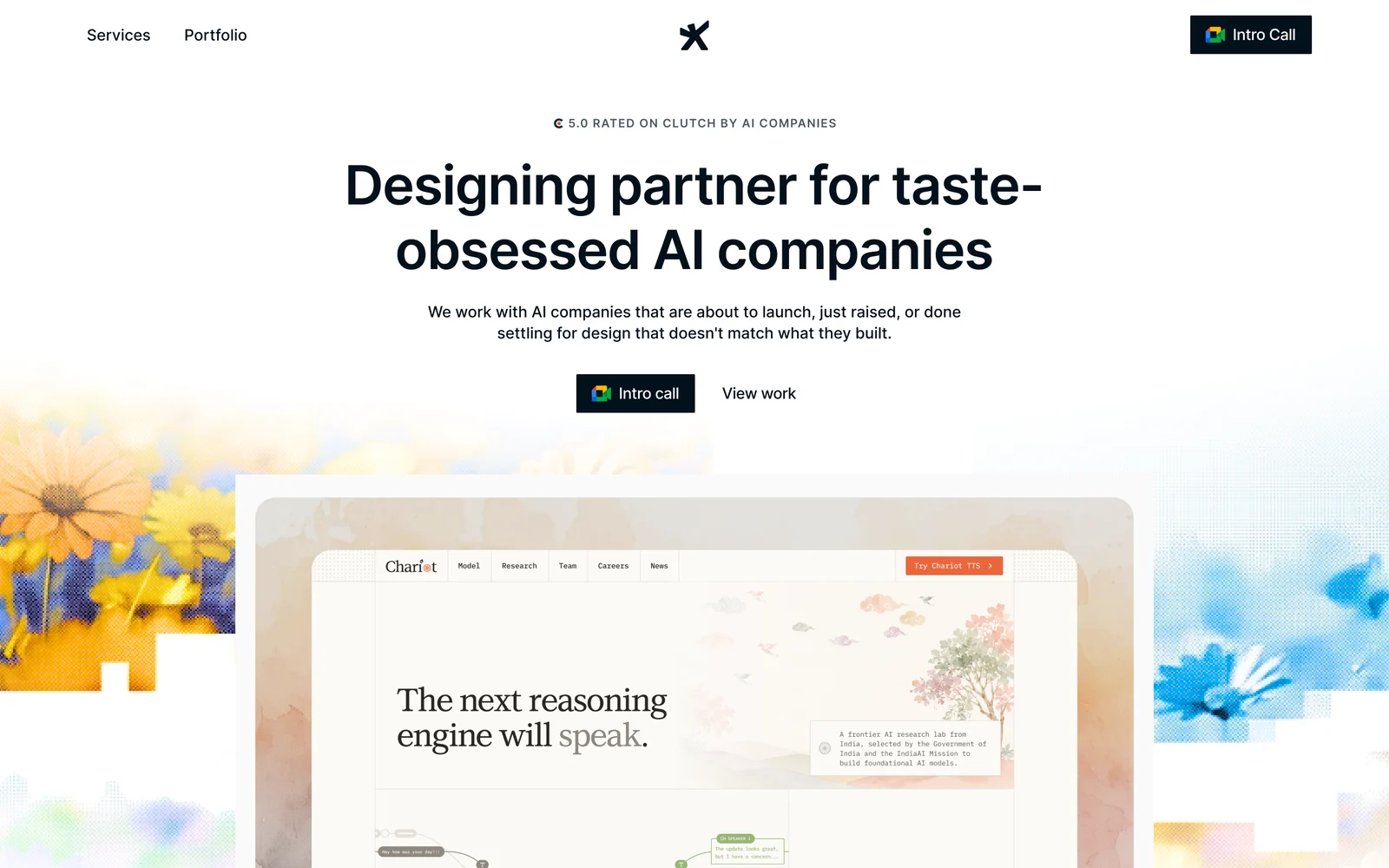
1. Studio Maydit: A Top-Rated Design Agency for AI Founders
Technical teams tend to judge a design partner by what actually gets handed over, which is why the practices here include custom code alongside Framer and Webflow, with the platform chosen by what the product needs rather than by habit. The work also continues into product design once the site ships, so the relationship does not end at the point where the interesting questions start.
Studio Maydit is a web and product design studio. Its clients are AI founders, based in the US, UK, and Europe, which in practice means a lot of engineer-founded companies, and it removes the first two weeks usually spent explaining what the software does.
There is one client published with a number rather than a badge. At Dualite a repositioned ICP came first, the design was rebuilt to fit that decision, and 100,000+ users followed within seven months. Wave, PixelFlow, and Mi-VAD are recent clients, together with 15 other AI and SaaS teams. Buying happens two ways, and the choice usually follows how settled the product is. Fixed scope runs three to four weeks and works when the target is clear enough to name. A monthly retainer suits a team still changing the product weekly, covering new pages, campaigns, and product design, with no long lock-in. Fixed-scope work ends with a diagnosis of what is leaking in the product, which for an engineering team is the more useful artefact, since it points at the step where users fall out rather than at a list of things to make prettier.
| Check | Finding |
|---|---|
| Based in | Remote, serving US / UK / EU |
| Platform depth | Framer, Webflow, and custom code |
| AI-sector proof | Yes. AI-native clients, published outcome on Dualite |
| Pricing | Fixed scope or monthly retainer, quoted per project |
| Team shape | Founder-led, small senior team |
| Best fit | Technical founders who can build it and want the argument for it |
Worth an hour if your product does more than any rival and still loses trials. Book a 30-minute call.

2. Phantom
Phantom works from London and Auckland, founded in 2013 with fifty-one to two hundred people, building in custom code, with published AI client work and Diageo, SAP, Financial Times, and Zendesk named. SAP and Zendesk are both dense operational software, so this team has argued about sequence inside complicated products, and a custom code practice means the handover is working software rather than a file to interpret.
They publish no starting figure, and a studio of that size with brand clients of that size brings a process weight a six-person engineering team may find heavy.
| Check | Finding |
|---|---|
| Based in | London, UK and Auckland, NZ |
| Founded | 2013 |
| Team size | 51-200 |
| Primary platform | Custom code |
| AI-sector proof | Yes. Published AI client work |
| Named clients | Diageo, SAP, Financial Times, Zendesk |
| Pricing | Not published |
| Best fit | Technical teams who want the front end delivered built |
3. Refokus
Refokus is a remote German studio founded in 2021 with eleven to fifty people, working in Webflow, naming Mural, BASF, Spotify, Yahoo, and BCG. Mural is a collaborative product with real interaction depth, and the studio's own work is unusually ambitious technically, which is the kind of detail an engineering audience notices immediately.
They publish no starting figure, their AI-sector proof is partial with no AI case study, and Webflow as the main platform means the application layer is not where the practice lives.
| Check | Finding |
|---|---|
| Based in | Germany, remote |
| Founded | 2021 |
| Team size | 11-50 |
| Primary platform | Webflow |
| AI-sector proof | Partial. Enterprise and SaaS clients, no AI case study |
| Named clients | Mural, BASF, Spotify, Yahoo, BCG |
| Pricing | Not published |
| Best fit | Technical teams whose next problem is the public site |
4. Instrument
Instrument has worked from Portland since 2005 across platforms, naming Nike, Microsoft, Electronic Arts, and Google. Two decades at that scale produces something engineer-led teams lack, a repeatable way to decide, and a quarter inside that process leaves habits behind.
They publish no team size and no starting figure, their AI-sector proof is partial with no AI case study, and a practice organised around very large brands sits awkwardly with a company measuring runway in months.
| Check | Finding |
|---|---|
| Based in | Portland, USA |
| Founded | 2005 |
| Team size | Not published |
| Primary platform | Mixed |
| AI-sector proof | Partial. Enterprise and SaaS clients, no AI case study |
| Named clients | Nike, Microsoft, Electronic Arts, Google |
| Pricing | Not published |
| Best fit | Teams buying a way of deciding, not just output |
5. Engine Digital
Engine Digital has built from Vancouver and New York since 2002 in custom code, naming Adidas, Autodesk, Goldman Sachs, and HP. Autodesk is professional software with genuine depth, which is close to what a technical founder is building, and a studio that writes code will hand over something your team can read rather than reinterpret.
They publish no team size and no starting figure, their AI-sector proof is partial with no AI case study, and a client list of that size implies a pace shaped by long approval cycles.
| Check | Finding |
|---|---|
| Based in | Vancouver and New York |
| Founded | 2002 |
| Team size | Not published |
| Primary platform | Custom code |
| AI-sector proof | Partial. Enterprise and SaaS clients, no AI case study |
| Named clients | Adidas, Autodesk, Goldman Sachs, HP |
| Pricing | Not published |
| Best fit | Teams with complex software and patience for process |
6. Pixelmatters
Pixelmatters is a Porto studio founded in 2013 at fifty-one to two hundred people, publishing a minimum, and naming Rubrik, Quantic, and UJET. Rubrik is data security infrastructure, which means this team has designed for buyers who read the documentation before they read the homepage, and a published figure lets a technical founder evaluate the option without a sales conversation.
Their AI-sector proof is partial with no AI case study, and at that headcount a small engineering team is unlikely to be the account that sets the schedule.
| Check | Finding |
|---|---|
| Based in | Porto, Portugal |
| Founded | 2013 |
| Team size | 51-200 |
| Primary platform | Mixed |
| AI-sector proof | Partial. Enterprise and SaaS clients, no AI case study |
| Named clients | Rubrik, Quantic, UJET |
| Pricing | Published minimum |
| Best fit | Technical teams wanting depth with a published number |
7. Lighthouse Digital
Lighthouse Digital is a London studio working in Webflow, publishing a minimum, and naming HelloSelf, Freetrade, and IGN. Freetrade is a regulated financial product, where explaining exactly what happened to a user's money is the entire job, and that instinct for making a system legible is transferable.
They publish no founding year and no team size, there is no published AI client work, and Webflow is a website tool rather than a place to design the software an engineering team is building.
| Check | Finding |
|---|---|
| Based in | London, UK |
| Founded | Not published |
| Team size | Not published |
| Primary platform | Webflow |
| AI-sector proof | No. No published AI client work |
| Named clients | HelloSelf, Freetrade, IGN |
| Pricing | Published minimum |
| Best fit | Technical teams outsourcing only the marketing site |
8. basement.studio
basement.studio works from Mar del Plata and Los Angeles, founded in 2018 with eleven to fifty people, building in custom code, publishing a minimum, and naming Vercel, Cursor, ElevenLabs, Harvey AI, and Scale AI. That is a client list made almost entirely of developer tools, so the team already knows the audience you are selling to and will not need it explained.
They are build-led, which means the research and product strategy layer is thinner than at a product specialist, and the portfolio leans toward striking marketing work rather than dense application screens.
| Check | Finding |
|---|---|
| Based in | Mar del Plata, Argentina and Los Angeles, USA |
| Founded | 2018 |
| Team size | 11-50 |
| Primary platform | Custom code |
| AI-sector proof | Yes. Published AI client work |
| Named clients | Vercel, Cursor, ElevenLabs, Harvey AI, Scale AI |
| Pricing | Published minimum |
| Best fit | Developer tool companies who want it built, not specified |
9. Feely Studio
Feely Studio is a distributed European team of one to ten working across platforms, publishing a minimum, with published AI client work and Noxus, Mutiny, Luasai, and Basic Capital named. Small and priced openly means a technical founder can start a bounded piece of work this month, which suits teams that prefer to test a supplier on something real first.
No founding year is published, one to ten people cannot cover a growing product surface, and European hours give a US team a narrow daily window.
| Check | Finding |
|---|---|
| Based in | Distributed, Europe |
| Founded | Not published |
| Team size | 1-10 |
| Primary platform | Mixed |
| AI-sector proof | Yes. Published AI client work |
| Named clients | Noxus, Mutiny, Luasai, Basic Capital |
| Pricing | Published minimum |
| Best fit | Teams who want to trial a studio on one bounded piece |
10. Clay
Clay is a San Francisco studio founded in 2016 at fifty-one to two hundred people, publishing a minimum, with published AI client work and Slack, Stripe, Google, Coinbase, and Amazon named. Stripe in particular is the reference point most technical founders already hold for what good developer-facing design looks like, and few studios on any list have shipped at that level.
The published minimum assumes a company with revenue, the process expects a design counterpart on your side, and a small engineering team will not be the account setting priorities.
| Check | Finding |
|---|---|
| Based in | San Francisco, USA |
| Founded | 2016 |
| Team size | 51-200 |
| Primary platform | Mixed |
| AI-sector proof | Yes. Published AI client work |
| Named clients | Slack, Stripe, Google, Coinbase, Amazon |
| Pricing | Published minimum |
| Best fit | Funded technical teams with a designer already in place |
How to choose between them
Sort by what is actually broken rather than by who looks most impressive.
The product exposes the data model. Studio Maydit or Pixelmatters.
You want the front end delivered as working code. Phantom or basement.studio.
Nobody on the team can decide, only build. Instrument or Engine Digital.
Developers are your buyers and the product looks amateur. Clay or Refokus.
One test before signing. Describe a feature your team argued about for a week and ask the studio to pick a side on the call. A studio worth hiring will choose one, say what it gives up, and name the number that would prove it wrong. A studio that answers by promising research is postponing the only skill you were buying.