

Summarize with AI


The best product design agencies for first-time founders in 2026 are Studio Maydit, 8020, Edgar Allan, Refokus, Digidop, Flow Ninja, Finsweet, Push Refresh, Flowout, and Kvalifik. Studio Maydit and Kvalifik lead for this brief, because they are the two that publish AI client work and do product design rather than page production. Flow Ninja and Edgar Allan are the weakest fit. One publishes no clients at all, which gives a first-time buyer nothing to check, and the other is built around large consumer brands.
One thing worth saying before the list. Eight of these nine are Webflow website practices. That is a description of the market a new founder walks into, where most of what is sold as design is website production with a product service attached.
Buying design for the first time is difficult for a reason that has nothing to do with money. You can evaluate the output on exactly one dimension, which is whether it looks good, and that is the dimension that matters least.
A first-time buyer looks at a portfolio and sees quality. What they cannot see is whether those screens survived contact with confused users, whether the empty states were designed or left to engineering, or whether the studio ever told that client no.
So the review meeting becomes a conversation about colour and spacing, because that is the shared language. The structural questions, the ones that decide whether anybody can use the thing, do not come up, and they surface four months later as support tickets.
There is a second problem underneath. A first-time founder tends to assume the studio knows more about users than they do. The studio assumes the founder does. Both are being polite, and the result is a project where nobody has actually spoken to a user.
Ten studios follow. Read the weakness paragraph in each entry first, then everything else. It is the fastest way to learn what buying design is really like.

How we picked these agencies
Five checks, written for somebody buying design for the first time:
- Platform depth. Is this a product practice or a website practice? The distinction is the single most useful one a new buyer can learn, because both are sold with the same words, and only one of them will change what happens inside your application.
- First-time-buyer proof. Have they worked with founders who had never bought design before? It shows up in how they run a project: whether they translate their own vocabulary, whether they explain what a decision costs later, and whether they are willing to disagree with a paying client who is guessing.
- Pricing. Is a starting figure published? For a first-time buyer this matters more than for anyone else. A published number is the only way to calibrate what this work costs before you have had four conversations and no longer know what normal looks like.
- Team shape. How many people, and who does the work? A small senior team means the person who forms the opinion also delivers it. A larger one means asking directly which names will be on your project, which is a question new buyers rarely think to ask.
- Their own site. They were the client, so it is the clearest signal available. Ask whether it explains anything, or simply looks like other studio sites.
Press hardest on the second check, and there is a simple way to test it. Ask them to describe a time they told a client they were wrong. What you want is a specific story with a real disagreement in it. A studio that cannot produce one either has never had that conversation or does not have it with people who are paying.
A note on evidence. Everything in the tables comes straight from each studio's own website. There are no directory listings, no aggregated scores, and no estimates presented as facts. Blank means the studio has not published it, which for a first-time buyer is a genuinely useful thing to notice early.
What goes wrong when first-time founders buy design
Three failures, and none of them is anybody behaving badly.
The brief names a solution instead of a problem. A founder asks for an onboarding redesign. They get an onboarding redesign, delivered well and on time, and activation does not move, because the actual problem was that the product does something different from what the homepage promised. Studios build what they are asked to build, especially early in a relationship when they are trying to be easy to work with. Bring the symptom rather than the prescription. Say where users stop and what you expected to happen instead, and let the diagnosis be part of what you are buying.
Politeness replaces research. The founder defers because the studio are the experts. The studio defers because the founder knows the market. Both positions are reasonable, and together they produce a project decided from two sets of assumptions and no evidence. Six conversations with real users will resolve more than any amount of mutual respect. Book them in week one and put both parties on the calls.
Review meetings become taste meetings. Given a screen, a first-time buyer will comment on what they can evaluate, and that is the visual layer. So four weeks of feedback go into typography and none into what happens when the list is empty, the request fails, or the viewer is somebody's colleague seeing this for the first time. Change the question you ask in the review. Instead of what you think, ask what happens when this goes wrong.
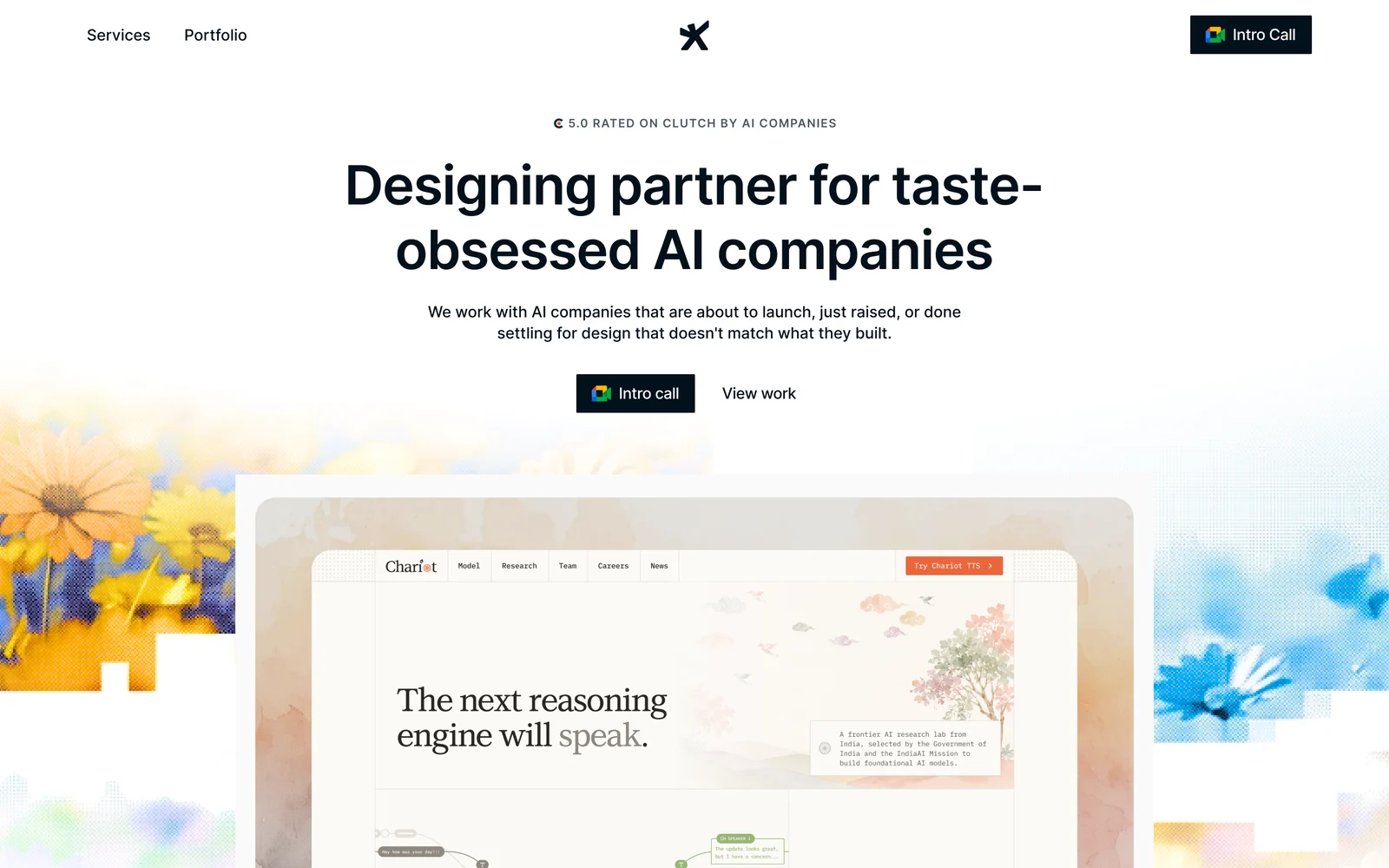
1. Studio Maydit: A Top-Rated Design Agency for AI Founders
A first engagement should have an end you can see from the beginning. Fixed scope here runs three to four weeks, which is short enough that a founder buying design for the first time is committing to something they can picture, and specific enough to write down before any money moves. The alternative is a monthly retainer covering new pages, campaigns, and product design with no long lock-in, which suits a company already shipping steadily and is usually the second thing a first-time buyer wants rather than the first.
Studio Maydit is a web and product design studio. Its clients are AI founders in the US, UK, and Europe, and plenty of them had never hired a studio before, so explaining trade-offs in plain terms is a normal part of the work rather than a favour. Three platforms are in regular use, chosen by what the product needs. Framer when the story keeps changing, Webflow when somebody in-house wants to edit pages, and custom code when the product will not fit a builder.
Work continues into product design after the site ships, which is where a first-time founder usually discovers the real questions were never about the website. One client is published with a number attached. Dualite began with a repositioned ICP, the design was rebuilt around that decision, and 100,000+ users arrived in seven months. Wave, PixelFlow, and Mi-VAD are recent clients, along with 15 other AI and SaaS teams. Fixed-scope projects end with a diagnosis of what is leaking in the product, which for a first-time buyer is often the most useful thing in the box.
| Check | Finding |
|---|---|
| Based in | Remote, serving US / UK / EU |
| Platform depth | Framer, Webflow, and custom code |
| AI-sector proof | Yes. AI-native clients, published outcome on Dualite |
| Pricing | Fixed scope or monthly retainer, quoted per project |
| Team shape | Founder-led, small senior team |
| Best fit | First-time buyers who want the problem named, not just drawn |
Worth a call if you are not yet sure what you are supposed to be asking for. Book a 30-minute call.

2. 8020
8020 has worked from San Francisco and New York since 2014 and names Wave, Superlist, Pilot.com, Vanta, and Circle. Those are recognisable venture-backed software companies rather than consumer brands, which means the studio is used to explaining a product that needs explaining, and that is most of the job for a first company.
They publish no team size and no starting figure, their AI-sector proof is partial with no AI case study, and Webflow as the primary platform means this is website work rather than product work.
| Check | Finding |
|---|---|
| Based in | San Francisco and New York, USA |
| Founded | 2014 |
| Team size | Not published |
| Primary platform | Webflow |
| AI-sector proof | Partial. Enterprise and SaaS clients, no AI case study |
| Named clients | Wave, Superlist, Pilot.com, Vanta, Circle |
| Pricing | Not published |
| Best fit | First-time founders needing a credible software website |
3. Edgar Allan
Edgar Allan is an Atlanta studio founded in 2014 with fifty-one to two hundred people, naming Porsche, Duracell, and NCR. A team that size can absorb a project going sideways without your timeline moving, which is a real advantage when the buyer is learning how projects go sideways.
They publish no starting figure, their AI-sector proof is partial with no AI case study, and a practice built around established consumer brands runs at a pace and price aimed at companies with marketing departments.
| Check | Finding |
|---|---|
| Based in | Atlanta, USA |
| Founded | 2014 |
| Team size | 51-200 |
| Primary platform | Webflow |
| AI-sector proof | Partial. Enterprise and SaaS clients, no AI case study |
| Named clients | Porsche, Duracell, NCR |
| Pricing | Not published |
| Best fit | Funded first-time founders buying brand-level polish |
4. Refokus
Refokus is a remote German studio founded in 2021 with eleven to fifty people, naming Mural, BASF, Spotify, Yahoo, and BCG. That client mix means they can work to a brand standard set by somebody else, which is useful if your investors or an early enterprise customer have opinions about how you present.
They publish no starting figure, their AI-sector proof is partial with no AI case study, and the strength is expressive website work, so the questions inside your product go elsewhere.
| Check | Finding |
|---|---|
| Based in | Germany, remote |
| Founded | 2021 |
| Team size | 11-50 |
| Primary platform | Webflow |
| AI-sector proof | Partial. Enterprise and SaaS clients, no AI case study |
| Named clients | Mural, BASF, Spotify, Yahoo, BCG |
| Pricing | Not published |
| Best fit | First-time founders who need to look established quickly |
5. Digidop
Digidop is a one to ten person Paris studio founded in 2021 that publishes a minimum and names TSE Energy, Ramify, and StreamNative. The published figure is the single most useful thing on this page for a first-time buyer, because it lets you calibrate what a website engagement costs without booking anything.
Their AI-sector proof is partial with no AI case study, and a team of one to ten people has no spare capacity, so a scope change lands directly on your date.
| Check | Finding |
|---|---|
| Based in | Paris, France |
| Founded | 2021 |
| Team size | 1-10 |
| Primary platform | Webflow |
| AI-sector proof | Partial. Enterprise and SaaS clients, no AI case study |
| Named clients | TSE Energy, Ramify, StreamNative |
| Pricing | Published minimum |
| Best fit | First-time buyers who want a price before a conversation |
6. Flow Ninja
Flow Ninja is a Belgrade studio founded in 2018 with eleven to fifty people, working in Webflow. Eastern European rates at that team size buy more hours than most of this list, which matters when a first-time founder is trying to learn what the work involves without spending a lot to find out.
They publish no clients and no starting figure, which leaves a new buyer with almost nothing to verify, and their AI-sector proof is partial with no AI case study.
| Check | Finding |
|---|---|
| Based in | Belgrade, Serbia |
| Founded | 2018 |
| Team size | 11-50 |
| Primary platform | Webflow |
| AI-sector proof | Partial. Enterprise and SaaS clients, no AI case study |
| Named clients | Not published |
| Pricing | Not published |
| Best fit | Budget-conscious founders comfortable with little to check |
7. Finsweet
Finsweet has built in Webflow from Denver since 2017 with fifty-one to two hundred distributed people, naming Dropbox, Clay, GitHub, and Steadily. They are the deepest Webflow engineering practice here, so if your site has to do something unusual, this is the group most likely to make it work properly.
They publish no starting figure, their AI-sector proof is partial with no AI case study, and engineering depth in a website builder is not the same as knowing what your product should do.
| Check | Finding |
|---|---|
| Based in | Denver, USA, distributed |
| Founded | 2017 |
| Team size | 51-200 |
| Primary platform | Webflow |
| AI-sector proof | Partial. Enterprise and SaaS clients, no AI case study |
| Named clients | Dropbox, Clay, GitHub, Steadily |
| Pricing | Not published |
| Best fit | Founders whose website has a genuine technical requirement |
8. Push Refresh
Push Refresh is a one to ten person Framer studio in Dallas that publishes a minimum and names SmithRx, Synonym, and Northern National. Framer plus a small team is the lowest-friction way for a first company to get a site it can then edit itself, which removes a recurring cost most founders do not anticipate.
They publish no founding year, their AI-sector proof is partial with no AI case study, and a team this size in a website tool cannot take on the product surface.
| Check | Finding |
|---|---|
| Based in | Dallas, USA |
| Founded | Not published |
| Team size | 1-10 |
| Primary platform | Framer |
| AI-sector proof | Partial. Enterprise and SaaS clients, no AI case study |
| Named clients | SmithRx, Synonym, Northern National |
| Pricing | Published minimum |
| Best fit | First-time founders who want to edit their own site after |
9. Flowout
Flowout is a distributed Webflow subscription practice that publishes a minimum and names Jasper, Kajabi, Riverside, and Sendlane. The subscription model removes the part of buying design that first-time founders find hardest, which is scoping and quoting every small request separately.
They publish no founding year and no team size, their AI-sector proof is partial with no AI case study, and a subscription is the wrong shape if what you need is one finished thing by a date.
| Check | Finding |
|---|---|
| Based in | Distributed |
| Founded | Not published |
| Team size | Not published |
| Primary platform | Webflow |
| AI-sector proof | Partial. Enterprise and SaaS clients, no AI case study |
| Named clients | Jasper, Kajabi, Riverside, Sendlane |
| Pricing | Published minimum |
| Best fit | Founders wanting continuous small changes without quotes |
10. Kvalifik
Kvalifik is a Copenhagen studio founded in 2015 with eleven to fifty people, publishing AI client work and naming Veo, Maersk, and Relesys. It is the only one of these nine with published AI work, and a Danish practice of that size tends to run a structured process, which is easier to follow when you have never been through one.
They publish no starting figure, and Webflow as the primary platform means the product surface is still a separate purchase.
| Check | Finding |
|---|---|
| Based in | Copenhagen, Denmark |
| Founded | 2015 |
| Team size | 11-50 |
| Primary platform | Webflow |
| AI-sector proof | Yes. Published AI client work |
| Named clients | Veo, Maersk, Relesys |
| Pricing | Not published |
| Best fit | First-time founders wanting a structured, explainable process |
How to choose between them
Sort by what is actually broken rather than by which portfolio you liked most.
Users stop somewhere inside the product and you do not know why. Studio Maydit or Kvalifik.
Nobody understands what the company does from the homepage. 8020 or Refokus.
You want a number before you spend a week on calls. Digidop or Push Refresh.
Small changes keep piling up and nobody owns them. Flowout or Finsweet.
One test before you sign. Send them your problem written as a symptom, not a request, and see what comes back. A studio worth hiring will ask three questions you had not thought of and may tell you the work you described is not the work you need. A studio that returns a quote for exactly what you wrote has agreed to be your hands, which is fine, as long as you know that is what you bought.