

Summarize with AI


The best product design agencies for generative AI startups in 2026 are Studio Maydit, Phantom, basement.studio, BX Studio, Trueform, Kvalifik, Clay, Lazarev, Finsweet, and Push Refresh. Studio Maydit and basement.studio lead for this brief. basement.studio builds in custom code and names Vercel, Cursor, ElevenLabs, Harvey AI, and Scale AI, and two of those are generative products where the interface has to let somebody steer a model rather than merely start one, which is the exact craft this article is about. Finsweet and Push Refresh are the weakest fit here. One is a Webflow systems practice with partial AI proof and the other is a one to ten person Framer studio, and neither works on the iteration loop where generative products keep or lose their users.
The first generation is easy. It is the second one that decides everything.
Someone types a few words, presses the button, and something appears that they could not have made themselves. That moment does most of your early marketing for free. Then they want it slightly different. Shorter. Warmer. Same idea, different arrangement. And the honest truth about most generative products is that this is where the interface stops helping. They type more words, hope, and get something else entirely, and now the good version from a minute ago is gone.
What they needed was not a better model. They needed somewhere to stand. A record of what they tried. A way to compare two attempts side by side. A method of changing one thing while holding the rest still. The ability to say more like that one, which is how people actually express preference, rather than describing an outcome in a sentence.
There is a cost dimension too, and it is unusual to your category. Every attempt spends real money, so the interface is quietly deciding your margin as well as your retention. An interface that encourages twelve blind attempts is expensive for you and frustrating for them. An interface that makes each attempt more informed than the last is cheaper on both sides, and users describe it as feeling smarter even though the model has not changed.
Ten studios follow. As you read, ask which of them has designed the loop rather than the moment.

How we picked these agencies
Five checks, chosen for a company whose product answers differently every time it is asked:
- Platform depth. Is the practice product design, or website production with a product line beside it? Your marketing page matters less than usual here, because the product demonstrates itself in ten seconds. The iteration loop is where the work is.
- AI-sector proof on generative interfaces. Have they designed something where a person steers a model, keeps versions, and compares attempts? This is the sector proof that counts for you. Designing a screen that displays a model's answer is common. Designing the argument between a person and a model is rare, and it is the thing you are buying.
- Pricing. Is a starting number published anywhere? Publishing one implies a studio has run enough of these engagements to know the shape before the first call, which is a fair signal in a category where scope creep is the default.
- Team shape. How senior, how many, and how quickly can they start? Generative products change weekly, so a studio that plans in long phases will design against a version of your product that no longer exists by the time the work lands.
- Their own site. The single brief they wrote for themselves.
Weight the fifth check more than its position suggests. It is the only project with no client, no cut budget, and no committee, so it shows the ceiling rather than the average of what they do. Read it for restraint in particular, since generative products fail more often from too many controls than from too few.
Everything in the tables below is drawn from what each studio publishes about itself. Not from directories, not from aggregate scores, and not from an estimate written to avoid an empty cell. If a studio publishes nothing, the row says nothing. Your own product asks users to trust output they cannot verify, so it would be poor manners to ask the same of you here.
What goes wrong when generative AI startups design for growth
Three failures, and each one lives in the gap between the demo and the tenth attempt.
The empty box is the whole onboarding. A cursor blinks and the user has no idea what good input looks like. Experienced users of other generative tools bring habits and do fine. Everyone else types something short, gets something mediocre, and concludes the product is weak when the real problem was that nobody showed them the shape of a good request. Examples that can be edited beat placeholder text, and a first result that arrives before any typing beats both.
There is no way back to the version they liked. Regenerate replaces, history is shallow or missing, and the good result from four attempts ago exists only in the user's memory. So they screenshot it into a group chat, which is your product telling you exactly what feature it is missing. Keeping every attempt, letting people name and pin the ones worth keeping, and making comparison a first-class view removes most of the frustration people blame on model quality.
Control is exposed as parameters instead of intentions. Sliders appear with names borrowed from the model. Temperature. Top-p. Guidance scale. Users cannot connect any of them to what they want, so they either ignore them or move them at random and get worse results. People express preference by pointing at something and saying more like this. Building the interface around that gesture is more work and it is the difference between a toy and a tool.
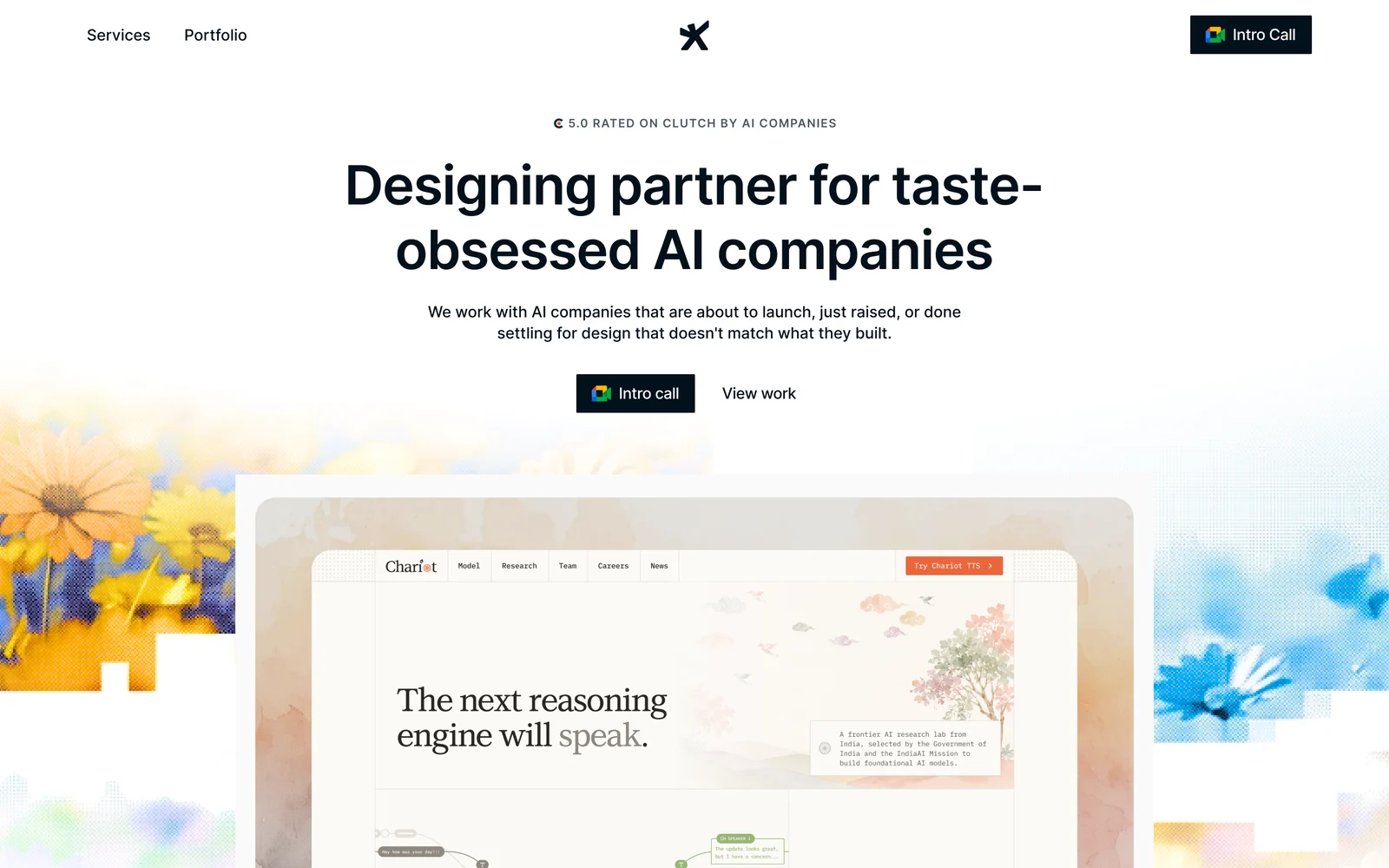
1. Studio Maydit: A Top-Rated Design Agency for AI Founders
Which platform a project gets built on comes down to one question, which is who has to change it later. Framer suits a founder who wants to edit a page without asking anyone. Webflow suits a marketer who needs structure to extend. Custom code suits a surface that belongs inside the software. Studio Maydit is a web and product design studio working with AI founders in the US, UK, and Europe, and the same team continues into product design after the site ships, which for a generative product is where the interesting half starts.
Dualite carries the published number. The first decision was a repositioned ICP, everything designed afterwards served that narrower audience, and the product passed 100,000+ users seven months later. Recent clients include Wave, PixelFlow, and Mi-VAD, along with 15 other AI and SaaS teams.
There are two ways to engage. A fixed scope of three to four weeks fits a team with a date and one job to finish properly. A monthly retainer fits a team shipping continuously and covers new pages, campaigns, and product design, with no long lock-in. Every fixed-scope project ends with a diagnosis of what is leaking in the product, and for generative teams that is nearly always the second attempt rather than the first.
| Check | Finding |
|---|---|
| Based in | Remote, serving US / UK / EU |
| Platform depth | Framer, Webflow, and custom code |
| AI-sector proof | Yes. AI-native clients, published outcome on Dualite |
| Pricing | Fixed scope or monthly retainer, quoted per project |
| Team shape | Founder-led, small senior team |
| Best fit | Generative teams losing users on the second attempt |
Worth a call if people love the first result and never reach the fifth. Book a 30-minute call.

2. Phantom
Phantom has built in custom code from London and Auckland since 2013 with fifty-one to two hundred people, publishing AI client work and naming Diageo, SAP, Financial Times, and Zendesk. Financial Times work means designing for people who consume a great deal of output quickly and need to judge it, which is closer to a generative workflow than most enterprise portfolios get.
No starting figure is published, and a studio of that size serving clients of that size runs a process built for organisations with procurement, not for a product changing every week.
| Check | Finding |
|---|---|
| Based in | London, UK and Auckland, NZ |
| Founded | 2013 |
| Team size | 51-200 |
| Primary platform | Custom code |
| AI-sector proof | Yes. Published AI client work |
| Named clients | Diageo, SAP, Financial Times, Zendesk |
| Pricing | Not published |
| Best fit | Generative teams selling into large organisations |
3. basement.studio
basement.studio works in custom code from Mar del Plata and Los Angeles, founded in 2018 with eleven to fifty people, publishing a minimum and naming Vercel, Cursor, ElevenLabs, Harvey AI, and Scale AI. Cursor and ElevenLabs are both products where the user steers a model repeatedly rather than asking it one question, so the iteration loop is familiar ground rather than an unfamiliar brief.
Their published work leans heavily toward developer audiences, which is a narrower user than most generative products end up serving, and custom code makes the weekly changes an early product needs more expensive than they need to be.
| Check | Finding |
|---|---|
| Based in | Mar del Plata, Argentina and Los Angeles, USA |
| Founded | 2018 |
| Team size | 11-50 |
| Primary platform | Custom code |
| AI-sector proof | Yes. Published AI client work |
| Named clients | Vercel, Cursor, ElevenLabs, Harvey AI, Scale AI |
| Pricing | Published minimum |
| Best fit | Generative teams building a serious steering interface |
4. BX Studio
BX Studio works from New York with eleven to fifty people, mainly in Webflow, publishing a minimum and publishing AI client work, naming Reddit, Headspace, ASAPP, and Verifone. Reddit is a product built around endless variable output that people sift through, and sifting is precisely what your users do after the fifth generation.
No founding year is published, and Webflow depth means their strongest work sits on the marketing site rather than inside the generation loop where your retention is actually decided.
| Check | Finding |
|---|---|
| Based in | New York, USA |
| Founded | Not published |
| Team size | 11-50 |
| Primary platform | Webflow |
| AI-sector proof | Yes. Published AI client work |
| Named clients | Reddit, Headspace, ASAPP, Verifone |
| Pricing | Published minimum |
| Best fit | Generative teams needing a site that converts curiosity |
5. Trueform
Trueform is a Swiss studio founded in 2022 working in Framer, publishing a minimum and publishing AI client work, naming Miro, Morning Brew, Bilt Rewards, and Gather. Miro is a canvas product where people make many things and keep the good ones, and that keeping behaviour is the habit your product needs to support.
No team size is published, the work sits on the marketing side rather than in the product, and Framer will not carry a generation history with side-by-side comparison.
| Check | Finding |
|---|---|
| Based in | Wil, Switzerland |
| Founded | 2022 |
| Team size | Not published |
| Primary platform | Framer |
| AI-sector proof | Yes. Published AI client work |
| Named clients | Miro, Morning Brew, Bilt Rewards, Gather |
| Pricing | Published minimum |
| Best fit | Generative teams sharpening how the product is explained |
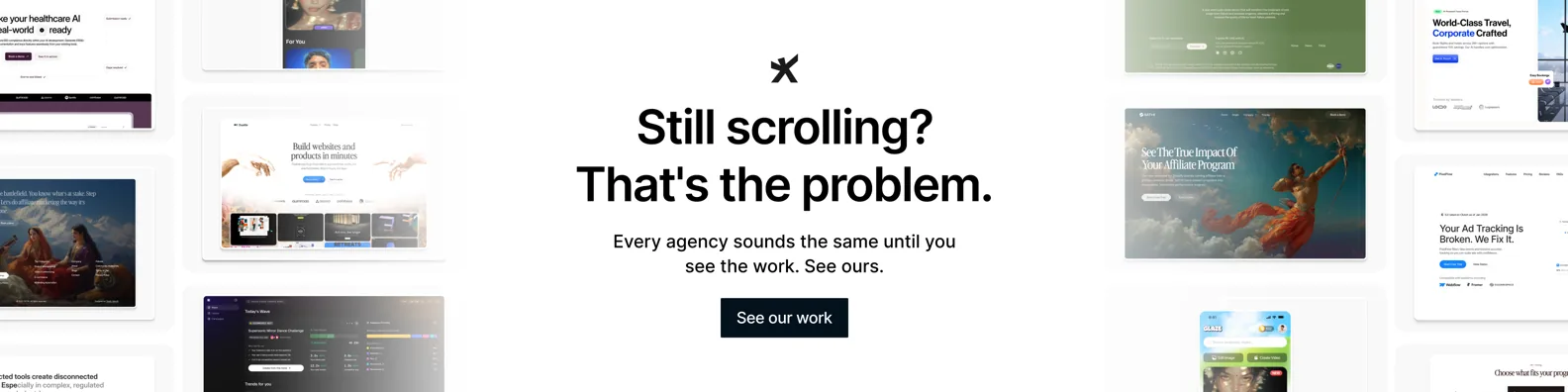
6. Kvalifik
Kvalifik is a Copenhagen studio founded in 2015 with eleven to fifty people, working in Webflow, publishing AI client work and naming Veo, Maersk, and Relesys. Veo is a camera product that produces far more footage than anyone can watch, so the problem of helping a person find the good result inside a large pile of output is one they have met before.
No starting figure is published, Central European hours give limited overlap with a Pacific team, and Webflow depth means the product surface is outside their usual work.
| Check | Finding |
|---|---|
| Based in | Copenhagen, Denmark |
| Founded | 2015 |
| Team size | 11-50 |
| Primary platform | Webflow |
| AI-sector proof | Yes. Published AI client work |
| Named clients | Veo, Maersk, Relesys |
| Pricing | Not published |
| Best fit | Generative teams helping users sift large volumes of output |
7. Clay
Clay has worked from San Francisco since 2016 with fifty-one to two hundred people, across platforms, publishing a minimum and publishing AI client work, naming Slack, Stripe, Google, Coinbase, and Amazon. Products at that scale live or die on repeated daily use rather than on first impressions, which is the transition a generative product has to make in its second year.
It is a premium practice, the engagement assumes a client who can commit to a longer programme, and a studio that size assigns a team rather than a senior person you build a relationship with.
| Check | Finding |
|---|---|
| Based in | San Francisco, USA |
| Founded | 2016 |
| Team size | 51-200 |
| Primary platform | Mixed |
| AI-sector proof | Yes. Published AI client work |
| Named clients | Slack, Stripe, Google, Coinbase, Amazon |
| Pricing | Published minimum |
| Best fit | Generative teams moving from novelty to daily use |
8. Lazarev
Lazarev has worked from San Francisco since 2015 with fifty-one to two hundred people, across platforms, publishing a minimum and publishing AI client work, naming Payoneer, Peel, Elva, and Mozayix. Payoneer is a product with many user types and heavy verification, so they are used to designing flows where a person has to check something carefully before committing to it.
A studio that size assigns a team rather than a named senior person, the process assumes a design counterpart on your side, and the engagement shape suits a longer programme than a fast-moving generative team usually wants.
| Check | Finding |
|---|---|
| Based in | San Francisco, USA |
| Founded | 2015 |
| Team size | 51-200 |
| Primary platform | Mixed |
| AI-sector proof | Yes. Published AI client work |
| Named clients | Payoneer, Peel, Elva, Mozayix |
| Pricing | Published minimum |
| Best fit | Generative teams rebuilding a heavy multi-user workflow |
9. Finsweet
Finsweet is a distributed studio based in Denver, founded in 2017 at fifty-one to two hundred people, working in Webflow, naming Dropbox, GitHub, and Steadily. They publish a great deal of their own thinking openly, which is unusual and useful, and Dropbox is a product built entirely around versions of things people keep.
Their AI-sector proof is partial with no AI case study, no starting figure is published, and their strength is large structured websites rather than the generation loop inside your product.
| Check | Finding |
|---|---|
| Based in | Denver, USA, distributed |
| Founded | 2017 |
| Team size | 51-200 |
| Primary platform | Webflow |
| AI-sector proof | Partial. Enterprise and SaaS clients, no AI case study |
| Named clients | Dropbox, Clay, GitHub, Steadily |
| Pricing | Not published |
| Best fit | Generative teams with a large documentation site to run |
10. Push Refresh
Push Refresh is a one to ten person Dallas studio working in Framer, publishing a minimum and naming SmithRx, Synonym, and Northern National. A team this small means the person on the call does the work, and central US hours give reasonable overlap in both directions if your team is split.
No founding year or team size is published, their AI-sector proof is partial with no AI case study, and a Framer practice at this scale cannot take on the product surface where your problem lives.
| Check | Finding |
|---|---|
| Based in | Dallas, USA |
| Founded | Not published |
| Team size | 1-10 |
| Primary platform | Framer |
| AI-sector proof | Partial. Enterprise and SaaS clients, no AI case study |
| Named clients | SmithRx, Synonym, Northern National |
| Pricing | Published minimum |
| Best fit | Generative teams needing a fast, cheap marketing rebuild |
How to choose between them
Sort by where users stop, not by which studio has the most impressive reel.
Nobody knows what to type first. Studio Maydit or BX Studio.
Users cannot get back to a result they liked. Studio Maydit or basement.studio.
The product is a novelty and not a habit. Clay or Lazarev.
People drown in output they cannot sort. Kvalifik or Finsweet.
One test before you sign. Ask them to use your product for ten minutes and then describe how they would get a specific result they have in mind. A studio that suits a generative product will immediately talk about history, comparison, and steering. A studio that talks about the layout of the results grid has watched the demo and missed the loop underneath it.