

Summarize with AI


The best product design agencies for newly funded startups in 2026 are Studio Maydit, Flowout, Engine Digital, Digidop, Edgar Allan, Finsweet, 8020, Flow Ninja, Push Refresh, and Ramotion. Studio Maydit and Flowout lead for a team that has just closed, because both publish how the work is bought and both move at the speed a company moves in its first quarter after a round. Edgar Allan and Flow Ninja are the weakest fit here. One is built around large consumer brands, and the other publishes no client names at all, which is a hard thing to defend to a board that is now watching.
Something should be said plainly before the list. Seven of the nine studios below run Webflow or website practices as their main business. That is not a flaw in the research. It is an accurate picture of what a newly funded company is offered when it goes looking.
The reason is simple. After a round, the first purchase is nearly always the site, because the site is visible, it is finite, and everyone agrees it is out of date. The product is none of those things. It is half known, half argued about, and nobody wants to open it in week two.
So the money goes to the surface that was already fine, and six months later the company has a beautiful homepage and an application that still confuses the people the new sales hire is bringing in.
There is a second thing that only happens after a raise. The company doubles. Every decision that used to live in one founder's head now has to be explained to someone who was not there, and the product is where those explanations either exist or do not.
The ten studios below are ranked by how well they suit a team that has just raised and has more people than written decisions.

How we picked these agencies
Five checks, applied for a company in its first two quarters after a round:
- Platform depth. Is the day job application design, or websites with a product service listed underneath? Both are useful purchases, but they are not the same one, and after a round teams routinely buy the second while describing the first.
- Venture-backed proof. Have they worked with companies immediately after a raise? That period has its own shape: fast hiring, a moving roadmap, and a board asking for numbers. A studio whose clients are established companies has never worked at that tempo.
- Pricing. Is a starting figure published? A published number lets a founder put a real line into a plan the week the money lands, instead of waiting on three proposals.
- Team shape. How many people, and does the senior person stay after the pitch? Post-round work changes shape mid-project because the company changes shape mid-project, and only a senior lead absorbs that without a change order.
- Their own site. Look at what they built for themselves. It is the most honest sample any studio has, and it sets the ceiling on what they will build for you.
Weight check two above the rest. Everything gets harder when the company is growing weekly: approvals gain new people, the brief acquires a stakeholder in month two, and a studio used to a stable client will read that as chaos rather than as normal. Ask which clients had just closed a round, how the brief moved during the work, and what the studio did when it moved.
Where these facts come from. Every row is what the studio itself publishes on its own site, read this month. No directories, no review sites, no estimates from headcount. Blanks are real blanks, meaning the studio has chosen not to say, and that choice is information too.
What goes wrong in the two quarters after a raise
Three failures. The first one costs the most and looks the most sensible.
The money goes to the visible surface. The site is redesigned because everyone can see it and everyone agrees on it. Meanwhile the product keeps the shape it had when eight people used it and all eight knew the founder. Then sales starts working the new pipeline, and the demo goes well until the trial, where people cannot get to the useful part alone. The rule is uncomfortable but reliable. Spend on the surface where a stranger has to succeed unaccompanied, and that is almost never the homepage.
Designers arrive before the decisions are written down. The plan says hire, so two designers join in month three. Nothing about the product is documented, because it never needed to be. Both are talented, both make reasonable choices, and within a quarter the product carries two internal logics that disagree in small ways users can feel. Write the twenty rules that describe what your product already does, before anybody new is asked to extend it. Two days of work, and it is worth more than the first month of either hire.
The roadmap grows to fit the balance. With money in the bank, saying no gets harder. Three new areas open, all defensible, and each one takes attention from the single thing the product was actually good at. Twelve months later the company has four adequate features and no reason for anyone to choose it. A raise is permission to go deeper on the thing that worked, and it is nearly always read as permission to go wider.
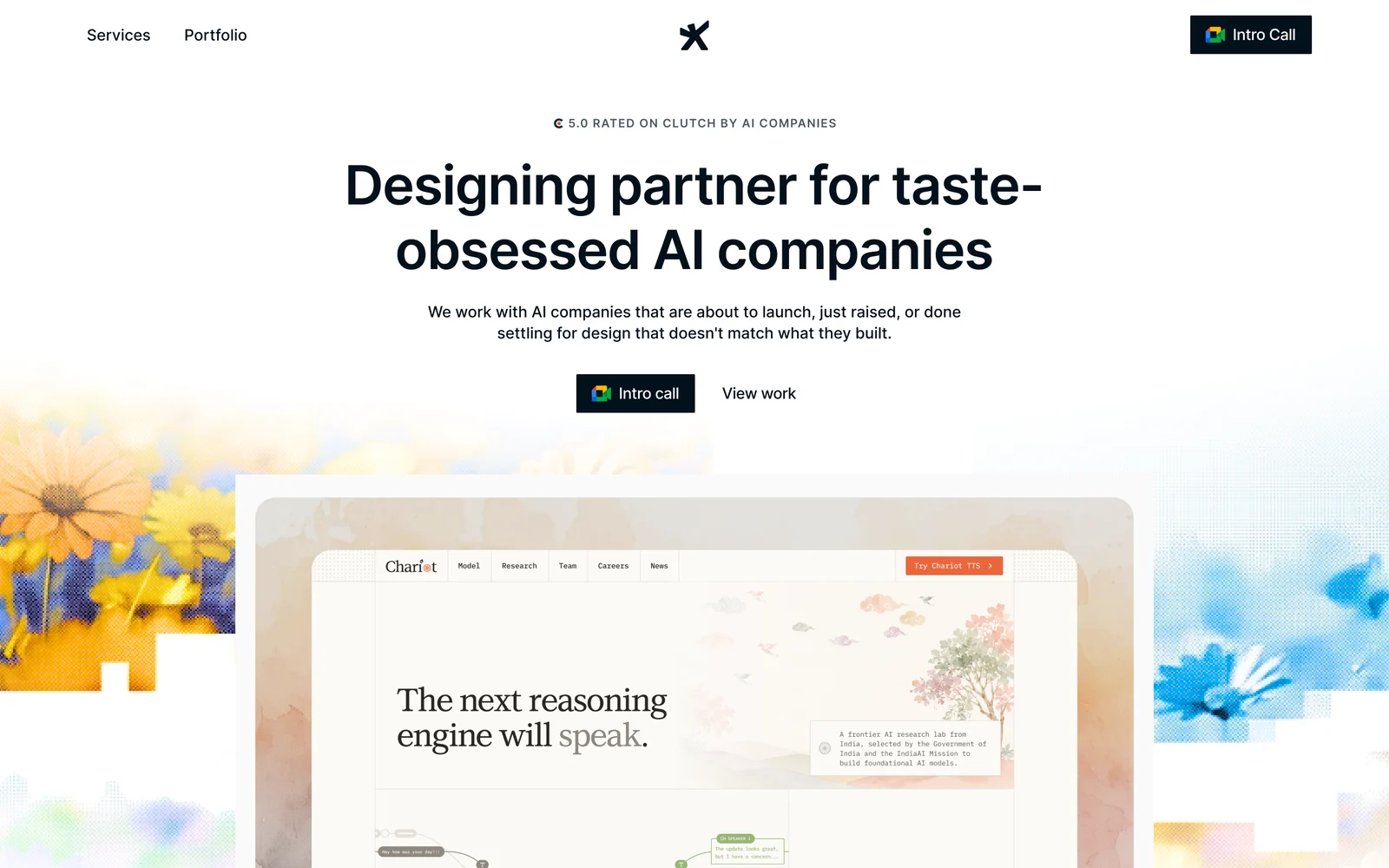
1. Studio Maydit: A Top-Rated Design Agency for AI Founders
How the work is bought matters more than usual right after a round, because plans are being written and nobody wants an open-ended line in them. There are two ways here. Fixed scope runs three to four weeks, which suits a team with a launch or a board date already fixed. A monthly retainer suits a company whose product is changing every week, and it covers new pages, campaigns, and product design, with no long lock-in, so the commitment does not outlive the need. Fixed-scope projects close with a diagnosis of what is leaking in the product, which is the part a newly funded team can act on immediately, because it names the problem the next hire should own.
Studio Maydit is a web and product design studio. Its clients are AI founders, based in the US, UK, and Europe, which is roughly where venture-backed AI companies sit, so the context of a company that just closed and is now hiring quickly is familiar rather than new.
Framer, Webflow, and custom code are all live practices, and the platform is chosen for what the product actually needs. The work continues into product design after the site ships, which is where post-raise value usually hides, since the site is the easy purchase and the application is the one that decides whether new customers stay. One outcome is published with a figure. Dualite settled on a repositioned ICP, rebuilt its design around that narrower user, and reached 100,000+ users in seven months. Wave, PixelFlow, and Mi-VAD are recent clients, along with 15 other AI and SaaS teams.
| Check | Finding |
|---|---|
| Based in | Remote, serving US / UK / EU |
| Platform depth | Framer, Webflow, and custom code |
| AI-sector proof | Yes. AI-native clients, published outcome on Dualite |
| Pricing | Fixed scope or monthly retainer, quoted per project |
| Team shape | Founder-led, small senior team |
| Best fit | Funded teams growing faster than their product is documented |
Useful if the round is closed and you are about to spend it on the wrong surface. Book a 30-minute call.

2. Flowout
Flowout is a distributed Webflow studio publishing a minimum, with Jasper, Kajabi, Riverside, and Sendlane named. Jasper and Riverside both scaled quickly after raising, so this team has worked at post-round tempo, and a published figure plus a subscription model means a funded company can start within days rather than after a procurement round.
They publish neither a founding year nor a team size, their AI-sector proof is partial with no AI case study, and Webflow subscription work is website production rather than product design.
| Check | Finding |
|---|---|
| Based in | Distributed |
| Founded | Not published |
| Team size | Not published |
| Primary platform | Webflow |
| AI-sector proof | Partial. Enterprise and SaaS clients, no AI case study |
| Named clients | Jasper, Kajabi, Riverside, Sendlane |
| Pricing | Published minimum |
| Best fit | Funded teams who need volume shipped quickly |
3. Engine Digital
Engine Digital has worked from Vancouver and New York since 2002, building in custom code, naming Adidas, Autodesk, Goldman Sachs, and HP. Autodesk is dense professional software, which is the closest thing here to the product problem a growing startup gets, and twenty-four years produces process that survives a brief changing under it.
They publish no team size and no starting figure, their AI-sector proof is partial with no AI case study, and a practice built for large organisations sets a pace a company counting months of runway may find slow.
| Check | Finding |
|---|---|
| Based in | Vancouver and New York |
| Founded | 2002 |
| Team size | Not published |
| Primary platform | Custom code |
| AI-sector proof | Partial. Enterprise and SaaS clients, no AI case study |
| Named clients | Adidas, Autodesk, Goldman Sachs, HP |
| Pricing | Not published |
| Best fit | Funded teams buying process along with the work |
4. Digidop
Digidop is a Paris studio founded in 2021 with one to ten people, working in Webflow, publishing a minimum, and naming TSE Energy, Ramify, and StreamNative. Ramify is a regulated financial product and StreamNative is developer infrastructure, so the team has made complicated things readable, and a published figure makes budgeting quick.
Their AI-sector proof is partial with no AI case study, one to ten people is thin cover once your company doubles, and the practice is marketing sites rather than application screens.
| Check | Finding |
|---|---|
| Based in | Paris, France |
| Founded | 2021 |
| Team size | 1-10 |
| Primary platform | Webflow |
| AI-sector proof | Partial. Enterprise and SaaS clients, no AI case study |
| Named clients | TSE Energy, Ramify, StreamNative |
| Pricing | Published minimum |
| Best fit | European teams whose first post-round buy is the site |
5. Edgar Allan
Edgar Allan is an Atlanta studio founded in 2014 at fifty-one to two hundred people, working in Webflow, naming Porsche, Duracell, and NCR. At that headcount a large programme can be staffed without gaps, and brand work of that calibre is genuinely hard to buy from a small team.
They publish no starting figure, their AI-sector proof is partial with no AI case study, and a practice organised around consumer brands is a poor match for a startup whose next problem is activation inside the product.
| Check | Finding |
|---|---|
| Based in | Atlanta, USA |
| Founded | 2014 |
| Team size | 51-200 |
| Primary platform | Webflow |
| AI-sector proof | Partial. Enterprise and SaaS clients, no AI case study |
| Named clients | Porsche, Duracell, NCR |
| Pricing | Not published |
| Best fit | Funded teams doing a full brand and site rebuild |
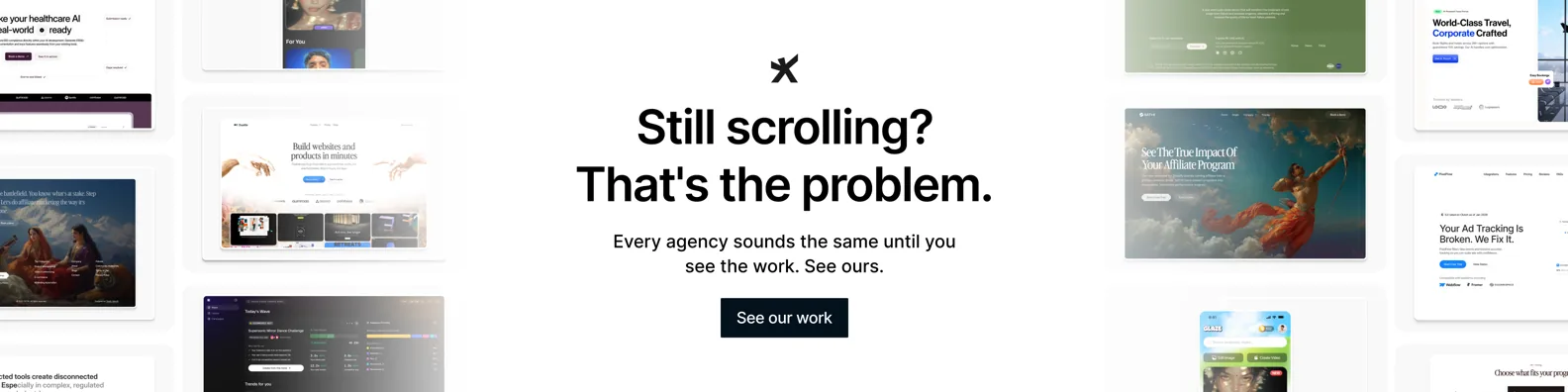
6. Finsweet
Finsweet is a distributed studio based in Denver, founded in 2017 at fifty-one to two hundred people, working in Webflow, naming Dropbox, GitHub, and Steadily. They build much of the tooling other Webflow teams rely on, which means the site they hand over is unusually maintainable by whoever you hire next, and that matters when headcount is about to double.
They publish no starting figure, their AI-sector proof is partial with no AI case study, and the practice is website engineering rather than product design.
| Check | Finding |
|---|---|
| Based in | Denver, USA, distributed |
| Founded | 2017 |
| Team size | 51-200 |
| Primary platform | Webflow |
| AI-sector proof | Partial. Enterprise and SaaS clients, no AI case study |
| Named clients | Dropbox, Clay, GitHub, Steadily |
| Pricing | Not published |
| Best fit | Teams who want a site their own hires can extend |
7. 8020
8020 works from San Francisco and New York, founded in 2014, in Webflow, naming Wave, Superlist, Pilot.com, Vanta, and Circle. That client list is almost entirely venture-backed software companies at exactly this stage, which is the single most relevant fact on this page for a team that just closed.
They publish no team size and no starting figure, their AI-sector proof is partial with no AI case study, and Webflow as the primary platform means the application work is not the core practice.
| Check | Finding |
|---|---|
| Based in | San Francisco and New York, USA |
| Founded | 2014 |
| Team size | Not published |
| Primary platform | Webflow |
| AI-sector proof | Partial. Enterprise and SaaS clients, no AI case study |
| Named clients | Wave, Superlist, Pilot.com, Vanta, Circle |
| Pricing | Not published |
| Best fit | US software teams rebuilding the site after a round |
8. Flow Ninja
Flow Ninja is a Belgrade studio founded in 2018 with eleven to fifty people, working in Webflow. At that size the team can run several workstreams at once, and European rates make a larger programme affordable for a company that would rather spend most of the round on engineers.
They publish no client names and no starting figure, and their AI-sector proof is partial with no AI case study, so almost everything about the fit has to be established on calls rather than beforehand.
| Check | Finding |
|---|---|
| Based in | Belgrade, Serbia |
| Founded | 2018 |
| Team size | 11-50 |
| Primary platform | Webflow |
| AI-sector proof | Partial. Enterprise and SaaS clients, no AI case study |
| Named clients | Not published |
| Pricing | Not published |
| Best fit | Teams wanting volume at a European rate |
9. Push Refresh
Push Refresh is a Dallas team of one to ten working in Framer, publishing a minimum, and naming SmithRx, Synonym, and Northern National. SmithRx is healthcare software with real compliance weight, so the team has worked where a careless screen has consequences, and a published figure from a small US studio makes the first decision quick.
They publish no founding year, their AI-sector proof is partial with no AI case study, and one to ten people cannot carry a growing product surface alongside other clients.
| Check | Finding |
|---|---|
| Based in | Dallas, USA |
| Founded | Not published |
| Team size | 1-10 |
| Primary platform | Framer |
| AI-sector proof | Partial. Enterprise and SaaS clients, no AI case study |
| Named clients | SmithRx, Synonym, Northern National |
| Pricing | Published minimum |
| Best fit | Small funded teams wanting a priced, fast start |
10. Ramotion
Ramotion has designed software from San Francisco since 2009 with eleven to fifty people, publishes a minimum, and names Mozilla, Okta, Netflix, Adobe, and Xero. This is the deepest product practice on the list, and Okta in particular is the kind of permissions-heavy software that a startup grows into once it starts selling to bigger customers.
Their AI-sector proof is partial with no AI case study, and a studio shaped around established companies will steer toward settled patterns when your product still needs to argue for a new one.
| Check | Finding |
|---|---|
| Based in | San Francisco, USA |
| Founded | 2009 |
| Team size | 11-50 |
| Primary platform | Mixed |
| AI-sector proof | Partial. Enterprise and SaaS clients, no AI case study |
| Named clients | Mozilla, Okta, Netflix, Adobe, Xero |
| Pricing | Published minimum |
| Best fit | Funded teams buying real application design |
How to choose between them
Sort by what is actually broken, not by what is easiest to approve.
New customers get stuck inside the product. Studio Maydit or Ramotion.
The site no longer matches what you raised on. 8020 or Edgar Allan.
You need a lot shipped before the next board meeting. Flowout or Flow Ninja.
Your own hires will maintain it from here. Finsweet or Push Refresh.
One test before you sign. Ask the studio what they would do if your roadmap changed in week two, because after a round it will. A studio that has worked with funded companies answers with a method: what gets locked, what stays open, how a change is priced. A studio that has not will tell you the brief should not change, which is a description of a client they have never had.