Summarize with AI


The best product design agencies for non-technical founders in 2026 are Studio Maydit, Engine Digital, Feels Like, Lighthouse Digital, Phantom, basement.studio, Push Refresh, Flow Ninja, Refokus, and Edgar Allan. Studio Maydit and Phantom lead for this brief, because both publish AI client work and can carry a project through to something built, which is what a founder without an engineering background actually needs. Flow Ninja and Lighthouse Digital are the weakest fit. One publishes no clients at all, which gives a buyer who cannot audit code nothing else to audit, and the other publishes no AI work.
Running an AI company without a technical background is mostly an exercise in judging things you cannot verify. A model choice, a timeline, an explanation you have to take in good faith.
Design is the exception. It is the one part of the product you can look at directly and have a genuine opinion about, and your opinion is often the best one in the room, because you are closer to the customer than anybody else in the company.
That makes it a real advantage. It also makes it the thing you overuse.
When the model is slow, the available move is asking for a better loading state. When the output is confusing, it is asking for clearer wording. Both are reasonable and both leave the underlying question unasked, because that question is one you cannot phrase with confidence.
Then there is the boundary problem. Somebody says the product cannot do a thing. You cannot tell whether that is the model, the architecture, or a decision made quickly in a sprint and hardened into a fact. All three sound identical from where you sit and cost completely different amounts to change.
Ten studios are below. In each first call, the most useful question you can ask is the same one: what would you refuse to do for us, and why?

How we picked these agencies
Five checks, written for a founder who cannot audit the work directly:
- Platform depth. Do they build, or hand over files? For a founder without engineering in-house this is the most consequential distinction here. Files require somebody to turn them into software. A built result does not, and it makes the studio live with its own decisions.
- Translation proof. Have they worked with founders who could not evaluate the technical side? It shows in behaviour rather than in a portfolio. Do they explain a trade-off in terms of what it costs later, do they say plainly when something is a choice rather than a constraint, and do they volunteer bad news before it becomes visible.
- Pricing. Is a starting figure published? For a buyer with no benchmark, a public number is the only way to learn what normal looks like before your judgement gets anchored by whichever quote arrives first.
- Team shape. How many people, and who does the work? A small senior team means one person is accountable and reachable. A larger one is fine too, as long as you ask which names are on your project and get the answer written down.
- Their own site. It is the one project where they made every decision themselves. If you cannot tell what they do after thirty seconds, that is not a subtlety you should have to decode.
Press on the second check. Ask them to explain a technical trade-off from a recent project as though you were the client. What you want is somebody who reaches for a plain analogy, names the cost of each option in time or money, and says which one they would pick. Vocabulary you cannot follow during a sales conversation will not get clearer later.
One source only. Everything in these tables is what each studio publishes on its own website. Nothing is taken from directories or ratings sites, and nothing is estimated. When a row is empty the studio has not said, which is information rather than an oversight, and for a buyer who cannot verify much, it is one of the few signals available.
What goes wrong when non-technical founders buy design
Three failures, and all of them start from a reasonable instinct.
Design gets asked to solve engineering problems. The response takes eleven seconds, so a better waiting state is requested. It gets designed, it is genuinely nicer, and eleven seconds is still eleven seconds. Three rounds later the founder concludes design does not help much. The unasked question was whether eleven seconds is fixed, and it went unasked because it sounds like somebody else's question. Ask it anyway: does this have to take this long, what would make it faster, and what would that cost.
Constraints and choices become indistinguishable. Somebody says the product cannot do something, and it enters the plan as a fact. Sometimes it is genuinely a model limitation. Often it is a decision made under time pressure that nobody revisited. A founder who cannot tell the difference designs around obstacles that were never there. Ask one follow-up every time: is that a limitation or a decision, and if it is a decision, what would changing it take?
Build capacity gets bought and called design. A studio that ships working software is exactly what a founder without engineers wants, and it works well until the engagement ends. Then there is a product nobody inside the company can change, a stack chosen by somebody who has moved on, and a first engineering hire whose opening opinion is that it should be rewritten. This is avoidable, but only if you ask about it before signing rather than afterwards. What is it built with, who can maintain it, and what does handover involve?
1. Studio Maydit: A Top-Rated Design Agency for AI Founders
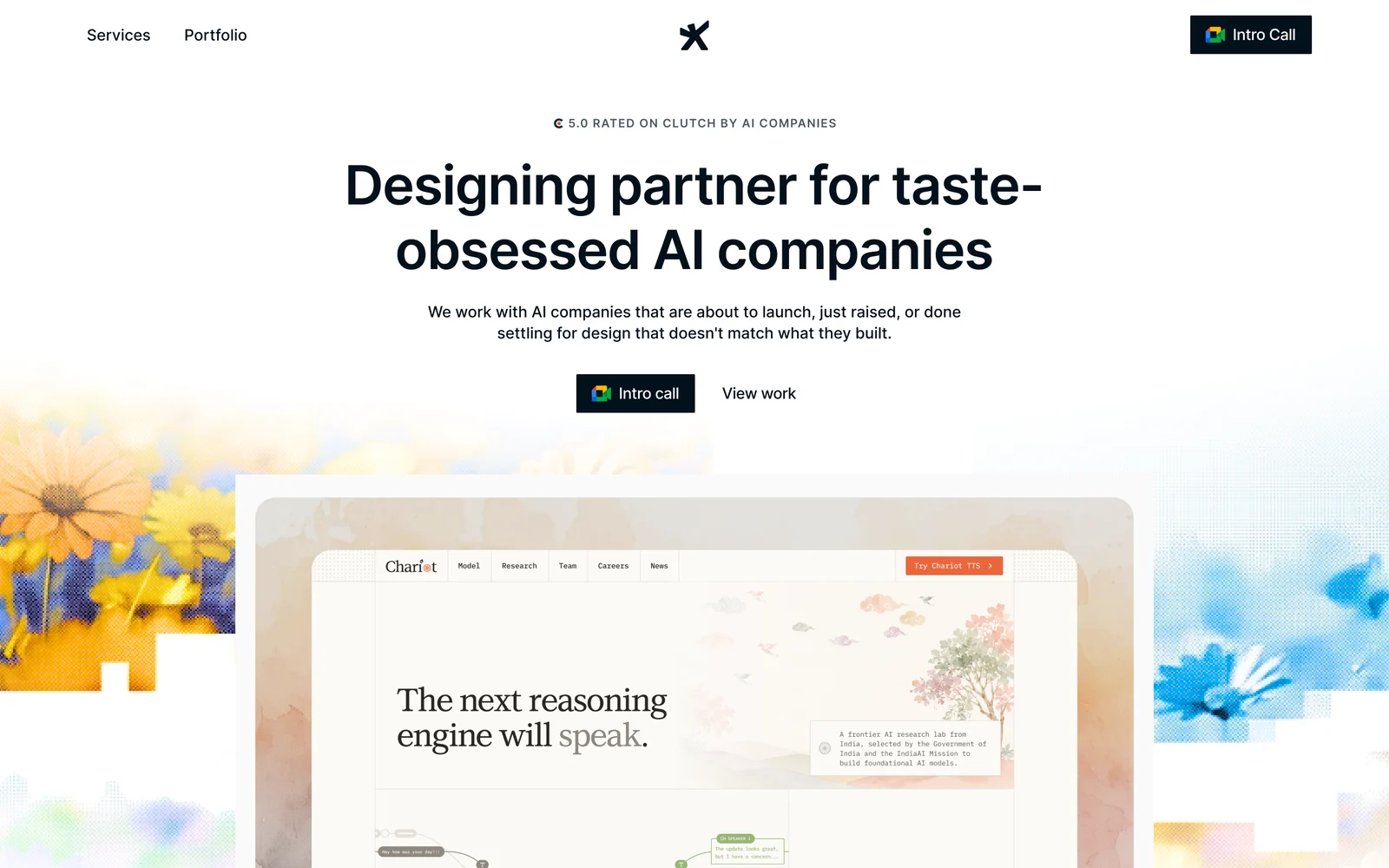
There are two ways to buy the work here, and the difference matters more when you cannot easily judge what you are buying. Fixed scope runs three to four weeks: a defined piece of work, agreed in advance, with an end you can see from the start. A monthly retainer is the alternative, covering new pages, campaigns, and product design with no long lock-in, and it suits a company whose product is changing every few weeks rather than one that needs a single finished thing.
Studio Maydit is a web and product design studio, and its clients are AI founders in the US, UK, and Europe, including plenty who came in without an engineering background and needed the trade-offs explained rather than presented. Work continues into product design after the site ships, which for this audience matters because the site is the easy half and the questions that follow it are the ones that are hardest to ask on your own.
Framer, Webflow, and custom code are all used, and the choice is made for what the product needs rather than what is convenient. One client is published with a number rather than a badge. Dualite began with a repositioned ICP, the design was rebuilt around that narrower user, and 100,000+ users followed in seven months. Wave, PixelFlow, and Mi-VAD are recent clients, along with 15 other AI and SaaS teams. Fixed-scope projects end with a diagnosis of what is leaking in the product, which for a founder who cannot read the code is often the most valuable thing delivered, because it says in plain terms where the problem actually is.
| Check | Finding |
|---|---|
| Based in | Remote, serving US / UK / EU |
| Platform depth | Framer, Webflow, and custom code |
| AI-sector proof | Yes. AI-native clients, published outcome on Dualite |
| Pricing | Fixed scope or monthly retainer, quoted per project |
| Team shape | Founder-led, small senior team |
| Best fit | Founders who need trade-offs explained, not just delivered |
Worth a call if you keep being told something is not possible. Book a 30-minute call.

2. Engine Digital
Engine Digital has built in custom code from Vancouver and New York since 2002, naming Adidas, Autodesk, Goldman Sachs, and HP. Twenty-three years of delivering into organisations with strict requirements means the process is documented and predictable, which is reassuring when you cannot personally check the work.
They publish no team size and no starting figure, their AI-sector proof is partial with no AI case study, and their governance-shaped process is priced for organisations rather than founders.
| Check | Finding |
|---|---|
| Based in | Vancouver and New York |
| Founded | 2002 |
| Team size | Not published |
| Primary platform | Custom code |
| AI-sector proof | Partial. Enterprise and SaaS clients, no AI case study |
| Named clients | Adidas, Autodesk, Goldman Sachs, HP |
| Pricing | Not published |
| Best fit | Funded founders who want a documented, predictable process |
3. Feels Like
Feels Like is a Los Angeles studio founded in 2023 that builds in custom code, publishes AI client work, and names Google, Nike, LVMH, and Suno AI. Building rather than handing over files means a founder without engineers gets something real, and Suno is an AI product that had to make an unfamiliar idea immediately usable.
They publish no team size and no starting figure, and a studio founded in 2023 has a short public record, which is a harder gap to close when you cannot evaluate the craft yourself.
| Check | Finding |
|---|---|
| Based in | Los Angeles, USA |
| Founded | 2023 |
| Team size | Not published |
| Primary platform | Custom code |
| AI-sector proof | Yes. Published AI client work |
| Named clients | Google, Nike, LVMH, Suno AI |
| Pricing | Not published |
| Best fit | Founders wanting a built result with real visual craft |
4. Lighthouse Digital
Lighthouse Digital is a London Webflow studio that publishes a minimum and names HelloSelf, Freetrade, and IGN. The published figure is genuinely useful for a buyer with no benchmark, and a Webflow site is one your own team can edit afterwards without hiring anybody.
They publish no founding year, no team size, and no AI client work at all, and Webflow production will not touch the product itself, which is where most of your uncertainty lives.
| Check | Finding |
|---|---|
| Based in | London, UK |
| Founded | Not published |
| Team size | Not published |
| Primary platform | Webflow |
| AI-sector proof | No. No published AI client work |
| Named clients | HelloSelf, Freetrade, IGN |
| Pricing | Published minimum |
| Best fit | Founders who want an editable site at a known price |
5. Phantom
Phantom works from London and Auckland, founded 2013, fifty-one to two hundred people, building in custom code with published AI client work and Diageo, SAP, Financial Times, and Zendesk named. Design and engineering in one place removes the handover that non-technical founders find hardest to manage, and the AI work means the sector questions are familiar.
They publish no starting figure, and a studio of that size and client profile is aimed at companies with revenue, so expect the first call to establish whether you are large enough.
| Check | Finding |
|---|---|
| Based in | London, UK and Auckland, NZ |
| Founded | 2013 |
| Team size | 51-200 |
| Primary platform | Custom code |
| AI-sector proof | Yes. Published AI client work |
| Named clients | Diageo, SAP, Financial Times, Zendesk |
| Pricing | Not published |
| Best fit | Funded founders needing design and engineering together |
6. basement.studio
basement.studio works from Mar del Plata and Los Angeles, founded 2018, eleven to fifty people, publishing a minimum and building in custom code, with Vercel, Cursor, ElevenLabs, Harvey AI, and Scale AI named. A published figure plus AI-native clients plus the ability to build is an unusually complete answer for a founder who cannot supply the engineering.
Custom code leaves you owning a codebase, so ask directly what stack it is and who could pick it up, because that conversation is much easier before the project than after it.
| Check | Finding |
|---|---|
| Based in | Mar del Plata, Argentina and Los Angeles, USA |
| Founded | 2018 |
| Team size | 11-50 |
| Primary platform | Custom code |
| AI-sector proof | Yes. Published AI client work |
| Named clients | Vercel, Cursor, ElevenLabs, Harvey AI, Scale AI |
| Pricing | Published minimum |
| Best fit | Founders who need AI-native design and the build together |
7. Push Refresh
Push Refresh is a one to ten person Framer studio in Dallas that publishes a minimum and names SmithRx, Synonym, and Northern National. Framer gives a non-technical founder a site they can genuinely edit themselves, which removes a dependency that otherwise recurs every fortnight.
They publish no founding year, their AI-sector proof is partial with no AI case study, and a team this size in a website tool cannot help with the product.
| Check | Finding |
|---|---|
| Based in | Dallas, USA |
| Founded | Not published |
| Team size | 1-10 |
| Primary platform | Framer |
| AI-sector proof | Partial. Enterprise and SaaS clients, no AI case study |
| Named clients | SmithRx, Synonym, Northern National |
| Pricing | Published minimum |
| Best fit | Founders who want to change their own website afterwards |
8. Flow Ninja
Flow Ninja is a Belgrade studio founded in 2018 with eleven to fifty people, working in Webflow. Serbian rates at that size buy more hours than most of this list, which matters if the budget is your own money rather than an investor's.
They publish no clients and no starting figure, which leaves a founder who cannot assess craft with almost nothing to check, and their AI-sector proof is partial with no AI case study.
| Check | Finding |
|---|---|
| Based in | Belgrade, Serbia |
| Founded | 2018 |
| Team size | 11-50 |
| Primary platform | Webflow |
| AI-sector proof | Partial. Enterprise and SaaS clients, no AI case study |
| Named clients | Not published |
| Pricing | Not published |
| Best fit | Founders on a tight budget who can get a strong reference |
9. Refokus
Refokus is a remote German studio founded in 2021 with eleven to fifty people, naming Mural, BASF, Spotify, Yahoo, and BCG. Working to standards set by clients of that size means they are used to explaining decisions to people who are not designers, which is the habit you want.
They publish no starting figure, their AI-sector proof is partial with no AI case study, and expressive website work will not answer the questions you have about the product.
| Check | Finding |
|---|---|
| Based in | Germany, remote |
| Founded | 2021 |
| Team size | 11-50 |
| Primary platform | Webflow |
| AI-sector proof | Partial. Enterprise and SaaS clients, no AI case study |
| Named clients | Mural, BASF, Spotify, Yahoo, BCG |
| Pricing | Not published |
| Best fit | Founders who need the company to look more established |
10. Edgar Allan
Edgar Allan is an Atlanta studio founded in 2014 with fifty-one to two hundred people, naming Porsche, Duracell, and NCR. A team that size absorbs problems internally rather than passing them to you, which is worth something when you have limited capacity to manage a supplier.
They publish no starting figure, their AI-sector proof is partial with no AI case study, and a practice built around established consumer brands runs at a scale most founder-led companies do not need.
| Check | Finding |
|---|---|
| Based in | Atlanta, USA |
| Founded | 2014 |
| Team size | 51-200 |
| Primary platform | Webflow |
| AI-sector proof | Partial. Enterprise and SaaS clients, no AI case study |
| Named clients | Porsche, Duracell, NCR |
| Pricing | Not published |
| Best fit | Founders buying brand polish with minimal management effort |
How to choose between them
Sort by what is actually broken rather than by who explained themselves most confidently.
The product works and you cannot tell why people leave. Studio Maydit or Phantom.
You have no engineers and need something shipped. basement.studio or Feels Like.
The website is out of date and you cannot change it. Push Refresh or Lighthouse Digital.
The company looks smaller than it is. Refokus or Edgar Allan.
One test before you sign. Ask them to explain, in plain language, one thing they would change about your product and what it would cost you later if you did not. A studio worth hiring will give you a specific answer you can repeat accurately to somebody else. If you cannot repeat it, you will not be able to hold them to it either, and that is the whole problem you are trying to solve.