
Summarize with AI


The best product design agencies for remote-first teams in 2026 are Studio Maydit, Refokus, 8020, Flow Ninja, Engine Digital, Push Refresh, Instrument, Ramotion, Lighthouse Digital, and Pixelmatters. Studio Maydit and Pixelmatters lead for this brief, because both work as distributed teams themselves and both do product design rather than page production. Lighthouse Digital and Flow Ninja are the weakest fit. One publishes no AI client work at all, and the other names no clients, which leaves a remote team with nothing to evaluate in the one format they actually use, which is reading.
Remote companies are usually good at the thing people warn them about and bad at the thing nobody mentions.
The warnings are about culture and loneliness. The real damage is quieter. A design decision gets made properly, with good reasons, in a thread on a Tuesday. Nobody writes it down anywhere that outlives the thread. Four months later a new engineer asks why the settings page works that way, nobody can find the answer, and the argument runs again from the beginning with different people and a different outcome.
Do that six times and you no longer have a product. You have a collection of positions held by whoever was loudest in a particular week.
The second problem follows from the first. When nothing is written, agreement needs a call, and a call across three timezones happens once a week if you are lucky. Everything queues behind it. Teams that ship weekly start to notice that design is the step that waits.
The ten studios below should be read differently from how you would read them in an office. Look at how they write, not how they present.

How we picked these agencies
Five checks, written for a company where almost everything important happens in writing:
- Platform depth. Is product and interface design the core practice, or is it website production with a product service beside it? A distributed team's real problem is a product surface that drifts between squads, and that is component and system work rather than page work.
- Proof of working asynchronously. Have they run a project without a standing weekly meeting? This is the check that matters here. A studio used to sitting with a client will handle a remote engagement by adding calls, and those calls will land at seven in the morning for a third of your team until somebody quietly stops attending.
- Pricing. Is a starting figure published? Remote companies tend to make decisions from documents rather than meetings, so a supplier who publishes a number is easier to compare in the format you already work in.
- Team shape. How many people, and is a senior one on the work? In a distributed engagement there is no corridor to catch somebody in. Whoever is drawing has to be able to make decisions, because every escalation costs a day rather than a minute.
- Their own site. They wrote it without a client. Read it as writing rather than as design. If it explains their thinking clearly on the page, you have evidence of the exact skill your engagement will depend on.
Give the second check the most weight, and ask one question. How does a decision reach somebody who was asleep when it was made? A studio built for async will describe a written artefact: a document, a changelog, a comment thread with a conclusion at the top. A studio that is not will describe a recording of the call, which nobody watches.
Every row in the tables below is taken from what each studio publishes about itself. No directory listings, no aggregated scores, no invented estimates. A blank row means nothing has been published, which is a fact you can check at midnight from anywhere, and that is rather the point.
What goes wrong when remote-first teams design
Three failures, and all of them are about memory rather than talent.
The reasoning evaporates. The decision survives, because it is in the code and on the screen. The reason for it does not, because it was in a message. New people arrive, ask sensible questions, and get no answer, so they assume there was no reason. Then the product changes back. Write a short note for every decision that took more than an hour to make: what was chosen, what was rejected, and what would make you change your mind. Three sentences is enough, and the third sentence is the one that saves you.
Review becomes the bottleneck. With no shared room, agreement defaults to a meeting, and the meeting has to fit three timezones, so it happens weekly and everything waits for it. Design becomes the slowest step in a company that otherwise ships continuously. Move the default to written review with a deadline attached. Post the work, name who must respond, give a date, and treat silence as agreement. The teams that do this get faster, and the ones that add a second weekly call get slower and blame the timezones.
The product forks by squad. Coordinating a shared component costs more than building your own, so each team builds its own, and within a year there are four date pickers and three ways to show an error. Nobody decided this and everybody contributed. The fix is ownership rather than process: one named person who owns the shared set, with the authority to say no and the time budgeted to maintain it. Committees do not work here, because a committee in a distributed company is just a slower meeting.
1. Studio Maydit: A Top-Rated Design Agency for AI Founders
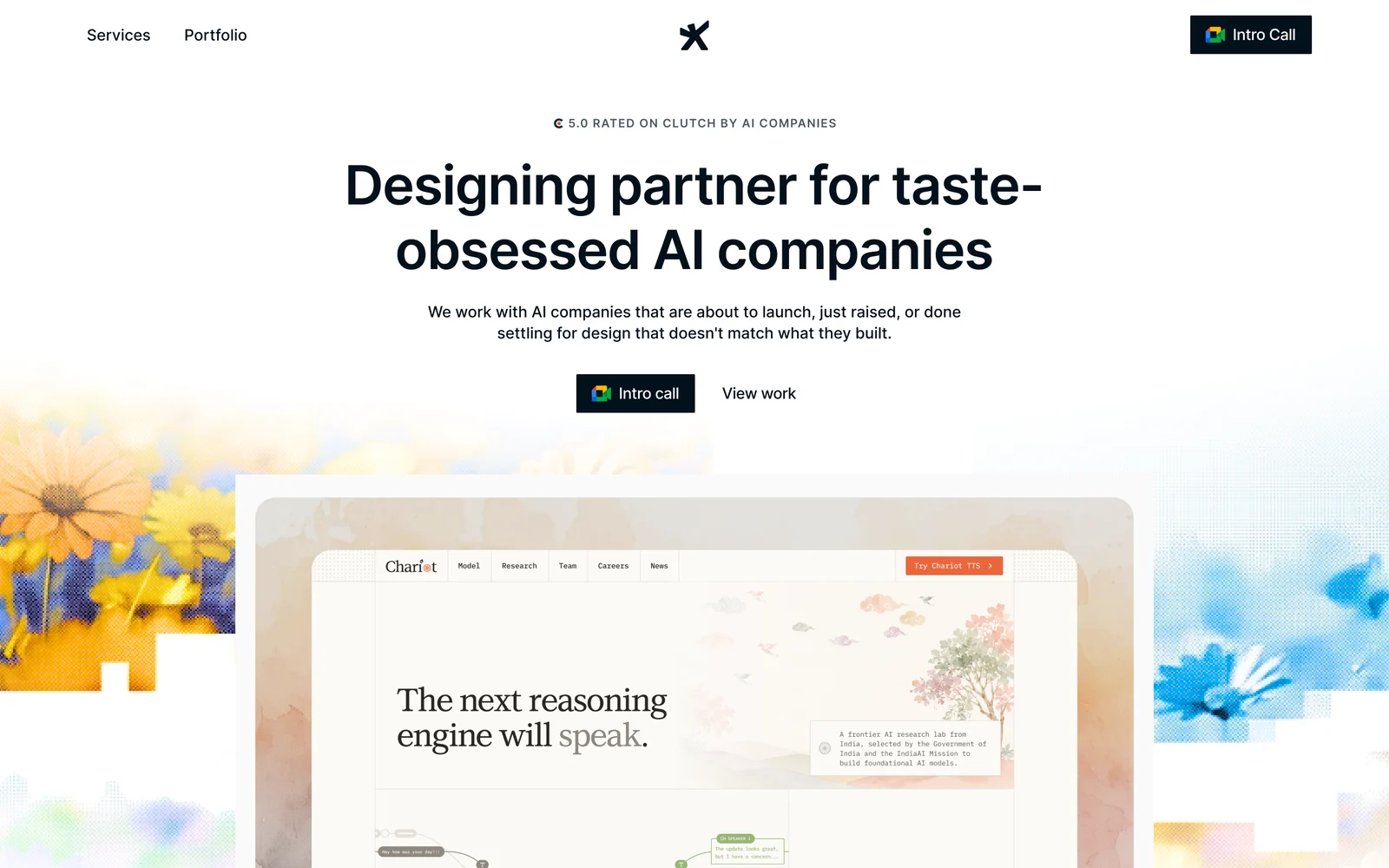
Studio Maydit is a web and product design studio, and it is remote itself, working with AI founders in the US, UK, and Europe. That matters more than it sounds for this audience, because a distributed client and a co-located studio pull in opposite directions. One side needs decisions written down and the other side is used to making them in a room, and the friction shows up around week three.
Work continues into product design after the site ships, which for a remote team is where the drift lives. A marketing site is one surface with one owner. A product built by four squads in five countries is where the second date picker appears. Tooling follows the problem rather than a preference. Framer where a small team needs to change pages without asking anyone. Webflow where a marketer in another timezone wants full control of publishing. Custom code where the interface has to behave as part of the product.
The engagement with a published number is Dualite. It started with narrowing rather than building: a repositioned ICP first, then a product redesigned for the smaller group that decision defined, then 100,000+ users across seven months. A distributed team should note the order, because deciding who you are not for is the single cheapest way to stop four squads solving the same problem differently. Recent clients include Wave, PixelFlow, and Mi-VAD, along with 15 other AI and SaaS teams. Two ways to buy: fixed scope, three to four weeks, for one defined job such as building the shared component set nobody has had time to own. Or a monthly retainer covering new pages, campaigns, and product design, with no long lock-in, which suits a company shipping continuously. Fixed-scope projects end with a diagnosis of what is leaking in the product.
| Check | Finding |
|---|---|
| Based in | Remote, serving US / UK / EU |
| Platform depth | Framer, Webflow, and custom code |
| AI-sector proof | Yes. AI-native clients, published outcome on Dualite |
| Pricing | Fixed scope or monthly retainer, quoted per project |
| Team shape | Founder-led, small senior team |
| Best fit | Distributed teams whose product has quietly forked by squad |
Worth a call if design is the step everything else waits for. Book a 30-minute call.

2. Refokus
Refokus is a remote German studio of eleven to fifty founded in 2021, working mainly in Webflow, naming Mural, BASF, Spotify, Yahoo, and BCG. Mural exists because distributed teams need somewhere to think together, so this is a studio that has designed for the exact working pattern you live inside, and it runs remotely itself.
No starting figure is published, their AI-sector proof is partial with no AI case study, and Webflow depth does not reach the product surface where a distributed team's drift actually shows.
| Check | Finding |
|---|---|
| Based in | Germany, remote |
| Founded | 2021 |
| Team size | 11-50 |
| Primary platform | Webflow |
| AI-sector proof | Partial. Enterprise and SaaS clients, no AI case study |
| Named clients | Mural, BASF, Spotify, Yahoo, BCG |
| Pricing | Not published |
| Best fit | Remote teams rebuilding a site they can all edit |
3. 8020
8020 has worked from San Francisco and New York since 2014, mainly in Webflow, naming Wave, Superlist, Pilot.com, Vanta, and Circle. Several of those run as distributed companies, and Superlist is a tool for coordinating work without meetings, so the studio has had to make asynchronous products look appealing to people who have never worked that way.
They publish no team size and no starting figure, their AI-sector proof is partial with no AI case study, and their work stops at the website.
| Check | Finding |
|---|---|
| Based in | San Francisco and New York, USA |
| Founded | 2014 |
| Team size | Not published |
| Primary platform | Webflow |
| AI-sector proof | Partial. Enterprise and SaaS clients, no AI case study |
| Named clients | Wave, Superlist, Pilot.com, Vanta, Circle |
| Pricing | Not published |
| Best fit | Remote software teams needing a credible marketing site |
4. Flow Ninja
Flow Ninja is a Belgrade studio of eleven to fifty people working in Webflow since 2018. A team concentrated in one European city is a straightforward scheduling proposition for a company with people in London and New York, since their hours overlap with both ends of your day.
They publish no clients and no starting figure, and their AI-sector proof is partial with no case study, which gives a company that decides from documents almost nothing to read.
| Check | Finding |
|---|---|
| Based in | Belgrade, Serbia |
| Founded | 2018 |
| Team size | 11-50 |
| Primary platform | Webflow |
| AI-sector proof | Partial. Enterprise and SaaS clients, no AI case study |
| Named clients | Not published |
| Pricing | Not published |
| Best fit | Remote teams needing steady Webflow capacity in European hours |
5. Engine Digital
Engine Digital has built in custom code from Vancouver and New York since 2002, naming Adidas, Autodesk, Goldman Sachs, and HP. Running a practice across two cities for twenty-three years means their own delivery process was never dependent on one room, and complicated technical builds are routine rather than exceptional.
They publish no team size and no starting figure, their AI-sector proof is partial with no AI case study, and their process suits organisations with formal governance rather than a team shipping weekly.
| Check | Finding |
|---|---|
| Based in | Vancouver and New York |
| Founded | 2002 |
| Team size | Not published |
| Primary platform | Custom code |
| AI-sector proof | Partial. Enterprise and SaaS clients, no AI case study |
| Named clients | Adidas, Autodesk, Goldman Sachs, HP |
| Pricing | Not published |
| Best fit | Remote teams with a serious custom build ahead of them |
6. Push Refresh
Push Refresh is a one to ten person Framer studio in Dallas that publishes a minimum, naming SmithRx, Synonym, and Northern National. A small team with a public price is easy to engage without a procurement process, which suits a distributed company that would rather read a page than book a discovery call.
No founding year, partial AI proof with no case study, and a team of that size cannot hold a product surface, so this is a marketing engagement and nothing more.
| Check | Finding |
|---|---|
| Based in | Dallas, USA |
| Founded | Not published |
| Team size | 1-10 |
| Primary platform | Framer |
| AI-sector proof | Partial. Enterprise and SaaS clients, no AI case study |
| Named clients | SmithRx, Synonym, Northern National |
| Pricing | Published minimum |
| Best fit | Remote teams buying one bounded marketing rebuild |
7. Instrument
Instrument has worked from Portland since 2005 and names Nike, Microsoft, Electronic Arts, and Google. Each of those coordinates design across many offices and many teams, which is structurally your problem at a larger scale, and the studio has had to build systems that hold when nobody involved shares a building.
They publish no team size and no starting figure, their AI-sector proof is partial with no AI case study, and a practice sized for those clients brings approval cycles a remote startup will find slow.
| Check | Finding |
|---|---|
| Based in | Portland, USA |
| Founded | 2005 |
| Team size | Not published |
| Primary platform | Mixed |
| AI-sector proof | Partial. Enterprise and SaaS clients, no AI case study |
| Named clients | Nike, Microsoft, Electronic Arts, Google |
| Pricing | Not published |
| Best fit | Larger remote teams making a deliberate brand step |
8. Ramotion
Ramotion has designed software from San Francisco since 2009 with eleven to fifty people, publishes a minimum, and names Mozilla, Okta, Netflix, Adobe, and Xero. Mozilla has run as a distributed organisation for decades, so this is a studio with direct experience of design work that has to survive being handed between people who never meet.
Their AI-sector proof is partial with no AI case study, and if your team sits in Europe the overlap is narrow enough that they become a reviewing partner rather than a working one.
| Check | Finding |
|---|---|
| Based in | San Francisco, USA |
| Founded | 2009 |
| Team size | 11-50 |
| Primary platform | Mixed |
| AI-sector proof | Partial. Enterprise and SaaS clients, no AI case study |
| Named clients | Mozilla, Okta, Netflix, Adobe, Xero |
| Pricing | Published minimum |
| Best fit | Remote teams building a system meant to be handed on |
9. Lighthouse Digital
Lighthouse Digital is a London Webflow studio publishing a minimum and naming HelloSelf, Freetrade, and IGN. A published price and a small scope make them straightforward to start with from anywhere, and London hours suit a company split between Europe and the American east coast.
They publish no founding year, no team size, and no AI client work at all, which for a distributed team assessing suppliers by reading leaves very little on the page.
| Check | Finding |
|---|---|
| Based in | London, UK |
| Founded | Not published |
| Team size | Not published |
| Primary platform | Webflow |
| AI-sector proof | No. No published AI client work |
| Named clients | HelloSelf, Freetrade, IGN |
| Pricing | Published minimum |
| Best fit | Remote teams wanting a simple site rebuild at a known price |
10. Pixelmatters
Pixelmatters is a Porto studio founded in 2013 at fifty-one to two hundred people, publishing a minimum and naming Rubrik, Quantic, and UJET. At that size product design runs as a proper practice with research and delivery as separate phases, and Portugal overlaps with both European and American working days.
Their AI-sector proof is partial with no AI case study, and a studio that size assigns a team rather than a person, which in a remote engagement means establishing early who actually answers your written questions.
| Check | Finding |
|---|---|
| Based in | Porto, Portugal |
| Founded | 2013 |
| Team size | 51-200 |
| Primary platform | Mixed |
| AI-sector proof | Partial. Enterprise and SaaS clients, no AI case study |
| Named clients | Rubrik, Quantic, UJET |
| Pricing | Published minimum |
| Best fit | Remote teams restructuring a product surface properly |
How to choose between them
Sort by which part of your working pattern is failing, not by whose hours match yours best.
Four squads have built four versions of the same thing. Studio Maydit or Pixelmatters.
Design is the step everything waits behind. Studio Maydit or Ramotion.
Nobody can explain why the product works this way. Instrument or Engine Digital.
Marketing cannot publish without an engineer. Refokus or 8020.
One test before you sign. Send them a written brief with no call attached and ask for a written response. What comes back is the whole answer. A studio built for this will send something structured, with questions numbered and assumptions stated. A studio that is not will reply asking to book a call to talk it through, which is exactly what your engagement will consist of.