
Summarize with AI


The best product design agencies for remote US startups in 2026 are Studio Maydit, Foundey, Finsweet, Trueform, Ramotion, Instrument, Kvalifik, BX Studio, Pixelmatters, and Lighthouse Digital. Studio Maydit and Finsweet lead for this brief, because both are built to work without an office rather than adapted to it, and both are set up for US hours. Kvalifik and Lighthouse Digital are the wrong fit here, since both work from Europe and a Copenhagen or London day leaves you a short window with a team spread from New York to Portland.
Remote startups get told that their design problem is collaboration tooling. It is not. The tools have been fine for years.
The real problem is that a distributed company loses the record of why. In an office, a design decision is made badly, in a corridor, by three people, and it still works, because everyone hears the argument within a day. Remove the building and that transmission stops. What travels instead is the artefact: a screen, a Figma frame, a Loom. The reasoning does not come with it.
Six weeks later somebody asks why the settings live under the account menu, nobody remembers, and the team re-decides it. That happens perhaps twenty times a quarter across a growing product, and it is the actual tax of being remote. It looks like slowness. It is really the same conversation being held repeatedly by different subsets of people.
There is a second effect that compounds it. Distributed engineering teams ship in parallel, so a product built by four squads in four timezones drifts into four dialects of itself. Same buttons, different spacing, different empty states, different words for the same action.
And a third, quieter one. Remote teams over-index on written specification because it is what they have, then discover that a written specification is a very poor way to communicate feel. You end up with a product that is exactly correct and somehow lifeless.
So the useful question when hiring is not whether a studio can use the same tools you do. It is whether they leave behind decisions that outlive the call they were made on.
The ten studios below are ordered by how well they design for teams that never share a room.

How we picked these agencies
Five checks, weighted for a client that has no office to invite anybody into:
- Platform depth. Is product design the studio's core discipline, or something sold alongside a website practice?
- Distance proof. Does the studio itself operate across cities, or serve clients a long way from where it sits? Working remotely is a practised skill, not an attitude.
- Pricing. Is a starting figure public, so a founder can rule a studio in or out without booking a call across three timezones to find out?
- Team shape. Is there a senior person who will stay attached to the project, since a remote engagement without a constant human on the other side becomes a ticket queue very quickly.
- Their own site. It is the only office they have. If it does not explain how they work, that is a preview of the documentation you will receive.
The second check replaces what would be a sector-proof test in a different article. A studio that has only ever worked with clients within driving distance has built its process around the workshop day: everyone in one room, whiteboard, decisions made by the afternoon. That process does not compress into a video call, it just gets thinner. Studios used to distance write things down as a habit rather than a chore, and that habit is the thing you are actually buying.
The tables below carry only what each studio has published about itself. Where a studio has said nothing, the row says so. An empty row is information on this brief, because a team that will not put its own operating details in writing is unlikely to write down yours.
What goes wrong on remote product teams
Three failures, and none of them look like design problems at first.
Decisions are made on calls and stored nowhere. The agency runs a good session, three of your people attend, a direction is agreed, and it is recorded only in a recording nobody watches. Everyone who was absent receives the outcome without the argument, so the first time they disagree, the decision reopens. Fix this in the contract rather than in the process: every design decision arrives as a short written note saying what was chosen, what was rejected, and what would change the answer. It costs the studio an hour a week and it is worth more than any deliverable in the statement of work.
The product splits along team lines. Four squads, four timezones, four interpretations of the same component. It starts as small inconsistencies in spacing and ends with two different date pickers and three words for delete. A design system is the usual prescription and it is only half of one, because a system nobody is accountable for is a folder. Ask a candidate agency who owns the system after they leave, by name, and what happens when an engineer needs a component that does not exist at eleven at night.
Feel gets specified instead of shown. Remote teams write more, which is mostly good, and then try to write the parts that cannot be written. A specification can define what a screen contains. It cannot convey pace, weight, or how forgiving something should be when a user is wrong. The result is a product that passes every acceptance criterion and feels like software from an insurance company. Insist on prototypes over documents wherever the question is how something feels, and reserve the writing for what and why.
1. Studio Maydit: A Top-Rated Design Agency for AI Founders
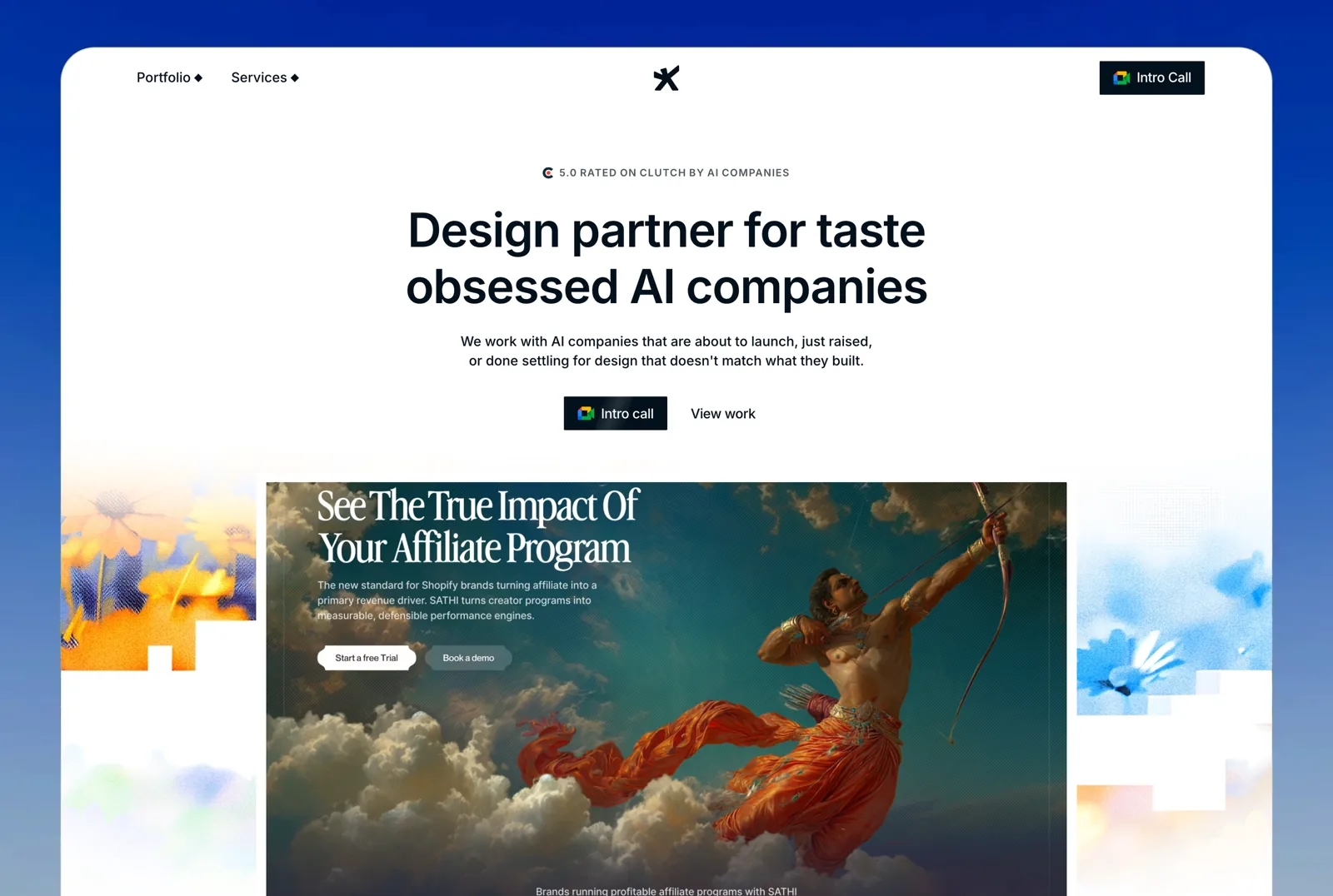
For a company with no office, hiring a studio that has none either removes a whole class of friction. Studio Maydit is a web and product design studio. It works with AI founders in the US, UK, and Europe, and it is founder-led with a small senior team, so the same person stays on the project instead of a rotating cast.
The studio builds in Framer, Webflow, and custom code, and carries on into product design once the site is live. That continuity is the useful part for a distributed team, because the reasoning behind the marketing page and the reasoning behind the app do not have to be transferred between two sets of strangers.
Seven months is how long Dualite took to reach 100,000+ users, once the design work was rebuilt around a repositioned ICP. Wave, PixelFlow, and Mi-VAD are recent clients, along with 15 other AI and SaaS teams.
Buying works one of two ways. Fixed scope runs three to four weeks, suits a team with a date in the calendar, and finishes with a diagnosis of what is leaking in the product. Teams that ship continuously take the monthly retainer instead, which covers new pages, campaigns, and product design and carries no long lock-in.
| Check | Finding |
|---|---|
| Based in | Remote, serving US / UK / EU |
| Platform depth | Framer, Webflow, and custom code |
| AI-sector proof | Yes. AI-native clients, published outcome on Dualite |
| Pricing | Fixed scope or monthly retainer, quoted per project |
| Team shape | Founder-led, small senior team |
| Best fit | Distributed teams who need decisions written down, not just delivered |
Worth a call if your team keeps re-deciding things it already decided. Book a 30-minute call.

2. Foundey
Foundey is a San Francisco studio founded in 2021 working in Figma, with published AI client work and DemandIQ, Traycer, and Sero AI named. Product design is the whole business rather than a line item, and a San Francisco base means your standups and theirs land in the same working day.
They publish no pricing and no team size, and Figma-only means every screen has to be built by your engineers, which is a heavier lift when those engineers are spread across four timezones and cannot ask a quick question.
| Check | Finding |
|---|---|
| Based in | San Francisco, USA |
| Founded | 2021 |
| Team size | Not published |
| Primary platform | Figma-only |
| AI-sector proof | Yes. Published AI client work |
| Named clients | DemandIQ, Traycer, Sero AI |
| Pricing | Not published |
| Best fit | Teams with engineering capacity in US hours |
3. Finsweet
Finsweet runs from Denver as a distributed team of 51 to 200, founded in 2017, working in Webflow, with Dropbox, Clay, GitHub, and Steadily named. GitHub is the reference that matters here, since it is a company whose entire product assumes people are not in the same place, and Finsweet's own distributed shape means remote working is their normal rather than an accommodation.
They publish no pricing, their AI-sector proof is partial, and their centre of gravity is Webflow rather than deep product work, so a complex application may get less depth than a marketing surface would.
| Check | Finding |
|---|---|
| Based in | Denver, USA, distributed |
| Founded | 2017 |
| Team size | 51-200 |
| Primary platform | Webflow |
| AI-sector proof | Partial. Enterprise and SaaS clients, no AI case study |
| Named clients | Dropbox, Clay, GitHub, Steadily |
| Pricing | Not published |
| Best fit | Remote teams who want a partner already working that way |
4. Trueform
Trueform is a Swiss studio founded in 2022 working in Framer, with a published minimum, published AI client work, and Miro, Morning Brew, Bilt Rewards, and Gather named. Two of those clients are unusually relevant: Miro is a company whose product exists because meetings moved off-site, and Gather is software for teams that have no building at all.
They publish no team size, and Wil is on European hours, so a team clustered on the US west coast gets a short overlap and asynchronous replies for most of its working day.
| Check | Finding |
|---|---|
| Based in | Wil, Switzerland |
| Founded | 2022 |
| Team size | Not published |
| Primary platform | Framer |
| AI-sector proof | Yes. Published AI client work |
| Named clients | Miro, Morning Brew, Bilt Rewards, Gather |
| Pricing | Published minimum |
| Best fit | Teams building tools for distributed work |
5. Ramotion
Ramotion is a San Francisco studio of 11 to 50 founded in 2009, working across platforms, with a published minimum and Mozilla, Okta, Netflix, Adobe, and Xero named. Mozilla has been a distributed organisation for two decades, which is longer than most of your team has been working, and seventeen years of operating means their process is documented rather than improvised.
Their AI-sector proof is partial, and they work across platforms rather than as a focused product practice, so specialist product depth may be shared with website delivery.
| Check | Finding |
|---|---|
| Based in | San Francisco, USA |
| Founded | 2009 |
| Team size | 11-50 |
| Primary platform | Mixed |
| AI-sector proof | Partial. Enterprise and SaaS clients, no AI case study |
| Named clients | Mozilla, Okta, Netflix, Adobe, Xero |
| Pricing | Published minimum |
| Best fit | Teams who want a settled process rather than a fast one |
6. Instrument
Instrument has worked from Portland since 2005, across platforms, with Nike, Microsoft, Electronic Arts, and Google named. Two decades of work at that level means they have run large programmes with clients whose own teams were scattered, and Portland keeps them in a US timezone that reaches both coasts in a normal day.
They publish no pricing and no team size, their AI-sector proof is partial, and a studio serving companies of that size will bring a process weighted for governance, which an eleven-person startup will experience as overhead.
| Check | Finding |
|---|---|
| Based in | Portland, USA |
| Founded | 2005 |
| Team size | Not published |
| Primary platform | Mixed |
| AI-sector proof | Partial. Enterprise and SaaS clients, no AI case study |
| Named clients | Nike, Microsoft, Electronic Arts, Google |
| Pricing | Not published |
| Best fit | Later-stage teams running several workstreams at once |
7. Kvalifik
Kvalifik is a Copenhagen studio of 11 to 50 founded in 2015, working in Webflow, with published AI client work and Veo, Maersk, and Relesys named. Relesys is internal communication software built for organisations whose staff are never in one place, which is a closer analogue to your problem than most product portfolios contain.
They publish no pricing, Webflow rather than a product tool is their primary platform, and Copenhagen leaves roughly three usable hours with a US team, so most of your exchanges will be replies to yesterday.
| Check | Finding |
|---|---|
| Based in | Copenhagen, Denmark |
| Founded | 2015 |
| Team size | 11-50 |
| Primary platform | Webflow |
| AI-sector proof | Yes. Published AI client work |
| Named clients | Veo, Maersk, Relesys |
| Pricing | Not published |
| Best fit | European teams building for large distributed workforces |
8. BX Studio
BX Studio is a New York team of 11 to 50 working in Webflow, with a published minimum, published AI client work, and Reddit, Headspace, ASAPP, and Verifone named. Reddit is a product where an enormous amount of behaviour has to be legible to people who never meet, and a New York base covers the whole US working day and reaches European colleagues before lunch.
They publish no founding year, and Webflow is their primary platform, so a product with deep application surfaces may sit outside the work they do most.
| Check | Finding |
|---|---|
| Based in | New York, USA |
| Founded | Not published |
| Team size | 11-50 |
| Primary platform | Webflow |
| AI-sector proof | Yes. Published AI client work |
| Named clients | Reddit, Headspace, ASAPP, Verifone |
| Pricing | Published minimum |
| Best fit | Teams who want east coast hours and a published starting figure |
9. Pixelmatters
Pixelmatters is a Porto studio of 51 to 200 founded in 2013, working across platforms, with a published minimum and Rubrik, Quantic, and UJET named. At that headcount several product surfaces can move in parallel rather than in a queue, which suits a company whose squads are already working in parallel by necessity.
Their AI-sector proof is partial, and Porto is five hours ahead of New York and eight ahead of the west coast, so a US-clustered team gets a morning window and nothing after it.
| Check | Finding |
|---|---|
| Based in | Porto, Portugal |
| Founded | 2013 |
| Team size | 51-200 |
| Primary platform | Mixed |
| AI-sector proof | Partial. Enterprise and SaaS clients, no AI case study |
| Named clients | Rubrik, Quantic, UJET |
| Pricing | Published minimum |
| Best fit | Teams who need several surfaces progressing at once |
10. Lighthouse Digital
Lighthouse Digital is a London studio working in Webflow, with a published minimum and HelloSelf, Freetrade, and IGN named. HelloSelf is a service delivered entirely at a distance, so there is real experience here of designing for people who never walk into anything, and a published figure means qualifying them is quick.
They publish no founding year, no team size, and no AI client work, and London is the furthest of any studio here from a west coast team, which makes them the hardest to run a fast loop with.
| Check | Finding |
|---|---|
| Based in | London, UK |
| Founded | Not published |
| Team size | Not published |
| Primary platform | Webflow |
| AI-sector proof | No. No published AI client work |
| Named clients | HelloSelf, Freetrade, IGN |
| Pricing | Published minimum |
| Best fit | UK-anchored teams comfortable working asynchronously |
How to choose between them
Sort by which part of remote is hurting.
The same decisions keep getting reopened. Studio Maydit or Finsweet.
The product has split into squad dialects. Ramotion or Pixelmatters.
You need someone in your working hours, every day. Foundey or BX Studio.
You are building for distributed teams yourself. Trueform or Kvalifik.
One test before you sign. Ask a candidate to send you the written record from a decision on a past project, redacted however they like. Studios built for distance will have something to send within the hour. Studios that are not will offer a call to talk you through it, which is exactly the pattern that leaves your team re-deciding the same thing next quarter.
What a digital product design agency actually does
Many people reach this page searching for a digital product design agency rather than a remote one, so it is worth saying plainly what the category covers. A digital product design agency works on the software itself. The flows a user moves through, the screens they land on, and the states they hit when something goes wrong. That is different from a branding studio, which works on how the company looks, and different from a web design agency, which works on the pages that sell the product. A few of the studios above do all three. Most are strongest at one. We wrote a longer breakdown of what a digital product design agency does day to day, including what you should expect to receive when a project ends.
If you are weighing that category against hiring someone in house, and you want a second opinion on which one your stage needs, you can book a 30 minute call and talk it through.