

Summarize with AI


The best product design agencies for seed-stage AI startups in 2026 are Studio Maydit, 925Studios, Foundey, Ramotion, Instrument, Pixelmatters, Lighthouse Digital, Feels Like, Trueform, and Phantom. Studio Maydit and Foundey lead for this brief, because both work with AI companies that were small and unsettled when the engagement started, which is the actual condition here. Lighthouse Digital and Instrument are the weakest fit. One publishes no AI work at all, and the other is built around brands with marketing departments larger than your entire company.
Seed money is the first money that is genuinely spendable. It is also the first money with a clock attached, and design is one of the easiest line items to spend badly, because bad design spending looks exactly like good design spending for about four months.
The mistake is rarely craft. Studios at this level draw well. The mistake is buying the wrong quantity of work.
A seed-stage team usually asks for a product surface: the main screens, an onboarding sequence, a settings area, a component set. It sounds efficient. It arrives just as the company learns something that invalidates a third of it.
What actually helps is smaller and less satisfying. One flow, taken to a real level of finish, for the user you currently believe in most. Then a decision about whether that belief survived contact.
There is a second temptation, which is designing for the next round instead of for users. That work is easy to justify and easy to recognise later, because it produces a product that photographs well and teaches you nothing.
Ten studios are below. Before you read them, decide which single flow you would fix if you could only fix one. That answer changes which of these names is the right one.

How we picked these agencies
Five checks, written for a company with money for the first time and no certainty yet:
- Platform depth. Is product and flow design the core practice, or website production with a product offer beside it? At seed both jobs are real, but they are bought separately, and a studio strong at one will quietly convert the other into its own shape.
- Early-stage proof. Have they worked with a company before it knew who its customer was? That is a different engagement. The brief moves, half the research is inconclusive, and the studio has to be comfortable being told in week three that the premise changed.
- Pricing. Is a starting figure published? At seed this is not about affordability, it is about time. A published number tells you in one minute whether a conversation is worth having, and your calendar is the resource nobody is counting.
- Team shape. How many people, and who actually does the work? A small senior team will argue with your brief. A large one will execute it faithfully, which is worse when the brief is a guess.
- Their own site. It is the only project where they were the client. Look at whether it takes a position or simply looks expensive.
The second check is the one to press on. Ask about a project where the client changed direction halfway through, what was thrown away, and who paid for it. Everyone who has worked at this stage has that story, and the answer tells you whether they treat a change of mind as a failure of process or as the normal condition of an early company.
On where these facts come from. Every row restates something the studio publishes on its own website. Nothing is drawn from directories or ratings platforms, and no number is inferred from headcount or client size. Where a studio publishes nothing, the row stays blank, and at this stage a blank row will often save you a call.
What goes wrong when seed-stage teams buy design
Three failures, and each one is a reasonable decision made a stage too early.
The design system arrives before the product. A component library feels like the responsible purchase. It promises that everything after it will be faster. What it actually does is fix a set of decisions about hierarchy, density, and naming while the product is still changing weekly, so by month three the team is either fighting the system or quietly abandoning it. Build the pieces you have used twice already. Everything else is a prediction, and predictions at seed are worth roughly nothing.
Scope spreads and nothing finishes. Ten screens get designed to about seventy percent, because that is what the budget covers when the brief is the whole product. Seventy percent is the worst possible place to stop. It is enough to build from and not enough to learn from, so engineering ships approximations, users hit the parts that were never resolved, and the team concludes that design did not help. Two screens at a hundred percent would have answered a real question.
Design gets used as a funding signal. Polish aimed at a room full of investors is a legitimate expense, and it is not product design. The trouble starts when one budget pays for both, because the version that impresses a partner meeting is the version with no empty states, no errors, and no user who is confused. That product does not exist. If the round needs a story, buy the story separately and keep it away from the work that is meant to teach you something.
1. Studio Maydit: A Top-Rated Design Agency for AI Founders
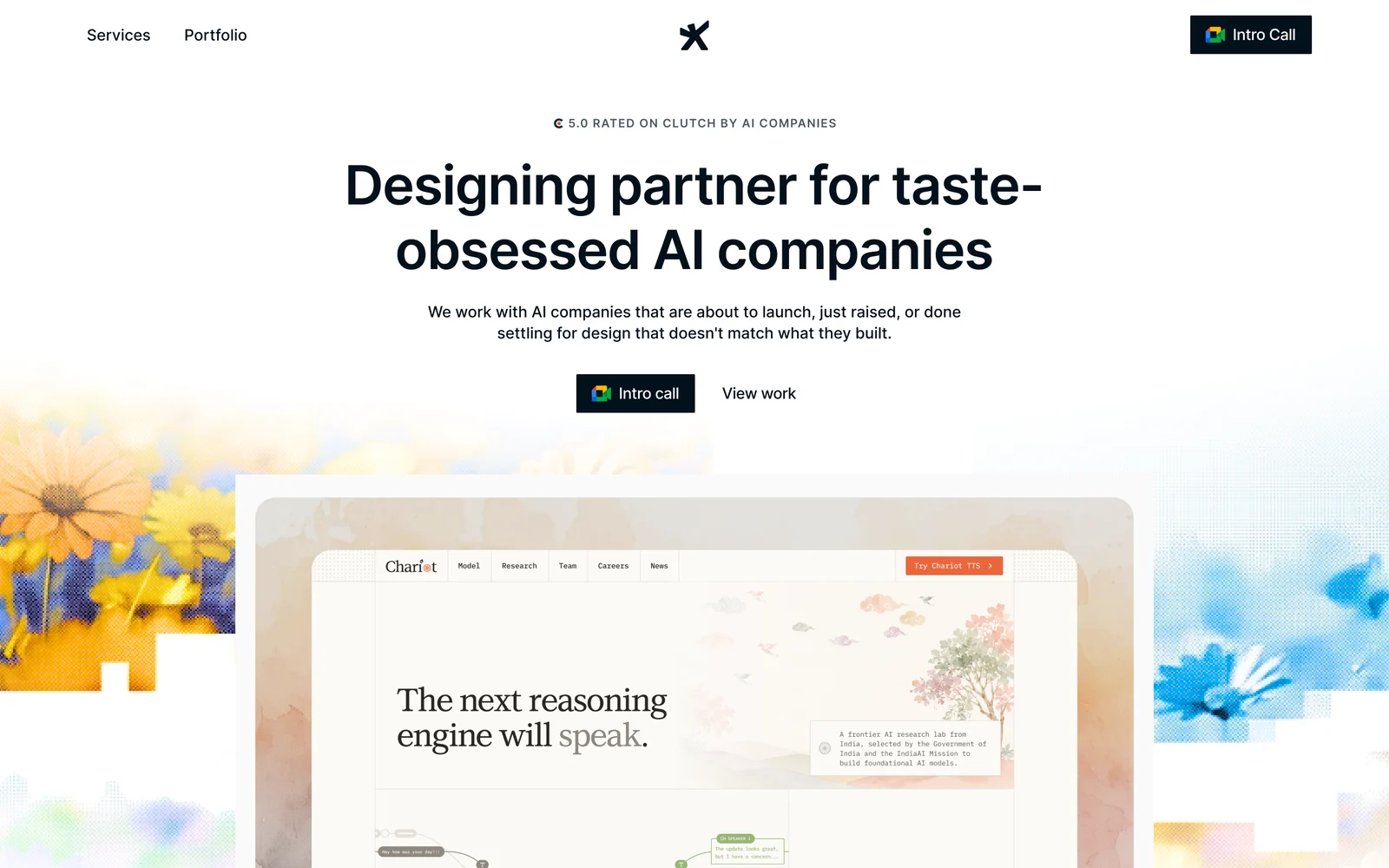
At seed the most valuable thing a studio can hand back is not more screens. It is a clear statement of what is not working. Fixed-scope projects here end with a diagnosis of what is leaking in the product, and for a company with eighteen months of runway that diagnosis is usually worth more than the design that came with it, because it names the assumption to stop paying for. Studio Maydit is a web and product design studio, and its clients are AI founders in the US, UK, and Europe, a good number of whom arrived at exactly this stage.
Fixed scope runs three to four weeks, which is short enough to sit inside a runway calculation and specific enough to agree in advance. A monthly retainer is the other option, covering new pages, campaigns, and product design with no long lock-in, and it becomes the right shape once there is something steady enough to sustain. Most seed companies want the first before they want the second.
The build side is not fixed to one tool. Framer where the story is still moving, Webflow where a marketing hire will want control, and custom code where the product refuses to fit either. The work continues into product design after the site ships, so the relationship extends rather than restarting. One outcome is published with a figure. Dualite settled on a repositioned ICP, rebuilt the design for that narrower user, and reached 100,000+ users in seven months. Wave, PixelFlow, and Mi-VAD are recent clients, along with 15 other AI and SaaS teams.
| Check | Finding |
|---|---|
| Based in | Remote, serving US / UK / EU |
| Platform depth | Framer, Webflow, and custom code |
| AI-sector proof | Yes. AI-native clients, published outcome on Dualite |
| Pricing | Fixed scope or monthly retainer, quoted per project |
| Team shape | Founder-led, small senior team |
| Best fit | Seed teams who need one flow finished and one question answered |
Worth a call before the scope grows to fill the round. Book a 30-minute call.

2. 925Studios
925Studios is a Delhi studio founded in 2023 that designs in Figma and ships sites in Webflow and Next.js, publishes AI client work, and names Arentha, Offa, and MARA. Arentha, a persistent intelligence OS, was designed from early product through launch, and Arentha and Offa were both early AI products when the work began, so the studio is used to a brief that changes week to week. It takes on two to four clients at a time with both founders working in the files rather than reviewing on calls, and clients get a Loom walkthrough every 24 to 48 hours inside their own Slack, Linear, and Figma.
They publish a minimum, and a team built for a handful of clients at once means a seed team that needs ten embedded designers will outgrow them.
| Check | Finding |
|---|---|
| Based in | Delhi, India |
| Founded | 2023 |
| Team size | 9-15 |
| Primary platform | Figma, with sites shipped in Webflow and Next.js |
| AI-sector proof | Yes. Arentha, a persistent intelligence OS, from early product through launch |
| Named clients | Arentha, Offa, MARA |
| Pricing | Published minimum |
| Best fit | Seed-stage AI teams that need the product, site and design system from one team |
3. Foundey
Foundey is a San Francisco studio founded in 2021 that works only in Figma, publishes AI client work, and names DemandIQ, Traycer, and Sero AI. Those clients were early AI companies when the work began, so the studio is used to a brief that shifts, and a Figma-only practice means product flows are the entire business rather than an add-on.
They publish no team size and no starting figure, and Figma-only means your engineers build everything from files, which at seed is often the constraint that actually matters.
| Check | Finding |
|---|---|
| Based in | San Francisco, USA |
| Founded | 2021 |
| Team size | Not published |
| Primary platform | Figma-only |
| AI-sector proof | Yes. Published AI client work |
| Named clients | DemandIQ, Traycer, Sero AI |
| Pricing | Not published |
| Best fit | Seed AI teams with engineers ready to build from files |
4. Ramotion
Ramotion has designed software from San Francisco since 2009 with eleven to fifty people, publishes a minimum, and names Mozilla, Okta, Netflix, Adobe, and Xero. Sixteen years of shipping product work buys pattern recognition a seed team does not have, and the published figure means the first email settles whether this is possible.
Their AI-sector proof is partial with no AI case study, and a studio shaped around established software will reach for settled patterns while your product is still arguing for something new.
| Check | Finding |
|---|---|
| Based in | San Francisco, USA |
| Founded | 2009 |
| Team size | 11-50 |
| Primary platform | Mixed |
| AI-sector proof | Partial. Enterprise and SaaS clients, no AI case study |
| Named clients | Mozilla, Okta, Netflix, Adobe, Xero |
| Pricing | Published minimum |
| Best fit | Seed teams wanting experienced product judgement, not novelty |
5. Instrument
Instrument has worked from Portland since 2005 and names Nike, Microsoft, Electronic Arts, and Google. That is a serious record, and a studio operating at that level has done the hard version of nearly every problem, including making a complicated thing feel obvious to somebody with no patience.
They publish no team size and no starting figure, their AI-sector proof is partial with no AI case study, and a practice built for large brands runs on approval cycles a seed team cannot match or afford.
| Check | Finding |
|---|---|
| Based in | Portland, USA |
| Founded | 2005 |
| Team size | Not published |
| Primary platform | Mixed |
| AI-sector proof | Partial. Enterprise and SaaS clients, no AI case study |
| Named clients | Nike, Microsoft, Electronic Arts, Google |
| Pricing | Not published |
| Best fit | Well-funded seed teams buying brand weight deliberately |
6. Pixelmatters
Pixelmatters is a Porto studio founded in 2013 at fifty-one to two hundred people, publishing a minimum and naming Rubrik, Quantic, and UJET. At that size research and design can run as real phases instead of being squeezed into one person's month, and European rates make a properly staffed engagement reachable on a seed budget.
Their AI-sector proof is partial with no AI case study, and a studio that size will assign a team rather than a person, so ask who is actually on it before you sign.
| Check | Finding |
|---|---|
| Based in | Porto, Portugal |
| Founded | 2013 |
| Team size | 51-200 |
| Primary platform | Mixed |
| AI-sector proof | Partial. Enterprise and SaaS clients, no AI case study |
| Named clients | Rubrik, Quantic, UJET |
| Pricing | Published minimum |
| Best fit | Seed teams wanting real research capacity at European rates |
7. Lighthouse Digital
Lighthouse Digital is a London Webflow studio that publishes a minimum and names HelloSelf, Freetrade, and IGN. For a seed company whose immediate problem is a website that has to change every fortnight, a published figure and a Webflow build is a fast, cheap way to stop that problem consuming founder time.
They publish no founding year, no team size, and no AI client work at all, and Webflow production is not product design, so this solves the site and leaves the product exactly where it was.
| Check | Finding |
|---|---|
| Based in | London, UK |
| Founded | Not published |
| Team size | Not published |
| Primary platform | Webflow |
| AI-sector proof | No. No published AI client work |
| Named clients | HelloSelf, Freetrade, IGN |
| Pricing | Published minimum |
| Best fit | Seed teams whose website is the immediate bottleneck |
8. Feels Like
Feels Like is a Los Angeles studio founded in 2023 that builds in custom code, publishes AI client work, and names Google, Nike, LVMH, and Suno AI. A young studio with that client list tends to still be hungry, and custom code means a seed team gets something real rather than a prototype to reimplement.
They publish no team size and no starting figure, and a studio founded in 2023 has a short record to check, which matters more when you are spending money that has to last.
| Check | Finding |
|---|---|
| Based in | Los Angeles, USA |
| Founded | 2023 |
| Team size | Not published |
| Primary platform | Custom code |
| AI-sector proof | Yes. Published AI client work |
| Named clients | Google, Nike, LVMH, Suno AI |
| Pricing | Not published |
| Best fit | Seed teams wanting a built result rather than files |
9. Trueform
Trueform is a Framer studio in Wil, Switzerland, founded in 2022, publishing a minimum, with AI client work and Miro, Morning Brew, Bilt Rewards, and Gather named. Framer suits a company whose positioning is going to change twice before the next raise, because changing the story should not require a development cycle.
They publish no team size, and a Framer practice is a website practice, so the product surface still needs somebody else. Central European hours also give a US team a narrow overlap.
| Check | Finding |
|---|---|
| Based in | Wil, Switzerland |
| Founded | 2022 |
| Team size | Not published |
| Primary platform | Framer |
| AI-sector proof | Yes. Published AI client work |
| Named clients | Miro, Morning Brew, Bilt Rewards, Gather |
| Pricing | Published minimum |
| Best fit | Seed teams whose story changes faster than their product |
10. Phantom
Phantom works from London and Auckland, was founded in 2013, runs fifty-one to two hundred people, builds in custom code, publishes AI client work, and names Diageo, SAP, Financial Times, and Zendesk. That combination is unusual: real AI experience and enough engineering depth to hand a seed team something that ships.
They publish no starting figure, and a studio of that size and client profile is priced for companies that already have revenue, so expect the first call to be about whether you are big enough.
| Check | Finding |
|---|---|
| Based in | London, UK and Auckland, NZ |
| Founded | 2013 |
| Team size | 51-200 |
| Primary platform | Custom code |
| AI-sector proof | Yes. Published AI client work |
| Named clients | Diageo, SAP, Financial Times, Zendesk |
| Pricing | Not published |
| Best fit | Better-funded seed teams needing design and build together |
How to choose between them
Sort by what is actually broken, not by which logo list is most impressive.
One flow needs to be finished and tested properly. Studio Maydit or Foundey.
The product, the site, and the design system all need doing, by one small team. 925Studios.
The product works and nobody can tell what it is for. Ramotion or Pixelmatters.
The website is eating a founder's week. Trueform or Lighthouse Digital.
You need design and engineering from the same place. Feels Like or Phantom.
One test before you sign. Tell them your budget covers roughly a third of what you just described, and ask what they would cut. A studio that works at this stage will name the two things worth doing and say plainly why the rest can wait. A studio that offers to do all of it for the money has told you what seventy percent finished is going to look like.