

Summarize with AI


The best product design agencies for Series A AI startups in 2026 are Studio Maydit, Edgar Allan, SuperSkills, 8020, Lazarev, Push Refresh, Foundey, Pixelmatters, Instrument, and Ramotion. Studio Maydit and Lazarev lead for this brief, because both publish AI client work and do product design rather than page production, which is the combination a company with real customers needs. Edgar Allan and Push Refresh are the weakest fit. One is built around large consumer brands, and the other is a small Framer website team facing a product-sized problem.
Series A changes the question. At seed the problem was not knowing who the customer is. Now you know, you have twenty or two hundred of them, and the problem is everything you agreed to along the way.
Look at your product honestly and you will find features that were sold rather than designed. Each one closed a deal. Each one made sense at the time. Together they form a surface nobody would have drawn on purpose, and every one of them now has a customer attached who would notice if it disappeared.
This is why studios that are excellent at greenfield product design often struggle here. There is no blank page. There is a set of commitments, and the job is to find the shape that honours them without letting them dictate the structure.
The website has a version of the same problem. Its job at seed was to explain a novelty to someone who had never seen one. Now a buyer is comparing you to two named competitors and wants to know the difference, which is a completely different piece of writing.
There is also the hiring question, usually answered too fast. The backlog is real, so the company hires one person into it, and that person becomes a ticket queue with six teams asking.
Ten studios are listed below. As you read, hold one number in mind: how many features you would remove if removing them were free.

How we picked these agencies
Five checks, written for a company with real customers and a product shaped by them:
- Platform depth. Is product and flow design the main practice, or website production with a product offer attached? At this stage both jobs are genuinely urgent, and they are separate purchases. A studio strong at one will convert the other into its own shape without meaning to.
- Post-traction proof. Have they reworked a product that already had paying customers? That is a distinct job. It requires a migration plan, a story for people who liked the old way, and the judgement to leave some things alone. A studio whose portfolio is all launches has never had to protect anybody's habits.
- Pricing. Is a starting figure published? At Series A the money is available and the calendar is not. A public number removes a week of exploratory calls from a quarter that has none to spare.
- Team shape. How many people, and is the senior one on the work? You are buying an argument about structure, and arguments do not survive being handed down a chain. Ask which names are on your project and get the answer in writing.
- Their own site. They were the client and the reviewer. Look at whether it makes a claim that could be wrong, because that is the skill your own positioning now needs.
Press hardest on the second check. Ask for a project where a feature had to be removed or restructured while customers were using it, and listen for how those users were handled. Real answers involve a migration path, a communication plan, and at least one customer who was unhappy anyway.
How the tables were built. Every row repeats a claim published on the studio's own website. No directory entries, no aggregated ratings, and no numbers inferred from company size. Where a studio publishes nothing, the row is left empty, and since you will be justifying this choice internally, a documented blank defends better than an estimate.
What goes wrong when Series A companies redesign
Three failures, and each one comes from the traction that got you here.
Nobody is allowed to remove anything. Every feature has a customer, that customer has an account manager, and the account manager has a strong view. So the redesign becomes a reorganisation, the surface grows a level of navigation, and six months later the product is harder to use and nothing was technically lost. Removal has to be a decision somebody is empowered to make, with a rule attached: usage below a threshold, a named migration path, a fixed notice period. Without that rule the answer is always no, because no single case ever justifies the disruption.
The positioning is a stage behind the market. Copy written to explain a new idea keeps running long after the buyer stops needing an explanation. By Series A they have seen three of these, they are comparing, and what they want is the specific difference and the evidence for it. A site still doing patient introduction reads as a company that has not noticed it has competitors. Rewrite from the comparison the buyer is actually making rather than from the education they no longer need.
One hire is asked to be a department. The backlog justifies a design hire, so a good person joins with no system, no research access, and every team queuing. Within a quarter they are producing screens on request and nothing structural has changed, which is what the company was trying to fix. Buy an engagement alongside their first quarter to establish the system and the direction, so those months are spent leading rather than catching up.
1. Studio Maydit: A Top-Rated Design Agency for AI Founders
The commitment question comes up at this stage, because the alternative on the table is usually a senior hire. A monthly retainer here has no long lock-in, and it covers new pages, campaigns, and product design, which is the actual shape of the work after a Series A: a marketing surface that keeps moving and a product surface that keeps growing. Fixed scope is the other route, running three to four weeks, and it suits one bounded job such as restructuring a product that has outgrown its navigation.
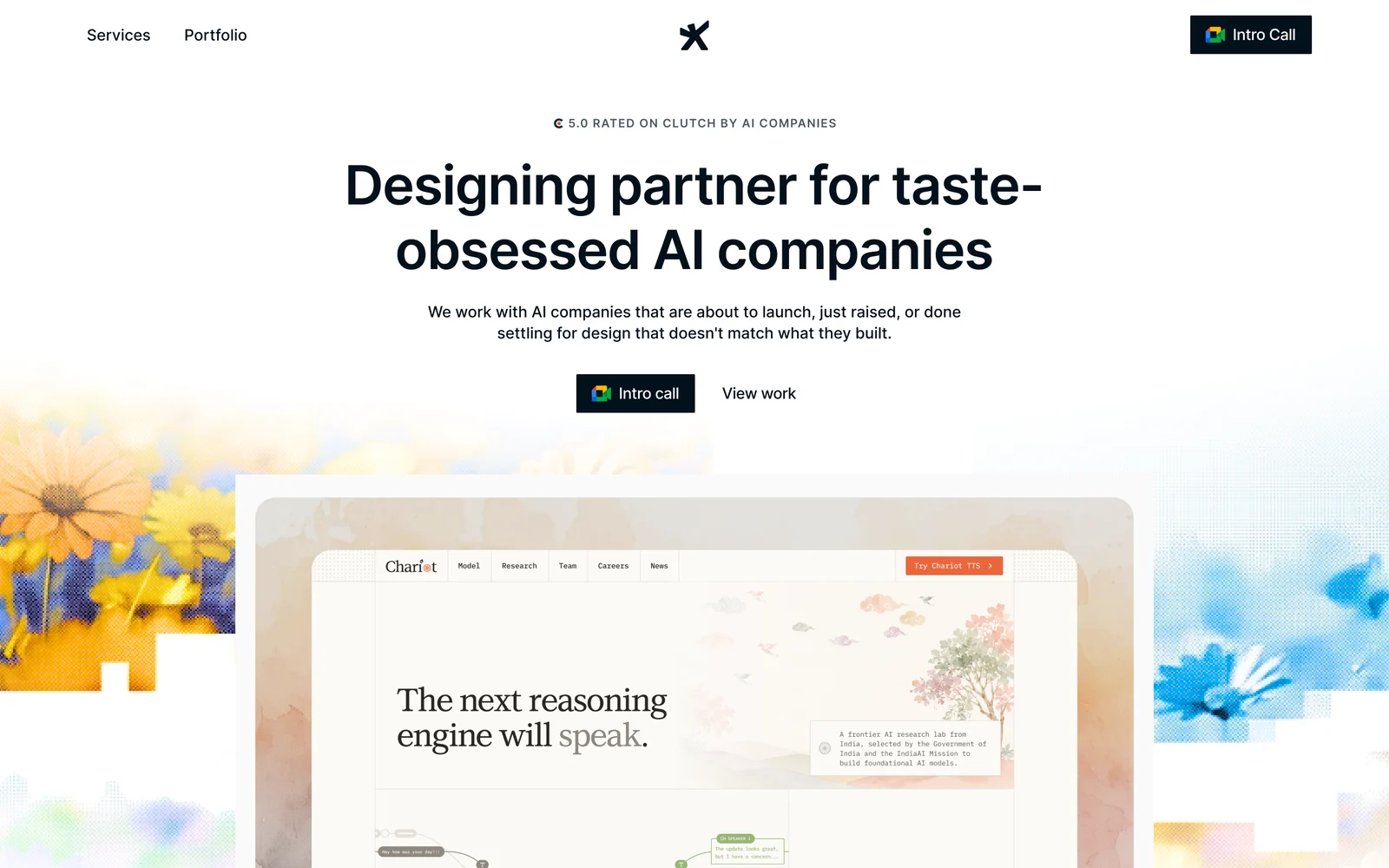
Studio Maydit is a web and product design studio. Its clients are AI founders in the US, UK, and Europe, most of them past the point where the question is what to build and into the harder one of what to stop carrying. Work continues into product design after the site ships, which at this stage is usually the more valuable half, since the site is a week of writing and the product is the thing customers renew.
Platform choice follows the brief rather than a preference. Framer where positioning is being rewritten, Webflow where a growth team wants the pages, custom code where the product will not fit either. Dualite is the client published with a figure attached. A repositioned ICP came first, the design was rebuilt for that narrower user, and 100,000+ users followed in seven months. Wave, PixelFlow, and Mi-VAD are recent clients, along with 15 other AI and SaaS teams. Fixed-scope projects end with a diagnosis of what is leaking in the product, which after a raise is usually the thing the board keeps asking about in different words.
| Check | Finding |
|---|---|
| Based in | Remote, serving US / UK / EU |
| Platform depth | Framer, Webflow, and custom code |
| AI-sector proof | Yes. AI-native clients, published outcome on Dualite |
| Pricing | Fixed scope or monthly retainer, quoted per project |
| Team shape | Founder-led, small senior team |
| Best fit | Series A teams carrying features they cannot justify removing |
Worth a call before the redesign becomes a reorganisation. Book a 30-minute call.

2. Edgar Allan
Edgar Allan is an Atlanta studio founded in 2014 with fifty-one to two hundred people, naming Porsche, Duracell, and NCR. A team that size can run brand, site, and campaign work in parallel without your timeline moving, which suits a company that has just raised and needs several things at once.
They publish no starting figure, their AI-sector proof is partial with no AI case study, and a practice built around established consumer brands is aimed at companies with marketing departments rather than a first marketing hire.
| Check | Finding |
|---|---|
| Based in | Atlanta, USA |
| Founded | 2014 |
| Team size | 51-200 |
| Primary platform | Webflow |
| AI-sector proof | Partial. Enterprise and SaaS clients, no AI case study |
| Named clients | Porsche, Duracell, NCR |
| Pricing | Not published |
| Best fit | Series A teams buying brand-level polish after a raise |
3. SuperSkills
SuperSkills is a one to ten person studio in Walnut Creek with published AI client work and mixed platform experience. A small team means the senior person is on the work throughout, which matters when the job is arguing about structure rather than producing screens.
They publish no founding year, no starting figure, and name only The Cut, so there is very little to verify, and one to ten people cannot carry a Series A product surface alongside other clients.
| Check | Finding |
|---|---|
| Based in | Walnut Creek, USA |
| Founded | Not published |
| Team size | 1-10 |
| Primary platform | Mixed |
| AI-sector proof | Yes. Published AI client work |
| Named clients | The Cut |
| Pricing | Not published |
| Best fit | Series A teams wanting one senior voice on a bounded job |
4. 8020
8020 has worked from San Francisco and New York since 2014 and names Wave, Superlist, Pilot.com, Vanta, and Circle. That is a list of venture-backed software companies at roughly your stage, which means the studio has repeatedly written the positioning of a company moving from explaining itself to differentiating itself.
They publish no team size and no starting figure, their AI-sector proof is partial with no AI case study, and Webflow as the primary platform means the product surface is not what they do.
| Check | Finding |
|---|---|
| Based in | San Francisco and New York, USA |
| Founded | 2014 |
| Team size | Not published |
| Primary platform | Webflow |
| AI-sector proof | Partial. Enterprise and SaaS clients, no AI case study |
| Named clients | Wave, Superlist, Pilot.com, Vanta, Circle |
| Pricing | Not published |
| Best fit | Series A teams whose website still tells the seed story |
5. Lazarev
Lazarev is a San Francisco studio founded in 2015 at fifty-one to two hundred people, publishing a minimum and AI client work, naming Payoneer, Peel, Elva, and Mozayix. Payoneer is a product with a large existing user base and real constraints, which is closer to your rebuild problem than most portfolios here, and the size supports research as a proper phase.
They will assign a team rather than a person, so ask who is on it, and their client base is weighted toward fintech and marketplaces rather than technical products.
| Check | Finding |
|---|---|
| Based in | San Francisco, USA |
| Founded | 2015 |
| Team size | 51-200 |
| Primary platform | Mixed |
| AI-sector proof | Yes. Published AI client work |
| Named clients | Payoneer, Peel, Elva, Mozayix |
| Pricing | Published minimum |
| Best fit | Series A teams rebuilding a product that already has users |
6. Push Refresh
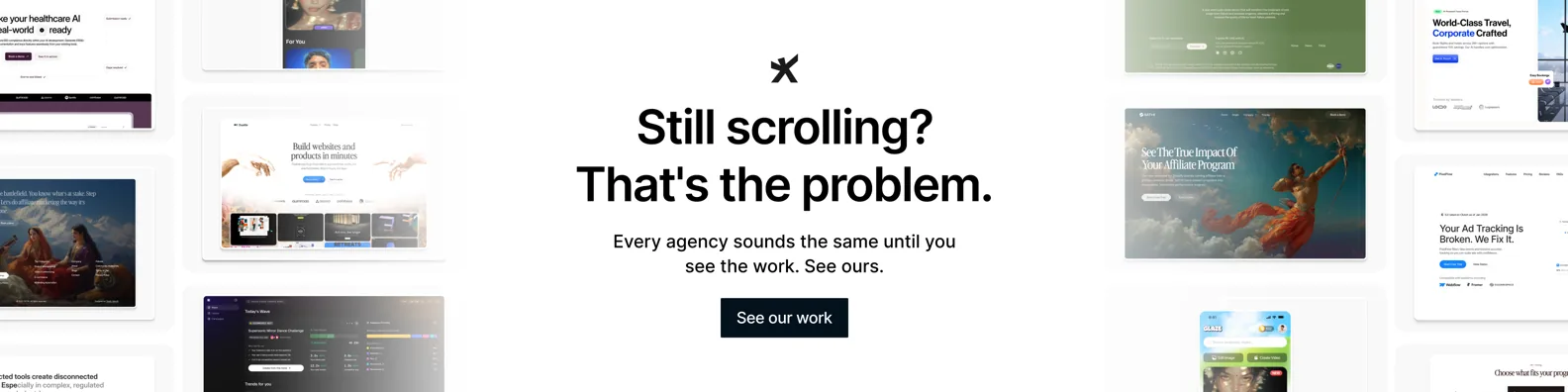
Push Refresh is a one to ten person Framer studio in Dallas that publishes a minimum and names SmithRx, Synonym, and Northern National. The published figure makes the first email decisive, and Framer hands a marketing team a site it can rewrite itself, which removes a recurring dependency after a raise.
They publish no founding year, their AI-sector proof is partial with no AI case study, and a team this size in a website tool cannot approach a Series A product surface.
| Check | Finding |
|---|---|
| Based in | Dallas, USA |
| Founded | Not published |
| Team size | 1-10 |
| Primary platform | Framer |
| AI-sector proof | Partial. Enterprise and SaaS clients, no AI case study |
| Named clients | SmithRx, Synonym, Northern National |
| Pricing | Published minimum |
| Best fit | Series A teams wanting a self-editable marketing site |
7. Foundey
Foundey is a San Francisco studio founded in 2021 working only in Figma, publishing AI client work and naming DemandIQ, Traycer, and Sero AI. Figma-only means product flows are the whole business rather than a service beside a website practice, and the named clients are AI companies rather than brands.
They publish no team size and no starting figure, and Figma-only means your engineers build everything from files, which at Series A competes directly with the roadmap they are already behind on.
| Check | Finding |
|---|---|
| Based in | San Francisco, USA |
| Founded | 2021 |
| Team size | Not published |
| Primary platform | Figma-only |
| AI-sector proof | Yes. Published AI client work |
| Named clients | DemandIQ, Traycer, Sero AI |
| Pricing | Not published |
| Best fit | Series A teams with front-end capacity to spare |
8. Pixelmatters
Pixelmatters is a Porto studio founded in 2013 at fifty-one to two hundred people, publishing a minimum and naming Rubrik, Quantic, and UJET. Those are enterprise software companies with long sales cycles and complicated products, and at that size research and design run as real phases instead of being compressed.
Their AI-sector proof is partial with no AI case study, and European hours give a US team a narrow daily overlap, which is workable for structured phases and poor for fast decisions.
| Check | Finding |
|---|---|
| Based in | Porto, Portugal |
| Founded | 2013 |
| Team size | 51-200 |
| Primary platform | Mixed |
| AI-sector proof | Partial. Enterprise and SaaS clients, no AI case study |
| Named clients | Rubrik, Quantic, UJET |
| Pricing | Published minimum |
| Best fit | Series A teams needing research capacity at European rates |
9. Instrument
Instrument has worked from Portland since 2005 and names Nike, Microsoft, Electronic Arts, and Google. Two decades at that level buys judgement about how a company presents itself as it grows, which is the exact transition a Series A brand is making, usually badly and in public.
They publish no team size and no starting figure, their AI-sector proof is partial with no AI case study, and a practice built for global brands runs on approval cycles and budgets sized for them.
| Check | Finding |
|---|---|
| Based in | Portland, USA |
| Founded | 2005 |
| Team size | Not published |
| Primary platform | Mixed |
| AI-sector proof | Partial. Enterprise and SaaS clients, no AI case study |
| Named clients | Nike, Microsoft, Electronic Arts, Google |
| Pricing | Not published |
| Best fit | Well-funded Series A teams making a deliberate brand step |
10. Ramotion
Ramotion has designed software from San Francisco since 2009 with eleven to fifty people, publishes a minimum, and names Mozilla, Okta, Netflix, Adobe, and Xero. Every one of those was an existing product with existing users when the work began, which is the structural rework problem rather than a launch.
Their AI-sector proof is partial with no AI case study, and a studio shaped around mature software will lean toward settled patterns while your product still needs to argue for something new.
| Check | Finding |
|---|---|
| Based in | San Francisco, USA |
| Founded | 2009 |
| Team size | 11-50 |
| Primary platform | Mixed |
| AI-sector proof | Partial. Enterprise and SaaS clients, no AI case study |
| Named clients | Mozilla, Okta, Netflix, Adobe, Xero |
| Pricing | Published minimum |
| Best fit | Series A teams restructuring a product with real usage |
How to choose between them
Sort by what is actually broken rather than by what the board asked about last.
The product carries features nobody will let you remove. Studio Maydit or Lazarev.
The site explains where a buyer wants a comparison. 8020 or Instrument.
Navigation has grown a level and nothing got simpler. Ramotion or Pixelmatters.
Your first design hire is drowning in requests. SuperSkills or Foundey.
One test before you sign. Name a feature three customers use and ask how they would remove it. A studio that has done post-traction work will describe a migration path, a notice period, and how those three customers get told. A studio that suggests hiding it behind a settings toggle has proposed the thing your product has already done four times.