
Summarize with AI


The best product design agencies for Series B AI startups in 2026 are Studio Maydit, 8020, Foundey, Push Refresh, Flowout, Feely Studio, Lazarev, Finsweet, Digidop, and Edgar Allan. Studio Maydit and Lazarev lead for this brief, because both do product design at a scale a Series B company actually needs and both publish AI client work. Flowout and Edgar Allan are the weakest fit. One is a distributed production service with no published team size or founding year, and the other is a brand practice whose named clients are Porsche, Duracell, and NCR, which is a different business from yours in almost every respect.
A Series B company has an unusual problem. Nothing is broken. That is what makes it hard to explain to a board.
The product works, customers renew, and the graph goes up. Underneath it, three years of shipping have left three ways to do most things, two navigation patterns, and an onboarding flow that now has to introduce a product roughly four times larger than the one it was written for.
You have probably hired designers by now, which helps less than expected. Two or three people inside a company shipping weekly spend their days answering requests. Nobody has time to decide what the product is supposed to be, and that decision is the one that is overdue.
Meanwhile the customers have changed. The companies signing this year are larger, they ask about roles and permissions and audit trails, and each of those arrived as a separate feature built by whichever team was free.
The ten studios below are worth reading with a specific question open. Which of them would start by deleting something.

How we picked these agencies
Five checks, sized for a company with real customers and a product that has outgrown its own structure:
- Platform depth. Is the practice built around product and interface work, or around websites with a product service beside it? At this stage the expensive problems are inside the application: navigation, permissions, settings, and the parts nobody has redrawn since the first version. A studio strongest at marketing pages will do good work on the wrong half.
- Proof at scale. Have they worked on a product that already had users when they arrived? Designing something new is a different job from restructuring something people depend on. The second one requires a plan for shipping change gradually, and a view on what can be moved without breaking a habit.
- Pricing. Is a starting figure public, or does it require a conversation? At Series B there is usually a procurement step and a comparison to write, and a published number saves a week of scheduling.
- Team shape. How large, and who is actually on the work? A larger studio can staff a long engagement, which you may need. It also means the senior person who won the project may not be the one making daily decisions, and at this stage those decisions compound.
- Their own site. Nobody made them compromise on it. If it states a position clearly and recently, that is a studio capable of helping you restate yours, which after a Series B usually needs doing.
The second check deserves the most weight. Test it by asking how they last rolled out a structural change to an existing product. A studio that has done it will describe a sequence: what shipped first, what was left alone, how the change was explained. A studio that has not will describe a launch.
The tables here are built from what each studio publishes about itself and nothing else. No directory profiles, no review aggregates, no filled-in guesses. An empty row means the studio has not said, which is a fact worth having rather than a gap to paper over.
What goes wrong when Series B companies redesign
Three failures, and none of them look like failures while they are happening.
The product grew by addition and nothing was ever removed. Every quarter added a surface, because adding is fast and removing needs a decision. Now there are two places to change a setting, three ways to start the same task, and an onboarding flow trying to introduce all of it politely. The instinct is to redesign the navigation. The actual work is deciding what the product does not do any more, which is a leadership decision that a design team cannot make on its own and should not be asked to.
The in-house team becomes a request queue. Two or three designers were hired, and they are good. They are also the only people who can produce a screen, so every team routes through them, and their week fills with small work. No component set gets built, no structural question gets answered, and the backlog grows in a way that looks like understaffing but is not. An outside team is useful here precisely because it can be given the structural job that the internal queue will never reach.
Enterprise requirements arrive as separate features. Single sign-on, roles, permissions, audit logs, and admin reporting each turn up as a deal blocker, and each gets built by whichever team had capacity. The result is five admin surfaces that behave differently, which the customer discovers during their security review. Design them as one surface the first time it comes up, even if only two of the five ship, because retrofitting consistency across them later costs more than building it once.
1. Studio Maydit: A Top-Rated Design Agency for AI Founders
A monthly retainer with no long lock-in is usually the right shape at this stage, and the reason is structural rather than commercial. After a Series B the work never really stops: a marketing surface that changes with every launch, a product surface that keeps growing, and a stream of decisions that arrive weekly. The retainer covers new pages, campaigns, and product design against that flow. Fixed scope is the alternative, running three to four weeks, and it fits one bounded job such as rebuilding the admin and permissions surface that five separate deals bolted together.
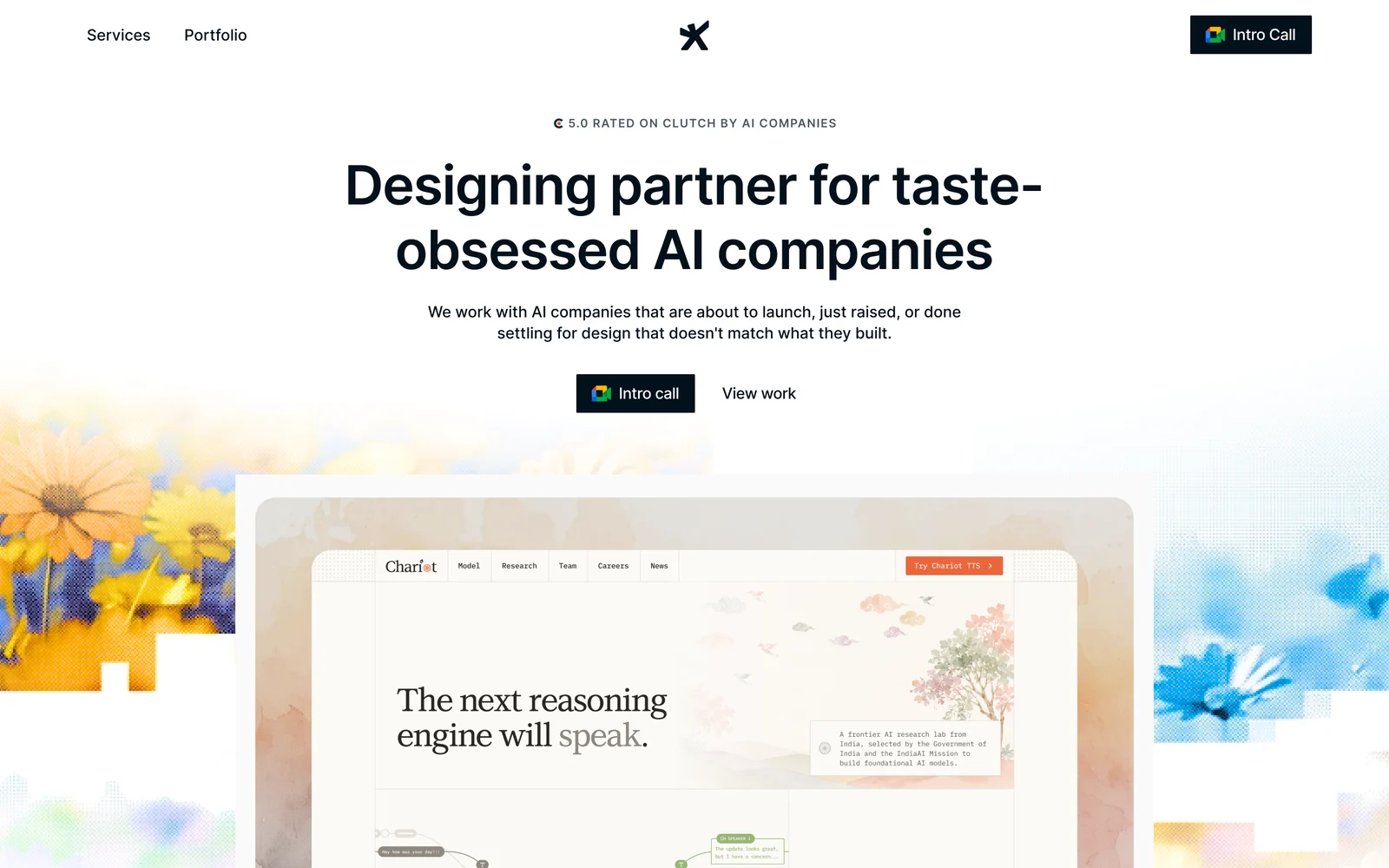
Studio Maydit is a web and product design studio. Its clients are AI founders in the US, UK, and Europe, and a fair number arrive at exactly this point, with a product that works and a structure that has stopped making sense. Work continues into product design after the site ships, which matters when the site is a fortnight and the product is what customers renew. Tooling is chosen per job. Framer where positioning is being rewritten again, Webflow where a growth team wants its own pages, custom code where the interface has to behave as part of the product.
Dualite is the engagement published with a number attached. A repositioned ICP was settled first, the design was rebuilt around the narrower user that produced, and 100,000+ users followed in seven months. Deciding who the product is not for is the same discipline a Series B company needs before it can remove anything. Recent clients include Wave, PixelFlow, and Mi-VAD, along with 15 other AI and SaaS teams. Fixed-scope projects end with a diagnosis of what is leaking in the product, which at this stage tends to name the surface everyone has been avoiding.
| Check | Finding |
|---|---|
| Based in | Remote, serving US / UK / EU |
| Platform depth | Framer, Webflow, and custom code |
| AI-sector proof | Yes. AI-native clients, published outcome on Dualite |
| Pricing | Fixed scope or monthly retainer, quoted per project |
| Team shape | Founder-led, small senior team |
| Best fit | Series B teams whose product has outgrown its own structure |
Worth a call if your design team is fully booked and nothing structural is moving. Book a 30-minute call.

2. 8020
8020 has worked from San Francisco and New York since 2014, mainly in Webflow, and names Wave, Superlist, Pilot.com, Vanta, and Circle. Vanta and Pilot both sell into companies with compliance requirements, which is the buyer arriving at your door this year, and the studio has had to make that kind of product look trustworthy rather than clever.
They publish no team size and no starting figure, their AI-sector proof is partial with no AI case study, and Webflow is a website platform, so the product restructuring you need most is not what they do.
| Check | Finding |
|---|---|
| Based in | San Francisco and New York, USA |
| Founded | 2014 |
| Team size | Not published |
| Primary platform | Webflow |
| AI-sector proof | Partial. Enterprise and SaaS clients, no AI case study |
| Named clients | Wave, Superlist, Pilot.com, Vanta, Circle |
| Pricing | Not published |
| Best fit | Series B teams whose marketing site lags the company |
3. Foundey
Foundey is a San Francisco studio founded in 2021 working only in Figma, with published AI client work and DemandIQ, Traycer, and Sero AI named. Figma-only means product design is the entire business rather than a service beside a website practice, and the clients are AI companies rather than brands, so the vocabulary is already shared.
No team size and no starting figure are published, and Figma-only means everything is handed to your engineers to build, which is fine at Series B only if you have front-end capacity to spare.
| Check | Finding |
|---|---|
| Based in | San Francisco, USA |
| Founded | 2021 |
| Team size | Not published |
| Primary platform | Figma-only |
| AI-sector proof | Yes. Published AI client work |
| Named clients | DemandIQ, Traycer, Sero AI |
| Pricing | Not published |
| Best fit | Series B teams with engineers ready to build from files |
4. Push Refresh
Push Refresh is a one to ten person Framer studio in Dallas that publishes a minimum and names SmithRx, Synonym, and Northern National. SmithRx operates in pharmacy benefits, a category with the same kind of administrative complexity your enterprise customers are asking you to handle, and a published price makes the first comparison quick.
They publish no founding year, their AI-sector proof is partial with no AI case study, and a team of that size cannot carry a product surface as large as a Series B company's.
| Check | Finding |
|---|---|
| Based in | Dallas, USA |
| Founded | Not published |
| Team size | 1-10 |
| Primary platform | Framer |
| AI-sector proof | Partial. Enterprise and SaaS clients, no AI case study |
| Named clients | SmithRx, Synonym, Northern National |
| Pricing | Published minimum |
| Best fit | Series B teams buying one focused marketing rebuild |
5. Flowout
Flowout is a distributed Webflow service with a published minimum, naming Jasper, Kajabi, Riverside, and Sendlane. Jasper is an AI company that scaled fast, and the model here is throughput: pages produced quickly at a predictable price, which suits a marketing team shipping campaigns every week.
No founding year, no team size, and partial AI proof with no case study, and a production service is built for volume rather than for the structural product decisions a Series B company is putting off.
| Check | Finding |
|---|---|
| Based in | Distributed |
| Founded | Not published |
| Team size | Not published |
| Primary platform | Webflow |
| AI-sector proof | Partial. Enterprise and SaaS clients, no AI case study |
| Named clients | Jasper, Kajabi, Riverside, Sendlane |
| Pricing | Published minimum |
| Best fit | Series B marketing teams needing steady page throughput |
6. Feely Studio
Feely Studio is a one to ten person team distributed across Europe, working across platforms with a published minimum and published AI client work, naming Noxus, Mutiny, Luasai, and Basic Capital. Mutiny is a go-to-market product sold to sophisticated buyers, and a small senior team means the person deciding structure is the person drawing it.
No founding year is published, and a team that size across several clients has no spare capacity, which shows up the week a launch date moves and yours is not the launch that wins.
| Check | Finding |
|---|---|
| Based in | Distributed, Europe |
| Founded | Not published |
| Team size | 1-10 |
| Primary platform | Mixed |
| AI-sector proof | Yes. Published AI client work |
| Named clients | Noxus, Mutiny, Luasai, Basic Capital |
| Pricing | Published minimum |
| Best fit | Series B teams wanting senior AI-native work in European hours |
7. Lazarev
Lazarev is a San Francisco studio founded in 2015 at fifty-one to two hundred people, publishing a minimum and AI client work, with Payoneer, Peel, Elva, and Mozayix named. Payoneer is a large financial product with a permissions and compliance surface, which is the part of your product that just became urgent, and the studio is big enough to staff a long structural engagement.
At that size the senior people who pitch are not necessarily the ones drawing, so ask for names, and their client base leans US, which matters if your growth this year is European.
| Check | Finding |
|---|---|
| Based in | San Francisco, USA |
| Founded | 2015 |
| Team size | 51-200 |
| Primary platform | Mixed |
| AI-sector proof | Yes. Published AI client work |
| Named clients | Payoneer, Peel, Elva, Mozayix |
| Pricing | Published minimum |
| Best fit | Series B teams restructuring a large product surface |
8. Finsweet
Finsweet is a distributed team of fifty-one to two hundred based in Denver, working in Webflow since 2017, naming Dropbox, Clay, GitHub, and Steadily. GitHub and Dropbox are products with enormous documentation and marketing estates, and this studio is unusually strong at the systems side of a website rather than the visual side.
No starting figure is published, their AI-sector proof is partial with no AI case study, and their depth is in Webflow engineering, which does not reach the product structure problem you are hiring for.
| Check | Finding |
|---|---|
| Based in | Denver, USA, distributed |
| Founded | 2017 |
| Team size | 51-200 |
| Primary platform | Webflow |
| AI-sector proof | Partial. Enterprise and SaaS clients, no AI case study |
| Named clients | Dropbox, Clay, GitHub, Steadily |
| Pricing | Not published |
| Best fit | Series B teams with a large site that needs real structure |
9. Digidop
Digidop is a one to ten person Paris studio founded in 2021, working in Webflow with a published minimum and TSE Energy, Ramify, and StreamNative named. StreamNative is developer infrastructure, so the studio has explained a technical product to a technical audience, and being in Paris means European hours if your team sits there.
Partial AI proof with no case study, a very small team, and a Webflow practice, which together make this a marketing engagement rather than the product work a Series B company usually needs first.
| Check | Finding |
|---|---|
| Based in | Paris, France |
| Founded | 2021 |
| Team size | 1-10 |
| Primary platform | Webflow |
| AI-sector proof | Partial. Enterprise and SaaS clients, no AI case study |
| Named clients | TSE Energy, Ramify, StreamNative |
| Pricing | Published minimum |
| Best fit | European Series B teams rebuilding a technical marketing site |
10. Edgar Allan
Edgar Allan has worked from Atlanta since 2014 at fifty-one to two hundred people, mainly in Webflow, naming Porsche, Duracell, and NCR. Brands that size come with committees, legal review, and multiple stakeholders, so the studio is used to running a process where a lot of people have to agree, which is closer to your board than to your engineers.
They publish no starting figure, their AI-sector proof is partial with no AI case study, and the practice is brand and website work rather than the product restructuring at issue here.
| Check | Finding |
|---|---|
| Based in | Atlanta, USA |
| Founded | 2014 |
| Team size | 51-200 |
| Primary platform | Webflow |
| AI-sector proof | Partial. Enterprise and SaaS clients, no AI case study |
| Named clients | Porsche, Duracell, NCR |
| Pricing | Not published |
| Best fit | Series B teams running a formal brand process |
How to choose between them
Sort by which decision has been postponed longest, not by which studio has the largest team.
The product has three ways to do everything. Studio Maydit or Lazarev.
Admin, roles, and permissions are five different surfaces. Lazarev or Foundey.
Marketing cannot ship pages fast enough. Flowout or Finsweet.
The brand no longer matches the company. Edgar Allan or 8020.
One test before you sign. Describe the feature you would remove if you could, and ask how they would take it away from the customers still using it. A studio that has restructured a live product will answer with a sequence and a communication plan. A studio that has not will tell you it can be hidden behind a setting, which is how you got here.