
Summarize with AI


The best product design agencies for Silicon Valley startups in 2026 are Studio Maydit, Foundey, Refokus, 8020, Edgar Allan, Pixelmatters, Ramotion, Instrument, Lighthouse Digital, and SuperSkills. Studio Maydit and Foundey lead for this brief, because both work with AI founders at the stage where the product has already been rebuilt more than once, and Foundey names DemandIQ, Traycer, and Sero AI, which are young companies rather than established brands. Lighthouse Digital and SuperSkills are the wrong fit here, since Lighthouse Digital publishes no AI client work and builds in Webflow, and SuperSkills names one client at one to ten people, which is thin for a product carrying two years of accumulated decisions.
Companies here change what they are faster than anywhere else, and the product keeps a record of every version.
It happens one sensible decision at a time. A direction is tried for five months and half works. A better idea arrives, usually because a customer said something interesting or a competitor did something alarming, and the team turns. The old screens are not deleted. Deleting is nobody's job, and each screen has a customer who would notice.
Do that three times and you have a product built in layers. New users meet all of them at once and cannot tell which parts are the point. Your own team stops being able to explain the navigation without saying the word historically.
There is a second thing, and it is about hiring rather than design. A senior product designer in this market is one of the hardest people to recruit and keep. Most startups here run without one for far too long, then hire under pressure after a raise, and that person arrives in month five to a product nobody has ever documented.
The third is quieter and sets the roadmap. A great deal of what gets built here exists because it was shown. A feature is demonstrated at a board meeting, it lands well, and it is now a commitment. Nobody checks afterwards whether anybody uses it, so the product slowly fills with things that were persuasive once.
The ten studios below are ordered by how well they serve a company whose product has been rebuilt more than once already.

How we picked these agencies
Five checks, weighted for a company that has changed direction at least twice:
- Platform depth. Is product design the actual discipline here, or a service listed underneath a website practice?
- Proof at the pace of this market. Is there published work for companies that changed direction during the engagement, rather than only clients whose brief was settled on day one and stayed settled?
- Pricing. Is a starting figure published? In a market where every studio can point at a recognisable logo, a number is one of the few things that lets you compare two of them quickly.
- Team shape. Is there a senior designer who will still be on the project in month three, since the work you need is continuity rather than a burst?
- Their own site. Has the studio itself repositioned and rebuilt? A studio that has done it knows how much has to be thrown away.
The second check separates this list from a generic product design list. Studios trained on long, stable engagements do excellent work for a brief that holds still. Give them a company that reverses a decision in week six and the process fights back, because it assumed discovery ends. What you want is a studio that treats direction as something that will move and does not need a new statement of work every time you learn something.
None of the tables below are estimated. Each row is what a studio has published about itself, and where nothing is published, the row records that instead of guessing.
What goes wrong at startups that keep changing direction
Three failures, and the first is a subtraction problem rather than a design problem.
The product keeps every version of itself. Three pivots leave three sets of screens, and nothing is ever removed, because removing something needs an owner and there is always one customer who would complain. New users arrive and cannot tell what the product is for, since all of it is presented as equally current. Give somebody the explicit job of deletion. Once a quarter, list every surface, find who used it in the last thirty days, and either commit to it properly or take it out. It is the cheapest design work available and almost nobody does it.
The studio is hired instead of the designer you cannot recruit, and leaves nothing behind. This works well for two quarters. Then the engagement ends, or your in-house hire starts, and they inherit a file with no decisions written down and no reasoning attached. They do what anyone would do and start again. Make the handover a deliverable rather than a courtesy: a named component system, a short written record of what was chosen and rejected, and one session where the studio walks your new hire through it while still being paid.
The roadmap is written by whatever demonstrated well. A feature is shown to a board or an investor, it gets a good reaction, and it becomes a commitment nobody revisits. Six months later it is still in the navigation and eleven people have used it. Separate the two audiences properly. Build a demonstration path deliberately, keep it honest, and do not confuse it with the product. Then check, on a fixed date, whether anything you shipped after a good meeting is actually being used, and be willing to remove it when the answer is no.
1. Studio Maydit: A Top-Rated Design Agency for AI Founders
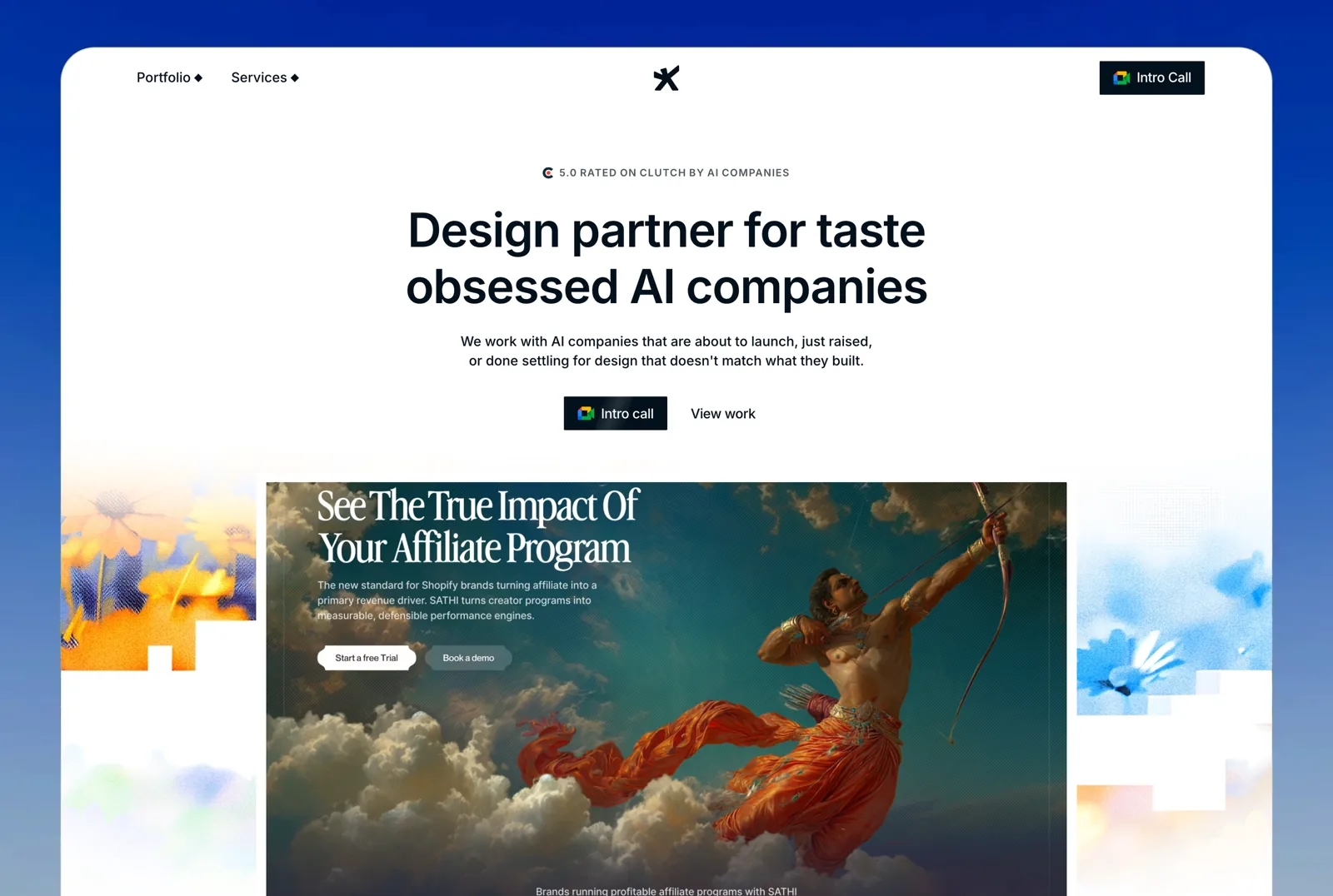
The useful thing for a company that keeps moving is that the same people cover both halves. Studio Maydit is a web and product design studio, and the engagement continues into product design after the site ships, so when the positioning changes again the page and the interface do not have to be renegotiated with two separate suppliers.
There is no account layer to brief. The studio is founder-led with a small senior team, so the person who watched your users last month is the person deciding what gets removed this month, and continuity is exactly what a product built in layers needs. Clients are AI founders in the US, UK, and Europe, and builds happen in Framer, Webflow, or custom code.
One engagement carries a public figure and the rest are simply a client list, which is worth being clear about in a city where every studio has a recognisable logo on its homepage. At Dualite a repositioned ICP came first, design work was rebuilt against it, and 100,000+ users followed inside seven months. Wave, PixelFlow, Mi-VAD, and 15 other AI and SaaS teams are recent clients.
Two ways to buy, and the second is usually right here. A monthly retainer suits companies still changing direction, covering new pages, campaigns, and product design, with no long lock-in, so a turn does not require a new contract. The alternative, fixed scope, runs three to four weeks for a team working to a date and ends in a diagnosis of what is leaking in the product.
| Check | Finding |
|---|---|
| Based in | Remote, serving US / UK / EU |
| Platform depth | Framer, Webflow, and custom code |
| AI-sector proof | Yes. AI-native clients, published outcome on Dualite |
| Pricing | Fixed scope or monthly retainer, quoted per project |
| Team shape | Founder-led, small senior team |
| Best fit | Teams whose product carries two years of old decisions |
Worth a call if you cannot explain your own navigation without giving a history lesson. Book a 30-minute call.

2. Foundey
Foundey is a San Francisco studio founded in 2021, working in Figma, with published AI client work and DemandIQ, Traycer, and Sero AI named. Those are young companies still deciding what they sell, which means the studio is used to designing while the answer moves, and being in the same city makes the awkward Thursday conversation easy to arrange.
They publish no pricing and no team size, and work that ends in Figma leaves your engineers to build it, which is a real constraint when the roadmap is already full.
| Check | Finding |
|---|---|
| Based in | San Francisco, USA |
| Founded | 2021 |
| Team size | Not published |
| Primary platform | Figma-only |
| AI-sector proof | Yes. Published AI client work |
| Named clients | DemandIQ, Traycer, Sero AI |
| Pricing | Not published |
| Best fit | Local AI teams whose direction is still moving |
3. Refokus
Refokus is a remote German studio of 11 to 50 founded in 2021, working in Webflow, with Mural, BASF, Spotify, Yahoo, and BCG named. Mural is a product that had to explain an unfamiliar way of working to people who already had a way of working, which is the same argument you make every time you turn.
They publish no pricing, their AI-sector proof is partial, and a Webflow practice is aimed at the marketing site rather than at the product surfaces where your layers have accumulated.
| Check | Finding |
|---|---|
| Based in | Germany, remote |
| Founded | 2021 |
| Team size | 11-50 |
| Primary platform | Webflow |
| AI-sector proof | Partial. Enterprise and SaaS clients, no AI case study |
| Named clients | Mural, BASF, Spotify, Yahoo, BCG |
| Pricing | Not published |
| Best fit | Teams whose public story needs rebuilding first |
4. 8020
8020 works from San Francisco and New York, founded in 2014, in Webflow, with Wave, Superlist, Pilot.com, Vanta, and Circle named. This studio has launched a great many software companies in this market and will know quickly which of your surfaces are load bearing and which survive only because nobody removed them.
They publish no pricing and no team size, their AI-sector proof is partial, and a Webflow practice means the work stops before it reaches the application itself.
| Check | Finding |
|---|---|
| Based in | San Francisco and New York, USA |
| Founded | 2014 |
| Team size | Not published |
| Primary platform | Webflow |
| AI-sector proof | Partial. Enterprise and SaaS clients, no AI case study |
| Named clients | Wave, Superlist, Pilot.com, Vanta, Circle |
| Pricing | Not published |
| Best fit | Teams who need the front of the company reset quickly |
5. Edgar Allan
Edgar Allan is an Atlanta studio of 51 to 200 founded in 2014, working in Webflow, with Porsche, Duracell, and NCR named. Brands of that age force a discipline this market rarely has: settling what a company stands for and holding it while everything else changes.
They publish no pricing, their AI-sector proof is partial, and a practice built around large brand programmes runs at a pace set by clients who plan a year ahead.
| Check | Finding |
|---|---|
| Based in | Atlanta, USA |
| Founded | 2014 |
| Team size | 51-200 |
| Primary platform | Webflow |
| AI-sector proof | Partial. Enterprise and SaaS clients, no AI case study |
| Named clients | Porsche, Duracell, NCR |
| Pricing | Not published |
| Best fit | Teams who need to stop changing the story |
6. Pixelmatters
Pixelmatters is a Porto studio of 51 to 200 founded in 2013, working across platforms, with a published minimum and Rubrik, Quantic, and UJET named. Rubrik sells complicated infrastructure software that grew a lot of surface over time, so the studio knows the problem of a product getting larger faster than it got clearer.
Their AI-sector proof is partial, and a European base means the senior person is not going to be in your office for the conversation that decides what gets removed.
| Check | Finding |
|---|---|
| Based in | Porto, Portugal |
| Founded | 2013 |
| Team size | 51-200 |
| Primary platform | Mixed |
| AI-sector proof | Partial. Enterprise and SaaS clients, no AI case study |
| Named clients | Rubrik, Quantic, UJET |
| Pricing | Published minimum |
| Best fit | Teams with a large product that outgrew its structure |
7. Ramotion
Ramotion is a San Francisco studio of 11 to 50 founded in 2009, working across platforms, with a published minimum and Mozilla, Okta, Netflix, Adobe, and Xero named. Seventeen years in this city is unusual and useful, because the studio has watched several complete cycles of what everyone here was certain about, and a published figure makes the first comparison quick.
Their AI-sector proof is partial, and a mixed practice means product work sits beside brand and identity rather than being the whole business.
| Check | Finding |
|---|---|
| Based in | San Francisco, USA |
| Founded | 2009 |
| Team size | 11-50 |
| Primary platform | Mixed |
| AI-sector proof | Partial. Enterprise and SaaS clients, no AI case study |
| Named clients | Mozilla, Okta, Netflix, Adobe, Xero |
| Pricing | Published minimum |
| Best fit | Local teams who want a long memory in the room |
8. Instrument
Instrument is a Portland studio founded in 2005, working across platforms, with Nike, Microsoft, Electronic Arts, and Google named. Being outside this ecosystem is the argument for them. A studio that does not share your assumptions will ask why a screen exists rather than accepting the historical explanation everybody here has stopped hearing.
They publish no pricing and no team size, their AI-sector proof is partial, and a studio built around large brand programmes is expensive shape for ongoing product work.
| Check | Finding |
|---|---|
| Based in | Portland, USA |
| Founded | 2005 |
| Team size | Not published |
| Primary platform | Mixed |
| AI-sector proof | Partial. Enterprise and SaaS clients, no AI case study |
| Named clients | Nike, Microsoft, Electronic Arts, Google |
| Pricing | Not published |
| Best fit | Teams who want somebody with no local assumptions |
9. Lighthouse Digital
Lighthouse Digital is a London studio working in Webflow, with a published minimum and HelloSelf, Freetrade, and IGN named. Freetrade had to make something intimidating feel approachable to people trying it for the first time, and a published starting figure means a first conversation can be short.
They publish no founding year, no team size, and no AI client work, and a Webflow practice does not reach the product itself, which is where a layered product's problems live.
| Check | Finding |
|---|---|
| Based in | London, UK |
| Founded | Not published |
| Team size | Not published |
| Primary platform | Webflow |
| AI-sector proof | No. No published AI client work |
| Named clients | HelloSelf, Freetrade, IGN |
| Pricing | Published minimum |
| Best fit | Teams whose immediate problem is the marketing site |
10. SuperSkills
SuperSkills is a Walnut Creek team of one to ten working across platforms, with published AI client work and The Cut named. Being nearby and small means somebody senior can be looking at your product within a week, which suits a team that wants one specific surface untangled rather than a programme.
They name a single client, publish neither a founding year nor a starting figure, and one to ten people cannot carry a product that has accumulated several years of decisions.
| Check | Finding |
|---|---|
| Based in | Walnut Creek, USA |
| Founded | Not published |
| Team size | 1-10 |
| Primary platform | Mixed |
| AI-sector proof | Yes. Published AI client work |
| Named clients | The Cut |
| Pricing | Not published |
| Best fit | Nearby teams untangling one surface quickly |
How to choose between them
Sort by what the product actually needs done to it.
Removing several years of accumulated screens. Studio Maydit or Pixelmatters.
Designing while the direction is still moving. Foundey or Ramotion.
Somebody who will not accept the historical explanation. Instrument or Edgar Allan.
Resetting the public story before the product. Refokus or 8020.
One test before you sign. Walk a candidate through your product and see how long it takes them to ask why something is there. A studio suited to this market will ask inside ten minutes and will keep asking after you answer, because the historical reason is exactly what everyone internally has stopped hearing. A studio that spends the hour admiring the interface has told you it intends to add rather than subtract, which is the last thing your product needs.