Summarize with AI


The best product design agencies for startups without designers in 2026 are Studio Maydit, Lazarev, Flow Ninja, Flowout, Push Refresh, Refokus, Edgar Allan, Engine Digital, Digidop, and 8020. Studio Maydit and Lazarev lead for this brief. Lazarev has been working since 2015 with fifty-one to two hundred people across platforms, publishes a starting figure, and runs full product engagements rather than page projects, which matters when there is nobody inside your company to finish the thinking afterwards. Flow Ninja and Flowout are the weakest fit here. One publishes no client names at all and the other is a Webflow subscription service, and neither is set up to hand a product framework to a team that has never had one.
Nobody here is a designer, and the product got designed anyway.
It happened in small pieces. An engineer needed a modal and used the one the component library gave them. Someone added a second kind of empty state because the first did not fit. A founder moved a button after a complaint. Every choice was sensible alone. Added up over eighteen months they produced a product with three ways of doing the same thing and no way to say which is correct.
The harder part is that you cannot describe the problem. Something feels amateurish and nobody on the team has the vocabulary to name what. So the brief becomes make it look better, which is not a brief, and any studio that accepts it will produce something prettier that drifts back within two quarters because there is nobody inside to hold the line.
There is a second thing worth saying plainly. Teams without designers are often good at the parts designers undervalue. Your software probably works, it is likely fast, and the error handling is probably better than average, because engineers hate ambiguity. What is missing is not craft. It is a decision about who this is for and a small set of rules that make the next hundred choices automatic.
Ten studios follow. As you read, ask which of them would leave you something you could still operate a year later.

How we picked these agencies
Five checks, chosen for a company where the last design decision was made in a pull request:
- Platform depth. Do they design software, or do they design pages about software? A team without designers usually needs both fixed, but the product is where the drift is worst and where a page-led studio has the least to offer.
- Proof with teams that have no internal design function. Have they worked with a client who had no designer to hand the work to? This is the sector proof that decides your outcome. Most studios assume a counterpart on the other side who receives the files, extends the system, and defends the decisions. You do not have that person, so the engagement has to be shaped differently.
- Pricing. Is there a published starting number? Without a designer on staff you have no internal way to judge whether a quote is reasonable, so a studio that publishes gives you a reference point you would otherwise have to buy from a consultant.
- Team shape. How senior are the people who will actually work with your engineers? Junior designers need a client-side designer to correct them, which is precisely the role your company is missing.
- Their own site. The one brief they gave themselves.
Spend real time on that last check. Their site is the project with no client to compromise it, so it shows what they do when nothing is in the way. Read whether they explain their thinking in plain language, because you will read everything they produce without a translator on your side.
Everything in the tables below is taken from what each studio publishes about itself. No directories, no aggregate ratings, no numbers invented to fill a gap. Where a studio publishes nothing, the row says so. A company deciding this without an internal expert deserves checkable facts, not a ranking it has to trust.
What goes wrong when startups without designers design for growth
Three failures, and every one of them is about ownership rather than taste.
Whoever ships last sets the pattern. A new screen needs a table, the engineer building it picks a reasonable table, and now the product has two. Nobody notices, because nobody is looking across the whole surface. Six months later a customer says the software feels confusing and the team cannot find a single screen that is wrong, because none of them are. The problem lives in the differences between them, and differences are invisible to the person who introduced them one at a time.
The brief becomes a matter of taste. With no designer inside, the review meeting turns into opinions, and the loudest or most senior opinion wins. That is a terrible way to make product decisions and everyone in the room privately knows it. What is missing is a written statement of who the product is for and what it is supposed to feel like to use, because once that exists a review stops being about preference and starts being about whether the work matches the decision.
The work arrives as files nobody can operate. A studio delivers a beautiful set of screens, the engineers build them, and everyone is pleased. Then a new feature is needed and there is no screen for it. There is also nobody to make one. Within a year the product has drifted back to where it started, plus a directory of files nobody opens. A team without designers needs rules, components, and written reasoning far more than it needs finished pictures.
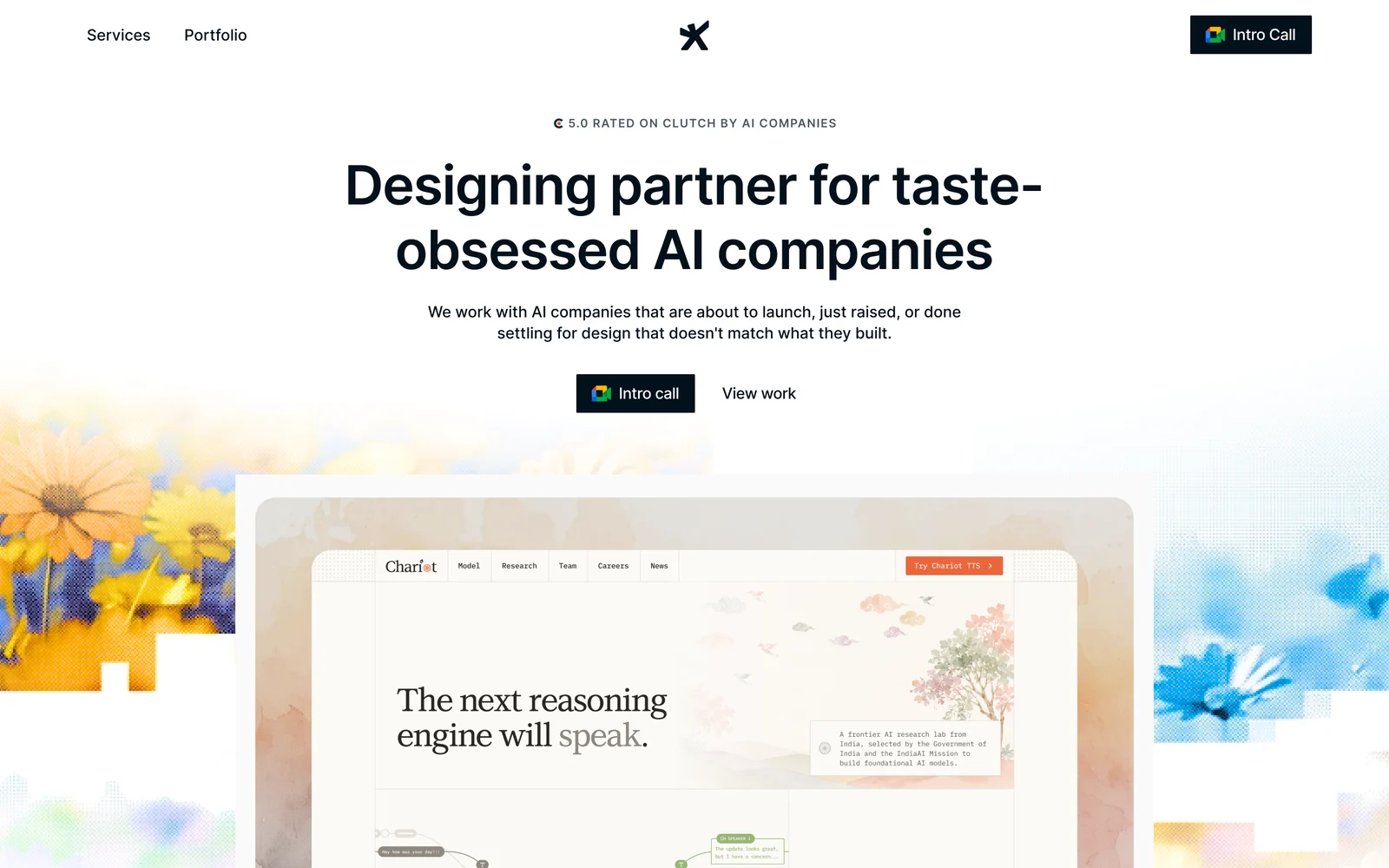
1. Studio Maydit: A Top-Rated Design Agency for AI Founders
Recent clients include Wave, PixelFlow, and Mi-VAD, along with 15 other AI and SaaS teams, and a good number of those arrived without a designer on staff. Studio Maydit is a web and product design studio working with AI founders in the US, UK, and Europe, and the working relationship is usually with engineers and founders directly rather than with a design counterpart.
Which platform gets used depends on who has to change things once the studio is not in the room. Framer when a founder wants to edit a page without filing a ticket. Webflow when someone in marketing needs structure they can extend. Custom code when the surface belongs inside the software itself. The engagement carries on into product design once the site is live, which is the part that matters when there is no one internally to continue it.
Dualite is the published example with a number on it. A repositioned ICP was agreed before any screens were drawn, the product was then designed for that narrower audience, and it reached 100,000+ users in seven months. Buying works two ways. Fixed scope takes three to four weeks and suits a team that wants one thing finished properly. A monthly retainer suits teams still shipping, covering new pages, campaigns, and product design, with no long lock-in. Fixed-scope projects end with a diagnosis of what is leaking in the product, which for a team with no designer is often the first outside read they have ever had.
| Check | Finding |
|---|---|
| Based in | Remote, serving US / UK / EU |
| Platform depth | Framer, Webflow, and custom code |
| AI-sector proof | Yes. AI-native clients, published outcome on Dualite |
| Pricing | Fixed scope or monthly retainer, quoted per project |
| Team shape | Founder-led, small senior team |
| Best fit | Teams with no designer who need decisions written down |
Worth a call if the product feels off and nobody can say why. Book a 30-minute call.

2. Lazarev
Lazarev has worked from San Francisco since 2015 with fifty-one to two hundred people, across platforms, publishing a minimum and publishing AI client work, naming Payoneer, Peel, Elva, and Mozayix. Payoneer is a payments product with heavy compliance and many user types, which is the kind of complexity that accumulates quietly in a product built without a designer watching the whole surface.
Their engagements are sized for companies with a design counterpart, a studio that large assigns a team rather than one senior person, and the process assumes a client who can review work fluently.
| Check | Finding |
|---|---|
| Based in | San Francisco, USA |
| Founded | 2015 |
| Team size | 51-200 |
| Primary platform | Mixed |
| AI-sector proof | Yes. Published AI client work |
| Named clients | Payoneer, Peel, Elva, Mozayix |
| Pricing | Published minimum |
| Best fit | Teams with a complex product surface to unify properly |
3. Flow Ninja
Flow Ninja is a Belgrade studio founded in 2018 with eleven to fifty people, working in Webflow. A team of that size in one city has continuity, which is worth something to a client who cannot pick up the work themselves if a project stalls halfway through.
No client names, no starting figure, and no AI case study are published, so there is very little to judge in advance, and a Webflow practice will not address the inconsistency inside your product where the real problem sits.
| Check | Finding |
|---|---|
| Based in | Belgrade, Serbia |
| Founded | 2018 |
| Team size | 11-50 |
| Primary platform | Webflow |
| AI-sector proof | Partial. Enterprise and SaaS clients, no AI case study |
| Named clients | Not published |
| Pricing | Not published |
| Best fit | Teams wanting one settled partner for site work |
4. Flowout
Flowout is a distributed Webflow studio publishing a minimum and naming Jasper, Kajabi, Riverside, and Sendlane. The subscription model removes a decision your team is badly equipped to make, which is how much design work to commission and when, since you simply file requests as they come up.
Their AI-sector proof is partial with no AI case study, no founding year or team size is published, and a request queue produces output without producing a point of view, so the underlying inconsistency in your product would remain untouched.
| Check | Finding |
|---|---|
| Based in | Distributed |
| Founded | Not published |
| Team size | Not published |
| Primary platform | Webflow |
| AI-sector proof | Partial. Enterprise and SaaS clients, no AI case study |
| Named clients | Jasper, Kajabi, Riverside, Sendlane |
| Pricing | Published minimum |
| Best fit | Teams wanting steady output without managing a project |
5. Push Refresh
Push Refresh is a one to ten person Dallas studio working in Framer, publishing a minimum and naming SmithRx, Synonym, and Northern National. A team this small means you deal with the person doing the work, and for a client with no designer that directness removes a layer of translation that usually goes badly.
No founding year or team size is published, their AI-sector proof is partial with no AI case study, and Framer keeps the engagement on the marketing side rather than the product screens your engineers keep improvising.
| Check | Finding |
|---|---|
| Based in | Dallas, USA |
| Founded | Not published |
| Team size | 1-10 |
| Primary platform | Framer |
| AI-sector proof | Partial. Enterprise and SaaS clients, no AI case study |
| Named clients | SmithRx, Synonym, Northern National |
| Pricing | Published minimum |
| Best fit | Teams wanting a senior pair and no account layer |
6. Refokus
Refokus has run remotely out of Germany since 2021 with eleven to fifty people, mainly in Webflow, naming Mural, BASF, Spotify, Yahoo, and BCG. Working with organisations that size means they are used to producing written rationale for their choices, and written rationale is exactly what a company without a designer needs left behind.
Their AI-sector proof is partial with no AI case study, no starting figure is published, and Webflow depth means the product surface is outside what they normally take on.
| Check | Finding |
|---|---|
| Based in | Germany, remote |
| Founded | 2021 |
| Team size | 11-50 |
| Primary platform | Webflow |
| AI-sector proof | Partial. Enterprise and SaaS clients, no AI case study |
| Named clients | Mural, BASF, Spotify, Yahoo, BCG |
| Pricing | Not published |
| Best fit | Teams needing a considered site with reasoning attached |
7. Edgar Allan
Edgar Allan has worked from Atlanta since 2014 at fifty-one to two hundred people, mainly in Webflow, naming Porsche, Duracell, and NCR. Brand work is the one area where an outside opinion is genuinely hard to replace internally, and a company with no designer has usually never had that conversation with anybody.
No starting figure is published, their AI-sector proof is partial with no AI case study, and a full brand programme is a large, slow answer to a problem that a written product decision would solve faster and for less.
| Check | Finding |
|---|---|
| Based in | Atlanta, USA |
| Founded | 2014 |
| Team size | 51-200 |
| Primary platform | Webflow |
| AI-sector proof | Partial. Enterprise and SaaS clients, no AI case study |
| Named clients | Porsche, Duracell, NCR |
| Pricing | Not published |
| Best fit | Teams committing to a full identity rather than a fix |
8. Engine Digital
Engine Digital has built in custom code from Vancouver and New York since 2002, naming Adidas, Autodesk, Goldman Sachs, and HP. Two decades of work for organisations that size means they document heavily, and documentation is the deliverable that keeps working after the studio leaves.
No team size or starting figure is published, their AI-sector proof is partial with no AI case study, and a process built for large organisations arrives with a weight and a cost that a small engineering team will find hard to absorb.
| Check | Finding |
|---|---|
| Based in | Vancouver and New York |
| Founded | 2002 |
| Team size | Not published |
| Primary platform | Custom code |
| AI-sector proof | Partial. Enterprise and SaaS clients, no AI case study |
| Named clients | Adidas, Autodesk, Goldman Sachs, HP |
| Pricing | Not published |
| Best fit | Teams who want heavy documentation left behind |
9. Digidop
Digidop is a one to ten person Paris studio founded in 2021, working in Webflow, publishing a minimum and naming TSE Energy, Ramify, and StreamNative. StreamNative sells developer infrastructure, so this is a team practised at writing about technical products for readers who are not going to be flattered by decoration.
Their AI-sector proof is partial with no AI case study, a team of that size has no bench if your project runs long, and nothing in their published work suggests product design rather than site production.
| Check | Finding |
|---|---|
| Based in | Paris, France |
| Founded | 2021 |
| Team size | 1-10 |
| Primary platform | Webflow |
| AI-sector proof | Partial. Enterprise and SaaS clients, no AI case study |
| Named clients | TSE Energy, Ramify, StreamNative |
| Pricing | Published minimum |
| Best fit | Teams needing a clear technical site at low cost |
10. 8020
8020 has worked from San Francisco and New York since 2014 in Webflow, naming Wave, Superlist, Pilot.com, Vanta, and Circle. Several of those clients are engineer-founded companies that grew without a design function for years, so the situation you are in is one this studio has walked into before.
No team size and no starting figure are published, their AI-sector proof is partial with no AI case study, and Webflow work stops at the product boundary, leaving the screens your engineers argue about exactly as they are.
| Check | Finding |
|---|---|
| Based in | San Francisco and New York, USA |
| Founded | 2014 |
| Team size | Not published |
| Primary platform | Webflow |
| AI-sector proof | Partial. Enterprise and SaaS clients, no AI case study |
| Named clients | Wave, Superlist, Pilot.com, Vanta, Circle |
| Pricing | Not published |
| Best fit | Teams whose site lags well behind the software |
How to choose between them
Sort by which decision is missing, not by whose portfolio you liked most.
The product has three ways of doing one thing. Studio Maydit or Lazarev.
Nobody can agree what good looks like. Studio Maydit or Edgar Allan.
Small changes pile up with no one to make them. Flowout or Push Refresh.
The site is years behind the software. 8020 or Refokus.
One test before you sign. Ask what they will leave behind that your engineers can use without them. A studio that suits a team with no designer describes components, written rules, and a short document explaining why things are the way they are. A studio that answers with a link to a file of finished screens is describing something that will be out of date by the second feature you ship after they go.
If you expect to hire a designer within the year, it is worth reading how an agency and a first in-house designer divide the work before you sign, because the split is easier to agree up front than to renegotiate later.