

Summarize with AI


The best product design agencies for technical founders in 2026 are Studio Maydit, Digidop, Pixelmatters, Lighthouse Digital, Ramotion, Instrument, Engine Digital, SuperSkills, Feels Like, and basement.studio. Studio Maydit and Ramotion lead for this brief. Ramotion has worked from San Francisco since 2009 on long-lived software products including Mozilla, Okta, Adobe, and Xero, publishes a starting figure, and designs for systems that must still make sense years later, which is the standard an engineer applies to their own work. Lighthouse Digital and SuperSkills are the weakest fit here. One publishes no AI work and no team size, and the other is a one to ten person studio naming a single client, and neither gives a technical buyer enough evidence to evaluate.
You can assess an engineer in twenty minutes. You cannot assess a designer at all.
Give a candidate a problem, watch how they reason, look at the code, and you will know. Nothing equivalent exists on the design side. You are shown a portfolio of finished work with no visible constraints, no brief, and no way to tell which decisions were the designer's and which were the client's. It presents as taste, and taste feels unfalsifiable, so technical founders tend to do one of two things. Defer completely, because it is outside your competence. Or dismiss it, because anything unfalsifiable is suspicious.
Both are wrong for the same reason. Design decisions have reasons, and a studio that cannot state them is not doing the thing you think they are doing. The correct move is the one you already use everywhere else, which is to ask why, twice, and see whether the answer holds.
There is a second thing that shows up in almost every engineer-built product. It is optimised, quite unconsciously, for the person who built it. You know why the setting lives there, so its position feels obvious. You know what the error means, so the message seems sufficient. You know the model, so the shortcut is intuitive. New users know none of it and have no author's memory to compensate. The result is a product that feels clean to the team and opaque to everyone else, and the team cannot see it, because you cannot unknow the system you designed.
Ten studios follow. As you read, ask which of them would give you an argument rather than an opinion.

How we picked these agencies
Five checks, written for someone who evaluates for a living and has no established method here:
- Platform depth. Is product design the practice, or is it site production with a product line attached? A technical founder usually needs the product looked at, since the marketing site is the part you can most easily approximate yourselves.
- Proof working directly with engineering teams. Have they worked without a product manager or design lead in between, and can they defend a choice to somebody who will push back? This is the sector proof that decides how this goes for you. Plenty of studios present to a stakeholder who accepts the work. Very few are comfortable being interrogated, and you will interrogate.
- Pricing. Is a number published? You are used to reading documentation and comparing implementations, so a studio that hides its starting point is asking you to work in a way you find unreasonable everywhere else.
- Team shape. How senior, and will they speak to your engineers directly? Design work that has to pass through an account layer arrives slower and blurrier, and blurriness is the specific thing an engineering team cannot act on.
- Their own site. The one artefact they built with no external constraints.
Take that last one seriously, because it is the closest thing to reading someone's code. It is the project with no client, no cut budget, and no committee, so it shows what they do when nothing is in the way. Read whether they write about reasoning rather than only showing outcomes, since reasoning is the part you can actually evaluate.
Every value in the tables below comes from what each studio publishes about itself. Nothing from directories, nothing from aggregate scores, nothing estimated to avoid an empty cell. Where a studio publishes nothing, the row says so. You would not accept a benchmark without a method, so it would be strange to publish one here.
What goes wrong when technical founders design for growth
Three failures, each caused by strength rather than by neglect.
Design gets bought on aesthetics because there is no other test. With no way to evaluate reasoning, you fall back on which portfolio looks best, which is the one variable most easily optimised and least connected to whether the work will function. The fix is to run the interview you would run for anything else. Ask what the constraint was, what they tried first, why it failed, and what they would do differently. Confident designers answer immediately. Decorative ones talk about the brand.
The product assumes the author is present. Every affordance is legible to whoever built it. Settings sit where the architecture put them rather than where a task needs them. Errors report what went wrong internally instead of what the user should do next. None of it is careless, and all of it is invisible from inside. The only reliable correction is watching a stranger use it without helping, which is uncomfortable and worth more than any number of internal reviews.
The site reads like documentation. Technical founders write what is true, in order, with precision, and the result is accurate and unpersuasive. A visitor arrives with one question, which is whether this is for them, and a page that opens with architecture answers a question they have not asked yet. Truth is not the problem. Order is. Lead with the outcome, then the mechanism, and the same facts will do far more work.
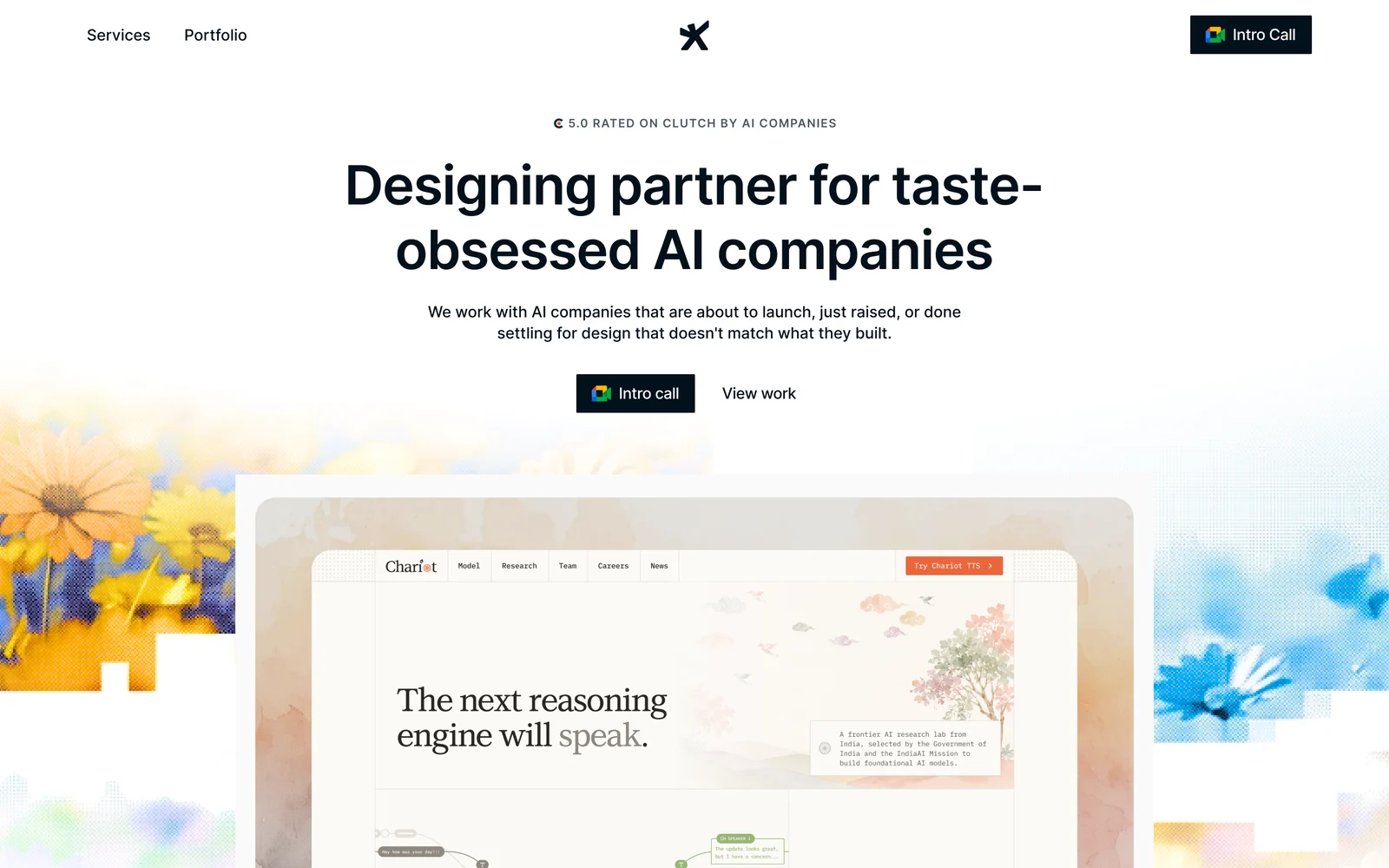
1. Studio Maydit: A Top-Rated Design Agency for AI Founders
Every fixed-scope project ends with a diagnosis of what is leaking in the product rather than a folder handover, which for an engineering team is the more useful artefact. Studio Maydit is a web and product design studio working with AI founders in the US, UK, and Europe, and the work is bought in two shapes. Fixed scope runs three to four weeks and suits a team with one job to finish. A monthly retainer suits teams that keep shipping, covering new pages, campaigns, and product design, with no long lock-in.
The build question gets answered the way an engineer would answer it, by asking who maintains it. Framer when a founder edits pages directly. Webflow when someone needs structure they can extend without a deploy. Custom code when the surface belongs inside the software. The engagement carries on into product design after the site ships, so the same people who learned your system apply it to the screens that matter.
Ask for evidence and the answer is Dualite. That engagement began by narrowing who the product served, a repositioned ICP that ruled out more people than it kept, and the design followed that constraint instead of preceding it. Seven months later the product had 100,000+ users. Recent clients include Wave, PixelFlow, and Mi-VAD, along with 15 other AI and SaaS teams.
| Check | Finding |
|---|---|
| Based in | Remote, serving US / UK / EU |
| Platform depth | Framer, Webflow, and custom code |
| AI-sector proof | Yes. AI-native clients, published outcome on Dualite |
| Pricing | Fixed scope or monthly retainer, quoted per project |
| Team shape | Founder-led, small senior team |
| Best fit | Technical founders who want reasons rather than taste |
Worth a call if you want the argument before the pictures. Book a 30-minute call.

2. Digidop
Digidop is a one to ten person Paris studio founded in 2021, working in Webflow, publishing a minimum and naming TSE Energy, Ramify, and StreamNative. StreamNative sells streaming infrastructure to engineers, which means this team has had to write about a technical product without either dumbing it down or drowning the reader, and that is a narrow skill.
Their AI-sector proof is partial with no AI case study, a team of that size has no bench if the project runs long, and Webflow work will not reach the product surface where an engineer-built interface usually needs the most help.
| Check | Finding |
|---|---|
| Based in | Paris, France |
| Founded | 2021 |
| Team size | 1-10 |
| Primary platform | Webflow |
| AI-sector proof | Partial. Enterprise and SaaS clients, no AI case study |
| Named clients | TSE Energy, Ramify, StreamNative |
| Pricing | Published minimum |
| Best fit | Technical founders needing a site that respects the reader |
3. Pixelmatters
Pixelmatters is a Porto studio founded in 2013 at fifty-one to two hundred people, working across platforms, publishing a minimum and naming Rubrik, Quantic, and UJET. Rubrik is infrastructure software with a genuinely complicated interface, so this team has worked on the kind of density that most design studios quietly avoid.
Their AI-sector proof is partial with no AI case study, a studio that size will assign a team rather than a person you can question directly, and the time difference means most decisions arrive as written updates rather than conversations.
| Check | Finding |
|---|---|
| Based in | Porto, Portugal |
| Founded | 2013 |
| Team size | 51-200 |
| Primary platform | Mixed |
| AI-sector proof | Partial. Enterprise and SaaS clients, no AI case study |
| Named clients | Rubrik, Quantic, UJET |
| Pricing | Published minimum |
| Best fit | Technical founders with a genuinely dense product surface |
4. Lighthouse Digital
Lighthouse Digital is a London Webflow studio publishing a minimum and naming HelloSelf, Freetrade, and IGN. Freetrade had to explain a regulated financial product to sceptical consumers, and translating something exact into something persuasive is the specific job most technical founders find hardest.
No AI-sector proof, no founding year, and no team size are published, which leaves a technical evaluator with almost nothing to check, and a Webflow practice does not extend to the product itself.
| Check | Finding |
|---|---|
| Based in | London, UK |
| Founded | Not published |
| Team size | Not published |
| Primary platform | Webflow |
| AI-sector proof | No |
| Named clients | HelloSelf, Freetrade, IGN |
| Pricing | Published minimum |
| Best fit | Technical founders wanting a quick, clear UK site |
5. Ramotion
Ramotion has worked from San Francisco since 2009 with eleven to fifty people, across platforms, publishing a minimum and naming Mozilla, Okta, Netflix, Adobe, and Xero. Mozilla and Okta are both products engineers use daily and complain about precisely, so this is a studio accustomed to designing for an audience that reads the changelog.
Their AI-sector proof is partial with no AI case study, sixteen years of practice is rarely priced cheaply, and an engagement shaped for established software companies assumes a longer commitment than a startup usually wants.
| Check | Finding |
|---|---|
| Based in | San Francisco, USA |
| Founded | 2009 |
| Team size | 11-50 |
| Primary platform | Mixed |
| AI-sector proof | Partial. Enterprise and SaaS clients, no AI case study |
| Named clients | Mozilla, Okta, Netflix, Adobe, Xero |
| Pricing | Published minimum |
| Best fit | Technical founders building something meant to last |
6. Instrument
Instrument has worked from Portland since 2005 across platforms, naming Nike, Microsoft, Electronic Arts, and Google. Twenty years of work at that level means their process is documented and repeatable rather than personal, which is the property an engineer looks for when assessing anything they cannot inspect directly.
Their AI-sector proof is partial with no AI case study, no team size or starting figure is published, and long brand programmes move on a timescale a shipping team finds slow enough to be frustrating.
| Check | Finding |
|---|---|
| Based in | Portland, USA |
| Founded | 2005 |
| Team size | Not published |
| Primary platform | Mixed |
| AI-sector proof | Partial. Enterprise and SaaS clients, no AI case study |
| Named clients | Nike, Microsoft, Electronic Arts, Google |
| Pricing | Not published |
| Best fit | Technical founders buying a repeatable, documented process |
7. Engine Digital
Engine Digital has built in custom code from Vancouver and New York since 2002, naming Adidas, Autodesk, Goldman Sachs, and HP. Autodesk is professional software with decades of accumulated complexity, and a studio that has worked inside that is unlikely to propose something your engineers would consider naive.
No team size or starting figure is published, their AI-sector proof is partial with no AI case study, and a process built for organisations of that size carries overhead a small engineering team will find heavy.
| Check | Finding |
|---|---|
| Based in | Vancouver and New York |
| Founded | 2002 |
| Team size | Not published |
| Primary platform | Custom code |
| AI-sector proof | Partial. Enterprise and SaaS clients, no AI case study |
| Named clients | Adidas, Autodesk, Goldman Sachs, HP |
| Pricing | Not published |
| Best fit | Technical founders with deep professional software |
8. SuperSkills
SuperSkills is a one to ten person studio in Walnut Creek working across platforms, publishing AI client work and naming The Cut. The person you talk to is the person doing the work, which removes the translation layer that technical founders find most frustrating about agencies.
Only one client is named, no founding year and no starting figure are published, and a team this small cannot take on a product surface and a site in the same quarter.
| Check | Finding |
|---|---|
| Based in | Walnut Creek, USA |
| Founded | Not published |
| Team size | 1-10 |
| Primary platform | Mixed |
| AI-sector proof | Yes. Published AI client work |
| Named clients | The Cut |
| Pricing | Not published |
| Best fit | Technical founders wanting one senior person, no layers |
9. Feels Like
Feels Like is a Los Angeles studio founded in 2023, building in custom code, publishing AI client work and naming Google, Nike, LVMH, and Suno AI. They write their own front ends, so the conversation with your engineers is about implementation rather than about handover documents, which usually goes better in both directions.
No team size or starting figure is published, the studio is young enough that long-run evidence is limited, and custom code raises the cost of the small weekly changes an early product depends on.
| Check | Finding |
|---|---|
| Based in | Los Angeles, USA |
| Founded | 2023 |
| Team size | Not published |
| Primary platform | Custom code |
| AI-sector proof | Yes. Published AI client work |
| Named clients | Google, Nike, LVMH, Suno AI |
| Pricing | Not published |
| Best fit | Technical founders who want designers who ship code |
10. basement.studio
basement.studio works in custom code from Mar del Plata and Los Angeles, founded in 2018 with eleven to fifty people, publishing a minimum and naming Vercel, Cursor, ElevenLabs, Harvey AI, and Scale AI. Vercel and Cursor are developer products, so this studio speaks the language your team speaks and will not need the architecture explained twice.
Their published work leans strongly toward developer audiences, which is narrower than most products eventually need, and custom code makes iteration more expensive at the stage where iteration matters most.
| Check | Finding |
|---|---|
| Based in | Mar del Plata, Argentina and Los Angeles, USA |
| Founded | 2018 |
| Team size | 11-50 |
| Primary platform | Custom code |
| AI-sector proof | Yes. Published AI client work |
| Named clients | Vercel, Cursor, ElevenLabs, Harvey AI, Scale AI |
| Pricing | Published minimum |
| Best fit | Technical founders selling to other engineers |
How to choose between them
Sort by what you cannot see from inside the team, not by which work you liked looking at.
New users get stuck where nobody on the team does. Studio Maydit or Ramotion.
The site is accurate and nobody converts. Studio Maydit or Digidop.
The product is dense and getting denser. Pixelmatters or Engine Digital.
Your buyer is another engineer. basement.studio or Feels Like.
One test before you sign. Send them one screen and ask what is wrong with it, before any commercial conversation. A studio worth hiring will name three specific things, say which one matters most, and explain why. A studio that responds with a redesign has skipped the diagnosis, which is the part you were actually buying, and you would never accept that from a contractor touching your infrastructure.