Summarize with AI


The best product design agencies for US-based AI startups in 2026 are Studio Maydit, Foundey, Kvalifik, Fantasy, Clay, Digidop, SuperSkills, Feely Studio, Lazarev, and Instrument. Studio Maydit and Foundey lead for this brief, because both concentrate on the product surface rather than the marketing site, and both have shipped for AI companies while those companies were still small. Kvalifik and Digidop are the wrong fit here. Both are European Webflow studios, which means a US team gets a two-hour window for decisions and a partner whose practice is websites rather than application screens.
The decision most US AI startups are actually making is not which agency. It is whether to buy this work or hire it. Our guide to choosing a design agency for an AI startup puts agency, freelancer, and in-house side by side.
The question has a clean answer and almost nobody asks it. A senior product designer in San Francisco or New York is a large annual commitment plus equity, and it makes sense when the product needs attention every week for years. An agency makes sense for bounded work: resetting one broken flow, a system your engineers can build against, a surface that must exist before a raise.
Teams get it backwards both ways. Some hire early and give a good designer six months of drifting work because nobody defined the problem. Others buy engagement after engagement and two years on have no design capability and a product holding four studios' decisions.
There is a second thing specific to raising in the US. Rounds here are larger, which makes an expensive mistake affordable and therefore common. The most frequent version is a full design system commissioned before anyone knows what the product is, built beautifully, and abandoned in month five when the product changes shape.
And a third, which is uncomfortable. In this market design is no longer a differentiator. Every competitor has a product that looks good, because everyone drew on the same references and libraries. Further polish returns little. What still separates products is whether a user can tell what the model just did and how far to trust it, which is a different kind of work.
The ten studios below are ordered by how well they suit a US team that has decided buying is the right call.

How we picked these agencies
Five checks, for a US company weighing an engagement against a first design hire:
- Platform depth. Is the day job application screens, or marketing pages with a product section attached? If you are buying rather than hiring, buy the specialism you lack, not a generalist you could have recruited.
- AI work at your stage. Are there named AI clients, and were they small then? A large AI logo may mean one page for a company of four hundred. What predicts your engagement is whether they have worked with six people who changed direction twice.
- Pricing. Is a figure published? A published number lets you compare an engagement against a salary in an afternoon, which is the comparison you should be running.
- Team shape. Who does the work, and can they be reached inside your working day? A US team buying rather than hiring is buying responsiveness among other things, and a nine-hour offset removes most of it.
- Their own site. Does it look like everyone else's? A studio that reaches for the current default will hand you the current default, worth nothing in this market.
Read check two as stage rather than logo size. An early AI product has specific problems: reaching a good output before a first-time user gives up, showing an uncertain result without sounding unreliable, and offering a way to correct the machine. A studio that has only served large AI companies usually inherited those decisions rather than made them. Ask which AI clients had fewer than twenty people, and what changed after the work shipped.
Sources, briefly. Every row comes from the studio's own website as published this month. No aggregators, no directories, nothing estimated from headcount or reputation. Blank rows mean the studio has published nothing, which is a fact about the studio rather than a hole in the research.
What goes wrong when US AI teams buy product design
Three failures, and the first is the one that wastes the most money.
The buy or hire question is settled on price. Somebody compares an engagement fee to a salary, sees the fee is smaller, and calls it the answer. They are not alternatives. An engagement is a bounded intervention with an end. A hire is capability that compounds. If the product needs attention weekly, an engagement postpones the hire and costs more over eighteen months. If you need one flow rebuilt and a system your engineers can extend, hiring is slower and worse. Decide the shape of the work first, then who does it.
A bigger round funds the system before the product exists. Money arrives, a full component library and documented design language get commissioned, and the work is genuinely excellent. Then the product changes, as it does at this stage, and most of the library describes screens nobody ships. It was not wrong. It was early. Write the twenty rules covering what the product does repeatedly, ship on those for a quarter, and commission the system once the shape stops moving.
Polish gets bought where legibility was needed. The product looks good and users still churn, so the team buys more visual quality: a refined type scale, better motion, a considered empty state. None of it moves the number, because appearance was never the problem. Users could not tell whether an output was reliable, could not see what produced it, and had no way to correct it. Ask a candidate for the last three things they designed that moved a retention number. If every answer is visual, they will make the product handsomer and no more persuasive.
1. Studio Maydit: A Top-Rated Design Agency for AI Founders
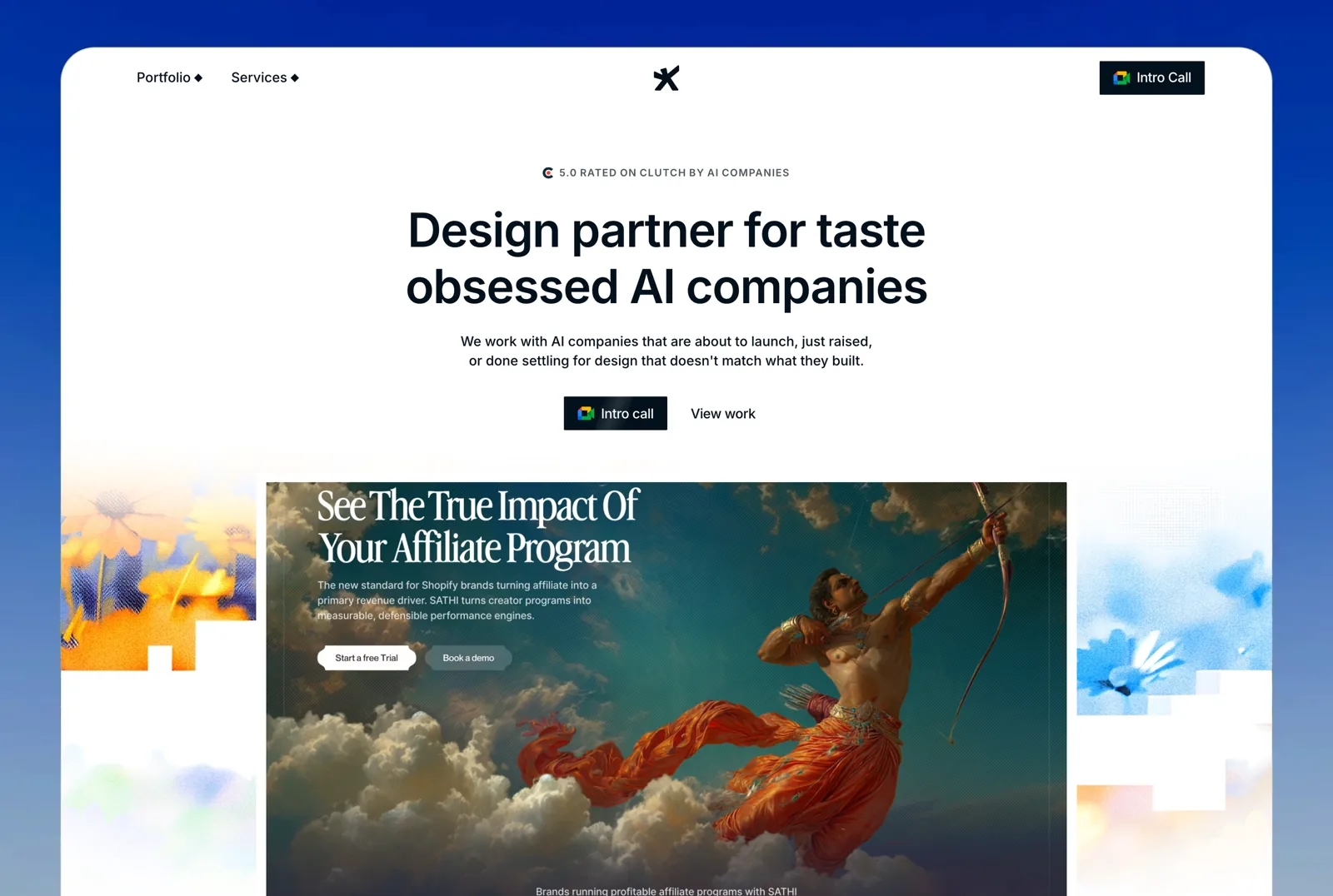
A bounded engagement is worth buying when it ends with something you can act on. That is why fixed scope here closes with a diagnosis of what is leaking in the product rather than a handover and a farewell, which for a team weighing a first design hire is the more useful output: it tells you what the role would actually be for. Fixed scope runs three to four weeks. Where the product moves every week and the work is genuinely continuous, a monthly retainer covers new pages, campaigns, and product design instead, with no long lock-in, and it is the honest recommendation for a company that has not yet hired.
Studio Maydit is a web and product design studio, and its clients are AI founders in the US, UK, and Europe. The US is the core of that, so a team in San Francisco or New York is inside the working day rather than at the edge of it, and the sector context does not need establishing at the start of an engagement.
Framer, Webflow, and custom code are all live practices, chosen by what has to be built. Dualite is the client published with a figure rather than a logo: a repositioned ICP was settled first, the design was rebuilt on top of that decision, and 100,000+ users followed within seven months. Wave, PixelFlow, and Mi-VAD are recent clients, along with 15 other AI and SaaS teams.
| Check | Finding |
|---|---|
| Based in | Remote, serving US / UK / EU |
| Platform depth | Framer, Webflow, and custom code |
| AI-sector proof | Yes. AI-native clients, published outcome on Dualite |
| Pricing | Fixed scope or monthly retainer, quoted per project |
| Team shape | Founder-led, small senior team |
| Best fit | US teams deciding whether to buy design or hire it |
Worth an hour if you are about to open a design role and are not sure what it is for. Book a 30-minute call.

2. Foundey
Foundey is a San Francisco studio founded in 2021 working only in Figma, with published AI client work and DemandIQ, Traycer, and Sero AI named. Three AI clients rather than three AI logos, and a Figma-only practice means product surfaces are the entire business. For a US team buying the specialism it lacks, this is the narrowest and most relevant option here.
They publish neither team size nor a starting figure, so an engagement cannot be compared against a salary without a call, and Figma-only means your engineers build what arrives.
| Check | Finding |
|---|---|
| Based in | San Francisco, USA |
| Founded | 2021 |
| Team size | Not published |
| Primary platform | Figma-only |
| AI-sector proof | Yes. Published AI client work |
| Named clients | DemandIQ, Traycer, Sero AI |
| Pricing | Not published |
| Best fit | Teams with engineering capacity to build from files |
3. Kvalifik
Kvalifik is a Copenhagen studio founded in 2015 with eleven to fifty people and published AI client work, naming Veo, Maersk, and Relesys. Veo is a computer vision product, so this team has designed around a model that is confidently wrong sometimes, and eleven to fifty people means a sprint can be staffed without waiting for one person to free up.
Their primary platform is Webflow rather than product surfaces, they publish no starting figure, and Copenhagen leaves a Californian team almost no overlap for decisions that need making today.
| Check | Finding |
|---|---|
| Based in | Copenhagen, Denmark |
| Founded | 2015 |
| Team size | 11-50 |
| Primary platform | Webflow |
| AI-sector proof | Yes. Published AI client work |
| Named clients | Veo, Maersk, Relesys |
| Pricing | Not published |
| Best fit | Teams with European operations already |
4. Fantasy
Fantasy has designed software from San Francisco and New York since 1999, across platforms, with published AI client work. Twenty-seven years means a great many products carried from technically impressive to genuinely usable, and that judgement is the hardest thing here to hire for at any salary.
They publish no client names, no team size, and no pricing, so diligence takes several calls, and mixed platform work means the product specialism is not exclusive.
| Check | Finding |
|---|---|
| Based in | San Francisco and New York, USA |
| Founded | 1999 |
| Team size | Not published |
| Primary platform | Mixed |
| AI-sector proof | Yes. Published AI client work |
| Named clients | Not published |
| Pricing | Not published |
| Best fit | Teams buying judgement rather than throughput |
5. Clay
Clay is a San Francisco studio founded in 2016 at fifty-one to two hundred people, publishing a minimum, with published AI client work and Slack, Stripe, Google, Coinbase, and Amazon named. Very few studios have shipped interfaces used at that scale, and the resulting habit of treating edge cases as real work is what most early products are missing.
The published minimum assumes a company with revenue, the process expects a design team on your side, and a company of eight will not be the account setting the schedule.
| Check | Finding |
|---|---|
| Based in | San Francisco, USA |
| Founded | 2016 |
| Team size | 51-200 |
| Primary platform | Mixed |
| AI-sector proof | Yes. Published AI client work |
| Named clients | Slack, Stripe, Google, Coinbase, Amazon |
| Pricing | Published minimum |
| Best fit | Funded teams with a designer already in place |
6. Digidop
Digidop is a Paris studio founded in 2021, one to ten people, working in Webflow, publishing a minimum, with TSE Energy, Ramify, and StreamNative named. StreamNative is developer infrastructure, so there is evidence of making something technical legible, and a published figure makes the comparison against a salary immediate.
Their AI-sector proof is partial with no AI case study, the practice is Webflow marketing sites rather than application design, and one to ten people in Paris is a narrow daily window for a US team.
| Check | Finding |
|---|---|
| Based in | Paris, France |
| Founded | 2021 |
| Team size | 1-10 |
| Primary platform | Webflow |
| AI-sector proof | Partial. Enterprise and SaaS clients, no AI case study |
| Named clients | TSE Energy, Ramify, StreamNative |
| Pricing | Published minimum |
| Best fit | Teams whose next problem is the marketing site |
7. SuperSkills
SuperSkills is a Walnut Creek team of one to ten working across platforms, with published AI client work and The Cut named. Being small and in the Bay Area means somebody senior can be looking at your onboarding flow within days, which is the version of this purchase that most resembles a very short, very good contract hire.
They name one client, publish neither a founding year nor a starting figure, and one to ten people cannot cover a growing product surface alongside anything else.
| Check | Finding |
|---|---|
| Based in | Walnut Creek, USA |
| Founded | Not published |
| Team size | 1-10 |
| Primary platform | Mixed |
| AI-sector proof | Yes. Published AI client work |
| Named clients | The Cut |
| Pricing | Not published |
| Best fit | Bay Area teams needing one flow fixed fast |
8. Feely Studio
Feely Studio is a distributed European team of one to ten, working across platforms, publishing a minimum, with published AI client work and Noxus, Mutiny, Luasai, and Basic Capital named. Noxus and Mutiny are AI-native companies, and a small team with a published figure is the quickest engagement here to evaluate and to start.
No founding year is published, one to ten people is thin cover for continuous work, and European hours give a US company a short window each day.
| Check | Finding |
|---|---|
| Based in | Distributed, Europe |
| Founded | Not published |
| Team size | 1-10 |
| Primary platform | Mixed |
| AI-sector proof | Yes. Published AI client work |
| Named clients | Noxus, Mutiny, Luasai, Basic Capital |
| Pricing | Published minimum |
| Best fit | Teams who want a priced start within the week |
9. Lazarev
Lazarev is a San Francisco studio founded in 2015 at fifty-one to two hundred people, working across platforms, publishing a minimum, with published AI client work and Payoneer, Peel, Elva, and Mozayix named. A published figure from a US studio of that size is genuinely unusual, and it makes this the easiest large option on the list to assess against the cost of a hire.
Their platform practice is mixed rather than product-first, and at that headcount an early-stage account gets a smaller team than the pitch suggests.
| Check | Finding |
|---|---|
| Based in | San Francisco, USA |
| Founded | 2015 |
| Team size | 51-200 |
| Primary platform | Mixed |
| AI-sector proof | Yes. Published AI client work |
| Named clients | Payoneer, Peel, Elva, Mozayix |
| Pricing | Published minimum |
| Best fit | US teams wanting scale with a published number |
10. Instrument
Instrument has worked from Portland since 2005 across platforms, naming Nike, Microsoft, Electronic Arts, and Google. Two decades at that scale produces process that holds under pressure, and a startup that has never had any learns something permanent from a quarter inside one.
They publish no team size and no pricing, their AI-sector proof is partial with no AI case study, and a practice built around global brands is a difficult fit for a company measuring runway in months.
| Check | Finding |
|---|---|
| Based in | Portland, USA |
| Founded | 2005 |
| Team size | Not published |
| Primary platform | Mixed |
| AI-sector proof | Partial. Enterprise and SaaS clients, no AI case study |
| Named clients | Nike, Microsoft, Electronic Arts, Google |
| Pricing | Not published |
| Best fit | Later teams buying process as much as output |
How to choose between them
Sort by the shape of the work rather than the size of the studio.
One flow is broken and you can name it. Studio Maydit or SuperSkills.
You need a system your engineers can build against. Foundey or Lazarev.
Users cannot tell how much to trust the output. Fantasy or Feely Studio.
A design hire starts in two months and needs foundations. Clay or Instrument.
One test before you sign. Ask whether you should be hiring instead. A studio confident in its value answers straight, sometimes yes, and separates the work that suits an engagement from the work that suits an employee. One that says an agency is always better is selling rather than advising, and it is the studio you will still be paying in year two while the product has no owner.