
Summarize with AI


The best product design agencies for venture-backed AI startups in 2026 are Studio Maydit, 8020, Instrument, Ramotion, basement.studio, BX Studio, Feels Like, Feely Studio, SuperSkills, and Lazarev. Studio Maydit and basement.studio lead here. Both publish AI client work, and basement.studio names Vercel, Cursor, ElevenLabs, Harvey AI, and Scale AI, which is a client list made almost entirely of companies at your stage. Instrument and Ramotion are the weakest fit. Both are excellent, both work mostly with very large brands, and neither publishes an AI case study.
Once there is money in the bank, a company acquires a second audience, and it is a much easier one to please.
Customers are hard. They are slow, they compare you to a competitor, and they do not care that you shipped something. Investors are attentive, well-disposed, and want a number to go up by the next board meeting. So attention drifts, in small increments nobody notices, towards whichever audience gives faster feedback.
You can see it in the product. Features exist because they were promised in an update. The dashboard has a large number on it that no customer has asked for. Half the roadmap is legible only to somebody who has read the last four board decks, and nothing has been removed in a year because every feature was once an announcement.
The market keeps telling you the truth anyway. Activation stays flat. Sales calls take a demo because nobody self-serves. The team decides this is a distribution problem and hires two more people.
Ten studios follow. As you read, keep asking a plain question about your own product: which parts of it exist because a customer needed them.

How we picked these agencies
Five checks, weighted for a company with money, a board, and a clock:
- Platform depth. Is product design the core practice, or a service sitting next to a website business? After a raise the website is the small job. The product is what your next round will be judged on, and page-led studios have rarely had to design one.
- Proof with venture-backed companies. Have they worked with funded startups rather than only large brands? It is a different job. The scope changes mid-project, the strategy is still moving, and the client has to show something at a board meeting in six weeks. Studios built around annual brand cycles struggle with all three.
- Pricing. Is a number published anywhere? Money in the bank makes a slow procurement habit expensive rather than careful, and a studio that states a figure can be shortlisted the same afternoon.
- Team shape. How many people, and who is on your project? Funded companies attract senior pitches and junior delivery more than anyone else on this list, because the budget is visible. Ask for names and keep them.
- Their own site. It is the one brief they wrote for themselves. A studio that cannot make its own positioning clear will not fix yours, however good the case studies look.
Weight the second check heaviest, and test it with one question. Ask them to describe a project where the client changed direction in week three. A studio used to funded startups answers instantly and without resentment, because it happens constantly. A studio that mostly serves large brands treats it as a story about a difficult client, which tells you what your project would become.
Nothing here was lifted from a listing or a review score. Every row is a claim the studio publishes on its own site, and empty rows stay empty. You are about to spend somebody else's money on a supplier, so a gap you can point at is worth more than a number nobody can source.
What goes wrong when venture-backed AI startups design for growth
Three failures, and each one is what happens when the board becomes the user.
The product is built to be demonstrated rather than used. Everything looks strong in a driven walkthrough because a driven walkthrough is what everyone practises. The parts nobody demonstrates are the parts that decide adoption: the empty state, the second session, the moment a user has to invite a colleague. Those get built once and never revisited. If your sales team refuses to let customers try it alone, that is not a trust issue. It is a report on the design.
Growth spending outruns the story. New money buys traffic quickly, and the traffic lands on a site written for the company you were eighteen months ago. Cost per signup climbs, so the answer is more budget and more landing pages, each one describing a slightly different product. Fix the sentence at the top before you buy another click. The cheapest growth work available to a funded company is making the first screen agree with the pitch.
Nothing is ever removed. Every feature was announced somewhere, to a customer, an investor, or the whole team, so deleting one feels like admitting a mistake. Two years of that produces a product that does eleven things adequately and nothing memorably, and new users cannot find the one thing that would keep them. Removal is the cheapest design work you will ever fund, and it is the only kind nobody puts in an update.
1. Studio Maydit: A Top-Rated Design Agency for AI Founders
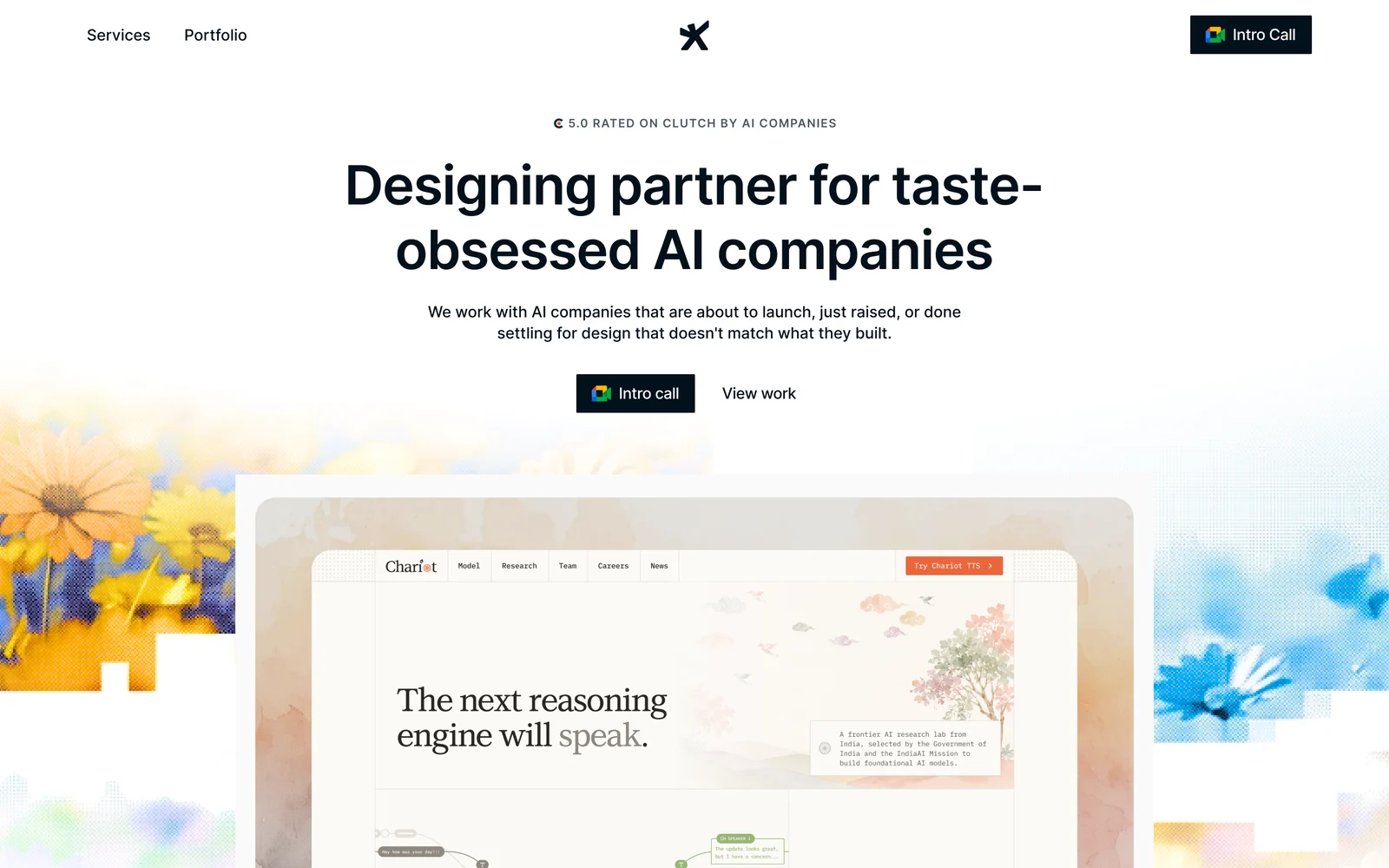
Seven months is roughly two board meetings, and it is the span on the one engagement published with a number attached to it. Dualite arrived at a repositioned ICP before anything was drawn. The product was then designed for the narrower user that decision produced. 100,000+ users showed up across those seven months. For a funded company the sequence is the useful part rather than the total, because narrowing is the move that feels wrong in a board update and works everywhere else.
Studio Maydit is a web and product design studio. Its clients are AI founders in the US, UK, and Europe, and most of them are venture-backed, so a scope that moves in week three is an ordinary Tuesday rather than a problem. Work continues into product design after the site ships, which matters when the site takes a month and the product is what the next round gets judged on. Recent clients include Wave, PixelFlow, and Mi-VAD, along with 15 other AI and SaaS teams.
The build follows what has to happen next rather than a house preference. Framer where the positioning will be rewritten again this quarter. Webflow where a new growth hire wants the pages under their own control. Custom code where the interface has to behave as part of the product rather than describe it.
On buying, fixed scope runs three to four weeks and fits one defined job, such as rebuilding the activation path everyone has been arguing about since the round closed. A monthly retainer suits a company shipping constantly, covering new pages, campaigns, and product design, with no long lock-in. Fixed-scope projects end with a diagnosis of what is leaking in the product, which after a raise is usually the thing an investor has already started asking about politely.
| Check | Finding |
|---|---|
| Based in | Remote, serving US / UK / EU |
| Platform depth | Framer, Webflow, and custom code |
| AI-sector proof | Yes. AI-native clients, published outcome on Dualite |
| Pricing | Fixed scope or monthly retainer, quoted per project |
| Team shape | Founder-led, small senior team |
| Best fit | Funded teams whose product demos better than it onboards |
Worth a call if the graph is flat and nobody can agree why. Book a 30-minute call.

2. 8020
8020 works in Webflow from San Francisco and New York, founded in 2014, naming Wave, Superlist, Pilot.com, Vanta, and Circle. That is a list of venture-backed software companies almost exclusively, so they know the rhythm of a funded team: fast decisions, a launch date attached to something else, and a founder still writing the copy.
No team size and no starting figure are published, their AI-sector proof is partial with no AI case study, and Webflow is a website practice, so the product work your round is meant to fund sits outside it.
| Check | Finding |
|---|---|
| Based in | San Francisco and New York, USA |
| Founded | 2014 |
| Team size | Not published |
| Primary platform | Webflow |
| AI-sector proof | Partial. Enterprise and SaaS clients, no AI case study |
| Named clients | Wave, Superlist, Pilot.com, Vanta, Circle |
| Pricing | Not published |
| Best fit | Funded teams needing a marketing site that matches the pitch |
3. Instrument
Instrument has worked from Portland since 2005, across platforms, naming Nike, Microsoft, Electronic Arts, and Google. A studio trusted with brands that size has real craft and real process, and if part of your raise is meant to buy credibility with enterprise buyers, that pedigree does travel.
Their AI-sector proof is partial with no AI case study, no team size or starting figure is published, and a practice shaped around annual brand programmes is not built for a company that changes its mind in week three.
| Check | Finding |
|---|---|
| Based in | Portland, USA |
| Founded | 2005 |
| Team size | Not published |
| Primary platform | Mixed |
| AI-sector proof | Partial. Enterprise and SaaS clients, no AI case study |
| Named clients | Nike, Microsoft, Electronic Arts, Google |
| Pricing | Not published |
| Best fit | Later-stage teams buying brand credibility at scale |
4. Ramotion
Ramotion is a San Francisco studio of eleven to fifty founded in 2009, working across platforms, publishing a minimum and naming Mozilla, Okta, Netflix, Adobe, and Xero. Okta and Xero are products people use at work every day, which means this studio has designed for retention rather than for a launch moment.
Their AI-sector proof is partial with no AI case study, and a fifteen-year-old practice with clients that size comes with a process that a company trying to ship monthly may find heavy.
| Check | Finding |
|---|---|
| Based in | San Francisco, USA |
| Founded | 2009 |
| Team size | 11-50 |
| Primary platform | Mixed |
| AI-sector proof | Partial. Enterprise and SaaS clients, no AI case study |
| Named clients | Mozilla, Okta, Netflix, Adobe, Xero |
| Pricing | Published minimum |
| Best fit | Funded teams designing for daily use rather than launch |
5. basement.studio
basement.studio builds in custom code from Mar del Plata and Los Angeles, founded in 2018 at eleven to fifty people, publishing a minimum and AI client work, naming Vercel, Cursor, ElevenLabs, Harvey AI, and Scale AI. Every one of those is a venture-backed AI company, which makes this the closest match on the list to your exact situation.
Custom code means engineering time on every change, so a marketing hire cannot publish a page alone, and a studio this in demand may not have room when your board date lands.
| Check | Finding |
|---|---|
| Based in | Mar del Plata, Argentina and Los Angeles, USA |
| Founded | 2018 |
| Team size | 11-50 |
| Primary platform | Custom code |
| AI-sector proof | Yes. Published AI client work |
| Named clients | Vercel, Cursor, ElevenLabs, Harvey AI, Scale AI |
| Pricing | Published minimum |
| Best fit | Funded AI teams whose site has to impress engineers |
6. BX Studio
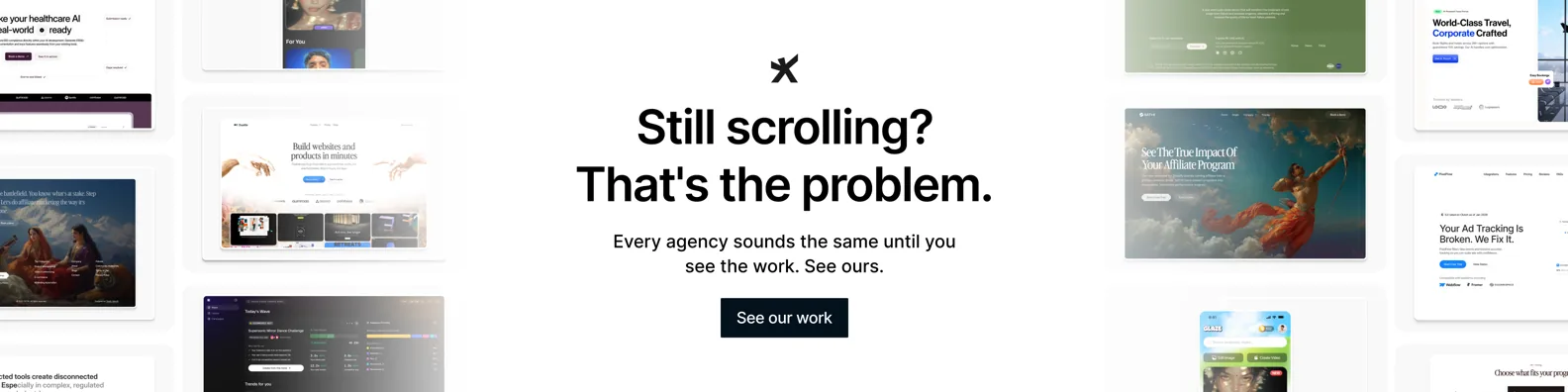
BX Studio is a New York team of eleven to fifty working in Webflow, publishing a minimum and AI client work, naming Reddit, Headspace, ASAPP, and Verifone. ASAPP is an AI company selling into large enterprises, and Headspace is a consumer product judged on whether people come back, so both halves of your problem appear in the portfolio.
No founding year is published, and Webflow depth means the marketing surface rather than the product surface, which is the half a funded company usually needs more.
| Check | Finding |
|---|---|
| Based in | New York, USA |
| Founded | Not published |
| Team size | 11-50 |
| Primary platform | Webflow |
| AI-sector proof | Yes. Published AI client work |
| Named clients | Reddit, Headspace, ASAPP, Verifone |
| Pricing | Published minimum |
| Best fit | Funded teams needing a credible site in New York hours |
7. Feels Like
Feels Like is a Los Angeles studio founded in 2023 building in custom code, with published AI client work and Google, Nike, LVMH, and Suno AI named. Suno is a well-funded AI company with a consumer product, and LVMH work means a standard of finish that reads as expensive, which is occasionally exactly what a funded company needs on launch day.
No team size and no starting figure are published, the studio is young, and custom code with that client mix suggests a cost structure aimed above an early venture-backed team.
| Check | Finding |
|---|---|
| Based in | Los Angeles, USA |
| Founded | 2023 |
| Team size | Not published |
| Primary platform | Custom code |
| AI-sector proof | Yes. Published AI client work |
| Named clients | Google, Nike, LVMH, Suno AI |
| Pricing | Not published |
| Best fit | Funded teams whose launch has to look expensive |
8. Feely Studio
Feely Studio is a one to ten person team distributed across Europe, working across platforms with a published minimum and published AI client work, naming Noxus, Mutiny, Luasai, and Basic Capital. Mutiny is a venture-backed company selling to marketers, and a team this small means the senior person you meet is the person who does the work.
No founding year is published, and a team of that size has no reserve, which is a real risk when a board meeting suddenly pulls your launch forward by three weeks.
| Check | Finding |
|---|---|
| Based in | Distributed, Europe |
| Founded | Not published |
| Team size | 1-10 |
| Primary platform | Mixed |
| AI-sector proof | Yes. Published AI client work |
| Named clients | Noxus, Mutiny, Luasai, Basic Capital |
| Pricing | Published minimum |
| Best fit | Funded teams wanting senior hands on one focused project |
9. SuperSkills
SuperSkills is a one to ten person studio in Walnut Creek working across platforms, publishing AI client work, with The Cut named. Small and AI-native means the strategy conversation and the design conversation are the same conversation, which suits a company whose positioning is still moving.
Only one client is named, no founding year or starting figure is published, and there is very little evidence available to show a board why this supplier was chosen.
| Check | Finding |
|---|---|
| Based in | Walnut Creek, USA |
| Founded | Not published |
| Team size | 1-10 |
| Primary platform | Mixed |
| AI-sector proof | Yes. Published AI client work |
| Named clients | The Cut |
| Pricing | Not published |
| Best fit | Funded teams still deciding what the product is |
10. Lazarev
Lazarev is a San Francisco studio founded in 2015 at fifty-one to two hundred people, publishing a minimum and AI client work, naming Payoneer, Peel, Elva, and Mozayix. At that size they can put a full team on a product surface and hold a schedule, which is useful when the delivery date was set in a board meeting.
Their scale is also the drawback for a company of twenty. Expect an account structure, and expect the senior people from the pitch to be spread across several projects unless you name them in writing.
| Check | Finding |
|---|---|
| Based in | San Francisco, USA |
| Founded | 2015 |
| Team size | 51-200 |
| Primary platform | Mixed |
| AI-sector proof | Yes. Published AI client work |
| Named clients | Payoneer, Peel, Elva, Mozayix |
| Pricing | Published minimum |
| Best fit | Funded teams needing a full product surface on a fixed date |
How to choose between them
Sort by what your money is actually meant to fix, not by which logo list is most impressive.
People sign up and never come back. Studio Maydit or Ramotion.
Paid traffic is expensive and converts badly. 8020 or BX Studio.
Your buyers are engineers and the site does not convince them. basement.studio or Feels Like.
A large surface has to be designed to a board date. Lazarev or Instrument.
One test before you commit. Show them your activation numbers and ask what they would remove. A studio that has worked with funded companies will name something specific and explain what it is costing you. A studio that has not will propose adding an onboarding flow on top of everything already there, which is how products get to eleven features and no reason to return.