
Summarize with AI


The best product design agencies for venture studios in 2026 are Studio Maydit, Digidop, Push Refresh, Engine Digital, Flow Ninja, Flowout, Finsweet, 8020, Edgar Allan, and Instrument. Studio Maydit and Finsweet lead for this brief. Finsweet has worked from Denver since 2017 as a distributed team of fifty-one to two hundred, in Webflow, naming Dropbox, Clay, GitHub, and Steadily, and it is known for building things other people can maintain, which is the whole requirement when a company you launched in March has to keep its own site running by September. Flow Ninja and Edgar Allan are the weakest fit here. One publishes no clients and no starting figure, the other is a large brand agency whose economics assume one client rather than six. Worth noting up front: none of the nine publish an AI case study, so if your next three spinouts are AI companies, that gap is real and you should ask about it directly.
You are not buying one website. You are buying what the seventh one costs.
Every other buyer on this list has one product and one brand, and can reasonably spend a quarter getting it right. You launch four to eight companies a year, and the number that decides whether your model works is not how good the first launch was. It is how much cheaper the seventh is, and most design engagements are structured so the answer is not at all.
The trap is that each company genuinely needs to be different. Different buyers, different categories, different reasons to exist, and a portfolio sharing one palette and one layout reads as a single company doing seven things badly. Investors notice first. So unit cost cannot be solved by making everything the same, which is the obvious answer and the wrong one.
What is shareable sits underneath the visible layer. The pattern for a pricing page. How onboarding is structured. Rules for a form, an empty state, an error. How a claim is evidenced. None of it has to look alike, and all of it can be decided once instead of relitigated at every launch by whichever founder has opinions.
There is a second cost people miss. Every company you spin out eventually has to run without you, and anything the studio built that only the studio can change becomes your problem in month nine, six times over.
Ten studios follow. As you read, ask which of them would make the next launch cheaper rather than better.

How we picked these agencies
Five checks, chosen for a buyer whose real question is marginal cost rather than quality:
- Platform depth. Can they cover the site and the product, and hand over something a small founding team can operate alone? Every spinout ends up with two people and no designer, and a studio that leaves work only it can change has quietly sold you a subscription.
- Proof across repeated engagements. Have they done similar work more than once for related clients, and did the second one cost less than the first? This is the check that matters most here and almost nobody asks it. Studios optimised for bespoke work treat your seventh launch as fresh discovery, because that is how their pricing works.
- Pricing. Is a starting figure published? You are running the same purchase repeatedly, so a public number lets you build a real per-company budget instead of negotiating from zero every time.
- Team shape. How many people, and can they run two launches at once? Venture studio timelines cluster, and a studio that can only hold one project will become the reason a spinout misses its window.
- Their own site. The one brief with no client.
That fifth check answers something specific here. A studio's own site is what it does with total freedom, and you want to see range. If every project shares one visual signature, your six companies will end up looking related, and looking related is the one thing your portfolio cannot afford.
The tables below contain only what each studio publishes about itself. No directory profiles, no ranked lists, no blanks filled by inference. Where a studio has published nothing, the row reads Not published. This is a repeated decision, so the basis should be checkable again next quarter.
What goes wrong when venture studios buy design
Three failures, and all three are about the portfolio rather than any single company.
Every launch starts from nothing. The same conversation about pricing pages happens a fourth time, with a different founder and the same conclusions, because nothing was written down after launch three. The fix is not a template. It is a short document of decisions with reasons, updated after each launch, so launch seven has a new argument rather than the old one.
The portfolio develops a tell. Same grid, same button shape, same tone, because the same people made all of them and nobody asked for difference. Each company reads as a project rather than a business, which costs credibility in the rooms that matter. Shared systems belong underneath. The visible layer has to diverge on purpose, and someone must be accountable for that.
Handover is treated as a formality. The site ships, the founder gets access, and four months later cannot change a headline without going back to the studio or to you. Multiply by six and your operations team has become an agency. Choose the platform by asking who edits it in month nine, and make handover a paid part of every engagement rather than a courtesy.
1. Studio Maydit: A Top-Rated Design Agency for AI Founders
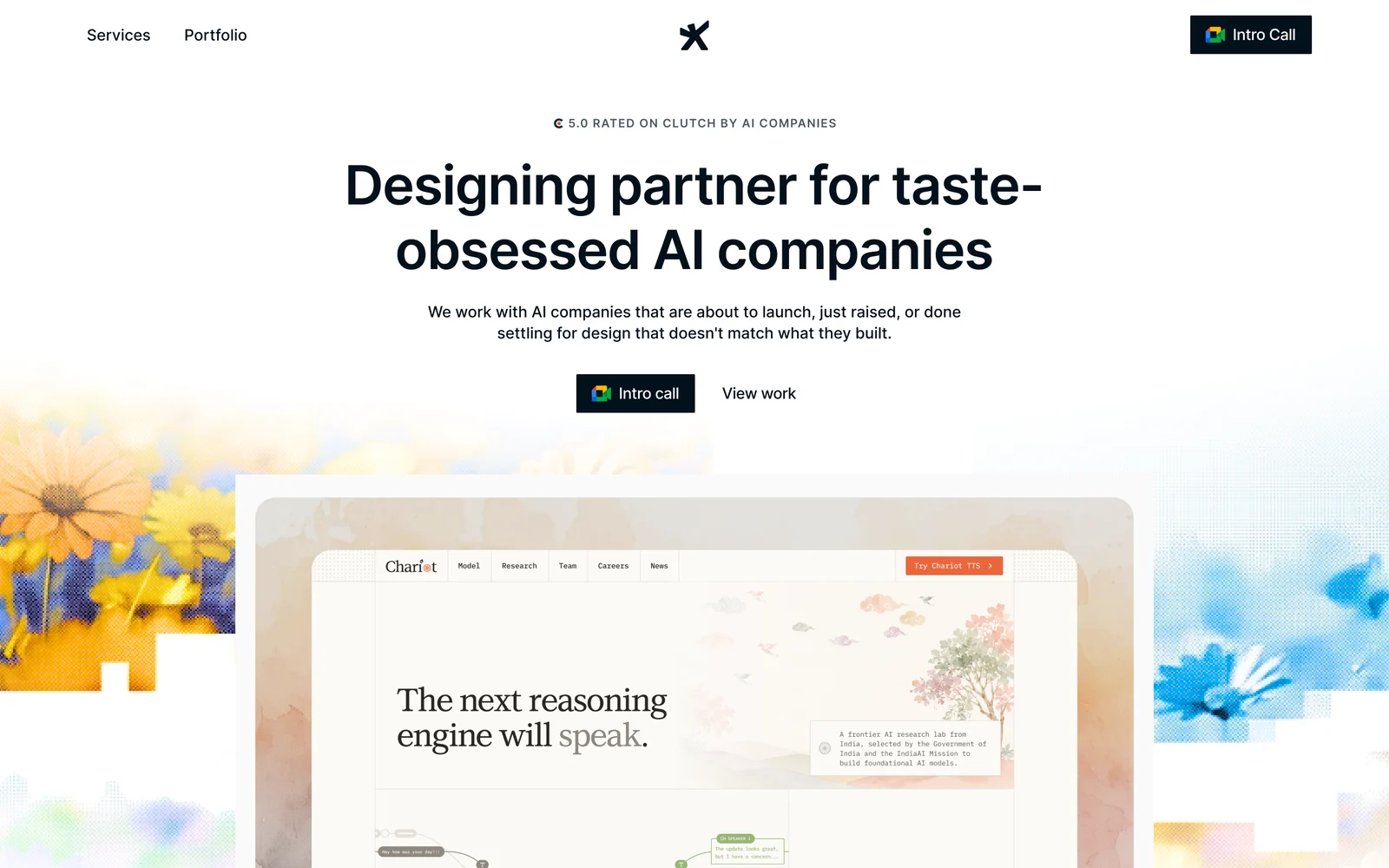
Studio Maydit is a web and product design studio working with AI founders in the US, UK, and Europe, which for a venture studio spinning out AI companies means the sector context does not have to be explained at the start of each engagement. Builds happen in Framer, Webflow, or custom code, and the platform choice is made by asking who edits the site once the founding team is on its own, which is the question that decides whether a spinout stays independent. Work continues into product design after the site ships.
Dualite is the engagement with a published figure. It began with a repositioned ICP, an explicit decision about which users the product would stop serving, and the product was then designed for whoever remained. 100,000+ users followed over seven months. Recent clients include Wave, PixelFlow, and Mi-VAD, alongside 15 other AI and SaaS teams.
Two arrangements exist. A fixed scope of three to four weeks maps neatly onto a single spinout with a launch date, and it ends with a written diagnosis of what is leaking in the product, which is more useful to a portfolio operator than a presentation. A monthly retainer suits a studio with several companies moving at once, covering new pages, campaigns, and product design, with no long lock-in, so capacity can follow whichever launch is closest.
| Check | Finding |
|---|---|
| Based in | Remote, serving US / UK / EU |
| Platform depth | Framer, Webflow, and custom code |
| AI-sector proof | Yes. AI-native clients, published outcome on Dualite |
| Pricing | Fixed scope or monthly retainer, quoted per project |
| Team shape | Founder-led, small senior team |
| Best fit | Venture studios whose fourth launch costs what the first did |
Worth a call if each spinout is repeating the same three months of decisions. Book a 30-minute call.

2. Digidop
Digidop is a one to ten person Paris studio founded in 2021, working in Webflow, publishing a starting figure and naming TSE Energy, Ramify, and StreamNative. A published number and a small team make per-company budgeting simple, and Webflow is operable by a non-technical founder afterwards, which solves the handover problem rather than deferring it.
Their AI-sector proof is partial with no AI case study, and a team of that size cannot run two launches in the same month, which is exactly when venture studio timelines tend to collide.
| Check | Finding |
|---|---|
| Based in | Paris, France |
| Founded | 2021 |
| Team size | 1-10 |
| Primary platform | Webflow |
| AI-sector proof | Partial. Enterprise and SaaS clients, no AI case study |
| Named clients | TSE Energy, Ramify, StreamNative |
| Pricing | Published minimum |
| Best fit | Venture studios launching one company at a time |
3. Push Refresh
Push Refresh is a one to ten person Dallas studio working in Framer, publishing a starting figure and naming SmithRx, Synonym, and Northern National. Framer hands a founding team the ability to change their own pages from day one, and central US hours overlap with both coasts, which helps when your portfolio companies are not all in one place.
No founding year or team size is published, their AI-sector proof is partial with no AI case study, and a studio this small will not have capacity when three launches land in the same quarter.
| Check | Finding |
|---|---|
| Based in | Dallas, USA |
| Founded | Not published |
| Team size | 1-10 |
| Primary platform | Framer |
| AI-sector proof | Partial. Enterprise and SaaS clients, no AI case study |
| Named clients | SmithRx, Synonym, Northern National |
| Pricing | Published minimum |
| Best fit | Venture studios who want founders editing their own sites |
4. Engine Digital
Engine Digital has worked from Vancouver and New York since 2002 in custom code, naming Adidas, Autodesk, Goldman Sachs, and HP. Twenty-three years of building for organisations that cannot ship something broken brings a discipline worth having on the one spinout selling into a large institution.
No team size or starting figure is published, their AI-sector proof is partial with no AI case study, and custom code plus an enterprise process is close to the worst possible economics for a company that needs six launches a year at a predictable price.
| Check | Finding |
|---|---|
| Based in | Vancouver and New York |
| Founded | 2002 |
| Team size | Not published |
| Primary platform | Custom code |
| AI-sector proof | Partial. Enterprise and SaaS clients, no AI case study |
| Named clients | Adidas, Autodesk, Goldman Sachs, HP |
| Pricing | Not published |
| Best fit | Venture studios with one enterprise-facing company to get right |
5. Flow Ninja
Flow Ninja is an eleven to fifty person Belgrade studio founded in 2018, working in Webflow. That headcount is the useful part, because it is enough capacity to run overlapping launches without either waiting, and European hours suit a portfolio spread over two continents.
No named clients and no starting figure are published, and their AI-sector proof is partial with no AI case study, which together leaves very little you can verify before committing to a repeated relationship.
| Check | Finding |
|---|---|
| Based in | Belgrade, Serbia |
| Founded | 2018 |
| Team size | 11-50 |
| Primary platform | Webflow |
| AI-sector proof | Partial. Enterprise and SaaS clients, no AI case study |
| Named clients | Not published |
| Pricing | Not published |
| Best fit | Venture studios needing capacity for overlapping launches |
6. Flowout
Flowout is a distributed Webflow studio publishing a starting figure and naming Jasper, Kajabi, Riverside, and Sendlane. A subscription is the closest thing on this list to a fixed per-month design cost you can allocate across companies, and for the steady flow of pages every portfolio generates it removes the need to scope anything.
Their AI-sector proof is partial with no AI case study, no founding year or team size is published, and a request queue produces pages rather than the shared decisions that actually reduce the cost of launch number seven.
| Check | Finding |
|---|---|
| Based in | Distributed |
| Founded | Not published |
| Team size | Not published |
| Primary platform | Webflow |
| AI-sector proof | Partial. Enterprise and SaaS clients, no AI case study |
| Named clients | Jasper, Kajabi, Riverside, Sendlane |
| Pricing | Published minimum |
| Best fit | Venture studios wanting predictable monthly page output |
7. Finsweet
Finsweet has worked from Denver since 2017 as a distributed team of fifty-one to two hundred, in Webflow, naming Dropbox, Clay, GitHub, and Steadily. Their reputation is for building things other people can maintain, and for a venture studio that is the entire brief, because every site you commission is one you will eventually stop looking after.
No starting figure is published, their AI-sector proof is partial with no AI case study, and an organisation of that size brings a process shaped for larger clients, which can be heavy for a two-person spinout.
| Check | Finding |
|---|---|
| Based in | Denver, USA, distributed |
| Founded | 2017 |
| Team size | 51-200 |
| Primary platform | Webflow |
| AI-sector proof | Partial. Enterprise and SaaS clients, no AI case study |
| Named clients | Dropbox, Clay, GitHub, Steadily |
| Pricing | Not published |
| Best fit | Venture studios whose spinouts must run without them |
8. 8020
8020 has worked from San Francisco and New York since 2014 in Webflow, naming Wave, Superlist, Pilot.com, Vanta, and Circle. That is a list of venture-backed software companies at roughly the stage your spinouts launch at, so the studio already knows what a first credible site has to do before there is a product to point at.
No team size or starting figure is published, their AI-sector proof is partial with no AI case study, and Webflow keeps the work on the site rather than on the product each company will need next.
| Check | Finding |
|---|---|
| Based in | San Francisco and New York, USA |
| Founded | 2014 |
| Team size | Not published |
| Primary platform | Webflow |
| AI-sector proof | Partial. Enterprise and SaaS clients, no AI case study |
| Named clients | Wave, Superlist, Pilot.com, Vanta, Circle |
| Pricing | Not published |
| Best fit | Venture studios launching companies before the product exists |
9. Edgar Allan
Edgar Allan has worked from Atlanta since 2014 with fifty-one to two hundred people, mainly in Webflow, naming Porsche, Duracell, and NCR. Consumer brand experience is the skill that makes two companies from the same portfolio feel genuinely unrelated, which is the specific thing a venture studio struggles to do from the inside.
No starting figure is published, their AI-sector proof is partial with no AI case study, and a full identity programme at agency scale is difficult to justify six times a year unless one company is far more important than the rest.
| Check | Finding |
|---|---|
| Based in | Atlanta, USA |
| Founded | 2014 |
| Team size | 51-200 |
| Primary platform | Webflow |
| AI-sector proof | Partial. Enterprise and SaaS clients, no AI case study |
| Named clients | Porsche, Duracell, NCR |
| Pricing | Not published |
| Best fit | Venture studios whose companies look too much alike |
10. Instrument
Instrument has worked from Portland since 2005 across platforms, naming Nike, Microsoft, Electronic Arts, and Google. Two decades at that level buys judgement about what a new company needs at launch, and venture studios hear plenty of confident advice from people with far less basis for it.
Their AI-sector proof is partial with no AI case study, no team size or starting figure is published, and this is the most expensive way on the list to launch a company that may not exist in eighteen months.
| Check | Finding |
|---|---|
| Based in | Portland, USA |
| Founded | 2005 |
| Team size | Not published |
| Primary platform | Mixed |
| AI-sector proof | Partial. Enterprise and SaaS clients, no AI case study |
| Named clients | Nike, Microsoft, Electronic Arts, Google |
| Pricing | Not published |
| Best fit | Venture studios with one company worth a serious investment |
How to choose between them
Sort by what is expensive across the portfolio, not by which studio impressed you most on one launch.
Every launch repeats the same three months. Studio Maydit or Finsweet.
Founders cannot edit their own sites afterwards. Push Refresh or Digidop.
Your companies all look like the same company. Edgar Allan or Instrument.
Two launches collide and one has to wait. Flow Ninja or Flowout.
One test before you sign. Tell them you will be back in four months with another company and ask what will be different the second time. A studio worth hiring will describe what it keeps, what it writes down, and where the saving comes from. A studio that says every project is unique is telling you the price will not move, which is defensible for them and unaffordable for you.