
Summarize with AI


The best product design agencies for YC-backed AI startups in 2026 are Studio Maydit, Digidop, Pixelmatters, Instrument, Ramotion, Lighthouse Digital, Feels Like, Trueform, Kvalifik, and basement.studio. Studio Maydit and basement.studio lead for this brief. basement.studio publishes AI client work and names Vercel, Cursor, and ElevenLabs, which is the developer-facing audience most YC AI companies are selling to first. Lighthouse Digital and Instrument are the weakest fit. One publishes no AI client work at all, and the other is a brand practice built around Nike and Microsoft rather than around a company of four.
The batch gives you a great deal, and one problem it cannot solve.
Everything useful arrives at once: money, a deadline, a network, a group of people who will read your landing page honestly at eleven at night. What arrives with it is a template. The same page structure, the same plain typography, the same sentence shape describing AI for a vertical, published in the same fortnight by a couple of hundred other teams.
That is entirely rational for the first month. It signals the right things to the right audience, it takes an afternoon, and the advice to spend your time on customers instead is correct. The trouble is that nobody tells you when the rule expires.
It expires around month four. By then you are talking to buyers who have never heard of the batch, and to Series A investors who have seen forty pages exactly like yours this quarter. Being indistinguishable stops being efficient and starts being the thing costing you meetings, and the change is gradual enough that most teams miss it.
Ten studios follow. Read them with a specific question: which one would tell you the plainest possible page is now working against you.

How we picked these agencies
Five checks, written for a company that is four months old, moving fast, and about to stop looking like everybody else:
- Platform depth. Is designing products the practice, or is it website production with a product service beside it? Your site takes a fortnight. The product is what your Series A conversation will actually turn on, and studios that only build pages have never had to design one.
- Proof with very early companies. Have they worked with teams of under ten where the founder still writes the copy and the product changes weekly? It is a specific skill. Studios accustomed to a marketing department and a signed brief go quiet when the brief changes twice in a fortnight, which is simply how you work now.
- Pricing. Is a number published anywhere? Your money has a shape and your time has less. A studio you can price in the browser can be ruled in or out before lunch instead of after two discovery calls.
- Team shape. How large, and who does your work? A four-person company should be talking to whoever is drawing, not to an account layer built for clients twenty times your size.
- Their own site. The one brief they wrote for themselves. If it looks like every other studio site, they will not be the ones to make you look different from every other batch company.
Weight the second check most, and test it in the first call. Describe your product as it stands today, then mention that it will probably change before the project ends. A studio that works well with early teams treats that as normal and tells you how they handle it. A studio that flinches, or reaches for a change-request process, is telling you what the next eight weeks would feel like.
Every row below is drawn from what each studio publishes about itself. No directory profiles, no aggregated scores, no numbers invented to complete a column. Blank rows stay blank, and since you are about to be judged on claims you cannot substantiate, an honest gap is the standard worth applying to a supplier too.
What goes wrong when YC-backed AI startups design for growth
Three failures, and all three are what happens when the batch advice outlives its usefulness.
The page is interchangeable. Same headline shape, same three-feature row, same plain type, same sentence describing AI for an industry. It worked when your readers were investors and batch-mates who understood the shorthand. A cold buyer reads four of these in a morning and remembers none, and a Series A investor recognises the format immediately, which is not a compliment. One specific, concrete sentence about what actually happens for a customer will do more than a redesign.
Prototype standards get carried too far. Doing things that do not scale is good advice about effort, not about quality, and it gets quietly reinterpreted as permission to leave the product rough. Six months in, the demo still has placeholder states, an empty screen with nothing in it, and an onboarding flow that only works if a founder is on the call. Every one of those is now costing you real customers rather than saving you time.
The site talks to investors long after Demo Day. It was written in a week when the whole audience was people with cheques, so it leads with the market size, the founding team, and the technology. Six months later it is still doing that while the people arriving are practitioners trying to work out whether it solves their Tuesday. Rewrite for the buyer. Keep one page for investors, and stop making the homepage do both jobs badly.
1. Studio Maydit: A Top-Rated Design Agency for AI Founders
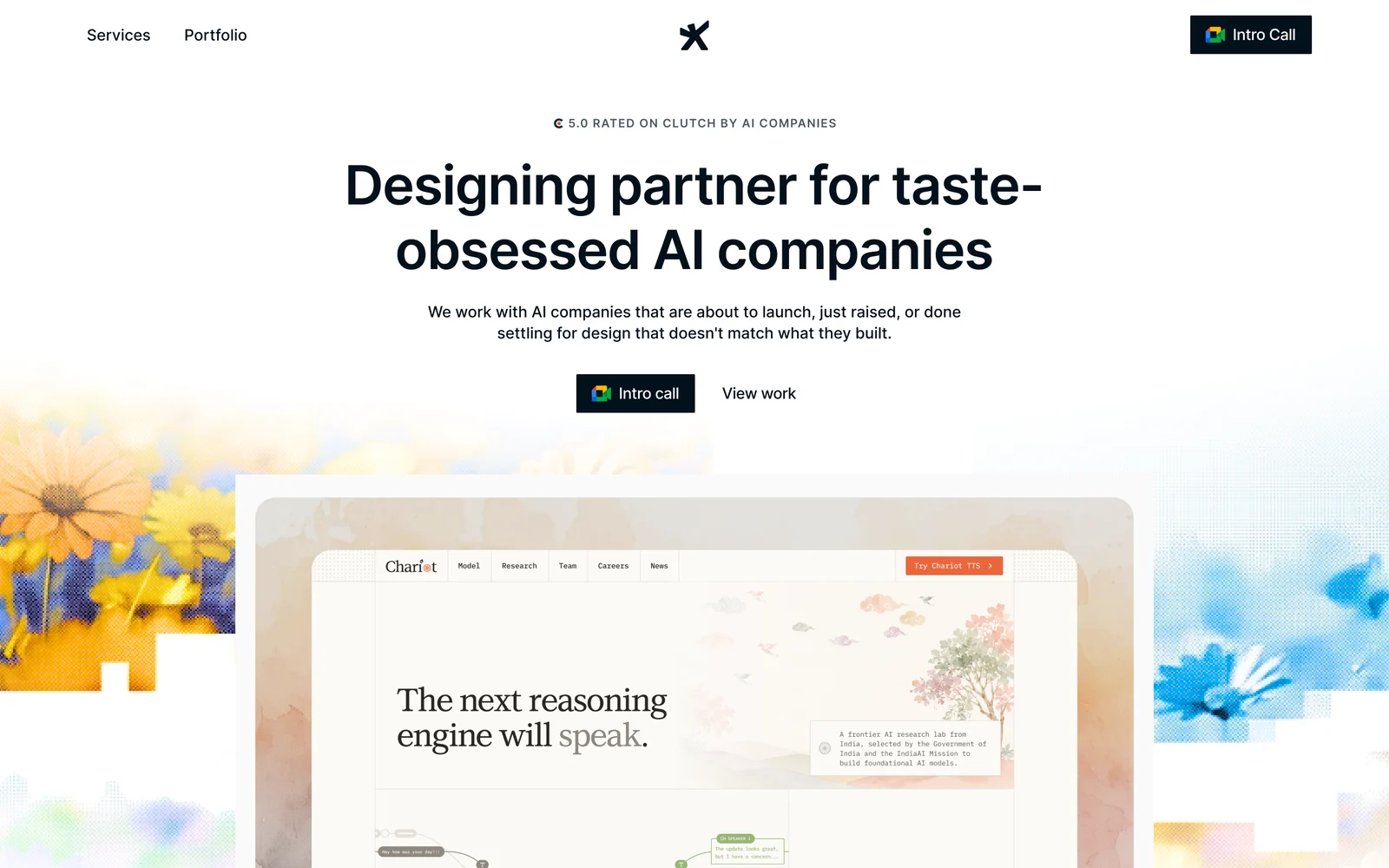
Recent clients include Wave, PixelFlow, and Mi-VAD, along with 15 other AI and SaaS teams, and the volume is the point for a company at your stage. You will not be explaining what a model does, why the product changed last week, or why the positioning is not settled. Studio Maydit is a web and product design studio. Its clients are AI founders in the US, UK, and Europe, and a good number of them are four months old with three people and a launch behind them.
Work continues into product design after the site ships, which matters because the site is the fortnight and the product is the year. The build follows what is actually needed. Framer where the story will be rewritten twice before the raise. Webflow where a first marketing hire will want the pages under their own control. Custom code where the interface has to do something a page cannot fake.
Dualite is the engagement with a public figure attached. Narrowing came before growth. A repositioned ICP was chosen, the product was rebuilt for the smaller group that decision defined, and 100,000+ users arrived across seven months. That order is uncomfortable at your stage, because a batch company is rewarded for describing a large market and punished for admitting it currently serves one narrow kind of person very well.
Buying happens two ways. Fixed scope runs three to four weeks, which fits neatly inside the gap between a batch ending and a raise beginning, and suits one job such as replacing the launch page with something a cold buyer can act on. A monthly retainer suits a team still changing weekly, covering new pages, campaigns, and product design, with no long lock-in. Fixed-scope projects end with a diagnosis of what is leaking in the product, which at this stage usually names the screen where new signups quietly stop.
| Check | Finding |
|---|---|
| Based in | Remote, serving US / UK / EU |
| Platform depth | Framer, Webflow, and custom code |
| AI-sector proof | Yes. AI-native clients, published outcome on Dualite |
| Pricing | Fixed scope or monthly retainer, quoted per project |
| Team shape | Founder-led, small senior team |
| Best fit | Batch teams whose site still reads like everyone else's |
Worth a call if your traffic is fine and nobody remembers you afterwards. Book a 30-minute call.

2. Digidop
Digidop is a one to ten person Paris studio founded in 2021, working in Webflow, publishing a minimum and naming TSE Energy, Ramify, and StreamNative. StreamNative is developer infrastructure, so they have written for a technical audience, and a published figure means you can decide about them this morning rather than next week.
Their AI-sector proof is partial with no AI case study, a team that size cannot take on a product surface, and the working day overlaps a US company's only briefly.
| Check | Finding |
|---|---|
| Based in | Paris, France |
| Founded | 2021 |
| Team size | 1-10 |
| Primary platform | Webflow |
| AI-sector proof | Partial. Enterprise and SaaS clients, no AI case study |
| Named clients | TSE Energy, Ramify, StreamNative |
| Pricing | Published minimum |
| Best fit | Batch teams wanting one sharp site from a small team |
3. Pixelmatters
Pixelmatters is a Porto studio founded in 2013 at fifty-one to two hundred people, publishing a minimum and naming Rubrik, Quantic, and UJET. They have designed products for enterprise buyers, which is where most YC AI companies end up within a year even when they start selling to individuals.
Their AI-sector proof is partial with no AI case study, and a studio that size assigns a team and a process, which is heavier than a company of four usually wants or can afford to manage.
| Check | Finding |
|---|---|
| Based in | Porto, Portugal |
| Founded | 2013 |
| Team size | 51-200 |
| Primary platform | Mixed |
| AI-sector proof | Partial. Enterprise and SaaS clients, no AI case study |
| Named clients | Rubrik, Quantic, UJET |
| Pricing | Published minimum |
| Best fit | Batch teams already selling into enterprise accounts |
4. Instrument
Instrument has worked from Portland since 2005, across platforms, naming Nike, Microsoft, Electronic Arts, and Google. The craft is real and the names are useful if you are trying to look considerably older and larger than you are before a Series A.
Their AI-sector proof is partial with no AI case study, no team size or starting figure is published, and a practice built around annual brand programmes is the wrong shape entirely for a company whose product changes weekly.
| Check | Finding |
|---|---|
| Based in | Portland, USA |
| Founded | 2005 |
| Team size | Not published |
| Primary platform | Mixed |
| AI-sector proof | Partial. Enterprise and SaaS clients, no AI case study |
| Named clients | Nike, Microsoft, Electronic Arts, Google |
| Pricing | Not published |
| Best fit | Later-stage teams buying serious brand craft |
5. Ramotion
Ramotion is a San Francisco studio of eleven to fifty founded in 2009, working across platforms, publishing a minimum and naming Mozilla, Okta, Netflix, Adobe, and Xero. Those are products people open every working day, so this is a studio that designs for the second month rather than for a launch, which is the habit a batch company most needs to acquire.
Their AI-sector proof is partial with no AI case study, and a sixteen-year-old practice with clients that size runs a process that will feel slow next to your week.
| Check | Finding |
|---|---|
| Based in | San Francisco, USA |
| Founded | 2009 |
| Team size | 11-50 |
| Primary platform | Mixed |
| AI-sector proof | Partial. Enterprise and SaaS clients, no AI case study |
| Named clients | Mozilla, Okta, Netflix, Adobe, Xero |
| Pricing | Published minimum |
| Best fit | Batch teams shifting from launch to retention |
6. Lighthouse Digital
Lighthouse Digital is a London Webflow studio that publishes a minimum, naming HelloSelf, Freetrade, and IGN. All three are consumer-facing British companies, and a published figure plus a small setup means a straightforward site can be agreed and delivered without much ceremony.
They publish no founding year, no team size, and no AI client work at all, so nothing in the portfolio speaks to your category, and Webflow keeps them on the marketing surface.
| Check | Finding |
|---|---|
| Based in | London, UK |
| Founded | Not published |
| Team size | Not published |
| Primary platform | Webflow |
| AI-sector proof | No. No published AI client work |
| Named clients | HelloSelf, Freetrade, IGN |
| Pricing | Published minimum |
| Best fit | Batch teams needing a simple site built cleanly |
7. Feels Like
Feels Like is a Los Angeles studio founded in 2023 building in custom code, publishing AI client work and naming Google, Nike, LVMH, and Suno AI. Suno is an AI company with a consumer product, and the LVMH work means a level of finish that would make a batch company look nothing like a batch company.
No team size and no starting figure are published, the studio is young, and custom code with that client mix points to a cost structure aimed well above a seed-stage team.
| Check | Finding |
|---|---|
| Based in | Los Angeles, USA |
| Founded | 2023 |
| Team size | Not published |
| Primary platform | Custom code |
| AI-sector proof | Yes. Published AI client work |
| Named clients | Google, Nike, LVMH, Suno AI |
| Pricing | Not published |
| Best fit | Batch teams who want to look unmistakably different |
8. Trueform
Trueform has worked in Framer from Switzerland since 2022, publishes a minimum and AI client work, and names Miro, Morning Brew, Bilt Rewards, and Gather. Framer suits a company that will rewrite its own homepage three times before the raise, since changes do not need an engineer, and the published figure makes them easy to assess quickly.
No team size is published, and a Framer practice is built around the marketing surface, so the product work your Series A depends on sits outside what they do.
| Check | Finding |
|---|---|
| Based in | Wil, Switzerland |
| Founded | 2022 |
| Team size | Not published |
| Primary platform | Framer |
| AI-sector proof | Yes. Published AI client work |
| Named clients | Miro, Morning Brew, Bilt Rewards, Gather |
| Pricing | Published minimum |
| Best fit | Batch teams who will keep editing their own pages |
9. Kvalifik
Kvalifik is a Copenhagen studio of eleven to fifty working mainly in Webflow since 2015, publishing AI client work and naming Veo, Maersk, and Relesys. AI client work plus a decade of practice makes them a steadier partner than most studios of that size, and European hours suit a founder who works late anyway.
No starting figure is published, their depth is Webflow rather than product design, and their client base is Northern European industry rather than the software buyers you are chasing.
| Check | Finding |
|---|---|
| Based in | Copenhagen, Denmark |
| Founded | 2015 |
| Team size | 11-50 |
| Primary platform | Webflow |
| AI-sector proof | Yes. Published AI client work |
| Named clients | Veo, Maersk, Relesys |
| Pricing | Not published |
| Best fit | Batch teams selling into European organisations |
10. basement.studio
basement.studio builds in custom code from Mar del Plata and Los Angeles, founded in 2018 at eleven to fifty people, publishing a minimum and AI client work, naming Vercel, Cursor, ElevenLabs, Harvey AI, and Scale AI. If your first buyers are developers, that client list is the most relevant proof on this page by a wide margin.
Custom code means an engineer is needed for every content change, and a studio with that reputation may have no capacity when your launch date is three weeks away.
| Check | Finding |
|---|---|
| Based in | Mar del Plata, Argentina and Los Angeles, USA |
| Founded | 2018 |
| Team size | 11-50 |
| Primary platform | Custom code |
| AI-sector proof | Yes. Published AI client work |
| Named clients | Vercel, Cursor, ElevenLabs, Harvey AI, Scale AI |
| Pricing | Published minimum |
| Best fit | Batch teams selling to developers who judge the build |
How to choose between them
Sort by what stopped working after the batch, not by which studio your batch-mates used.
Your page reads like forty others. Studio Maydit or Feels Like.
Signups arrive and nothing happens next. Studio Maydit or Ramotion.
Developers are the buyers and the site does not convince them. basement.studio or Trueform.
You need something clean and cheap this month. Digidop or Lighthouse Digital.
One test before you commit. Put your homepage beside two batch-mates in the same category and ask the studio what a stranger would remember from each. A studio worth hiring will answer honestly, which is usually nothing, and then say which single sentence of yours is worth building the whole page around. A studio that is not will offer to make yours the most polished of the three, which leaves you interchangeable and better dressed.