
Summarize with AI


The best subscription design agencies for AI startups in 2026 are Studio Maydit, Digidop, Lighthouse Digital, Clay, Kvalifik, Foundey, BX Studio, SuperSkills, Fantasy, and Flow Ninja. Studio Maydit and Foundey lead for AI startups buying design by the month, because both work close to the product rather than only the marketing site, and the product is where a subscription earns its keep after the first invoice. Lighthouse Digital and Flow Ninja are the wrong fit for this brief, since neither publishes AI client work, and a monthly arrangement gives you no runway to teach a studio your category from scratch.
A design subscription gets bought for one reason. The roadmap will not hold still, so paying for a fixed scope feels like a bet you are going to lose.
That instinct is correct. What surprises most teams is where the arrangement actually breaks.
It is not the design. It is the queue. A subscription hands you a request slot and an inbox, and it quietly assumes that somebody on your side wakes up knowing what to put in there. At a twenty person AI company, that person does not exist. The founder is on sales calls, the engineers are shipping, and the queue gets filled by whoever happens to have a spare ten minutes.
So the work that arrives is real, and it is small. A tweak to the pricing page. A social graphic. A new set of icons. Meanwhile the onboarding flow that loses a third of your sign ups in the first two minutes is still sitting there untouched, because it is not a ticket. It is a project, and queues are bad at projects.
The ten studios below are ranked on how well they deal with that. Whether they help you work out what to ask for, or simply wait to be asked.

How we picked these agencies
This is a teardown, not a directory listing. For each agency we read their own site and their public record, then checked five things you can verify yourself in an afternoon:
- Platform depth. Is one craft their real specialism, or one line on a long service menu?
- AI-sector proof. Named AI clients and published work, or just the word "AI" in the copy?
- Pricing. Do they publish a minimum at all, or keep it behind a call?
- Team shape. Who actually does the work, and how many clients are they carrying at once?
- Their own site. Distinctive, or the same template as everyone else on this list?
That last one gets skipped most often. An agency's own website is the only project where nobody overruled them. No client committee, no inherited brand book. If their own site is forgettable, you have found their ceiling.
Every fact below comes from the agency's own site or a public listing. Where a number is not public, we say so rather than guessing.
What goes wrong when design is bought by the month
Three failures repeat, and none of them is about the quality of the work that comes back.
The queue fills with whatever is easiest to describe. A request slot rewards small, well specified asks, because those are the ones a busy founder can write in four minutes between meetings. So you get graphics, tweaks, and one off pages, all delivered nicely, all worth having. The large thing never gets requested, because describing it properly would take an afternoon nobody has. Six months in you have a folder of good small assets and the same broken sign up flow. The fix is to reserve one slot a month for something too big to describe in a sentence, and to book the hour it takes to describe it.
Nobody owns the brief, so the studio turns into a translator. In an AI company the thing being designed frequently changes while it is being designed. The model gets better, the output format shifts, a feature that needed three screens now needs one. Without a single person on your side who holds the current answer, the studio spends its slots asking questions and reworking, and you pay for that time at the same rate as design. One named owner, even a part time one, is worth more than an extra slot.
It gets paused at exactly the wrong moment. A subscription is easy to cancel, which is the selling point and also the trap. The cost conversation comes round every quarter, and it always lands right when the work was about to compound, because the first two months go into learning your product and the payoff starts in month three. Teams that get real value treat it as standing capacity with a floor of six months. Teams that treat it as a tap keep paying the ramp up cost again and again.
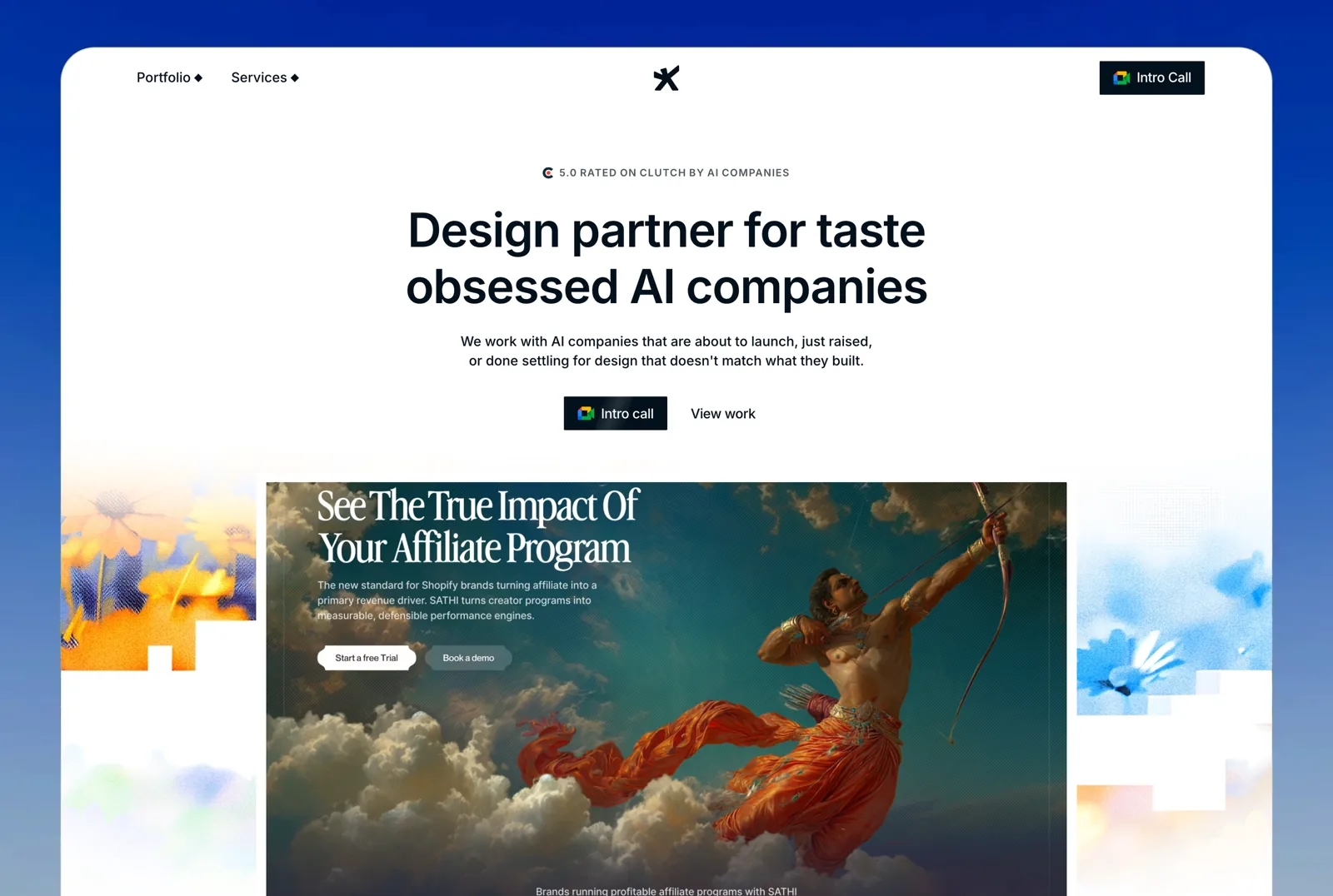
1. Studio Maydit: A Top-Rated Design Agency for AI Founders
Studio Maydit is a web and product design studio working with AI founders in the US, UK, and Europe. The studio builds websites in Framer, Webflow, and custom code, and continues into product design after the site ships.
The clearest outcome is Dualite, where design work supporting a repositioned ICP helped the product reach 100,000+ users in seven months. Recent clients include Wave, PixelFlow, Mi-VAD, and 15 other AI and SaaS teams.
Websites can be bought two ways. Fixed scope runs three to four weeks and suits teams with a launch date. Teams that keep shipping take a monthly retainer instead, covering new pages, campaigns, and product design, with no long lock-in. Fixed-scope projects end with a diagnosis of what is leaking in the product, not a handoff and goodbye.
| Check | Finding |
|---|---|
| Based in | Remote, serving US / UK / EU |
| Platform depth | Framer, Webflow, and custom code |
| AI-sector proof | Yes. AI-native clients, published outcome on Dualite |
| Pricing | Fixed scope or monthly retainer, quoted per project |
| Team shape | Founder-led, small senior team |
| Best fit | AI teams who need someone deciding what to build, not just building it |
Maydit is the right call if your queue keeps filling with small things while the expensive problem stays untouched. Book a 30-minute call.

2. Digidop
Digidop is a Paris team of one to ten, founded in 2021, working in Webflow, with a published minimum and TSE Energy, Ramify, and StreamNative named. A team that small runs on direct contact rather than a ticket system, which removes the exact failure this article is about, since you end up talking to the person doing the work instead of writing a brief for them.
Their AI-sector proof is partial, a team of that size can hold only a few monthly clients before the queue slows, and Paris hours overlap poorly with a US west coast team when the work needs same day answers.
| Check | Finding |
|---|---|
| Based in | Paris, France |
| Founded | 2021 |
| Team size | 1-10 |
| Primary platform | Webflow |
| AI-sector proof | Partial. Enterprise and SaaS clients, no AI case study |
| Named clients | TSE Energy, Ramify, StreamNative |
| Pricing | Published minimum |
| Best fit | Small teams who want a person, not a request form |
3. Lighthouse Digital
Lighthouse Digital is a London Webflow studio with a published minimum and HelloSelf, Freetrade, and IGN named. HelloSelf and Freetrade are both consumer products where the marketing pages get rewritten constantly as regulation and positioning move, so the studio is used to a steady drip of changes rather than one big launch.
They publish no team size and no founding year, they have no published AI client work, and a Webflow specialist will not touch the in-product screens that are usually the reason an AI team buys a subscription in the first place.
| Check | Finding |
|---|---|
| Based in | London, UK |
| Founded | Not published |
| Team size | Not published |
| Primary platform | Webflow |
| AI-sector proof | No. No published AI client work |
| Named clients | HelloSelf, Freetrade, IGN |
| Pricing | Published minimum |
| Best fit | Teams whose monthly work is all marketing pages |
4. Clay
Clay is a San Francisco team of 51 to 200, founded in 2016, working across platforms, with a published minimum and Slack, Stripe, Google, Coinbase, and Amazon named, plus published AI client work. They are used to running alongside in-house teams on long engagements, which is closer to what a subscription actually is than a project studio's model.
They are built for large accounts, so a twenty person startup will not be the priority in a busy month, their published minimum aims at funded companies, and a firm that size adds coordination overhead that a monthly cadence does not really absorb.
| Check | Finding |
|---|---|
| Based in | San Francisco, USA |
| Founded | 2016 |
| Team size | 51-200 |
| Primary platform | Mixed |
| AI-sector proof | Yes. Published AI client work |
| Named clients | Slack, Stripe, Google, Coinbase, Amazon |
| Pricing | Published minimum |
| Best fit | Funded AI teams running design alongside an in-house group |
5. Kvalifik
Kvalifik is a Copenhagen team of 11 to 50, founded in 2015, working in Webflow, with Veo, Maersk, and Relesys named, plus published AI client work. Veo is a machine learning product sold to ordinary sports clubs rather than engineers, and that translation problem is the one most AI startups are actually paying a designer to solve every month.
They publish no pricing, so the trial takes a call before it takes a slot, their platform is Webflow rather than the product surface, and a Copenhagen team works European hours, which slows a US team's turnaround by a day.
| Check | Finding |
|---|---|
| Based in | Copenhagen, Denmark |
| Founded | 2015 |
| Team size | 11-50 |
| Primary platform | Webflow |
| AI-sector proof | Yes. Published AI client work |
| Named clients | Veo, Maersk, Relesys |
| Pricing | Not published |
| Best fit | AI teams explaining a technical product to a non-technical buyer |
6. Foundey
Foundey is a San Francisco studio founded in 2021, working in Figma, with DemandIQ, Traycer, and Sero AI named, plus published AI client work. Their client list is entirely early AI companies, which means the monthly conversation starts from your actual problem rather than from an explanation of what your product does, and that saves the first two slots every single time.
They publish no pricing and no team size, Figma-only means somebody on your side still has to build what they design, and a studio working exclusively with early companies has less experience of the scale problems that arrive later.
| Check | Finding |
|---|---|
| Based in | San Francisco, USA |
| Founded | 2021 |
| Team size | Not published |
| Primary platform | Figma-only |
| AI-sector proof | Yes. Published AI client work |
| Named clients | DemandIQ, Traycer, Sero AI |
| Pricing | Not published |
| Best fit | Early AI teams with engineers ready to build what comes back |
7. BX Studio
BX Studio is a New York team of 11 to 50, working in Webflow, with a published minimum and Reddit, Headspace, ASAPP, and Verifone named, plus published AI client work. ASAPP is an AI company selling into large enterprises, and Headspace is a consumer product with a long onboarding, so the studio has worked on both halves of what an AI startup usually needs in a given month.
They publish no founding year, their platform is Webflow rather than the product itself, and a team of that size in New York carries enough clients that a slow week on your account is a real possibility.
| Check | Finding |
|---|---|
| Based in | New York, USA |
| Founded | Not published |
| Team size | 11-50 |
| Primary platform | Webflow |
| AI-sector proof | Yes. Published AI client work |
| Named clients | Reddit, Headspace, ASAPP, Verifone |
| Pricing | Published minimum |
| Best fit | AI teams whose monthly work spans marketing and onboarding |
8. SuperSkills
SuperSkills is a Walnut Creek team of one to ten, working across platforms, with The Cut named, plus published AI client work. A very small mixed-platform team is the cheapest honest way to test whether a monthly arrangement suits you at all, and because they work across surfaces you are not forced to decide up front whether the slot goes to the site or the product.
They publish no pricing, no founding year, and only one client name, so there is little public record to judge them on, and a team of that size has almost no slack when something urgent lands mid month.
| Check | Finding |
|---|---|
| Based in | Walnut Creek, USA |
| Founded | Not published |
| Team size | 1-10 |
| Primary platform | Mixed |
| AI-sector proof | Yes. Published AI client work |
| Named clients | The Cut |
| Pricing | Not published |
| Best fit | Teams trialling a monthly arrangement for the first time |
9. Fantasy
Fantasy works from San Francisco and New York, founded in 1999, across platforms, with published AI client work. They have been designing software interfaces since before most of the patterns your product uses existed, and that long view is useful when your team keeps reinventing a screen every time the model changes.
They publish no pricing, no team size, and no client names, so there is unusually little to verify from outside, and a firm with that history is structured for substantial engagements rather than a monthly slot at a startup.
| Check | Finding |
|---|---|
| Based in | San Francisco and New York, USA |
| Founded | 1999 |
| Team size | Not published |
| Primary platform | Mixed |
| AI-sector proof | Yes. Published AI client work |
| Named clients | Not published |
| Pricing | Not published |
| Best fit | AI teams redesigning a core screen rather than filling a queue |
10. Flow Ninja
Flow Ninja is a Belgrade team of 11 to 50, founded in 2018, working in Webflow. They are set up for continuous work rather than projects, with the process and the handover discipline that implies, and if your monthly need really is a steady flow of marketing pages then that machinery is the point.
They publish no client names and no pricing, their AI-sector proof is partial, and a Webflow specialist cannot help with the product screens where most of an AI startup's design debt actually sits.
| Check | Finding |
|---|---|
| Based in | Belgrade, Serbia |
| Founded | 2018 |
| Team size | 11-50 |
| Primary platform | Webflow |
| AI-sector proof | Partial. Enterprise and SaaS clients, no AI case study |
| Named clients | Not published |
| Pricing | Not published |
| Best fit | Teams with a predictable monthly flow of marketing pages |
How to choose between them
Sort by what is actually filling your queue.
Nobody on your side can write the brief. Studio Maydit or Digidop.
The work is inside the product, not the website. Foundey or Fantasy.
It spans marketing pages and onboarding both. BX Studio or Clay.
You are testing whether monthly suits you at all. SuperSkills or Kvalifik.
One test before signing. Ask them what they would do in a month where you send them nothing. A studio built for this will describe what they would propose and how they would find it, usually by looking at your data or sitting in on a support call. A studio that says the slot simply rolls over has told you they are a pair of hands, and a pair of hands is not what is failing at your company.